

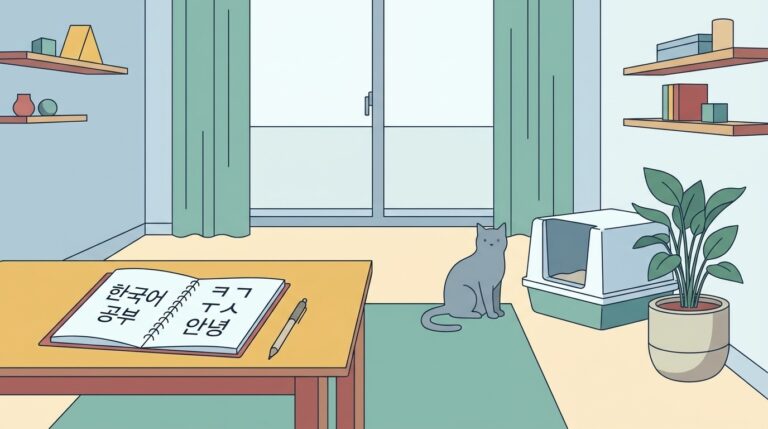
Phase 1: 공감 (Story-driven Empathy Opening)
안녕하세요! 매일한글 에디터입니다. (Hello! This is your Daily Hangul editor.)
If you have ever adopted a cat while living in a sleek, compact Seoul officetel or a high-rise apartment, you already know the universal heartbreak that occurs precisely at 3:00 AM. You step barefoot out of bed toward the kitchen for water, only to experience that dreaded, crunchy sensation beneath your sole: cat litter scattered across wooden flooring like a miniature desert. In Korea, we playfully refer to this phenomenon as 사막화 (samakhwa), or “desertification.”
Finding the perfect cat litter in Korea can be a surprisingly high-stakes linguistic and cultural challenge. Walk into any specialty pet store in Hongdae or browse Coupang Rocket Delivery, and you are inundated with hyper-specific jargon: sodium bentonite grades, clumping velocity, tracking prevention, and dust-filtering processes. Many advanced expats tell us: “I can discuss Korean economic policy in business meetings, but the moment I need to ask a pet shop owner whether a bentonite litter causes conjunctivitis or eye-crust in my Persian cat, I freeze.”
This guide was designed based on authentic field consultations with long-time foreign residents, feline veterinarians in Gangnam, and self-proclaimed Korean “cat butlers” (집사). By mastering these C2-level communicative nuances, you will not only secure your cat’s urinary health and keep your apartment dust-free, but you will also communicate with local pet care professionals at the level of a seasoned native.
Phase 2: 핵심 표현 3선 심층 분석 (3 Core Expressions In-Depth)
1. 모래 유목민 (Morae yumongmin)
- Pronunciation: [Morae yumongmin] (Sounds like “Mo-reh you-mong-min”)
- Meaning: Literally “Litter Nomad”; figuratively refers to a cat guardian who continually hops from one brand of litter to another without settling on a definitive product.
- K-Culture Moment: Commonly heard in YouTube vlogs of Korean pet creators or read in pet parenting communities like “Nyang-i-ne” (냥이네) when lamenting the eternal struggle to balance clumping power and price.
- Editor’s Insight: Koreans frequently append “유목민” (nomad) to daily consumer dilemmas (e.g., 쿠션 유목민 for makeup cushion nomads). Using this term shows an advanced understanding of contemporary socio-lexical wordplay.
- Situation Spectrum: Casual (✅) / Semi-formal (✅) / Formal (⚠️ – acceptable in casual business settings like pet retail, but slightly colloquial for veterinary academic papers)
- 🤔 Think About It: In your native tongue, do you describe indecisive consumer habits through historical or nomadic metaphors? What does this say about modern consumer behavior in fast-paced urban societies?
2. 응고력과 먼지 날림 (Eunggoryeok-gwa meonji nallim)
- Pronunciation: [Eunggoryeok-gwa meonji nallim] (Analogous to “Oong-go-ryeok gwa mun-jee nal-lim”)
- Meaning: “Clumping capacity and dust dispersion.”
- K-Culture Moment: The definitive gold-standard metric cited by Korean pet product reviewers when comparing American Wyoming bentonite against domestic micro-processed brands.
- Editor’s Insight: Notice the Sino-Korean compound 응고력 (凝固力, coagulation/clumping power) contrasted with the native Korean phrase 먼지 날림 (dust flying/kicking up). C2 speakers seamlessly toggle between technical Hanja vocabulary and vivid native verb-nominalizations.
- Situation Spectrum: Casual (✅) / Semi-formal (✅) / Formal (✅)
- 🤔 Think About It: How does the fusion of Sino-Korean technical nouns and descriptive native verbs create precision in consumer advocacy?
3. 사막화 방지 (Samakhwa bangji)
- Pronunciation: [Samakhwa bangji] (Sounds like “Sah-mahk-hwa bahng-jee”)
- Meaning: “Desertification prevention” — the active practice of mitigating the litter granules your cat tracks out of the box onto your floor.
- K-Culture Moment: Used constantly in online pet homeware reviews for honeycomb-patterned mats (벌집매트) or top-entry litter boxes.
- Editor’s Insight: 사막화 is an environmental science term for geographical desertification. Applying it hyperbolically to living room floors is characteristic of the expressive, slightly dramatic humor found in Korean domestic culture.
- Situation Spectrum: Casual (✅) / Semi-formal (✅) / Formal (✅)
- 🤔 Think About It: Why do cultures repurpose catastrophic geographic terms for minor household nuisances? How does shared domestic struggle create communal slang?
Phase 3: 교과서 한국어 vs 진짜 한국어 (Textbook vs. Real-World Korean)
Situation 1: Cleaning out the cat litter box
- 📖 교과서 한국어 (Textbook Korean):
“고양이 배설물을 화장실에서 치웠습니다.”
(Goyangi baeseolmureul hwajangsil-eseo chiwossseumnida. / “I removed the cat excrement from the restroom.”) - 🗣️ 진짜 한국어 (Real-World Korean):
“오늘도 퇴근하자마자 감자랑 맛동산 열심히 캤어요.”
(Oneuldo toegeunhajamaja gamjarang matdongsan yeolsimhi kaesseoyo. / “As soon as I got home from work today, I diligently dug up potatoes and Matdongsan.”) - 💡 왜 다를까? (Why the difference?): Korean pet parents playfully refer to clumped urine as 감자 (potatoes) due to their rounded starch-like shape, and solid stool as 맛동산 (Matdongsan) after a famous ridged, peanut-crusted traditional Korean snack. Saying “배설물” sounds clinical and cold among fellow pet lovers.
Situation 2: Expressing product dissatisfaction and ongoing search
- 📖 교과서 한국어 (Textbook Korean):
“적합한 모래를 찾지 못하여 여러 제품을 시험해 보고 있습니다.”
(Jeokhapan moraelreul chatji mothayeo yeoreo jepumeul siheomhae bogo issseumnida. / “Because I have not found suitable litter, I am testing various products.”) - 🗣️ 진짜 한국어 (Real-World Korean):
“먼지 적고 응고력 좋은 벤토나이트를 못 찾아서 아직도 모래 유목민 신세예요.”
(Meonji jeokgo eunggoryeok joeun bentonaiteureul mot chajaseo ajikdo morae yumongmin sinseyeo. / “I haven’t found a low-dust, high-clumping bentonite yet, so I’m still stuck living as a litter nomad.”) - 💡 왜 다를까? (Why the difference?): Natural conversational Korean at an advanced level incorporates metaphorical self-deprecation (신세, “lot in life / predicament”) to build camaraderie with store clerks or fellow guardians.
Phase 4: K-Culture 딥다이브 & 비언어적 매너 (K-Culture Deep Dive & Non-Verbal Nuance)
4-1. 눈치 (Nunchi) & Gestural Etiquette in Korean Pet Care
When discussing pet products in Korean retail or veterinary settings, modesty and non-verbal deference go hand-in-hand with technical inquiries:
* The Two-Handed Weight Check: When picking up a heavy 6kg to 10kg bag of bentonite, store clerks will often rush over to help. Always hold the bag or point toward it with an open palm facing upward rather than pointing with an index finger.
* Elevator Etiquette in High-Rise Complexes: Carrying a bulk pack of bentonite in residential elevators requires acute 눈치 (nunchi). If a neighbor enters, hold the bag low to your side or place it between your feet so the dusty exterior does not touch their dry-cleaned clothing. A gentle, slight bow of the head acknowledging their space softens the burden of sharing tight spaces.
4-2. Cultural Code Analysis: The Rise of “Jipsa” (집사) Culture
Over the past decade, South Korea has witnessed a seismic shift from viewing cats as stray alley dwellers (formerly degraded as 도둑고양이, “thief cats”) to revered family companions celebrated as 길고양이 (street cats) or 반려묘 (companion cats). This evolution spawned the national identity of the 집사 (Jipsa, butler).
Korean apartments emphasize minimalist wooden aesthetics, meaning cat furniture and litter maintenance must integrate invisibly. Because bentonite clay dust can circulate through closed-circuit heating systems (보일러 온돌 floor heating can bake and lift dried dust into the room air), Korean owners are hyper-vigilant about dust-removal processing (집진 공정). To understand Korean pet culture is to understand this blend of unconditional affection, architectural spatial constraints, and meticulous indoor hygiene.
Phase 5: 실전 롤플레이 시나리오 (Real-World Roleplay Scenario)
Setting: A specialized pet boutique in Seongsu-dong, Seoul.
Characters:
* Learner (You): An experienced cat guardian seeking high-tier bentonite litter.
* Boss Park (NPC): An insightful, middle-aged boutique owner with three rescue cats.
- Learner:
“사장님, 안녕하세요! 저희 아이가 눈곱이 자주 끼어서 그런데, 먼지 날림이 거의 없는 벤토나이트 모래 추천해 주실 수 있나요?”
(Sajangnim, annyeonghaseyo! Jeohui aiga nungobi jaju kkieoseo geureonde, meonji nallimi geoui eomneun bentonaiteu morae chucheonhae jusil su innayo?)
“Hello, Boss! My cat often gets eye discharge; could you recommend a bentonite litter with virtually no dust dispersion?”
🎭 Hands politely clasped in front, tilting head with genuine concern. -
Boss Park:
“아이구, 눈곱이 끼면 집사님 걱정이 이만저만이 아니시겠어요. 혹시 지금 쓰시는 건 입자가 굵은 편인가요, 가는 편인가요?”
(Aigu, nungobi kkimyeon jipsanim geokjeongi imanjeomani anisigesseoyo. Hoksi jigeum sseusineun geon ipjaga gulgeun pyeon-ingayo, ganeun pyeon-ingayo?)
“Oh dear, if there’s eye discharge, you must be worried sick. By the way, is the litter particle you currently use on the coarser or finer side?”
🎭 Leaning forward attentively with an empathetic nod. -
Learner:
“가는 입자를 쓰고 있는데, 응고력은 만족스럽지만 사막화랑 먼지가 너무 심해서 모래 유목민 생활을 청산하고 싶어요.”
(Ganeun ipjareul sseugo inneunde, eunggoryeogeun manjokseureopjiman samakhwarang meonjiga neomu simhaeseo morae yumongmin saenghwareul cheongsanhago sipeoyo.)
“I’m using fine grains; the clumping is satisfactory, but the tracking and dust are so bad that I’d really love to end my life as a litter nomad.”
🎭 Giving a wry, self-deprecating smile. -
Boss Park:
“그 마음 백번 이해하죠. 그럼 에어 워싱으로 미세먼지를 99% 걸러낸 이 국산 프리미엄 라인을 한번 써보세요. 탈취력도 꽤 탄탄합니다.”
(Geu maeum baekbeon ihaehajyo. Geureom eeo wosing-euro misemeonjireul gusipgu peosenteu geolleonaen i guksan peurimieom raineul hanbeon sseoboseyo. Talchwiryeokdo kkwae tantanhamnida.)
“I completely understand that feeling. In that case, try this domestic premium line that filters 99% of microdust via air-washing. Its odor control is also quite solid.”
🎭 Tapping the side of a heavy matte bag to demonstrate sturdy packaging. -
Learner:
“혹시 벤토나이트 특유의 냄새나 인공 향료가 첨가되어 있지는 않나요? 기호성을 좀 타는 편이라서요.”
(Hoksi bentonaiteu teugyui naemsaena ingong hyangryoga cheomgadoeeo itjineun annayo? Gihoseong-eul jom taneun pyeon-iraseoyo.)
“Does this have that distinct bentonite odor, or does it contain artificial fragrances? My cat is somewhat finicky regarding preference.”
🎭 Raising eyebrows slightly while closely checking the ingredient label. -
Boss Park:
“완전 무향 제품이고, 활성탄만 소량 들어가 있어서 후각 예민한 냥이들도 거부감 없이 바로 적응할 겁니다.”
(Wanjeon muhyang jepum-igo, hwalseongtanman soryang deureoga isseoseo hugak yeminhan nyang-ideuldo geobugam eopsi baro jeogeunghal geomnida.)
“It is 100% unscented with only a small trace of activated carbon, so even kitties with sensitive olfaction adapt right away without aversion.”
🎭 Gesturing palms outward to reassure the shopper. -
Learner:
“다행이네요! 일단 한 포만 먼저 가져가서 기호성 테스트를 해보고 괜찮으면 정기 배송으로 정착해야겠어요.”
(Dahaeng-ineyo! Ildan han poman meonjeo gajyeogaseo gihoseong teseuteureul haebogo gwaenchanheumyeon jeonggi baesong-euro jeongchakhaeyagesseoyo.)
“What a relief! I’ll take just one bag first to test preference, and if it goes well, I’ll settle down with a regular subscription.”
🎭 Taking out a payment card with both hands. -
Boss Park:
“탁월한 선택이십니다. 써보시고 감자 캘 때 부스러짐 없는지 꼭 확인해 보세요! 영수증 여기 있습니다.”
(Tagwolhan seontaegisimnida. Sseobosigo gamja kael ttae buseureojim eomneunji kkok hwaginhae boseyo! Yeongsujeung yeogi issseumnida.)
“An excellent choice. Test it out and make sure there is no crumbling when you dig for ‘potatoes’! Here is your receipt.”
🎭 Handing the receipt back using both hands with a bright smile.
🔀 인터랙티브 분기점 (Interactive Branching Point)
Imagine Boss Park asks: “혹시 기존 모래가 많이 남으셨나요?” (Do you have a lot of your old litter left over?) How do you respond?
- Option A: “네, 남은 건 그냥 변기에 조금씩 버리려고요.” (Yeah, I’m just planning to flush the leftovers down the toilet bit by bit.)
- Outcome: 🚫 Bad (Catastrophic Risk). Bentonite is expandable clay; flushing it will instantly block your apartment pipe, causing millions of won in plumbing damages and social embarrassment with building management.
- Option B: “네, 아까우니까 새 모래 위에 바로 전부 부어버릴 생각이에요.” (Yes, it’s a waste, so I’ll just dump all of it right on top of the new litter immediately.)
- Outcome: ⚠️ Risk (Behavioral Rejection). Abrupt changes in texture or dust profiles can cause feline stress, leading to bathroom strikes or inappropriate elimination outside the box.
- Option C: “네, 적응할 수 있게 기존 모래랑 며칠간 비율을 조절하면서 서서히 섞어주려고요.” (Yes, I plan to mix it gradually with the old litter over a few days while adjusting ratios so my cat can adapt.)
- Outcome: ✅ Best (Master Butler Level). Demonstrates advanced veterinary know-how, flawless phrasing, and thoughtful pet care methodology.
Phase 6: 10초 감정 섀도잉 드릴 (10-Second Shadowing Drill)
Read the following lines aloud, honoring the pause markers (/) and channeling the emotional context in brackets:
[🥺 속상하고 간절한 톤 / Frustrated yet earnest]
“먼지 날림 때문에 / 아이 눈물자국이 심해져서 / 모래를 꼭 바꿔야 해요.”
(Meonji nallim ttaemune / ai nunmuljagugi simhaejyeoseo / moraelreul kkok bakkwoya haeyo.)
“Because of the dust kicking up / my cat’s tear stains got worse / so I absolutely must switch litters.”-
[💡 단호하면서도 세련된 뉘앙스 / Confident and sophisticated]
“응고력이 약하면 / 감자가 부스러져서 / 전체 갈이 주기가 / 너무 짧아지더라고요.”
(Eunggoryeogi yakhamyeon / gamjaga buseureojyeoseo / jeonche gari jugiga / neomu jjalbajideoragoyo.)
“If clumping power is weak / the ‘potatoes’ crumble / so the complete litter change cycle / ends up becoming far too short.” -
[😊 안도감과 뿌듯함 / Relieved and proud]
“드디어 / 사막화 없는 모래에 정착해서 / 모래 유목민 탈출했습니다!”
(Deudieo / samakhwa eomneun morae-e jeongchakhaeseo / morae yumongmin talchulhaessseumnida!)
“Finally / having settled on a litter without desertification / I have escaped life as a litter nomad!”
Phase 7: K-Culture 미니 사전 (4 Essential Keywords)
-
집사 (Jipsa) | Noun
- Literal translation: Butler / Steward.
- Contemporary usage: The ubiquitous self-identifier for cat guardians in Korea. It encapsulates humorous devotion—acknowledging that the feline is the master of the residence while the human is the humble servant attending to food and hygiene.
- 감자 캐기 (Gamja kaegi) | Verb Phrase
- Literal translation: Digging up potatoes.
- Contemporary usage: The act of scooping clumped urine balls from bentonite clay. When a litter produces hard, non-crumbling clumps, cat owners praise it as producing “단단한 왕감자” (firm, giant potatoes).
- 맛동산 (Matdongsan) | Noun
- Literal translation: A famous ridged, sweet Korean snack.
- Contemporary usage: A playful euphemism for solid feline feces coated with litter grains. Used to make daily pet chore updates lighthearted on social media.
- 기호성 (Gihoseong) | Noun (Sino-Korean)
- Literal translation: Palatability / Preference / Acceptability.
- Contemporary usage: Originally used in animal nutrition for food taste preferences, but in Korea, it is universally applied to litter texture. If a cat eagerly uses a new litter, it has “기호성이 좋다” (high preference rating).
Phase 8: 여행자와 거주자를 위한 생존 키트 (Resident & Traveler Survival Kit)
Top 3 Practical Phrases for Pet Shops
- “가장 안 부스러지고 탈취력 좋은 벤토나이트가 어떤 건가요?”
(Gajang an buseureojigo talchwiryeok joeun bentonaiteuga eotteon geon-gayo?)
Pro Tip: Use this to cut straight to the chase and find the most durable, odor-neutralizing bentonite in stock. - “모래 전체 갈이 할 때 쓸 대용량 사이즈도 있나요?”
(Morae jeonche gari hal ttae sseul daeyongnyang saijudo innayo?)
Pro Tip: 전체 갈이 (jeonche gari) means discarding 100% of the old litter and washing the pan, which Korean vets recommend doing every 3–4 weeks for bentonite. - “이거 변기에 버리면 안 되는 불연성 쓰레기 맞죠?”
(Igeo byeonggie beorimyeon an doeneun buryeonseong sseuregi matjyo?)
Pro Tip: Confirms the waste categorization for eco-friendly local disposal.
Editor’s Residential Guide: Disposal & Supply Logistics
- Never flush bentonite down Korean plumbing: Korean urban sewer networks rely on strict septic regulations. Used bentonite clay must be disposed of in designated waste bags.
- Depending on your local district office (구청, Gu-office), used cat litter must go either into a standard 종량제 봉투 (Standard volume-rate garbage bag) or a 불연성 종량제 마대 (Non-combustible PP woven waste sack) available at local community centers or convenience stores. Search your local municipality guidelines via Naver Map app store search to locate nearby district centers (주민센터).
- Need emergency litter delivered by dawn? Use Baemin B-Mart pet supplies section or Coupang Rocket Delivery for midnight bentonite crises.
Phase 9: “한 발 더 깊이” (Reflective Humanities Essay)
Language mirrors how a society conceptualizes coexistence. In South Korea, the shift from using the word 애완 (aewan)—which historically carried implications of playing with a miniature, decorative novelty—to 반려 (banryeo), meaning a lifelong journey companion sharing one’s life path, marks a radical cultural maturation.
Because most Koreans inhabit high-density communal apartment complexes, the journey of selecting the right cat litter goes beyond mere consumerism; it represents a micro-social balancing act. Preventing tracking dust and masking litter odor is not simply about personal comfort; it reflects communal consideration for shared ventilation and building hygiene. To master this vocabulary is to witness how modern Koreans harmonize unconditional love for animals within tightly structured architectural communities.
💬 Your Turn: Does your culture have specialized slang terms for scooping cat litter or living in apartments with pets? Share your favorite pet idioms in the comments below!
Phase 10: FAQ & 오해 방지 (FAQ Schema & Misconceptions)
Q: Can I flush tofu litter (두부모래) down the toilet in Korea even if bentonite is forbidden?
A: While tofu litter dissolves more easily in water than bentonite clay, older Korean officetels and multi-family villa buildings (빌라) have curved, narrow drainage pipes. Even tofu litter can swell and cause catastrophic blockages if dumped in bulk. The safest method is bagging it in official municipal waste sacks.
Q: Why do Korean pet shops emphasize “집진 (dust collection)” so heavily for bentonite?
A: Korean homes rely on underfloor 온돌 (ondol) radiant heating. Warm floors dry out litter boxes faster, which can cause micro-fines to circulate through dry air in winter, triggering respiratory issues and feline asthma. Therefore, multi-stage air-washed litters command a premium price.
Q: What is the difference between 굵은 입자 (coarse grain) and 가는 입자 (fine grain)?
A: Coarse grains track less and reduce 사막화, but some cats find them uncomfortable underfoot. Fine grains mimic real natural soil, yielding superior clumping and high feline palatability (기호성), but require heavy-duty honeycomb mats around the litter pan.
🚨 Common Mistakes Warning Board
- Mistake: Asking for “고양이 흙” (cat dirt/soil).
- Correct Action: Use the official word 고양이 모래 (cat sand/litter) or specify the mineral type directly: 벤토나이트 (bentonite).
- Mistake: Throwing out used litter in recycling plastic bins.
- Correct Action: Litter soaked with biological waste cannot be recycled. Always use designated volume-rate trash bags (종량제 봉투) or local non-combustible sacks (불연성 마대).
- Mistake: Calling a street cat “도둑고양이” in public conversations.
- Correct Action: This archaic term is considered derogatory and insensitive. Always use the respectful community term 길고양이 (street cat) or affectionately 길냥이 (gil-nyang-i).
Phase 11: 액션 미션 & 참여 유도 (Action Missions)
- 🥉 Bronze Mission (Solo Practice): Stand in front of a mirror and recite the three 섀도잉 (shadowing) lines from Phase 6, ensuring your transitions between Sino-Korean compound words like 응고력 and native phrases like 먼지 날림 sound smooth.
- 🥈 Silver Mission (Digital Engagement): Visit an online Korean pet store (such as Pet Friends or Coupang) and find three different bentonite products. Identify their stated 집진 공정 (dust removal process) and compare their clumping descriptions in Korean notes.
- 🥇 Gold Mission (Real-world Execution): Visit a physical pet shop or vet clinic in Korea. Inquire about their bentonite selection using the phrase: “먼지 날림 적고 응고력 탄탄한 벤토나이트 모래 추천해 주실 수 있나요?”
- 🎮 K-Culture Mission: Search the hashtag
#감자수확or#모래유목민on Instagram or YouTube Shorts. Watch how Korean pet parents humorously film their daily litter scoop routines!
Phase 12: 인터랙티브 퀴즈 챌린지 (Interactive Quiz Challenge)
Quiz 1. Situational Judgment
Your cat starts scratching vigorously around the litter box, sneezes from fine airborne powder, and avoids stepping inside. How would you accurately describe this situation to a Korean vet?
* (A) “우리 고양이가 맛동산을 너무 좋아해서 화장실에서 안 나와요.”
* (B) “모래 먼지 날림 때문에 결막염이나 호흡기 자극이 온 것 같아서 모래를 바꾸려 해요.”
* (C) “사막화 방지 매트가 너무 예뻐서 모래를 다 버렸어요.”
Quiz 2. Fill-in-the-Blank
Complete the sentence using the appropriate natural slang learned in this unit:
“아직 마음에 쏙 드는 모래에 정착하지 못해서 3년째 ( ) 생활을 벗어나지 못하고 있어요.”
Quiz 3. True / False Cultural Check
- T / F: In Korean cat culture, referring to urine clumps as “감자 (potatoes)” is considered impolite, so you should only say “소변 덩어리” when speaking to fellow cat guardians.
👉 Click here to reveal Answers & Explanations!
- Quiz 1 Answer: (B)
- Explanation: Option (B) precisely isolates dust-induced conjunctivitis/respiratory strain (먼지 날림 때문에 결막염이나 호흡기 자극…). Option (A) nonsensically claims the cat loves stool, and (C) irrelevant discusses decorative mats.
- Quiz 2 Answer: 모래 유목민 (Morae yumongmin)
- Explanation: A “litter nomad” who cannot settle on one dependable brand.
- Quiz 3 Answer: False (F)
- Explanation: The exact opposite is true! Among Korean pet guardians and community members, calling them “감자” is considered endearing, empathetic, and culturally native. Using clinical phrasing like “소변 덩어리” sounds unnaturally sterile in casual company.
- Explanation: The exact opposite is true! Among Korean pet guardians and community members, calling them “감자” is considered endearing, empathetic, and culturally native. Using clinical phrasing like “소변 덩어리” sounds unnaturally sterile in casual company.







