

Phase 1: Empathy (Welcome to the Speed of Seoul!)
안녕하세요! 매일한글 에디터입니다. (Hello! I am your Daily Hangul editor.)
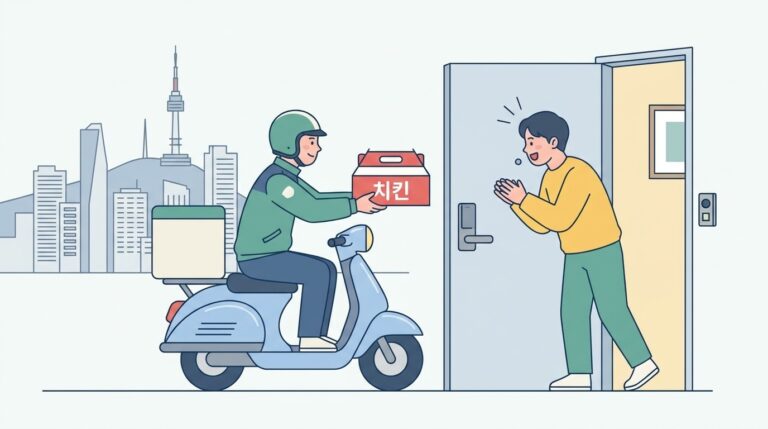
Picture this: It is 10:30 PM on a crisp Friday evening in Seoul. You are curled up on the sofa watching your favorite K-drama, and a sudden craving for crunchy, savory Korean fried chicken hits you. You tap through a delivery app on your phone, place your order, and get up to grab a glass of cold water. Before you even set the glass down, the doorbell rings: Ding-dong!
You open the door, and there stands the delivery rider holding a steaming, crackling box of chicken. You check your watch: only twelve minutes have passed! Is this teleportation? Or magic? Welcome to Korea’s world-famous 빨리빨리 (Pballi-Pballi / Hurry-Hurry) culture!
For many of our beginner Korean learners, moments like this trigger a mix of pure joy and tongue-tied panic. You want to celebrate the unbelievable speed, compliment the rider, or share the thrill with your Korean friends, but textbook sentences like “The delivery is prompt” feel robotic.
Do not worry! Based on real classroom scenarios and feedback from travelers living in Seoul, this guide will teach you the exact, natural, A2-level Korean expressions to show your delight when your food arrives in the blink of an eye. Let’s dive in!
Phase 2: Top 3 Core Expressions
1. 벌써 왔어요? (한글)
- Pronunciation: [Beolsseo wasseoyo?] (Sound analogy: “Beol” sounds like “ball” with a soft ‘uh’, “sseo” sounds like a crisp “saw”, “wah-sseo-yo”)
- Meaning: Direct Translation: “Did it come already?” vs Actual Nuance: “Wow, it’s here already?! That was shockingly fast!”
- K-Culture Moment: Seen in almost every contemporary slice-of-life K-drama (like Hospital Playlist), where busy doctors order takeout and the food arrives before they can even untie their surgical scrubs.
- Editor’s Insight: The magic word here is 벌써 (beolsseo). While textbooks teach “already” as a neutral time marker, native speakers inject it with delightful shock.
- Situation Spectrum: Casual ✅ | Semi-formal ✅ | Formal ⚠️
- 🤔 Think About It: In your home country, do you usually track delivery riders with worry, or do you expect them to arrive early?
2. 대박 빠르다! (한글)
- Pronunciation: [Daebak ppareuda!] (Sound analogy: “Dae-bahk” like “day-bark” without the r, “ppa-reu-dah” with a sharp double-p pop)
- Meaning: Direct Translation: “Jackpot fast!” vs Actual Nuance: “This is crazy fast! Unbelievable speed!”
- K-Culture Moment: Mukbang creators streaming live on YouTube who click “order” at the beginning of their stream and unpack steaming tteokbokki within fifteen minutes.
- Editor’s Insight: An essential exclamation for your A2 toolkit. Pairing the iconic slang 대박 (daebak) with the plain descriptive ending -다 (-da) expresses spontaneous, unfiltered amazement.
- Situation Spectrum: Casual ✅ | Semi-formal ⚠️ | Formal 🚫
- 🤔 Think About It: How does your language express surprise at efficiency without sounding impatient?
3. 한국 배달 최고예요! (한글)
- Pronunciation: [Hanguk baedal choegoyeyo!] (Sound analogy: “Han-gook bae-dahl chweh-go-yeh-yo”)
- Meaning: Direct Translation: “Korean delivery is the best!” vs Actual Nuance: “Nothing beats Korean delivery service! You guys are amazing!”
- K-Culture Moment: Foreign travel vloggers sitting by the Han River on picnic mats, marveling at warm fried chicken delivered straight to their picnic zone.
- Editor’s Insight: This is the ultimate warm compliment to share with Korean roommates, friends, or hosts who ordered the meal on your behalf.
- Situation Spectrum: Casual ✅ | Semi-formal ✅ | Formal ✅
- 🤔 Think About It: Why has food delivery become a point of national pride in modern South Korea?
Phase 3: Textbook Korean vs Real Native Korean
Situation 1: Telling your friend that the food just arrived
- 📖 교과서 한국어 (Textbook): 음식 배달이 도착했습니다. (Eumsik baedari dochakhaesseumnida. / “The food delivery has arrived.”)
- 🗣️ 진짜 한국어 (Real Native): 배달 벌써 왔어요! (Baedal beolsseo wasseoyo! / “The delivery is already here!”)
- 💡 왜 다를까? (Why the difference?): The textbook version sounds like an automated subway announcement. Real Koreans highlight their happy shock using 벌써 (already).
Situation 2: Praising how fast the restaurant handled the order
- 📖 교과서 한국어 (Textbook): 배달 속도가 대단히 신속합니다. (Baedal sokdoga daedanhi sinsokhumnida. / “The delivery speed is exceptionally prompt.”)
- 🗣️ 진짜 한국어 (Real Native): 진짜 빠르네요! (Jinjja ppareuneyo! / “Wow, it’s really so fast!”)
- 💡 왜 다를까? (Why the difference?): Native conversation thrives on emotional endings like -네요 (-neyo), which indicates genuine personal awe rather than sterile facts.
Phase 4: K-Culture Deep Dive & Non-Verbal Manners
4-1. 눈치 (Nunchi) & Delivery Etiquette
When that buzzer rings, 눈치 (Nunchi – situational awareness) swings into action:
* The Quick Reception: Do not keep the delivery rider waiting at the door. Riders work on tight schedules. Spring up promptly!
* Two-Handed Receive: When taking the heavy bag, lightly support it with both hands while bowing your head slightly (15 to 30 degrees).
* The Magic Parting Phrase: Say a warm, energetic “감사합니다! (Gamsahamnida! / Thank you!)” or “수고하세요! (Sugohaseyo! / Thank you for your hard work!)” as they turn toward the elevator.
4-2. The DNA of “Pballi-Pballi” Culture
Korea’s 빨리빨리 (Pballi-Pballi) phenomenon is often misunderstood as sheer stress or impatience. In reality, it is a deeply rooted cultural value centered on consideration for the other person’s time. In a hyper-connected society with an ultra-dense urban layout, getting piping hot soup or crispy fried chicken to someone before it gets soggy is seen as the ultimate gesture of hospitality and care.
Phase 5: Real-Life Roleplay Scenario
- Setting: Friday night at your Korean friend Minho’s studio apartment in Hongdae. You both ordered Chimaek (chicken + drink) just 13 minutes ago.
- Characters:
- You: Eager A2 Korean learner with a growling stomach.
- Minho (민호): Your Korean buddy who prides himself on knowing the fastest fried chicken spots.
Turn 1 (민호): 치킨 시킨 지 얼마 안 됐는데 문 앞 벨 울렸어! (Chikin sikin ji eolma an dwaenneunde mun ap bel ullyeosseo! / “The doorbell just rang even though we barely ordered the chicken!”) 🎭 Jumps off the rug with wide, excited eyes
Turn 2 (You): 벌써 왔어요? 진짜 빠르다! (Beolsseo wasseoyo? Jinjja ppareuda! / “It’s already here? That is crazy fast!”) 🎭 Checks your wristwatch in pure disbelief
Turn 3 (민호): 이게 바로 K-배달의 힘이지. 내가 받아올게! (Ige baro K-baedal-ui him-iji. Naega bada-olge! / “This is the true power of K-delivery. I’ll grab it!”) 🎭 Hurries to open the front door
Turn 4 (You): 와, 문 열자마자 맛있는 냄새 대박이에요! (Wa, mun yeoljamaja masinneun naemsae daebagieyo! / “Wow, the minute the door opened, the aroma was amazing!”) 🎭 Clears the low wooden coffee table with enthusiasm
Turn 5 (민호): 15분 만에 오다니, 오늘 라이더님 진짜 최고다. (Sibo-bun man-e odani, oneul raideo-nim jinjja choegoda. / “Arriving in 15 minutes? Today’s rider is truly legendary.”) 🎭 Plops the steaming carton on the table
Turn 6 (You): 한국 배달 진짜 최고예요! (Hanguk baedal jinjja choegoyeyo! / “Korean food delivery is genuinely the best!”) 🎭 Claps your hands together in celebration
Turn 7 (민호): 식기 전에 얼른 먹자. 캔 음료수 줄게! (Sikki jeone eolleun meokja. Kaen eumnyosu julge! / “Let’s eat before it cools down. Here’s a cold soda!”) 🎭 Pops open a can and slides it toward you
Turn 8 (You): 맛있게 먹겠습니다! 잘 먹을게요! (Mas-itge meokgetseumnida! Jal meogeulgeyo! / “I will eat with gratitude! Thanks for the feast!”) 🎭 Picks up wooden chopsticks with a broad smile
🔀 Interactive Decision Point
How would you reply when Minho brings the food to the table?
* Choice A: “배달이 왜 이렇게 느려요?” (Baedari wae ireoke neuryeoyo? / Why is the delivery so slow?)
* Feedback (Bad): Ouch! Arriving in 15 minutes is lightning-quick. Asking why it is slow sounds ungrateful and spoils the cheerful atmosphere.
* Choice B: “대박 빠르다! 배달 기사님 최고!” (Daebak ppareuda! Baedal gisa-nim choego! / Crazy fast! The delivery rider is the best!)
* Feedback (Best): Perfect! Natural, high-energy A2 Korean that shows your excitement and praises the service like a true local.
* Choice C: “배송 물류 시스템의 효율성이 우수하네요.” (Baesong mullyu siseutem-ui hyoyulseong-i usuhTransformation)
* Feedback (Risk): Grammatically accurate, but it sounds like a logistics management textbook! Minho will wonder if he is eating dinner with a professor.
Phase 6: 10-Second Emotion Shadowing Drill
Practice these lines aloud! Follow the pause markers (/) and match the emotion tag in brackets:
[😲 Wide eyes, expressing pleasant shock]
“벌써 / 왔어요? / 대박 빠르다!”
(Beolsseo / wasseoyo? / Daebak ppareuda!)-
[😋 Mouth-watering excitement, tapping the table]
“냄새 대박! / 한국 배달 / 최고예요!”
(Naemsae daebak! / Hanguk baedal / choegoyeyo!) -
[👏 Clapping hands, impressed by the speed]
“15분 만에 오다니 / 진짜 빨라요!”
(Sibo-bun man-e odani / jinjja ppallayo!)
Phase 7: K-Culture Mini Dictionary
- 배달 (Baedal) | Food Delivery | The lifeblood of Korean urban nightlife. You will see this word on flyers, scooters, and neon restaurant signs.
- 빨리빨리 (Pballi-pballi) | Hurry-hurry / Fast-paced ethos | The national cultural mindset emphasizing efficiency, quick turnaround, and zero wasted time.
- 총알배송 (Chong-al baesong) | Bullet delivery | Slang and promotional term describing orders that arrive at supersonic speed.
- 라이더님 (Raideo-nim) | Delivery Rider / Driver | The respectful contemporary term combining “rider” with the honorific suffix -님 (-nim) to address delivery couriers politely.
Phase 8: Survival Kit for Travelers
Top 3 Survival Expressions
- 문 앞에 두고 가주세요. (Mun ape dugo gajuseyo.)
Meaning: “Please leave it in front of the door.”
Pro Tip: Perfect when you stay at an Airbnb or want contactless delivery. - 얼마나 걸려요? (Eolmana geollyeoyo?)
Meaning: “How long will it take?”
Pro Tip: Use this at takeaway counters when deciding whether to wait or take a seat. - 맛있게 먹겠습니다! (Mas-itge meokgetseumnida!)
Meaning: “I will enjoy this meal!”
Pro Tip: Say this right after opening the delivery boxes with your friends.
Editor’s Travel Note
Navigating food delivery in Korea as an international traveler is easier than ever. While domestic apps like Baemin and Yogiyo require a Korean resident registration or local phone verification, you can use the English-friendly [Shuttle delivery app download for foreign travelers] or order takeout through [Naver Map English takeout search] for pickup. If ordering to an apartment building, always verify the entrance building passcode and paste it into the order request box!
Phase 9: “한 발 더 깊이” (Think Deeper)
In Western cultures, speed can sometimes feel rushed or impersonal, as if businesses are trying to turn tables quickly. In Korea, however, speed is viewed through the lens of empathy and community devotion. Delivering food at top speed ensures that the cook’s hard work stays delicious and the customer does not suffer from hunger. Speed is, quite literally, an act of modern Korean warmth.
💬 Your Turn: What is the quickest food delivery you have ever experienced in your own country? What late-night snack would you order in Seoul right now? Share your thoughts in the comments below!
Phase 10: FAQ & Common Mistakes
Q: Can I tip the delivery driver in Korea if they arrive super fast?
A: In South Korea, tipping culture does not exist! Delivery fees are already settled in the app. Tipping cash can make drivers feel flustered or confused. A bright “감사합니다! (Gamsahamnida!)” or offering a sealed cold bottled water in summer is the best way to show appreciation.
Q: Can I use “대박 빠르다” when speaking directly to an elderly person or restaurant owner?
A: No. “대박 빠르다” is casual, informal speech meant for friends and peers. When speaking politely to an elder or shop owner, say: “정말 빠르네요! (Jeongmal ppareuneyo! – It’s truly so fast!)”.
Q: What is the difference between “이미” and “벌써”?
A: Both translate roughly to “already.” However, 이미 (imi) denotes an expected, factual completion (e.g., “He already left”), while 벌써 (beolsseo) expresses surprise or delight that something happened way sooner than imagined.
🚨 Common Mistakes TOP 3
- Yelling “빨리 와요!” (Pballi wayo! – Come quick!) to a delivery driver:
Correct Action: Never rush the driver. Scooter safety is a major social topic in Korea. Wait patiently and celebrate when they arrive safely! - Saying “이미 왔어요?” instead of “벌써 왔어요?”:
Correct Action: Use 벌써 to capture that wide-eyed excitement about the delivery speed. - Forgetting to say “잘 먹겠습니다” when a friend orders for you:
Correct Action: Always thank the person who placed the order or paid before digging into the food.
Phase 11: Action Mission & Engagement
- 🥉 Bronze Mission (Solo Drill): Look in the mirror, open your eyes wide in surprise, and say “벌써 왔어요? 대박 빠르다!” three times with natural rhythm.
- 🥈 Silver Mission (Social Share): Next time you order takeout or fast food, snap a photo and post it with the caption: “한국 배달 최고예요! #DailyHangul #PballiPballi”.
- 🥇 Gold Mission (Real-Life Mastery): The next time your food arrives fast in Korea or at a Korean restaurant, smile warmly at the staff and say: “진짜 빠르네요! 감사합니다!”
🎮 K-Culture Mission: Watch an episode of a modern K-drama featuring an office party or late-night study session. Listen carefully for the moment someone yells “벌써 왔어?!” when the takeout arrives!
Phase 12: Interactive Quiz Challenge
1. Situational Judgment:
Your friend orders jajangmyeon, and the doorbell rings after only 10 minutes. What is the most natural, enthusiastic reaction to say to your friend?
(A) 배송 시스템이 정상 작동했습니다.
(B) 벌써 왔어요? 대박 빠르다!
(C) 왜 이렇게 일찍 와서 귀찮게 해요?
2. Fill-in-the-Blank:
Complete the sentence to express pleasant surprise:
“치킨이 (_______) 왔어요? 진짜 빨라요!”
(Hint: The word for “already” that shows surprise)
3. True or False:
In South Korea, it is polite and expected to hand a cash tip to the scooter delivery rider if the food arrives faster than promised. (True / False)
👉 Click to view Answers & Explanations
- Answer: (B)
Explanation: “벌써 왔어요? 대박 빠르다!” captures authentic, upbeat excitement that friends share over fast food. -
Answer: 벌써 (beolsseo)
Explanation: “벌써” is used when time moves quicker than anticipated, signaling delightful amazement. -
Answer: False
Explanation: Korea does not have a tipping culture. Giving cash directly can be awkward. A polite two-handed bow and a warm “감사합니다” is the gold standard of manners!







