

Phase 1: Empathy & Storytelling
안녕하세요! 매일한글 에디터입니다. (Hello! I’m your Daily Hangul editor.)
Picture this: You step out of Hongik University Station in Seoul on a crisp January morning, ready for an exciting day of café hopping. Suddenly, your phone erupts with a deafening siren that sounds like an alien invasion. Heads turn, people glance at their screens, and everyone immediately zips their coats up to their chins. You look down: an alert flashes with bold red letters reading [한파주의보] (Cold Wave Advisory). The wind howls down the avenue like an open industrial freezer, slicing right through your stylish denim jacket. Your fingers go numb within ninety seconds, and your phone battery drops 20% in the blink of an eye. You want to ask for a warm hand pack at a convenience store or check if it is safe to travel outside, but panic sets in: How do I explain that I am literally freezing in Korean?
If you have ever felt paralyzed when winter temperatures plunge in Korea, take a deep breath. You are not alone! Over the past ten years of coaching beginner expats and travelers, I have seen dozens of students turn into human popsicles simply because they didn’t know three elementary survival phrases. In Korea, winter disaster safety isn’t just about survival—it is a warm, communal experience where strangers remind each other to stay safe. Today, I’ll walk you through real, actionable A1-level Korean that will keep you cozy, confident, and completely safe during a sudden Korean cold wave.
Phase 2: Core 3 Expressions In-Depth
1. 너무 추워요! (Neomu chuwoyo!)
- Pronunciation: [noh-moo choo-wuh-yo] (Think of ‘no-moo’ like ‘no more’, and ‘choo’ like a train whistle ‘choo-choo’ followed by ‘wuh-yo’)
- Meaning: Literal: “Too cold!” | Nuance: “It’s freezing!” or “I’m so cold!”
- K-Culture Moment: Seen in almost every winter variety show like Running Man or 2 Days & 1 Night whenever the cast is subjected to an outdoor penalty challenge in Gangwon-do.
- Editor’s Insight: In English, “too” often carries a negative, critical meaning (“too salty,” “too hot”). In conversational Korean, 너무 (neomu) is used universally as an intensifier meaning “so” or “super”! You can use it freely to bond with anyone shivering nearby.
- Situation Spectrum:
- Casual (to friends): 너무 추워! (Neomu chuwo!) ✅
- Semi-formal (polite to strangers, staff): 너무 추워요! (Neomu chuwoyo!) ✅
- Formal (news anchor / official): 대단히 춥습니다. (Daedanhi chupsumnida.) 🚫 (Too stiff for daily life)
- 🤔 Think About It: In many Western cultures, talking about the weather is just polite small talk. In Korea, exclaiming about the cold is an invitation for empathy. When someone hears you say this, their natural instinct is to offer you warmth!
2. 핫팩 있어요? (Hatpaek isseoyo?)
- Pronunciation: [haht-pek ee-ssuh-yo?] (Say ‘hot’ with a short crisp ‘t’, ‘pack’, followed by ‘e-seo-yo’)
- Meaning: Literal: “Is there a hot pack?” | Nuance: “Do you have hand warmers?”
- K-Culture Moment: In K-Dramas like Crash Landing on You or Weightlifting Fairy Kim Bok-joo, characters often slip activated hot packs into each other’s coat pockets as an unspoken gesture of affection.
- Editor’s Insight: The pattern [Noun] + 있어요? (isseoyo?) is your ultimate superpower in Korea. Whether you need a hot pack, hot water, or a tissue, simply drop the noun in front of 있어요?. During a cold advisory, convenience store counters keep hot packs front and center.
- Situation Spectrum:
- Casual (to younger friends): 핫팩 있어? (Hatpaek isseo?) ✅
- Semi-formal (at stores, cafes): 핫팩 있어요? (Hatpaek isseoyo?) ✅
- Formal (official inquiry): 핫팩 구비되어 있습니까? (Hatpaek gubidoeeo itsseumnikka?) 🚫 (Overly formal for shopping)
- 🤔 Think About It: Notice how Korean eliminates the need for pronouns like “Do you have” or “Can I buy.” It focuses purely on existence: “Does a hot pack exist here?” Simple, efficient, and stress-free!
3. 따뜻하게 입으세요. (Ttatteuthage ibeuseyo.)
- Pronunciation: [tah-teut-hah-geh ee-beu-seh-yo] (Double ‘tt’ is a punchy, crisp ‘t’ sound. ‘Ttat-teut’ sounds like a cozy snap of firewood)
- Meaning: Literal: “Wear warmly.” | Nuance: “Bundle up! / Dress warmly!”
- K-Culture Moment: Parents say this in K-dramas before their kids head off to school, and idols frequently send this exact message on fan communication apps like Weverse during sub-zero mornings.
- Editor’s Insight: This phrase is the ultimate manifestation of Korean care culture. Ending a conversation with 따뜻하게 입으세요 is the winter equivalent of saying “Take good care of yourself.”
- Situation Spectrum:
- Casual: 따뜻하게 입어! (Ttatteuthage ibeo!) ✅
- Semi-formal / Polite: 따뜻하게 입으세요. (Ttatteuthage ibeuseyo.) ✅
- Super Formal: 따뜻하게 입으십시오. (Ttatteuthage ibeusipsio.) ⚠️ (Used mostly in public transit announcements)
- 🤔 Think About It: How often do you tell a coworker or shopkeeper to dress warmly in your native culture? In Korea, checking in on someone’s physical warmth is an everyday sign of basic courtesy.
Phase 3: Textbook Korean vs. Real Korean
Situation 1: Reacting to the freezing wind outside
- 📖 Textbook Korean: 오늘 날씨가 매우 춥습니다. (Oneul nalssiga maeu chupsumnida. – Today’s weather is very cold.)
- 🗣️ Real Korean: 오늘 날씨 진짜 미쳤어요! (Oneul nalssi jinjja michyeosseoyo! – Today’s weather is seriously crazy!)
- 💡 Why is it different? While the textbook phrase sounds like an automated weather satellite report, locals immediately bond over how extreme the Siberian cold front feels using conversational exaggerations like 진짜 (jinjja – really/seriously).
Situation 2: Suggesting someone wear a heavy coat
- 📖 Textbook Korean: 두꺼운 외투를 착용하십시오. (Dukkeoun oetureul chak-yonghasipsio. – Please wear thick outer garments.)
- 🗣️ Real Korean: 롱패딩 꼭 챙겨 입으세요! (Long-paeding kkok chaeng-gyeo ibeuseyo! – Make sure to wear your long padded coat!)
- 💡 Why is it different? Koreans rarely use formal Sino-Korean nouns like ‘외투’ (outerwear) or ‘착용’ (wearing) in conversation. Instead, they reference specific winter gear like Korea’s unofficial national winter uniform: the iconic ankle-length 롱패딩 (long padding)!
Phase 4: K-Culture Deep Dive & Non-Verbal Manners
4-1. 눈치 (Nunchi) & Cold-Weather Etiquette
When a cold wave alert hits Korea, everyone’s body language shifts synchronously. Here is how to blend in naturally:
* The Penguin Tuck: Walking with hands in your pockets can be dangerous on icy sidewalks. Koreans tuck their hands inside their coat sleeves (known affectionately as 소매 쏙 – somaessok) while maintaining upright balance.
* The Double-Handed Hand Warmer Hold: When someone hands you a hot pack or a warm can of coffee, accept it with both hands, holding it close to your chest. Shrugging your shoulders gently with a quiet “와, 살 것 같아요!” (Wa, sal geot gat-ayo! – Wow, this saves my life!) displays perfect natural etiquette.
* Indoor Heater Awareness: When entering a heated café or subway car, immediately unzip your coat. Leaving a bulky, wet padded coat zipped up while standing in crowded warm subways is considered slightly lacking in nunchi (awareness of communal comfort).
4-2. The Cultural Codes: Long Padding & The Winter Snack Oasis
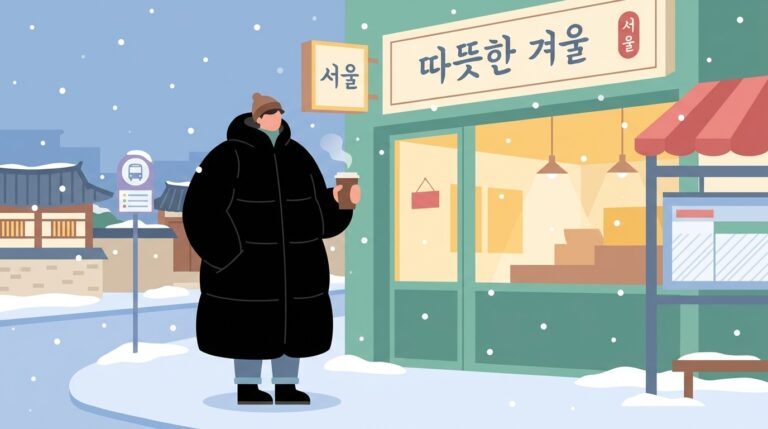
Why is everyone in Seoul wearing identical ankle-length black puffer coats? In Korean winter culture, 롱패딩 (long padding) is not a fashion statement—it is certified urban survival equipment. Because Korea’s winter wind blows directly from Siberia, long coats act like wearable sleeping bags.
Furthermore, Korean winter safety includes spontaneous roadside rescue stations: the beloved street cart! When the alert blares, people flock to street carts selling 어묵 (eomuk – fish cake skewers). In Korea, you are openly encouraged to grab a small paper cup, ladle steaming fish-cake broth directly from the vat, and sip it while standing inside the plastic winter vinyl tent. It’s warm, free of charge with your skewer, and keeps hypothermia at bay!
Phase 5: Real-Life Roleplay Scenario
Setting: A cozy, bright GS25 convenience store in Seoul during a -14°C cold wave. You stagger through the sliding doors, shivering violently. Minho, a friendly 20-something store clerk, is stacking instant ramen behind the counter.
- Turn 1 (Minho): 어서 오세요! 밖이 정말 춥죠?
- (Eoseo oseyo! Bakki jeongmal chupjyo?)
- “Welcome! It’s really cold outside, isn’t it?”
🎭 Smiling warmly and rubbing his hands together to show empathy.
- Turn 2 (You): 네, 너무 추워요! 재난 문자 왔어요.
- (Ne, neomu chuwoyo! Jaenan munja wasseoyo.)
- “Yes, it’s so cold! I got an emergency disaster alert.”
🎭 Shivering and pointing to your phone screen.
- Turn 3 (Minho): 맞아요, 오늘 한파 주의보예요. 조심하셔야 해요.
- (Majayo, oneul hanpa juuiboyeyo. Josimhasyeoya haeyo.)
- “That’s right, today is a cold wave advisory. You have to be careful.”
🎭 Nodding with a concerned, earnest expression.
- Turn 4 (You): 혹시… 핫팩 있어요?
- (Hoksi… hatpaek isseoyo?)
- “By any chance… do you have hot packs?”
🎭 Looking around the counter with hopeful eyes.
- Turn 5 (Minho): 네! 계산대 바로 앞에 붙이는 핫팩이랑 손난로 다 있어요.
- (Ne! Gyesandae baro ape buchineun hatpaek-irang sonnallro da isseoyo.)
- “Yes! Right in front of the counter, we have both adhesive hot packs and pocket hand warmers.”
🎭 Pointing directly to the display right beside the register.
- Turn 6 (You): 이거 두 개 주세요. 계산해 주세요.
- (Igeo du gae juseyo. Gyesanhae juseyo.)
- “Please give me two of these. Please ring them up.”
🎭 Handing over two hand warmers and your payment card with two hands.
- Turn 7 (Minho): 영수증 드릴까요? 따뜻한 보리차도 서비스로 데워 드릴게요.
- (Yeongsujeung deurilkkayo? Ttatteut-han borichado seobiseuro dewo deurilkeyo.)
- “Would you like a receipt? I’ll also warm up some barley tea in the hot case for you.”
🎭 Handing back your card with both hands and a polite bow.
- Turn 8 (You): 감사합니다! 따뜻하게 입으세요!
- (Gamsahamnida! Ttatteuthage ibeuseyo!)
- “Thank you! Please dress warmly!”
🎭 Smiling gratefully as you shake the hot pack to activate it.
🔀 Interactive Decision Point
Minho hands you an unopened hot pack. You want to ask how to make it work. What do you say?
* Option A: “이거 어떻게 써요?” (Igeo eotteoke sseoyo? – How do I use this?)
* Option B: “왜 안 따뜻해요?” (Wae an ttatteuthaeyo? – Why isn’t this warm?)
* Option C: “그냥 버려주세요.” (Geunyang beoryeojuseyo. – Just throw it away.)
Feedback:
* Option A is [Best]: Natural, respectful, and perfectly clear! Minho will gladly demonstrate shaking it (흔들기) and rubbing it.
* Option B is [Risk]: Hot packs take 3–5 minutes to heat up after exposure to oxygen. Asking this right away sounds like an impatient complaint.
* Option C is [Bad]: Saying “just throw it away” is rude and throws Minho’s kind assistance back in his face!
Phase 6: 10-Second Emotion Shadowing Drill
Practice reading these out loud! Focus on the rhythm slashes / and match the emotion cue.
[🥶 Shivering & urgently]- 너무 / 추워요! / 진짜 / 얼 것 같아요!
- (Neomu / chuwoyo! / Jinjja / eol geot gat-ayo!)
- “It’s / so cold! / Seriously / feels like I’m freezing!”
[🥺 Desperate & polite]- 저기요… / 혹시 / 따뜻한 물 / 있어요?
- (Jeogiyo… / hoksi / ttatteut-han mul / isseoyo?)
- “Excuse me… / by any chance / warm water / do you have?”
[🧣 Warm & caring farewell]- 감기 / 조심하시고, / 따뜻하게 / 입으세요!
- (Gamgi / josimhasigo, / ttatteuthage / ibeuseyo!)
- “Catching a cold / please be careful of, / and warmly / please dress!”
Phase 7: K-Culture Mini Dictionary
- 한파주의보 (Hanpa Juuibo)
- Translation: Cold Wave Advisory
- Context: Issued by the Korea Meteorological Administration when morning low temperatures drop below -12°C for two consecutive days or when sudden drops threaten severe damage. When you hear this, prepare layered clothing.
- 핫팩 (Hatpaek)
- Translation: Hot Pack / Chemical Pocket Warmer
- Context: Single-use packets containing iron powder that oxidizes to produce heat up to 60°C. Divided into 붙이는 핫팩 (adhesive pads for clothing) and 손난로 (pocket hand warmers).
- 롱패딩 (Long-paeding)
- Translation: Ankle-length Down Padded Coat
- Context: Essential Korean winter outerwear designed to shield knees and calves from sub-zero winds. Considered an indispensable everyday item from December through February.
- 재난문자 (Jaenan Munja)
- Translation: Emergency Disaster Cell Broadcast Alert
- Context: Loud public cell broadcasts sent to all phones within specific regional towers during blizzards, cold waves, or typhoons with instructions to stay indoors and check water pipes.
Phase 8: Traveler’s Survival Kit
Top 3 Survival Phrases
- 동파 조심하세요. (Dongpa josimhaseyo.)
- Meaning: “Watch out for frozen water pipes.”
- Pro Tip: If staying in an Airbnb or traditional house during a cold wave, leave the bathroom tap dripping on cold water to prevent burst pipes.
- 안에 들어가도 돼요? (Ane deureogado dwaeyo?)
- Meaning: “May I wait inside?”
- Pro Tip: Perfect when you are shivering outside a closed restaurant or transit stall and need quick shelter.
- 따뜻한 걸로 주세요. (Ttatteut-han geollo juseyo.)
- Meaning: “Please give me the hot version of this.”
- Pro Tip: Korea is famous for iced Americano even in winter (얼죽아 – Eoljuk-ah). If you want hot coffee or tea, specify this phrase firmly!
Editor’s Travel Note
- Free Heated Benches: When waiting for city buses in Seoul, look for benches made of dark stone or wood marked 온열의자 (Heated Seat). They are electrically heated to 38°C—sit down to instantly warm your legs!
- Subway Wind Shelters: Look for enclosed glass shelters labeled 고객대기실 (Customer Waiting Room) on open-air subway platforms (like Line 1 or Line 2 above ground).
- Essential Mobile Tools: Download the official English Emergency Ready App download from the Ministry of the Interior and Safety for translated emergency disaster text alerts. For indoor routing and real-time bus arrivals with heated bench indicators, check the Naver Map app download.
Phase 9: “One Step Deeper” (Cultural Reflection)
In many societies, weather conditions are treated as an impersonal fact of nature. You check the temperature, grab an umbrella, and go on with your day. But in Korean society, harsh weather triggers an instinctive activation of 정 (Jeong)—the invisible fabric of shared warmth, empathy, and collective care. When an elderly shopkeeper or a passing acquaintance tells you “날씨가 너무 춥죠? 감기 조심하고 따뜻하게 입어요” (The weather is so cold, right? Watch out for catching a cold and dress warmly), they are not simply commenting on the thermometer. They are momentarily taking responsibility for your physical comfort. In Korea, asking if you are warm is another way of saying, “You matter to our community.”
💬 Your Turn: How does your home country treat sudden severe weather alerts? Do neighbors reach out, or do people mostly stay solitary? Share your stories in the comments below!
Phase 10: FAQ & Common Mistakes
Q: Why do my Korean friends still drink iced coffee during a Hanpa Juuibo alert?
A: Korea has a humorous cultural subculture called 얼죽아 (Eol-Juk-Ah), short for 얼어 죽어도 아이스 아메리카노 (“Even if I freeze to death, I’ll drink Iced Americano!”). Many younger Koreans consider iced drinks refreshing after sitting inside intensely heated offices or subway cars. Don’t feel pressured to copy them—order hot drinks with 따뜻한 걸로 주세요 (Ttatteut-han geollo juseyo)!
Q: What should I do when my phone screeches with a loud siren alert?
A: Do not panic. In 95% of winter cases, this is simply a 재난문자 (Disaster Cell Alert) announcing a cold wave advisory or heavy snow warning. Take a screenshot and run it through a translation app, or look for the keywords 한파 (Cold Wave) or 대설 (Heavy Snow).
Q: Can I place adhesive hot packs directly onto my bare skin?
A: Absolutely not! Korea’s skin-burn warning rules strictly advise sticking 붙이는 핫팩 (adhesive hot packs) onto an undershirt or inner layer of clothing. Direct skin contact can cause severe low-temperature burns (저온 화상).
🚨 Common Mistakes Warning Board
- Mistake: Pronouncing 너무 (neomu) with a flat, bored voice.
- Correct Action: Stretch the first syllable slightly: “너~무 추워요!” to show real, relatable human emotion.
- Mistake: Confusing 있어요? (Isseoyo? – Do you have?) with 주세요 (Juseyo – Give me).
- Correct Action: Always confirm availability first (“핫팩 있어요?”), wait for the clerk to show you the options, then say “이거 주세요”.
- Mistake: Forgetting the polite ending -요 (-yo) when talking to bus drivers or clerks.
- Correct Action: Never just say “너무 추워!” to a shopkeeper—that is casual speech (반말). Always attach -요: “너무 추워요!”
Phase 11: Action Missions
- 🥉 Bronze Mission (Solo Practice): Stand in front of your mirror with your winter coat on. Look yourself in the eye, shiver dramatically, and repeat three times with feeling: “너무 추워요! 따뜻하게 입으세요!”
- 🥈 Silver Mission (Social Media / Community): Take a photo of your warmest winter item (gloves, coat, or tea) and post it on your Instagram Story or X with the caption: “오늘 한파주의보예요! 따뜻하게 입으세요 ❄️🧣”.
- 🥇 Gold Mission (Real-Life Mastery): The next time you visit a Korean convenience store or restaurant during cold weather, look at the clerk and warmly say: “날씨가 너무 추워요! 수고하세요!” (The weather is so cold! Keep up the good work!)”
🎮 K-Culture Discovery Mission: Watch any winter episode of a Korean variety show (such as Running Man or a winter vlog by your favorite K-pop group). Listen closely for the word “추워” (chuwo). Count how many times they say it in the first ten minutes!
Phase 12: Interactive Quiz Challenge
Test your cold-wave survival skills with these three quick questions!
Q1. Situational Decision
You are walking in Myeongdong and the wind chill drops to -15°C. Your hands are burning from the frost. You walk into an Olive Young or convenience store. Which sentence gets you a pocket warmer the fastest?
* (A) 핫팩 어디 있어요? (Hatpaek eodi isseoyo?)
* (B) 따뜻하게 입으세요! (Ttatteuthage ibeuseyo!)
* (C) 재난문자 보내주세요. (Jaenan-munja bonaejuseyo.)
Click here to reveal the answer & explanation
Answer: (A) 핫팩 어디 있어요? (Where are the hot packs?)
Explanation: Option A directly asks for the location of the hand warmers. Option B means “dress warmly” (which you say when saying goodbye), and Option C means “please send me a disaster text,” which makes no sense to a store clerk!
Q2. Fill in the Blank
When you want to wish your friend a safe, warm day in freezing weather, fill in the missing word:
“감기 조심하고 _________ 입으세요!”
Click here to reveal the answer & explanation
Answer: 따뜻하게 (Ttatteuthage)
Explanation: 따뜻하게 입으세요 means “Please dress warmly.” Combined with 감기 조심하고 (be careful not to catch a cold), this forms the classic Korean winter caring greeting.
Q3. True or False Culture Check
True or False: In Seoul, public bus stop benches with the sign 온열의자 are heated seats provided for free by the district government.
Click here to reveal the answer & explanation
Answer: True!
Explanation: Most modern bus stops across Seoul and other major Korean cities feature thermo-regulated smart benches that heat up to keep waiting commuters warm during winter weather advisories!







