

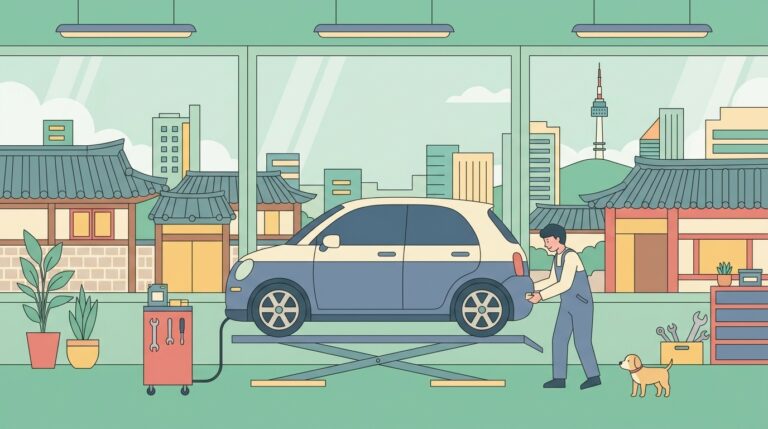
Master Korean Car Maintenance: Tire Pressure and Replacement Guide
Phase 1: 공감 (Story-driven Empathy Opening)
안녕하세요! 매일한글 에디터입니다. Welcome back to another real-world Korean language survival guide!
Picture this: You are on an unforgettable road trip along the breathtaking coastal highway of Gangneung. K-indie music is playing on your dashboard, the fresh ocean breeze is filling your car, and life feels like a scene straight out of a healing K-Drama. Suddenly, a sharp ding echoes through the cabin. A bright yellow horseshoe-shaped warning symbol flashes on your dashboard: your TPMS (Tire Pressure Monitoring System) light just turned on.
Your heart sinks. Driving on an underinflated tire along curvy mountain highways is hazardous, but the thought of pulling into a local Korean auto repair shop (카센터 – ka-sen-teo) feels equally terrifying. What if they ask complicated mechanical questions? How do you ask them to inspect tread wear without sounding like a robotic translation tool? Many foreign residents and travelers in Korea simply ignore these warning lights or call expensive emergency services because they lack the practical vocabulary to communicate with neighborhood mechanics.
Today, we are solving that pain point once and for all. Drawing from over a decade of real classroom experiences and feedback from intermediate expatriate drivers living across Korea, this guide gives you the exact conversational tools, cultural non-verbal cues, and confidence to walk into any Korean repair garage. You will speak like a savvy local driver, save money, and keep your road trips completely safe. Let us dive in!
Phase 2: 핵심 표현 3선 심층 분석 (Core Expressions Deep Dive)
1. 공기압 좀 체크해 주실 수 있나요?
- Pronunciation: Gong-gi-ap jom che-keu-hae ju-sil su in-na-yo? (Sound simile: Imagine saying “Gong” like a meditation bell, “gi” like ‘give’ without the ‘ve’, and “ap” like ‘up’ with a soft ‘p’.)
- Meaning: “Could you please check the tire air pressure?” (Literal: Air pressure / a bit / check / can you do?)
- K-Culture Moment: You pull into a neighborhood repair garage (카센터) before embarking on a long Chuseok holiday highway drive. As the technician approaches your driver-side window, you lower your glass and politely make this request.
- Editor’s Insight: The tiny word 좀 (jom) is Korea’s ultimate politeness lubricant. Without 좀, the sentence sounds like an operational demand. With 좀, it translates to a respectful, humble request that instantly lowers social friction.
- Situation Spectrum:
- Casual (Friends): 🚫 (Do not use with mechanics)
- Semi-formal (Polite everyday): ✅ (Perfect for auto shops)
- Formal (Official report): ⚠️ (Grammatically fine, but slightly conversational)
- 🤔 Think About It: In English, we often ask “Can you check my tires?” directly. Why do Koreans add softening adverbs like 좀 (a little) even when paying for professional service?
2. 타이어 마모 상태가 어떤가요?
- Pronunciation: Ta-i-eo ma-mo sang-tae-ga eo-tteon-ga-yo? (Sound simile: “Ma-mo” rhymes with ‘tah-moe’, sounding smooth and crisp.)
- Meaning: “How is the wear and tear condition on my tires?” (Literal: Tire / abrasion / condition / how is it?)
- K-Culture Moment: Seen frequently in consumer protection segments on Korean reality shows like Han Moon-chul’s Dashcam Review (한블리), where road safety experts emphasize checking tire tread before seasonal monsoons.
- Editor’s Insight: 마모 (ma-mo) is a Sino-Korean term (摩擦 + 耗) referring to abrasion or gradual wearing down. Using this specific technical word instead of vague adjectives like 오래됐어요? (Is it old?) immediately signals to the mechanic that you understand basic car care, preventing anyone from overcharging you.
- Situation Spectrum:
- Casual: 🚫
- Semi-formal: ✅ (Standard polite inquiry)
- Formal: ✅ (Used in inspection reports and formal evaluations)
- 🤔 Think About It: How does mastering precise Sino-Korean nouns elevate your credibility when negotiating services in Korea compared to using generic descriptive verbs?
3. 타이어 갈 때가 된 것 같아요.
- Pronunciation: Ta-i-eo gal ttae-ga doen geot ga-ta-yo. (Sound simile: “Gal ttae” sounds like saying ‘gull’ + ‘teh’ with a tense, snappy ‘tt’.)
- Meaning: “I think it is about time to replace the tires.” (Literal: Tire / to change / time / has become / it seems like.)
- K-Culture Moment: A character in an everyday Korean vlog or lifestyle drama notices their steering wheel vibrating in the rain and remarks to their passenger that the tread is gone.
- Editor’s Insight: Notice the verb 갈다 (gal-da). While textbooks prefer the formal Sino-Korean verb 교체하다 (gyo-che-ha-da), real native drivers almost always use 갈다 when speaking casually or conversationally. Pairing it with ~ㄴ 것 같아요 (~n geot ga-ta-yo) softens your opinion, showing humility before the technician confirms the diagnosis.
- Situation Spectrum:
- Casual: ⚠️ (Change ending to 된 것 같아 for friends)
- Semi-formal: ✅ (Natural and standard for real interactions)
- Formal: ⚠️ (Use 교체 시기가 도래했습니다 in technical documents)
- 🤔 Think About It: Why do Koreans prefer indirect opinion markers like “it seems like” even when a physical fact (like a worn tire) is blatantly obvious?
Phase 3: 교과서 한국어 vs 진짜 한국어 (Textbook vs Real Korean)
Situation 1: Asking to refill air pressure
- 📖 교과서 한국어 (Textbook): 타이어에 공기를 주입해 주십시오. (Ta-i-eo-e gong-gi-reul ju-ip-hae ju-sip-si-o.) – “Please inject air into the tires.”
- 🗣️ 진짜 한국어 (Real-life): 공기압 좀 봐주실 수 있어요? (Gong-gi-ap jom bwa-ju-sil su iss-eo-yo?) – “Could you take a quick look at the air pressure?”
- 💡 왜 다를까? (Why the difference?): Using 주입하다 (to inject) sounds like an instructional manual written in 1995. In genuine Korean workshops, drivers ask mechanics to “take a look” (봐주다), blending diagnosis and refilling into one polite, natural phrase.
Situation 2: Asking if the tire tread is worn out
- 📖 교과서 한국어 (Textbook): 타이어의 교체 주기 도래 여부를 확인 바랍니다. (Ta-i-eo-ui gyo-che ju-gi do-rae yeo-bu-reul hwak-in ba-ram-ni-da.) – “Please confirm whether the replacement cycle for the tire has arrived.”
- 🗣️ 진짜 한국어 (Real-life): 타이어 마모 한계선 거의 다 닿았나요? (Ta-i-eo ma-mo han-gye-seon geo-ui da da-an-na-yo?) – “Has it almost reached the tread wear indicator?”
- 💡 왜 다를까? (Why the difference?): Native intermediate speakers mention the specific physical marker—마모 한계선 (wear indicator line). It cuts through vagueness and asks for an objective, tangible assessment.
Phase 4: K-Culture 딥다이브 & 비언어적 매너 (Deep Dive & Non-verbal Etiquette)
4-1. 눈치 (Nunchi) & Mechanic Workshop Gestures
Visiting a Korean 카센터 requires subtle non-verbal awareness:
1. The Squat & Point (쪼그려 앉기): When the mechanic bends down to check your tread depth or sidewall condition, never remain standing tall with your arms crossed. Squat down slightly alongside them at a respectful distance (about 1 meter). It signals that you are engaged and eager to learn rather than acting like a demanding inspector.
2. The Canned Coffee Etiquette (캔커피 매너): If a mechanic refills your tire air or checks small issues without charging a diagnostic fee, it is customary Korean manners to buy a chilled canned coffee (such as Let’s Be or Maxim T.O.P) from the corner convenience store or the garage’s indoor vending machine and hand it over with both hands, saying: “날씨 더운데 감사합니다!” (Nal-ssi deoun-de gam-sa-ham-ni-da! – Thank you in this hot weather!).
4-2. Culture Code: The “Chuseok Safe Highway” Phenomenon
Before major national holidays like Chuseok (Korean Thanksgiving) or Seollal (Lunar New Year), millions of families hit the expressways simultaneously in what is dubbed Gwi-seong-gil (귀성길 – the journey back home). To prevent massive pileups, expressway rest areas (휴게소) and corporate service centers (like Hyundai Bluehands and Kia Auto Q) provide 무상 점검 서비스 (Free vehicle inspection services). Taking your car in specifically for tire pressure and brake pad health before a long road trip is considered a vital civic duty and an unspoken pillar of Korean road culture.
Phase 5: 실전 롤플레이 시나리오 (Roleplay Simulation)
Setting: A tidy neighborhood auto shop (동네 카센터) in Mapo-gu, Seoul. A slight chill is in the air. The owner, Mechanic Park (박 사장님), wipes his hands on a clean work cloth as you pull your vehicle into the repair bay.
- 사원 박 (Mechanic Park): 어서 오세요! 어디가 불편해서 오셨어요?
(Eoseo oseyo! Eodiga bulpyeonhaeseo osyeosseoyo?)
“Welcome! What seems to be the trouble today?”
🎭 Greets you with a warm smile, holding a digital tire gauge. -
당신 (You): 안녕하세요, 사장님. 계기판에 공기압 경고등이 떠서요.
(Annyeonghaseyo, sajangnim. Gye-gi-pane gong-gi-ap gyeong-go-deungi tteoseoyo.)
“Hello, boss. The tire pressure warning light came on my dashboard.”
🎭 Points toward the instrument cluster with an open palm. -
사원 박 (Mechanic Park): 아, 날씨가 갑자기 추워져서 그럴 수도 있어요. 바퀴 네 개 다 한번 봐드릴게요.
(A, nalssiga gapjagi chuwojyeoseo geureol sudo isseoyo. Bakwi ne gae da hanbeon bwadeurilgeyo.)
“Ah, that often happens when the temperature drops suddenly. Let me check all four wheels for you.”
🎭 Bends down by the front driver-side wheel and unscrews the valve cap. -
당신 (You): 네, 부탁드립니다. 그리고 타이어 마모 상태도 같이 봐주실 수 있나요?
(Ne, butakdeurimnida. Geurigo ta-i-eo ma-mo sang-taedo gachi bwa-jusil su innayo?)
“Yes, please. And could you also check the tire wear condition while you’re at it?”
🎭 Squats down a step away, watching attentively. -
사원 박 (Mechanic Park): 앞 타이어는 괜찮은데, 뒤쪽 타이어는 마모 한계선에 거의 닿았네요. 비 올 때 미끄러울 수 있어요.
(Ap ta-i-eoneun gwaenchaneunde, dwijjok ta-i-eoneun ma-mo han-gye-seone geoui daatneyo. Bi ol ttae mikkeureoul su isseoyo.)
“The front tires look fine, but the rear ones are almost touching the wear limit line. They might slip when it rains.”
🎭 Points his work light at the tiny rubber bridge inside the tread groove. -
당신 (You): 아, 정말요? 그럼 지금 바로 갈아야 할까요, 아니면 위치 교환으로 될까요?
(A, jeongmalyo? Geureom jigeum baro garaya halkkayo, animyeon wichi gyo-hwaneuro doelkkayo?)
“Oh, really? Should I replace them right away, or would a tire rotation be enough?”
🎭 Tilts head thoughtfully, evaluating practical options. -
사원 박 (Mechanic Park): 뒤쪽 트레드가 너무 닳아서 위치 교환보다는 두 짝 먼저 교체하시는 게 안전해요.
(Dwijjok teuredoga neomu daraseo wichi gyo-hwanbodaneun du jjak meonjeo gyo-chehasineun ge anjeonhaeyo.)
“The rear tread is worn too thin. Rather than a rotation, it’s safer to replace that pair first.”
🎭 Stands up and gives an honest, reassuring nod. -
당신 (You): 네, 사장님 말씀대로 안전하게 갈아주세요. 비용은 대략 얼마인가요?
(Ne, sajangnim malsseumdaero anjeonhage garajuseyo. Bi-yongeun daeryak eolmaingayo?)
“Okay, let’s replace them safely as you suggested. Roughly how much will it cost?”
🎭 Nods in agreement and enters the office to review tire inventory.
🔀 인터랙티브 분기점 (Interactive Decision Point)
When Mechanic Park tells you the rear tires are worn, how do you respond?
- Choice A: “너무 비싼 거 아니에요? 그냥 바람만 넣고 갈게요!” (Isn’t that too expensive? Just pump air and I’ll leave!)
- Feedback [Bad ❌]: Accusing a mechanic of high prices before asking for a quote creates instant awkwardness and breaks trust. Korean mechanics appreciate calm inquiries regarding options.
- Choice B: “혹시 추천하시는 가성비 좋은 모델로 견적 확인해 주실 수 있나요?” (Could you check an estimate for a model with good value for money that you recommend?)
- Feedback [Best ⭐️]: Professional, polite, and uses the magic word 가성비 (cost-effectiveness). The mechanic will search for reliable mid-tier domestic tires (like Hankook or Kumho) that match your budget.
- Choice C: “그냥 제일 싼 중고 타이어로 아무거나 끼워주세요.” (Just fit whatever cheapest used tire you have.)
- Feedback [Risk ⚠️]: While acceptable in an emergency, asking for “whatever used tire” might result in an mismatched speed rating or aged rubber compound that compromises wet handling.
Phase 6: 10초 감정 섀도잉 드릴 (Emotional Shadowing Drill)
Practice these lines out loud. Match the slash / pauses and internalize the emotional tags.
[🚗 당황스러움과 걱정을 담아 - With flustered concern]
“저기 사장님, / 주행 중에 갑자기 / 공기압 경고등이 떴는데 / 잠깐 봐주실 수 있나요?”
(Jeogi sajangnim, / ju-haeng jung-e gapjagi / gong-gi-ap gyeong-go-deungi tteonneunde / jamkkan bwa-jusil su innayo?)-
[🔍 꼼꼼하고 똑 부러지게 - Thorough and discerning]
“타이어 마모 한계선까지 / 얼마나 남았어요? / 이번 장마철 전에 / 갈아야 할까요?”
(Ta-i-eo ma-mo han-gye-seon-kkaji / eolmana nam-asseoyo? / Ibeon jangmacheol jeone / garaya halkkayo?) -
[🤝 정중하고 신뢰를 보내며 - Respectful and trusting]
“사장님 추천대로 / 앞뒤 위치 교환하고 / 휠 얼라인먼트까지 / 같이 맞춰주세요.”
(Sajangnim chucheondaero / apdwi wichi gyo-hwanhago / hwil eol-la-in-meonteu-kkaji / gachi matchwojuseyo.)
Phase 7: K-Culture 미니 사전 (Mini Dictionary)
- 공임비 (Gong-im-bi) – Labor Cost / Service Fee
Usage: Unlike parts costs, Korean repair centers frequently charge an itemized 공임비 for installation and inspection. Platforms like Gongim Nara (공임나라) standardize this labor fee nationwide. - 마모 한계선 (Ma-mo Han-gye-seon) – Tread Wear Indicator
Usage: The tiny raised rubber bar located inside tire grooves. If the tire surface touches this line, legal roadworthiness is expired. - 휠 얼라인먼트 (Hwil Eol-la-in-meon-teu) – Wheel Alignment
Usage: Often shortened to 얼라이 (eol-la-i) in garage slang. Necessary when tires wear unevenly (편마모 – pyeon-ma-mo). - 지렁이 (Ji-reong-i) – Tire Plug (Literal: “Earthworm”)
Usage: The brown vulcanized rubber strip used to quickly patch nail punctures. If you get a puncture, mechanics will ask: “지렁이 하나 때우면 됩니다” (We just need to patch it with an earthworm).
Phase 8: 여행자를 위한 생존 키트 (Traveler’s Survival Kit)
TOP 3 Survival Phrases
- “공기압 네 짝 다 36으로 맞춰주세요.”
(Gong-gi-ap ne jjak da samsip-yugeuro matchwo-juseyo.)
Pro Tip: “Please set all four tires to 36 PSI.” (Adjust the number based on the sticker on your driver-side door jamb). - “펑크 난 곳이 있는지 확인해 주세요.”
(Peong-keu nan gosi inneunji hwak-inhae juseyo.)
Pro Tip: Use 펑크 (puncture/flat). If one tire’s pressure is drastically lower than the others, this phrase directs them straight to the puncture test. - “타이어 언제 생산된 제품이에요?”
(Ta-i-eo eonje saeng-san-doen jepum-ieyo?)
Pro Tip: Asking when new tires were manufactured prevents shops from installing aged inventory sitting in warehouses for years.
Editor’s Travel Note: Apps & Roadside Services
- Free Air Pumping at Self-Gas Stations: Most modern expressway rest areas and large inner-city gas stations offer automated tire inflators (셀프 공기압 주입기) free of charge. Simply dial your desired PSI on the digital screen, attach the nozzle to your valve, and wait for the beep.
- Insurance Emergency Dispatch: If you are stranded with a flat tire, your Korean auto insurance provides 긴급출동 서비스 (Emergency Roadside Assistance) 5 to 6 times per year for free. Search for your insurer’s app via the 네이버 지도 앱 다운로드 to share your exact GPS location with their call center.
Phase 9: 한 발 더 깊이 (Deeper Cultural Reflection)
In many Western cultures, auto repair is viewed as an individualistic, strictly transactional service where every question is governed by warranties and contracts. In Korea, neighborhood mechanics operate on a deeply rooted 단골 (Dan-gol – Loyal Regular Patron) culture. When you visit a local 카센터 and address the head technician respectfully as 사장님 (Sajangnim), acknowledging their craftsmanship, you transition from an anonymous customer into a valued member of the neighborhood ecosystem. Mechanics will often check fluid levels, inflate your tires, and wipe your windshield completely free of charge simply because an ongoing social bond was forged.
💬 Your Turn: Have you ever experienced car trouble in a foreign country? How does the culture of small independent workshops in your home country compare to Korea’s friendly neighborhood 카센터? Share your thoughts below!
Phase 10: FAQ & 오해 방지 (FAQ Schema)
Q: Is checking tire pressure free of charge at Korean auto repair shops?
A: Historically, local garages inspected and filled tires for free as a neighborhood courtesy. However, due to rising operational costs and liability regulations, many shops now charge a nominal fee of 5,000 KRW to 10,000 KRW unless accompanied by other maintenance services. Always ask politely beforehand: “공기압 점검 비용이 얼마인가요?” (How much is the tire pressure check fee?).
Q: What is the difference between Bluehands, Auto Q, and a regular Car Center?
A: Bluehands (블루핸즈) and Kia Auto Q (오토큐) are official certified service networks for Hyundai and Kia vehicles, ideal for warranty work and computerized diagnostic recalls. A regular 카센터 (Car Center) is an independent garage that repairs all brands, often offering faster turnarounds, flexible aftermarket parts, and negotiable pricing.
Q: Can I bring my own tires purchased online to a Korean garage?
A: Yes! This is extremely common in Korea. Drivers buy discounted tires on e-commerce sites (like Coupang or Danawa) and ship them directly to certified install shops like 공임나라 (Gongim Nara), paying only the standardized labor fee (공임비) for mounting and balancing.
🚨 Common Mistakes (흔한 실수)
- Calling a flat tire a “Flat”: Saying “My tire is flat” won’t register with older Korean mechanics. Instead, use the ubiquitous Konglish word 펑크 (Peong-keu – puncture).
- Confusing Bar and PSI: Korea universally uses PSI for consumer passenger cars, though some imported European cars display kPa or Bar. Always clarify numbers in PSI (e.g., 삼십육 – 36).
- Ignoring the DOT Date Code: Foreign drivers often buy replacement tires without verifying the 4-digit manufacture date stamp on the sidewall. Always check that the tire was produced within the past 6 to 12 months.
Phase 11: 액션 미션 & 참여 유도 (Action Missions)
- 🥉 Bronze Mission (Solo Practice): Go to your car or look at a photo of a tire. Squat down and say aloud 3 times: “타이어 마모 한계선 거의 다 닿았나요?”
- 🥈 Silver Mission (Social Sharing): Snap a photo of a tire air inflator machine next time you visit a Korean highway rest stop (휴게소) and share it on Instagram with the hashtag
#매일한글자동차. - 🥇 Gold Mission (Real Life): Next time you pass a neighborhood 카센터, step in and ask the technician: “사장님, 공기압 점검 좀 부탁드려도 될까요?” Hand them a canned drink afterward!
- 🎮 K-Culture Mission: Watch an episode of a Korean car review show (such as 오토기어 or 모터리언) and listen for the words 접지력 (grip) and 편마모 (uneven wear).
Phase 12: 인터랙티브 퀴즈 챌린지 (Interactive Quiz)
Test your intermediate automotive Korean knowledge below!
- Situation Judgment: You run over a nail on Olympic Expressway and notice tire pressure dropping. What should you ask the mechanic to install?
- A) 와이퍼 (Wiper)
- B) 지렁이 (Earthworm / Tire plug)
- C) 엔진오일 (Engine oil)
- Fill-in-the-blank: Complete the natural expression:
“타이어 트레드가 다 닳아서 새로 ______ 때가 됐어요.”
(The tire tread is all worn out, so it’s time to replace them.)- Hint: Verb meaning ‘to replace/grind’.
- True / False Cultural Check:
Expressway rest areas in Korea never provide free tire inflators, so you must always call an insurance tow truck.- (True / False)
👉 Click to view answers & explanations!
-
Answer: B) 지렁이
Explanation: Mechanics humorously call vulcanized tire puncture plugs 지렁이 because of their dark, worm-like appearance. -
Answer: 갈 (from 갈다)
Explanation: 갈 때가 됐어요 is the natural, conversational idiom for “it’s time to replace/change.” -
Answer: False
Explanation: Most expressway rest areas (고속도로 휴게소) feature a free self-maintenance corner equipped with digital tire inflators, vacuums, and dust blowers.







