

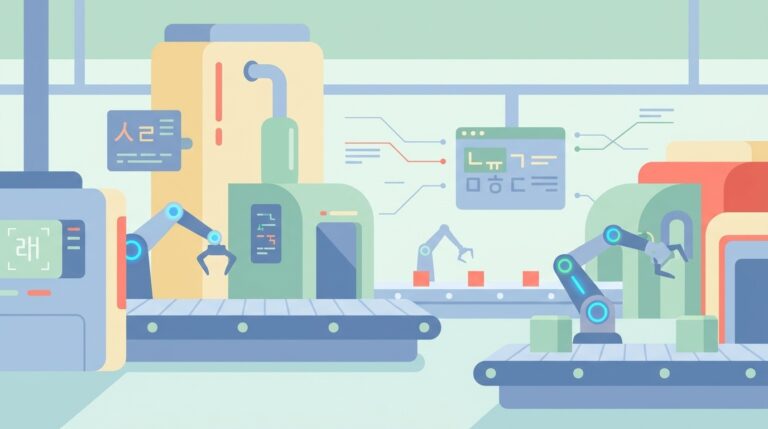
Mastering Smart Factory and IoT Korean: Automation on the Shop Floor
Phase 1: Empathy & Storytelling Opening
안녕하세요! 매일한글 에디터입니다. (Hello! It’s your Daily Hangul editor.)
Picture this: You are standing on the pristine, reflective epoxy floor of an advanced smart factory in Pangyo or Ulsan. Robotic arms articulate with surgical precision, automated guided vehicles (AGVs) glide along magnetic tracks, and massive digital twin dashboards flicker with live telemetry. Suddenly, an alarm chime rings out. The lead production engineer turns to you, eyes wide, and says: “센서 통신에 랙 걸려서 3번 라인 물리기 직전인데, 오프셋 값 즉시 잡아야 합니다!” You took advanced Korean courses, aced TOPIK level 6, and can analyze modern literature with ease—yet in this split-second operational crisis, your mind draws a blank.
Industrial Internet of Things (IoT) and cyber-physical automation operate in a high-stakes, fast-paced linguistic universe. When downtime costs millions of won per second, textbook Korean simply won’t cut it. Based on direct insights from international engineers collaborating with Korean manufacturing giants, this guide bridges that exact gap. By internalizing these authentic C1-level expressions, you will not only speak the language of cutting-edge Industry 4.0 but also earn the deep respect of your Korean engineering counterparts.
Phase 2: Core Expressions Deep Dive
1. 실시간 모니터링 체계를 구축하다 (Silsigan moniteoring chegyereul guchukada)
- Pronunciation: [Sil-si-gan mo-ni-teo-ring che-gye-reul gu-chu-ka-da] (Think of “che-gye” sounding briskly like ‘chair-yeah’ said with firm cadence)
- Meaning: Literal: “To construct a real-time monitoring system” | Nuance: Architecting an end-to-end telemetry pipeline where edge sensor data drives autonomous closed-loop decisions.
- K-Culture Moment: Seen in boardroom presentations in tech-centric K-dramas like Start-Up, where technical leads present infrastructure scalability to skeptical executives.
- Editor’s Insight: The verb 구축하다 carries immense professional gravity compared to basic words like 만들다 (to make). Using it instantly signals high-level strategic ownership.
- Situation Spectrum: Casual 🚫 | Semi-formal ⚠️ | Formal ✅
- 🤔 Think About It: Notice how Korean industrial discourse defaults to 체계 (systematic infrastructure) over individual tools. How does this reflect the Korean corporate focus on organizational harmony and standardized process?
2. 공정 이상 징후를 사전에 감지하다 (Gongjeong isang jinghureul sajeone gamjihada)
- Pronunciation: [Gong-jeong i-sang jing-hu-reul sa-jeo-ne gam-ji-ha-da] (Pronounce “jing-hu” similar to ‘jing-who’)
- Meaning: Literal: “To detect process abnormality symptoms in advance” | Nuance: Leveraging predictive maintenance algorithms to flag micro-deviations before line failure occurs.
- K-Culture Moment: Reminiscent of industrial thrillers and investigative corporate dramas where vigilant technicians spot anomalous patterns in supervisory control data right before a crisis.
- Editor’s Insight: The term 징후 (symptom/omen) combined with 사전 감지 (early/predictive detection) showcases sophisticated technical intuition. It shows you aren’t just reacting to failures; you are anticipating them.
- Situation Spectrum: Casual 🚫 | Semi-formal ⚠️ | Formal ✅
- 🤔 Think About It: How does Korea’s fast-paced 빨리빨리 (hurry, hurry) mindset paradoxically demand ultra-proactive error prevention to keep automated output moving without disruption?
3. 설비 가동률을 극대화하다 (Seolbi gadongnyureul geukdaehwahada)
- Pronunciation: [Seol-bi ga-dong-nyu-reul geuk-dae-hwa-ha-da] (Notice the liquid assimilation: “gadong-ryul” flows naturally into [gadongnyul])
- Meaning: Literal: “To maximize equipment operation rate” | Nuance: Tuning overall equipment effectiveness (OEE) and minimizing micro-stops to optimize manufacturing yield.
- K-Culture Moment: The triumphant climax of an industrial transformation project where production yields break company records.
- Editor’s Insight: This phrase ties IoT capabilities directly to corporate bottom lines. In cross-functional steering meetings, this bridges the gap between software developers and factory floor directors.
- Situation Spectrum: Casual 🚫 | Semi-formal ✅ | Formal ✅
- 🤔 Think About It: Why is equipment utilization rate (가동률) regarded as a badge of pride for the entire operational unit, rather than just an engineering metric?
Phase 3: Textbook Korean vs. Real Korean
Situation 1: Reporting IoT Sensor Latency
- 📖 교과서 한국어: “센서의 데이터 전송 지연이 발생하고 있습니다.” (Sensoryui deiteo jeonsong jiyeoni balsaenghago itseumnida. / Data transmission delay of the sensor is occurring.)
- 🗣️ 진짜 한국어: “센서 쪽에 딜레이 걸려서 라인 꼬일 것 같아요.” (Senser jjoge dillei geollyeoseo rain kkoil geot gatayo. / There’s lag on the sensor end, so the line might get tangled up.)
- 💡 왜 다를까? On the bustling plant floor, engineers mix established loanwords (딜레이) with dynamic physical verbs like 꼬이다 (to become tangled or botched) to express urgent operational jeopardy.
Situation 2: Proposing Parameter Recalibration
- 📖 교과서 한국어: “파라미터 수치를 변경하여 제어 상태를 최적화합시다.” (Paramiteo suchireul byeongyeonghayeo jeeo sangtaereul choejeokhwahapsida. / Let us change parameter figures to optimize control states.)
- 🗣️ 진짜 한국어: “세팅값 좀 다시 잡고 마진 폭 타이트하게 가시죠.” (Setting-gap jom dasi japgo majin pok taiteuhage gasijyo. / Let’s recalibrate the settings and tighten up our margin tolerances.)
- 💡 왜 다를까? Real practitioners favor the pragmatic verbal idiom 값을 잡다 (to dial in/lock in values) and concise descriptors like 타이트하게 to convey crisp, confident craftsmanship.
Phase 4: K-Culture Deep Dive & Non-Verbal Manners
4-1. 눈치 (Nunchi) & Gestures on the Plant Floor
In a Korean automated facility, pointing an index finger directly at an engineer’s HMI terminal or automated cell can be perceived as aggressive and blame-shifting. Instead, gesture toward telemetry visualizations with an open palm angled slightly upward. When an unexpected system halt triggers yellow rotating beacons, exercise acute 눈치 (situational intuition): maintain focused silence, avoid speculative excuses, and observe the Section Chief (과장) or Team Leader (팀장) before speaking. Once they solicit input, deliver your diagnostic assessment concisely.
4-2. The Cultural Nexus: 현장 (Hyun-jang / The Gemba) & 야식 (Late-Night Solidarity)
No matter how advanced your machine learning algorithms or edge gateways are, Korean engineering philosophy venerates 현장 (the actual physical floor). Sitting in an air-conditioned IT suite far from the machinery is frowned upon. The highest respect is reserved for the architect who stands alongside operators in safety goggles and cleanroom gear. Solving line stoppages during overnight shifts often ends with steaming bowls of instant ramyeon or delivery fried chicken (야식) in the breakroom—this is where real industrial camaraderie and long-term professional trust are solidified.
Phase 5: Real-Life Roleplay Scenario
Setting: Control room of an automated EV battery plant in Ochang. Amber warning alerts pulse on the central SCADA terminal.
Characters:
* Park Cha-jang (박 차장): Veteran Automation Production Lead, sharp and detail-oriented.
* You: Senior IoT Systems Architect.
- 박 차장: “알렉스 씨, 4공구 용접 로봇 쪽 데이터 피드가 자꾸 튀는데 확인해 보셨어요?”
(Alex-ssi, 4-gonggu yongjeop robot jjok deiteo pideuga jakku twineunde hwaginhae bosyeosseoyo?)
“Alex, the data feed from the tool #4 welding robot keeps spiking. Have you checked it out?”
🎭 [불안한 표정으로 대형 모니터를 손바닥으로 가리키며] -
You: “네, 차장님. 엣지 게이트웨이 로그 분석해 보니 패킷 손실이 간헐적으로 발생하고 있습니다.”
(Ne, chajangnim. Etji geiteuwei rogeu bunseokhae boni paekit sonsiri ganheoljeogeuro balsaenghago itseumnida.)
“Yes, Mr. Park. Analyzing the edge gateway logs, packet loss is occurring intermittently.”
🎭 [침착하게 태블릿 화면의 시계열 차트를 제시하며] -
박 차장: “패킷 손실이라… 인터록 걸려서 라인 셧다운되기 직전입니다. 원인이 뭡니까?”
(Paekit sonsirira… Inteorok geollyeoseo rain syeotdaondoegi jikjeonimnida. Wonini mwomnikka?)
“Packet loss… We’re right on the verge of an interlock line shutdown. What’s the root cause?”
🎭 [팔짱을 끼며 미간을 찌푸린 채] -
You: “진동 센서 통신 노이즈 때문인 것 같습니다. 샘플링 주기를 소폭 조정해서 부하를 줄여야 합니다.”
(Jindong senser tongsin noijeu ttaemunin geot gatseumnida. Saempleuring jugireul sopok jojeonghaeseo buhareul juryeoya hamnida.)
“It appears to be communication noise from the vibration sensor. We should slightly adjust the sampling frequency to alleviate load.”
🎭 [차분하지만 단호한 어조로] -
박 차장: “주기를 늘리면 실시간 모니터링 정밀도에 영향 주는 거 아닙니까?”
(Jugireul neurimyeon silsigan moniteoring jeongmildo-e yeonghyang juneun geo animnikka?)
“If we extend the cycle, won’t it compromise our real-time monitoring precision?”
🎭 [의구심을 품은 눈빛으로 응시하며] -
You: “임계치 필터링 알고리즘을 함께 태우면 정밀도 저하 없이 이상 징후만 선별 감지할 수 있습니다.”
(Imgyechi pilteoring algorijeumeul hamkke taeumyeon jeongmildo jeoha eopsi isang jinghuman seonbyeol gamjihal su itseumnida.)
“If we deploy our threshold filtering algorithm alongside it, we can selectively detect anomalies without losing precision.”
🎭 [자신감 있는 미소와 함께 고개를 끄덕이며] -
박 차장: “좋습니다. 라인 안 서게 바로 핫픽스 적용하고 결과 실시간 공유해 주세요.”
(Jotseumnida. Rain an seoge baro hatpikseu jeogyeonghago gyeolgwa silsigan gong-yuhae juseyo.)
“Agreed. Apply the hotfix right away so the line doesn’t stall, and share the live updates.”
🎭 [안도하며 어깨를 가볍게 툭 치며] -
You: “즉각 패치 적용하고 모니터링 결과 보고드리겠습니다!”
(Jeukgak paechi jeogyeonghago moniteoring gyeolgwa bogodeurigetseumnida!)
“I will apply the patch immediately and report back on the telemetry results!”
🎭 [단정하게 목례하며 즉시 키보드를 입력하며]
🔀 Interactive Decision Point
How do you handle updating the Section Chief when the live patch deployment begins?
* Option A: “제가 알아서 완벽하게 고칠 테니 차장님은 신경 끄셔도 됩니다.” (I’ll fix it on my own, so you don’t need to concern yourself.)
❌ Bad: Extremely dismissive, breaks professional hierarchy, and damages collective trust.
* Option B: “패치 배포 시작했습니다. 센서 레이턴시 정상 범위 복귀하는 즉시 수치 공유하겠습니다.” (Patch deployment initiated. I’ll share figures the moment sensor latency returns to normal.)
✅ Best: Demonstrates proactive communication, respect for rank, and metrics-driven execution.
* Option C: “하드웨어 문제 같으니 센서 제조사 엔지니어 올 때까지 라인 세우시죠.” (Seems like a hardware fault, so let’s halt the line until the vendor engineer arrives.)
⚠️ Risk: Suggests shutting down production without exhaustive troubleshooting; management will question your problem-solving grit.
Phase 6: 10-Second Emotion Shadowing Drill
[🚨 긴박하고 단호하게 - Urgent & Resolute]
“AGV 동선 간섭으로 / 라인 다운 위험이 있으니 / 즉각 인터록 걸어주세요!”
(AGV dongseon ganseobeuro / rain daun wiheomi isseuni / jeukgak inteorok georeojuseyo! / Risk of line downtime due to AGV path conflict, so trip the interlock immediately!)-
[🧐 분석적이고 신중하게 - Analytical & Deliberate]
“수집된 엣지 컴퓨팅 로그를 보면 / 특정 구역 센서에서 / 노이즈가 튀는 것 같습니다.”
(Sujipdoen etji keompyuting rogeureul bomyeon / teukjeong guyeok sensereo-seo / noijeuga twineun geot gatseumnida. / Looking at the edge computing logs collected, noise seems to spike from sensors in a specific zone.) -
[🤝 자신감 넘치고 든든하게 - Confident & Reliable]
“알고리즘 튜닝 완료했으니 / 금일부터는 오차 범위 내에서 / 자동 보정될 겁니다.”
(Algorijeum tyuning wanryohaesseuni / geum-ilbuteoneun ocha beomwi nae-eseo / jadong bojeongdoel geomnida. / Algorithm tuning is complete, so starting today it will auto-calibrate within the tolerance margin.)
Phase 7: K-Culture Mini Dictionary
-
티칭 (Tiching / Robot Teaching & Trajectory Calibration)
Usage: Programming coordinates and tool orientation for 6-axis industrial manipulators.
Context: Engineers frequently say, “티칭 좌표가 1mm 틀어져서 보정 들어갑니다” (The robot teaching coordinates were off by 1mm, so recalibration is underway). -
인터록 (Inteorok / Safety Interlock Circuit)
Usage: Hardware or PLC safety logic designed to shut down motion instantly when a human or obstacle breaches a sensor perimeter.
Context: Essential safety phrase: “도어 열리면 인터록 바로 작동하는지 확인하세요” (Verify that the interlock trips instantly when the safety enclosure door opens). -
수율 (Suyu-l / Manufacturing Yield Rate)
Usage: The percentage of non-defective items produced out of total raw components inputted.
Context: The holy grail KPI: “IoT 기반 품질 검사 자동화로 이번 분기 수율이 2% 올랐습니다” (Through IoT-driven automated quality inspection, this quarter’s yield rose by 2%). -
라인을 타다 (Raineul tada / Flowing with Line Cadence)
Usage: Signifies that components, automated AGVs, and assembly stations operate in uninterrupted harmony.
Context: An operational compliment: “공정 밸런싱이 잘 맞아서 제품이 라인 아주 매끄럽게 잘 타네요” (Line balancing is dialed in, so the product is flowing through the line smoothly).
Phase 8: Survival Kit for Business Visitors
TOP 3 Survival Expressions for Industrial Plants:
- “클린룸 방진복 어디서 갈아입나요?” (Kkeullinrum bangjinbok eodiseo gara-imnnayo? / Where do I change into cleanroom bunny suits?)
Pro Tip: High-tech battery and semiconductor lines strictly require electrostatic discharge (ESD) smocks and footwear before entry. - “출입증 태그 찍고 들어가면 되나요?” (Churipjeung taegeu jjikgo deureogamyeon doenikkayo? / Do I badge in with this visitor pass to enter?)
Pro Tip: Security gates in Korean manufacturing complexes are tied to automated attendance and zone-clearance RFID trackers. - “보안 스티커 미부착 단말기는 반입 불가인가요?” (Boan seutikeo mi-buchak danmalgineun ban-ip bulga-ingayo? / Are devices without security stickers prohibited on the floor?)
Pro Tip: Almost every Korean Tier-1 production hub places tamper-evident stickers over smartphone cameras upon entry.
Editor’s Travel Note
Visiting industrial innovation zones in Gumi, Changwon, or Pangyo? Public transit routes change dynamically in industrial complexes. We strongly suggest checking the 네이버 지도 앱 다운로드 for real-time bus arrival telemetry, or dispatching registered mobility services using the 카카오 T 앱 다운로드 platform when shuttling between manufacturing campuses.
Phase 9: “One Step Deeper” (Thought Essay)
In western manufacturing discourse, industrial automation is frequently discussed as the complete replacement of human fallibility by autonomous logic. In the Korean industrial ecosystem, however, automation is viewed as an amplification of collective human responsibility (공동 책임). When an automated process trips an alarm, the entire team—from software designers to mechanical technicians—gathers physically at the station to share diagnostic insight. High-tech automation in Korea does not eradicate social connection; rather, it demands sharper communicative nuance, swift mutual respect, and synchronized professional etiquette.
💬 Your Turn: In your home country, how are unexpected automated line failures communicated between software architects and shop-floor technicians? Share your experiences in the comments below!
Phase 10: FAQ & Common Mistakes
Q: What is the real difference between “설비” (seolbi) and “장비” (jangbi) in factory automation?
A: While both refer to equipment, 설비 describes large-scale physical manufacturing infrastructure and permanent plant systems (e.g., utility piping, conveyor lines, environmental chambers), whereas 장비 usually refers to standalone tools, test stations, or individual robotic instruments.
Q: Can I use “에러” (ereor) interchangeably with “이상 징후” (isang jinghu)?
A: No. 에러 (Error) denotes a realized, binary fault condition where software or hardware has already failed or thrown an exception code. 이상 징후 (Anomaly precursor) refers to subtle warning trends—such as thermal spikes or micro-vibrations—detected via telemetry before an actual error halts production.
Q: When addressing the head of production, should I use their job title or their name?
A: Always append their organizational title followed by the honorific suffix -nim (e.g., 공장장님 [Plant Manager], 파트장님 [Part Lead], or 반장님 [Floor Foreman]). Addressing senior production leaders merely by their name and ssi (알렉스 씨) is considered a major social faux pas in factory culture.
🚨 Common Mistakes Alert!
- Saying “스마트 공장” instead of “스마트 팩토리” in modern industry: While grammatically correct, contemporary Korean industry uniformly uses the loanword 스마트 팩토리 for technical branding and documentation.
- Over-using English acronyms without polite verb endings: Stating simply “PLC 체크 완료” can sound curt. Always attach professional endings: “PLC 체크 완료했습니다.”
- Failing to report status in real time: In Korean plants, silence equals negligence. Even if a bug is still being diagnosed, report interim progress (“현재 원인 파악 중입니다”).
Phase 11: Action Missions
- 🥉 Bronze Mission (Solo Shadowing): Practice saying “설비 가동률을 극대화하기 위해 실시간 이상 징후를 감지하고 있습니다” three times with a confident, analytical tone in front of a mirror.
- 🥈 Silver Mission (Tech Community Sharing): Write a brief social media post or forum response describing an IoT automation project you admire, utilizing the terms 실시간 모니터링 and 공정 최적화.
- 🥇 Gold Mission (Real-World Application): In your next stand-up or technical meeting with Korean colleagues, replace casual phrases like 고치다 with 파라미터를 보정하다 or 체계를 구축하다.
🎮 K-Culture Mission: Watch a documentary or corporate video showcasing Hyundai Motor Group’s Singapore Global Innovation Center (HMGICS) or Samsung’s automated semiconductor fabs. Spot how many times engineers say 공정 (process) and 수율 (yield)!
Phase 12: Interactive Quiz Challenge
1. Contextual Judgment Quiz
An automated soldering arm experiences an unexpected thermal drift during night production. Which response shows superior C1 competence when reporting to the Team Leader?
* (A) “로봇이 고장 났어요. 내일 아침에 수리업체 부를게요.”
* (B) “온도 센서 임계치 초과로 이상 징후가 감지되어, 즉각 캘리브레이션 및 파라미터 보정 진행 중입니다.”
* (C) “기계는 원래 밤에 가끔 멈추니까 재부팅하겠습니다.”
2. Fill-in-the-Blank
“IoT 센서 데이터를 통합 분석하여 공장 전체의 _________ 가동률을 극대화할 수 있었습니다.”
(Hint: High-level word for factory facility infrastructure)
3. True / False Cultural Check
(True or False) Pointing directly with an outstretched index finger toward a technician’s terminal during an automated line stoppage is considered polite and direct communication in Korean manufacturing culture.
🔍 Click here to reveal answers and explanations!
- Answer: (B)
Explanation: Option B uses precise C1 terminology (이상 징후 감지, 임계치 초과, 파라미터 보정) and communicates proactive remediation. Options A and C reveal unprofessional passivity. - Answer: 설비 (Seolbi)
Explanation: 설비 가동률 (equipment operational rate) is the exact industry-standard compound used across Korean manufacturing. - Answer: False
Explanation: Finger-pointing is seen as accusatory. Professionals always present telemetry charts or equipment areas with an open hand or neutral posture.







