

Whispers Between the Lines: The Art of Korean Indie Bookstore Curation for Advanced Learners
Phase 1: 공감 (Immersive Cultural Opening)
안녕하세요! 매일한글 에디터입니다.
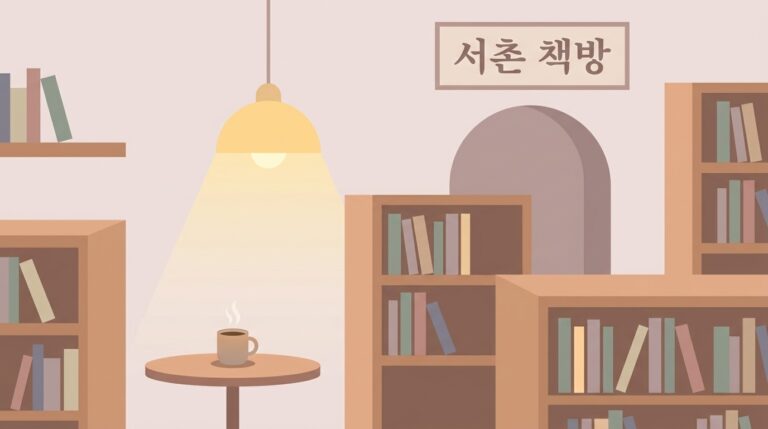
Imagine stepping off the bustling pavement of Seoul’s Seochon or Mangwon-dong, slipping into a quiet alleyway where the urban rush suddenly decelerates into absolute stillness. You push open the weathered oak door of a tucked-away independent bookstore (dongnip seojeom, 독립서점). The scent of roasted drip coffee mingles with the woody perfume of freshly pressed paper. There are no bestseller towers here, no neon signs screaming discounts. Instead, you find kraft-paper-wrapped “blind books” tied with twine, hand-annotated index cards tucked into poetry collections, and limited-edition zines printed by solo creators.
Then comes the moment of hesitation. The bookstore keeper (chaekbangjigi, 책방지기) looks up with a quiet, welcoming nod. You want to ask about the philosophy behind their collection; you want to express why a particular translated essay touched a nerve, or inquire about the socio-cultural texture of the independent publishing movement. Yet, textbook Korean leaves you stranded in rigid, transactional phrases like “이 책이 유명합니까?” (Is this book famous?) or dry academic formulations that sound like a civil service exam. You feel the profound gap between standard fluency and literary resonance.
This guide was born from that exact creative frustration, inspired by real feedback from our advanced learners seeking to inhabit the authentic, nuanced spaces of contemporary Korean arts. Mastering the elevated language of literary curation does more than polish your C2 portfolio—it grants you emotional citizenship in Korea’s most introspective cultural salons. Let us walk together through the quiet revolution of Korean independent bookshops.
Phase 2: 핵심 표현 3선 심층 분석 (Core Expressions in Depth)
1. 결이 맞다 (Gyeori matda)
- Pronunciation: [Gyeo-ri mat-da] (Pronounce ‘gyeo’ like the ‘yeo’ in ‘yearn’ preceded by a soft ‘g’, followed by ‘ri’ and ‘mat-da’)
- Meaning: Literally “the grain aligns” (as in the grain of polished timber or textile). In actual usage, it conveys that an artwork, an aesthetic ethos, or a person’s temperament effortlessly resonates on the exact same subtle wavelength as yours.
- K-Culture Moment: An indie bookseller explains why a niche translation of a French philosopher sits alongside an indie photobook of decaying Seoul alleys: “두 작품이 서로 결이 맞아서 나란히 놓았어요.” (Both works share an intrinsic aesthetic grain, so I displayed them side by side.)
- Editor’s Insight: Korean aesthetics prize natural, unforced harmony. When something is “결이 맞다,” it suggests an effortless affinity that transcends superficial genre boundaries. It is the ultimate compliment in contemporary Seoul literary circles.
- Situation Spectrum: Casual (✅) | Semi-formal (✅) | Formal (✅ with polite endings: 결이 맞습니다)
- 🤔 Think About It: English often uses technical metaphors like “being on the same wavelength.” How does the Korean tactile metaphor of “wood/fabric grain” alter your emotional understanding of resonance?
2. 취향을 타다 (Chwihyangeul tada)
- Pronunciation: [Chwi-hyang-eul ta-da] (Articulate ‘chwi’ sharply like ‘twee’ with an aspirated ‘ch’, followed by ‘hyang’ and ‘tah-dah’)
- Meaning: Literally “to ride on taste.” In context, it means that an artwork or experience is intrinsically polarizing, deeply subjective, and distinctly niche rather than universally appealing.
- K-Culture Moment: When a reader deliberates over an experimental typography zine, the curator gently counsels: “이 책은 취향을 좀 타는 편이라, 먼저 앞부분을 음미해 보세요.” (This book relies heavily on personal taste, so please sample the opening pages first.)
- Editor’s Insight: Notice the active verb 타다 (to ride). In Korean pop culture and aesthetics, works that 취향을 타다 are not flawed; rather, they demand a kindred spirit who can ride their peculiar rhythm. Embracing niche subjectivity is the very soul of the indie book movement.
- Situation Spectrum: Casual (✅) | Semi-formal (✅) | Formal (⚠️ – In formal literary criticism, 호불호가 갈리다 is often preferred)
- 🤔 Think About It: In mass consumer culture, universality is praised. Why do independent spaces celebrate the fact that a creation is 취향을 타는 rather than universally pleasing?
3. 행간을 읽다 (Haengganeul ikda)
- Pronunciation: [Haeng-ga-neul ik-da] (Smoothly blend the nasal ‘haeng-gan’ into the particle ‘eul’, followed by ‘ik-da’ where the double batchim resolves to ‘k’)
- Meaning: Literally “to read between the printed lines.” Figuratively, it refers to deciphering unspoken sentiments, deliberate stylistic omissions, and psychological undercurrents in prose and human interactions.
- K-Culture Moment: In a literary salon in Euljiro analyzing Han Kang’s translated novellas, a participant remarks: “번역가가 원작의 절제된 행간을 온전히 살려냈더군요.” (The translator fully preserved the original work’s restrained unspoken spaces.)
- Editor’s Insight: Korean is a high-context communicative ecosystem where silence speaks volumes. At the C2 level, moving from explicit grammar decoding to 행간을 읽는 태도 (the posture of reading between lines) marks the transition from fluent outsider to intuitive native-level conversationalist.
- Situation Spectrum: Casual (✅) | Semi-formal (✅) | Formal (✅)
- 🤔 Think About It: Can silence and negative space be translated across different linguistic systems without losing their cultural weight?
Phase 3: 교과서 한국어 vs 진짜 한국어 (Textbook vs. Real-world Korean)
Situation 1: Describing a polarizing, avant-garde publication
- 📖 교과서 한국어: 이 책은 사람마다 호불호가 갈릴 수 있는 특이한 책입니다.
(I chaekeun saram-mada hobulho-ga gal-lil su inneun teugi-han chaek-imnida.)
“This book is an unusual book about which people may have likes and dislikes.” - 🗣️ 진짜 한국어: 호불호의 영역이라기보다는, 독자의 고유한 취향과 결이 맞닿아야 온전한 진가를 드러내는 책이에요.
(Hobulho-ui yeong-yeok-iragibodaneun, dokja-ui goyu-han chwihyang-gwa gyeori matda-aya onjeon-han jingareul deureonaeneun chaek-ieyo.)
“Rather than a matter of simple likes and dislikes, this book only reveals its true value when it aligns with the reader’s unique aesthetic grain.” - 💡 왜 다를까? Textbook Korean relies on rigid, clinical descriptors like 호불호 or 특이하다, which can sound dismissive. Cultivated native speakers use evocative concepts such as 결이 맞닿다 (grains touching) to elevate the discussion of subjective art.
Situation 2: Inquiring about a curator’s selection criteria
- 📖 교과서 한국어: 사장님, 왜 이 책을 여기에 진열하셨습니까?
(Sajangnim, wae i chaekeul yeogi-e jin-yeolhasyeoss-seumnikka?)
“Owner, why did you display this book here?” - 🗣️ 진짜 한국어: 책방지기님의 어떤 큐레이션 의도와 철학이 깃든 책인지 조심스럽게 여쭤봐도 될까요?
(Chaekbangjiginim-ui eotteon kyure-isyeon uido-wa cheolhak-i gitdeun chaek-inji josimseureopge yeojjwobwado doelkkayo?)
“May I politely ask what curatorial philosophy and intention are imbued in this book?” - 💡 왜 다를까? Asking “왜 진열했습니까” sounds like an administrative audit. Framing the question around 큐레이션 철학이 깃들다 (philosophy imbued within) demonstrates reverence for the curator’s craftsmanship.
Phase 4: K-Culture 딥다이브 & 비언어적 매너 (Deep Dive & Nuance)
4-1. 눈치(Nunchi) & Indie Bookstore Etiquette
Korean independent bookstores are not public libraries or high-volume transit retail hubs; they are curated private sanctuaries. Practicing spatial Nunchi requires acute awareness:
1. Acoustic Restraint: Whisper or converse in muted tones. The gentle hum of the coffee grinder and acoustic background music form the room’s sensory tapestry.
2. Tactile Courtesy: When handling self-published zines (dongnipchulpanmul), lift them gently using both hands. Many have delicate exposed bindings or risograph-printed covers susceptible to finger oils.
3. Photography Protocol: Never point your lens at silent readers. If taking aesthetic interior snapshots, ask permission first, photograph only the cover surfaces (표지 위주로), and silence your camera shutter.
4-2. Cultural Code: The Rise of Blind Books & Literary Escapism
Why has the young Korean generation turned en masse toward small neighborhood bookshops (dongne chaekbang)? In a hyper-connected society driven by algorithmic hyper-optimization, discovering a book curated by human hands provides immense emotional solace (wiro, 위로). Consider the trend of 블라인드 북 (Blind Date with a Book): volumes completely wrapped in opaque paper with only three handwritten thematic keywords—such as #번아웃 (burnout), #새벽두시 (2 AM), #방황 (wandering). Readers willingly purchase them sight unseen, surrendering control to serendipity and the curator’s taste.
Phase 5: 실전 롤플레이 시나리오 (Interactive Salon Scenario)
Setting: Goyo Seojae (고요서재), a tranquil indie bookstore tucked inside a stone-wall alley of Seochon. Sunlight filters through linen curtains onto reclaimed timber shelves.
Characters:
* 민서 (Min-seo): The discerning curator-owner wearing tortoiseshell glasses and a linen apron.
* 당신 (You): An advanced literary researcher looking for nuanced contemporary translated literature.
Turn 1: 민서
🎭 따뜻한 보리차 한 잔을 건네며 부드러운 미소로 맞이한다.
“천천히 둘러보세요. 오늘은 조용한 산문집 위주로 서가를 다시 꾸며봤습니다.”
(Cheoncheonhi dulleoboseyo. Oneureun joyong-han sanmunjip wiju-ro seogareul dasi kkumyeobwasseumnida.)
“Take your time browsing. Today, I reorganized our shelves focusing primarily on quiet essay collections.”
Turn 2: 당신
🎭 손글씨 추천 쪽지가 달린 갈색 포장 도서를 조심스레 어루만지며.
“감사합니다. 저기, 서가에 놓인 큐레이션 메모들을 보니 책방지기님의 고유한 결이 그대로 묻어나는 것 같아요.”
(Gamsahamnida. Jeogi, seoga-e noin kyure-isyeon memodeureul boni chaekbangjiginim-ui goyu-han gyeori geudaero mudeonaneun geot gat-ayo.)
“Thank you. Looking at the curation notes across the shelves, your own distinct aesthetic grain seems to resonate through them all.”
Turn 3: 민서
🎭 눈을 반짝이며 의외라는 듯 고개를 끄덕인다.
“알아봐 주시니 참 기쁘네요. 요즘은 워낙 알고리즘이 추천을 도맡다 보니, 이런 아날로그적인 취향의 제안이 더 소중하게 느껴져요.”
(Arabwa jusini cham gippeuneyo. Yojeumeun wonak algorijeum-i chucheoneul domatda boni, ireon anallogeujeogin chwihyang-ui je-an-i deo sojunghage neukkyeojyeoyo.)
“I’m delighted you noticed. Nowadays, algorithms handle most recommendations, so analog curation based on personal taste feels all the more precious.”
Turn 4: 당신
🎭 책의 첫 장을 넘기며 여운을 느끼는 표정으로.
“맞아요. 특히 이 번역서는 원작의 건조한 문체 속에 숨은 행간을 정말 섬세하게 포착해냈네요.”
(Majayo. Teukhi i beon-yeokseoneun wonjak-ui geonjohan munche soge sumeun haengganeul jeongmal seomsehage pochakhaenaenneyo.)
“Exactly. In particular, this translated volume captured the subtle unspoken subtext beneath the dry original prose so delicately.”
Turn 5: 민서
🎭 서랍에서 한정판 독립출판물을 꺼내 보여주며.
“안목이 대단하시네요! 사실 이 소책자는 워낙 실험적이라 취향을 심하게 탈까 봐 서랍에 숨겨뒀던 책이에요.”
(Anmog-i daedanhasineyyo! Sasil i sochaekjaneun wonak silheomjeog-ira chwihyangeul simhage talkka bwa seorabe sumgyeodwotteon chaek-ieyo.)
“Your literary eye is remarkable! Honestly, this booklet is so experimental that I hid it in the drawer, fearing it might depend too heavily on niche taste.”
Turn 6: 당신
🎭 호기심 어린 눈빛으로 두 손으로 소책자를 받아 들며.
“오히려 그런 뾰족한 개성이야말로 동네책방이 지켜내야 할 진정한 가치가 아닐까요?”
(Ohiryeo geureon ppyojokhan gaeseong-iyamallo dongnechaekbang-i jikyeonaeya hal jinjeonghan gachiga anilkkayo?)
“Isn’t that sort of sharp, unapologetic individuality the very value neighborhood bookstores ought to safeguard?”
Turn 7: 민서
🎭 깊이 공감하며 책갈피 하나를 덤으로 얹어준다.
“가슴을 울리는 말씀이네요. 손님처럼 결이 맞는 분과 대화를 나누는 시간이 이 서점을 지탱하는 힘입니다.”
(Gaseumeul ullineun malsseum-ineyyo. Sonnim-cheoreom gyeori manneun bungwa daehwareul nanuneun sigani i seojeomeul jitaenghaneun him-imnida.)
“Your words deeply move me. Conversations with kindred spirits like you are what sustain this humble bookstore.”
Turn 8: 당신
🎭 기분 좋게 지갑을 꺼내며 결제를 준비한다.
“이 특별한 만남도 소중한 인연이니, 숨겨두셨던 이 책까지 함께 데려가겠습니다.”
(I teukbyeolhan mannamdo sojunghan in-yeon-ini, sumgyeodusyeotteon i chaekkkaji hamkke deryeogagess-seumnida.)
“This encounter is a meaningful connection in itself, so I would love to purchase this hidden gem as well.”
🔀 인터랙티브 분기점 (Branch Point)
민서 asks you what reading theme you are searching for today:
“오늘 손님의 마음에 가닿기를 바라는 특별한 문장이 있으신가요?” (Is there a particular phrase you wish to touch your heart today?)
- 선택지 A: “알고리즘에서 벗어나, 서늘한 현실 속에서도 따뜻한 온기가 깃든 독립 산문집을 만나보고 싶어요.”
- 평가 (Best – Elevated & Cultured): Connects emotional vulnerability with literary terminology (온기가 깃들다, 독립 산문집). The bookseller will treat you like an esteemed literary patron.
- 선택지 B: “여기서 제일 비싸고 번역 잘 된 베스트셀러 아무거나 추천해 주세요.”
- 평가 (Bad – Tone Deaf): Clashes with the indie bookstore ethos. Asking for commercial bestsellers or judging books purely by price ignores the value of curated spaces.
- 선택지 C: “그냥 특이해서 인스타그램에 올리기 좋은 책이면 다 좋습니다.”
- 평가 (Risk – Superficial): Booksellers might be polite, but prioritizing Instagram aesthetic over substance diminishes mutual cultural rapport.
Phase 6: 10초 감정 섀도잉 드릴 (Shadowing Drill)
Practice reading with breathing pauses marked by / and guided by the emotional cues:
[🌿 담담하면서도 진심 어린 경의를 표하며]
“서가 곳곳에 서린 / 책방지기님의 고유한 결이 / 문장마다 고스란히 묻어나는 것 같아요.”
(Seoga gotgose seorin / chaekbangjiginim-ui goyu-han gyeori / munjang-mada goseuran-hi mudeonaneun geot gat-ayo.)
“Across every shelf, / the curator’s distinct personal grain / seems to saturate every single sentence.”-
[✨ 지적 호기심과 조심스러운 탐색의 어조로]
“이 산문집은 취향을 좀 타겠지만, / 행간에 숨겨진 침묵을 따라가다 보면 / 깊은 울림을 주네요.”
(I sanmunjibeun chwihyangeul jom tagetjiman, / haenggan-e sumgyeojin chimmuk-eul ttaragada bomyeon / gipeun ullimeul juneyo.)
“This essay collection might be niche in taste, / but as you follow the silence hidden between the lines, / it yields a profound resonance.”
Phase 7: K-Culture 미니 사전 (Key Lexicon)
- 큐레이션 (Kyure-isyeon) | Curation
Usage: Refers to the deliberate selection, thematic pairing, and spatial staging of publications by an independent bookseller, resisting mass commercial distribution patterns. - 독립출판물 (Dongnip-chulpan-mul) | Independent Publication / Zine
Usage: Self-published literature created without the intervention of conventional publishers or ISBN systems, celebrating uncompromised individual expression. - 책방지기 (Chaekbang-jigi) | Bookstore Keeper / Curator
Usage: An affectionate, traditional term replacing the sterile word “사장님” (owner) or “점원” (clerk), emphasizing stewardship of literary sanctuary. - 인생책 (Insaeng-chaek) | Life-Defining Book
Usage: A work that fundamentally shifts your worldview or provides salvation during life’s darker chapters. Often sought in indie bookshops.
Phase 8: 여행자를 위한 생존 키트 (Traveler’s Survival Kit)
서바이벌 표현 TOP 3
- “이 책방에서만 만나볼 수 있는 독립출판물이 있을까요?”
(I chaekbang-eseoman mannabol su inneun dongnipchulpanmuri isseulkkayo?)
Pro Tip: Unlocks private drawers or self-published zines not found on commercial online platforms. - “블라인드 북의 키워드 중에서 ‘위로’와 관련된 책 추천 부탁드려요.”
(Beullaindeu buk-ui kiwodeu jung-eseo ‘wiro’-wa gwanryeondoen chaek chucheon butakdeuryeoyo.)
Pro Tip: Demonstrates emotional trust in the curator’s discernment rather than fixating on author names. - “책 표지 위주로 무음 카메라 촬영을 조용히 해도 괜찮을까요?”
(Chaek pyoji wiju-ro mueum kamera chwaryeong-eul joyonghi haedo gwaenchaneulkkayo?)
Pro Tip: Asking before snapping photos immediately signals high-level cultural manners (nunchi).
Editor’s Travel Note
- Mapping Hidden Bookshops: Search engines often miss newly opened independent spots. Use the 네이버 지도 앱 다운로드 platform and query keywords like
동네책방,독립서점, or북카페in arts-heavy neighborhoods like Tongin-dong, Yeonhui-dong, or Euljiro. - Ethical Patronage: Unlike giant chains, small indie spaces operate on razor-thin margins. If you spend an hour enjoying their air conditioning and browsing handwritten notes, show your solidarity by purchasing at least one book, an art postcard, or a cup of drip coffee.
Phase 9: “한 발 더 깊이” (Philosophical Reflection)
In a contemporary society often described as hyper-efficient and algorithmically pre-packaged, the Korean independent bookstore boom represents a quiet rebellion. It is a refusal to let market forces homogenize human emotion. When a chaekbangjigi pairs a handwritten quote with an obscure zine, they are creating a sanctuary for slow time (neurin sigan), allowing readers to reclaim their subjective interiority. Entering these spaces is not merely shopping; it is participating in a communal act of literary preservation.
💬 Your Turn: Have you ever encountered a book or an artwork that felt completely 결이 맞다 with your own life? What unspoken lines (행간) do you cherish most in your native language? Share your reflections in the comments below!
Phase 10: FAQ & 오해 방지 (FAQ Schema)
Q: Can I sit and read books for free in Korean independent bookshops like in Kyobo Book Centre?
A: Generally, no. Large bookstore chains allow unfettered browsing, but independent bookshops operate on curated selections with many fragile, unwrapped copies. Browse sample copies (열람용 도서) respectfully, and purchase books before settling down for long reading sessions.
Q: Are indie bookstores in Korea open to English speakers who want to discuss literature?
A: Absolutely! Most young bookstore keepers are passionate bibliophiles who welcome foreign scholars and enthusiasts. Using thoughtful expressions like 결이 맞다 or 큐레이션 immediately builds cultural trust and sparks deep conversations.
Q: Is bargaining acceptable if I buy multiple independent publications?
A: Never. Book prices in Korea are governed by the Fixed Book Price System (dosojeong-gaje, 도서정가제). Independent book prices are strictly fixed, and attempting to haggle violates cultural decorum.
🚨 흔한 실수 (Common Mistakes) 경고판
- Mistake: Calling the owner “아저씨” (Ajeossi) or “이모” (Imo).
Correct Action: Address them elegantly as 책방지기님 (Chaekbangjiginim) or 대표님/사장님 (Daepyonim/Sajangnim). - Mistake: Unwrapping “Blind Date” books without buying them.
Correct Action: The opaque wrapping is meant to remain sealed until purchased. Choose solely based on the curated exterior notes! - Mistake: Expecting massive corporate discounts.
Correct Action: Recognize that your full-price purchase directly subsidizes indie authors and neighborhood culture.
Phase 11: 액션 미션 & 참여 유도 (Action Missions)
- 🥉 Bronze Mission (Solo): Stand in front of your mirror and practice reciting Phase 6 Shadowing Drill 1 with calm, measured breath control.
- 🥈 Silver Mission (SNS): Photograph your personal bookshelf or a favorite Korean novel, posting with the caption: “내 영혼과 결이 맞는 문장들을 찾아서.” (In search of sentences that align with my soul’s grain.)
- 🥇 Gold Mission (Real World): Visit an independent bookstore in Korea (or email an indie curator), using the phrase: “책방지기님의 큐레이션 의도가 깃든 책을 한 권 추천받고 싶습니다.”
🎮 K-Culture Mission: Watch an episode of a culturally reflective Korean drama or variety program set in a bookshop (e.g., When the Weather Is Fine / 날씨가 좋으면 찾아가겠어요). Identify how the characters express empathy through silence and understated dialogue!
Phase 12: 인터랙티브 퀴즈 챌린지 (Interactive Quiz)
- [상황 판단] A friend shows you an experimental, nonlinear essay that you find personally fascinating, though you know it won’t be a commercial hit. Which sophisticated expression best describes it?
- A) 이 책은 완전 엉망이라 인기가 없을 것 같아요.
- B) 독자의 취향을 좀 타겠지만, 결이 맞는 사람에겐 깊은 울림을 줄 책이에요.
- C) 책 가격이 너무 비싸서 아무도 안 살 거예요.
- [빈칸 채우기] 완성된 문장을 만들어 보세요:
“그 소설가는 말을 아낌으로써, 독자가 스스로 (_______)을 읽어내도록 유도한다.”- (Hint: Spaces between the printed lines)
- [True / False] In Korean independent bookstores, it is standard practice to tear open the kraft wrapping of a “Blind Book” to inspect the contents before paying. (T/F)
정답 및 해설 확인하기 (Click to reveal answers & explanations)
-
정답: B
해설: Option B captures both nuanced literary diplomacy (취향을 타다) and soulful affinity (결이 맞다), embodying true C2 conversational elegance. -
정답: 행간 (Haenggan)
해설: 행간을 읽다 is the classic literary idiom for interpreting unspoken subtext and the deliberate pauses between words. -
정답: False
해설: Blind books are designed to be bought based solely on curatorial cues and hashtags. Peeling the wrapping spoils the mystery and damages the retail presentation.






