

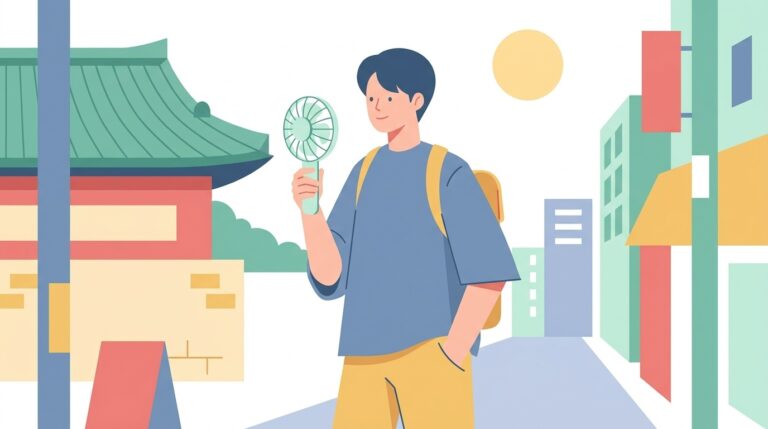
Korean Summer Survival Guide: Beat the Heat Like a Local with Your Mini-Fan
Phase 1: Empathy (Storytelling Opening)
안녕하세요! (Annyeonghaseyo!) I’m your Daily Hangul editor and your personal Seoul culture navigator.
Picture this: It is mid-July in Seoul. You exit Hongik University Station after a scenic subway ride. The second you step onto the pavement, an invisible wall of heavy, tropical humidity hits your chest. Within forty seconds, your forehead is glowing with sweat, your shirt is sticking to your back, and you wonder how on earth locals are strolling past looking pristine, fresh, and completely unbothered.
Then, you notice the secret. Almost every second person—from high schoolers in uniform to stylish office workers in Gwanghwamun—is holding a sleek, pastel-colored electronic device humming softly right in front of their chin. Welcome to the kingdom of the 손풍기 (son-pung-gi), Korea’s iconic handheld fan!
In Korea, a portable fan is not just an electronic accessory; it is an absolute summer lifeline, a social icebreaker, and a window into everyday manners. Many intermediate learners tell me: “Teacher, I knew the formal word for air conditioner, but on the street, everyone kept talking about ‘son-pung-gi’ and ‘pukpuk jjida’—I felt so lost!” Don’t worry. In this guide tailored for intermediate (B1) learners, we will break down the essential phrases, unwritten social etiquette, and cultural nuances so you can beat the heat, make friends, and navigate Korea’s sizzling summer with confidence.
Phase 2: Core Expressions Deep Dive
1. 손풍기 좀 빌려줄 수 있어요? (Son-pung-gi jom billyeojul su isseoyo?)
- Pronunciation: Son-poong-gee jom beel-lyeo-jool soo ee-sseo-yo? (Think of the English word son + pooh with an ng sound, followed by gee).
- Meaning: Literal: “Can you lend [me] hand-fan a little?” | Actual Nuance: “Could I borrow your mini-fan for a quick second?”
- K-Culture Moment: You see this constantly in behind-the-scenes clips of historical K-dramas (사극), where actors wrapped in five layers of heavy royal silk desperately share fans between takes.
- Editor’s Insight: Notice the tiny word 좀 (jom). While it literally translates to “a little,” in spoken Korean it acts as a magical politeness cushion. Without 좀, your request sounds blunt; with 좀, it transforms into an endearing, considerate plea.
- Situation Spectrum:
- Casual (Friends): ✅ 손풍기 좀 빌려줘! (Son-pung-gi jom billyeojwo!)
- Semi-formal (Polite everyday): ✅ 손풍기 좀 빌려줄 수 있어요? (Son-pung-gi jom billyeojul su isseoyo?)
- Formal (Strict business setting): 🚫 손풍기 좀 빌려주실 수 있습니까? (Awkward—handheld fans are rarely shared formally with corporate superiors!)
- 🤔 Think About It: In your country, would you ask an acquaintance to borrow a personal electronic gadget? In Korea, sharing cooling breeze is a warm gesture of communal bonding (정, jeong).
2. 더위 먹은 것 같아요. (Deowi meogeun geot gat-ayo.)
- Pronunciation: Deo-wee meo-geun geot gah-tah-yo. (Sounds like duh-wee mug-un gut gah-tah-yo).
- Meaning: Literal: “I think I ate the heat.” | Actual Nuance: “I feel exhausted from the heat / I think I have mild heatstroke.”
- K-Culture Moment: A classic line on outdoor variety shows like Running Man whenever the cast completes a grueling sprint under the scorching midday sun.
- Editor’s Insight: In Korean, you don’t just endure extreme heat—you “eat” it (더위를 먹다). Koreans also use the verb 먹다 (meokda) for gaining age (나이를 먹다), getting scared (겁을 먹다), or getting scolded (욕을 먹다). Adding ~은 것 같아요 softens your physical condition diagnosis naturally.
- Situation Spectrum:
- Casual: ✅ 나 더위 먹었나 봐. (Na deowi meogeonna bwa.)
- Semi-formal: ✅ 더위 먹은 것 같아요. (Deowi meogeun geot gat-ayo.)
- Formal: ⚠️ 더위를 먹은 것 같습니다. (Grammatically fine, but in high-formality, describe symptoms like dizziness instead.)
- 🤔 Think About It: Why does Korean grammar use active culinary verbs like “eating” to express passive physiological vulnerabilities to climate?
3. 바람 세기 좀 올려도 돼요? (Baram segi jom ollyeodo dwaeyo?)
- Pronunciation: Bah-rahm seh-gee jom ohl-lyeo-doh dwae-yo?
- Meaning: Literal: “May I raise the wind intensity a little?” | Actual Nuance: “Do you mind if I turn up the fan speed / blast setting?”
- K-Culture Moment: Sitting at a shared communal table in an open-terrace cafe in Seongsu-dong, asking a companion before switching the table fan from gentle breeze to turbo power.
- Editor’s Insight: 바람 (baram) means wind or air breeze, and 세기 (segi) means intensity or power level. Combined with the permission grammar ~어도 돼요?, it strikes the sweet spot of B1 polite communication.
- Situation Spectrum:
- Casual: ✅ 바람 세기 좀 올려도 돼? (Baram segi jom ollyeodo dwae?)
- Semi-formal: ✅ 바람 세기 좀 올려도 돼요? (Baram segi jom ollyeodo dwaeyo?)
- Formal: ✅ 바람 세기를 조금 올려도 되겠습니까? (Baram segireul jogeum ollyeodo doegesseumnikka?)
- 🤔 Think About It: Modifying shared air currents in public spaces is considered sensitive in Korea. How does asking before changing the airflow show group consideration?
Phase 3: Textbook Korean vs Real Korean
Situation 1: Describing the suffocating summer climate
- 📖 Textbook Korean: 오늘 날씨가 매우 덥습니다. (Oneul nalssiga maeu deopseumnida. – Today the weather is very hot.)
- 🗣️ Real Korean: 오늘 날씨 진짜 푹푹 찌네요! (Oneul nalssi jinjja pukpuk jineyo! – Wow, it feels like a steamer out here today!)
- 💡 Why the difference?: The onomatopoeic phrase 푹푹 찌다 (pukpuk jjida) evokes food simmering in a bamboo steam basket. Native speakers prefer vivid sensory adjectives over clinical words like 매우 (maeu).
Situation 2: Emphasizing the necessity of a handheld fan
- 📖 Textbook Korean: 여름에는 휴대용 선풍기를 소지하는 것이 유익합니다. (Yeoreumeneun hyudaeyong seonpung-gireul sojihaneun geosi yu-ikhapnida. – In summer, possessing a portable electric fan is beneficial.)
- 🗣️ Real Korean: 여름엔 손풍기 진짜 필수템이에요! (Yeoreumen son-pung-gi jinjja pil-su-tem-i-e-yo! – A handheld fan is an absolute must-have during summer!)
- 💡 Why the difference?: Street Korean loves compound abbreviations: 손 (hand) + 선풍기 (fan) = 손풍기, and 필수 (essential) + 아이템 (item) = 필수템.
Phase 4: K-Culture Deep Dive & Non-Verbal Manners
4-1. Nunchi (눈치) & Handheld Fan Etiquette
Using a mini-fan in Korea comes with unspoken social rules:
1. The Bangs Dilemma (앞머리 사수): Many Koreans put significant effort into styling their curtain bangs or fringe with hair rollers (구르프). Never point your fan directly into someone’s face or forehead without asking—you might ruin their styling! Direct the airflow gently toward their chin, neck, or chest.
2. Subway Rush-Hour Etiquette: On crowded lines like Seoul Subway Line 2 or Line 9, keep your fan low. Blasting a high-speed whirring motor right by a seated stranger’s ear or whipping your hair into their eyes is considered a major lack of 눈치 (nunchi). Keep the setting on low and angle it strictly to yourself.
4-2. The Evolution of the Fan Phenomenon
Handheld fans were once considered cheap promotional trinkets given out by banks. Today, thanks to K-Pop idol airport style and beauty culture, they are refined fashion statements. You will see idols holding high-tech brushless fans with neck straps, cooling metal plates (which cool down to 10°C on contact), or silicone animal ears matching popular webtoon characters. Gifting a premium pastel fan to a friend before an outdoor music festival is a classic gesture of modern Korean affection.
Phase 5: Real-World Roleplay Scenario
Setting: It is 2:00 PM in the winding, sunlit alleys of Ikseon-dong. The pavement is radiating heat, and your iced Americano is already melting.
Characters:
* Minji (민지): Your energetic Korean classmate who planned a walking cafe tour.
* You: An intermediate learner fighting against dehydration.
- Turn 1 (Minji): 와, 오늘 기온 35도래요. 진짜 푹푹 찐다! (Wa, oneul gion samsib-o-doraeyo. Jinjja pukpuk jjinda!)
🎭 Fans herself vigorously with a cafe receipt.
(Wow, they say it’s 35 degrees today. It’s boiling like a steam pot!) - Turn 2 (You): 맞아요, 저 벌써 더위 먹은 것 같아요. (Maj-ayo, jeo beolsseo deowi meogeun geot gat-ayo.)
🎭 Panting slightly and wiping sweat from your brow.
(I know, I feel like I’m already getting heat exhaustion.) - Turn 3 (Minji): 어떡해! 잠깐 그늘로 피해요. 가방에 손풍기 없어요? (Eotteokhae! Jamkkan geuneullo pihaeyo. Gabang-e son-pung-gi eopseoyo?)
🎭 Looking concerned and pointing to a nearby traditional roof eaves.
(Oh no! Let’s duck into the shade for a second. Don’t you have a mini-fan in your bag?) - Turn 4 (You): 깜빡하고 숙소에 두고 왔어요… (Kkamppakhago suksoe dugowasseoyo…)
🎭 Looking defeated and apologetic.
(I forgot and left it at my accommodation…) - Turn 5 (Minji): 아이고, 한국 여름에 손풍기는 필수템인데! 제 거 같이 쐬어요. (Aigo, hanguk yeoreume son-pung-gineun pil-su-tem-inde! Je geo gachi ssoeyeo.)
🎭 Pulls out a cute lavender fan and holds it toward your chest.
(Oh dear, in Korean summer a mini-fan is a must-have! Let’s share mine.) - Turn 6 (You): 고마워요! 바람 세기 좀 올려도 돼요? (Gomawoyo! Baram segi jom ollyeodo dwaeyo?)
🎭 Asking politely before clicking the power button.
(Thank you! Do you mind if I turn up the fan speed a notch?) - Turn 7 (Minji): 당연하죠! 최대 세기로 틀어요. 와, 이제 좀 살 것 같죠? (Dang-yeonhajyo! Choedae segiro teureoyo. Wa, ije jom sal geot gatjyo?)
🎭 Smiling brightly as the turbo breeze kicks in.
(Of course! Crank it up to max. Ah, feel like you can survive now?) - Turn 8 (You): 네, 진짜 살 것 같아요. 시원한 음료수 제가 살게요! (Ne, jinjja sal geot gat-ayo. Siwonhan eumnyosu jega salgeyo!)
🎭 Sighing in massive relief and pointing toward a convenience store.
(Yes, I feel like I’ve returned to life. Let me buy us cold drinks!)
🔀 Interactive Decision Point
Minji looks thirsty and is fanning you generously. How do you respond?
- Option A: “민지 씨, 계속 들고 있으면 팔 아프니까 여기 테이블에 세워둬요! 제가 시원한 에이드 사 올게요.”
Feedback: [BEST] – Thoughtful, empathetic, and shows acute understanding of shared comfort. - Option B: “손풍기 시원하네요. 오늘 하루 종일 제가 들고 다녀도 돼요?”
Feedback: [RISK] – Sounds slightly possessive. Borrowing is fine for a few minutes, but taking over personal gear for the whole day burdens your friend. - Option C: “귀하의 냉각 장비 작동에 감사드립니다. 기온 하강을 확인했습니다.”
Feedback: [BAD] – Overly robotic and awkward translation software Korean. Breaks the natural, friendly rapport!
Phase 6: 10-Second Emotion Shadowing Drill
Practice these natural rhythm pauses marked by / with the designated emotion:
[🥵 지치고 헐떡이며 / Exhausted and panting]- 아, 진짜… / 날씨가 / 미쳤나 봐요!
(Ah, jinjja… / nalssiga / michyeonna bwayo!)
→ “Ah, seriously… / the weather / has gone totally crazy!”
- 아, 진짜… / 날씨가 / 미쳤나 봐요!
[🥹 간절하고 조심스럽게 / Pleading and polite]- 혹시 / 손풍기 바람 / 조금만 / 나눠줄 수 있어요?
(Hoksi / son-pung-gi baram / jogeumman / nanwojul su isseoyo?)
→ “By any chance, / could you share / a little bit of that fan breeze / with me?”
- 혹시 / 손풍기 바람 / 조금만 / 나눠줄 수 있어요?
[😌 시원하고 극락을 맛본 듯 / Relieved and blissfully refreshed]- 와… / 이제 진짜 / 살 것 같다!
(Wa… / ije jinjja / sal geot gatda!)
→ “Wow… / now I finally feel like / I can survive!”
- 와… / 이제 진짜 / 살 것 같다!
Phase 7: K-Culture Mini Dictionary
- 손풍기 (Son-pung-gi) [Noun]
- A portmanteau of 손 (son, hand) and 선풍기 (seon-pung-gi, electric fan). Used universally in stores, vlogs, and street conversation instead of the clunky official term 휴대용 선풍기.
- 필수템 (Pil-su-tem) [Noun/Slang]
- Essential item (필수 + item). Commonly used in beauty shopping, travel packing lists, and lifestyle product reviews.
- 푹푹 찌다 (Puk-puk jji-da) [Verb phrase]
- Describes stifling, humid heat where the atmosphere feels saturated like boiling water in a covered cooker.
- 살 것 같다 (Sal geot gat-da) [Idiomatic expression]
- Literally “feels like I will live.” Used after drinking ice-cold water, entering an air-conditioned room, or cooling down after extreme exhaustion.
Phase 8: Survival Kit for Travelers
TOP 3 Emergency Phrases
- 손풍기 충전 케이블 빌릴 수 있나요? (Son-pung-gi chungjeon keibeul billil su innayo?)
- Pro Tip: Most Korean cafes have battery-charging stations or USB ports near wall plugs. Ask the barista politely!
- 제일 시원한 자리로 앉아도 돼요? (Jeil siwonhan jariro anj-ado dwaeyo?)
- Pro Tip: Use this when stepping into a BBQ restaurant where grilling charcoal makes indoor air stifling.
- 얼음물 좀 많이 주실 수 있어요? (Eoreummul jom mani jusil su isseoyo?)
- Pro Tip: Normal tap water is rarely served; Koreans expect ice water (얼음물) on hot days.
Editor’s Travel Note
- Where to buy: Need a fan right away? Walk into any Daiso (다이소) for cheap budget options (3,000–5,000 KRW), or visit Olive Young (올리브영) for high-performance aesthetic fans with safety certification (15,000–28,000 KRW).
- Subway cooling hack: Korean subway trains have designated 약냉방차 (Mild Air-Conditioned Cars), usually cars 4 and 7 (or cars 3 and 4 on certain lines). If you feel dizzy and overheated, avoid those cars and board the middle cars for full-blast AC.
- Navigation Tip: Before heading out, use the 네이버 지도 길찾기 서비스 to scout indoor underground shopping arcades (지하상가) between metro exits to avoid direct sun exposure.
Phase 9: A Step Deeper (Reflection)
In Korean society, physical comfort is rarely an isolated individual experience. When someone pulls out a mini-fan on a muggy bus stop bench, watch what happens next: they almost instinctively tilt the fan 45 degrees toward the person next to them, smiling and saying, “같이 쐬어요 (Let’s share the breeze).” This small act embodies 정 (jeong)—an unspoken, communal warmth that seeks to alleviate collective hardship. Even the smallest cool breeze becomes an instrument of social connection.
💬 Your Turn: How does your home culture handle oppressive summer heat? Would sharing an electronic handheld fan with an acquaintance feel natural or slightly intrusive? Share your thoughts in the comments below!
Phase 10: FAQ & Avoiding Misunderstandings
Q: Can I carry my rechargeable handheld fan on airplanes departing Korea?
A: Yes, but only in your carry-on luggage! Because modern handheld fans contain Lithium-ion rechargeable batteries, aviation security regulations in Korea strictly prohibit placing them in checked baggage. Always keep them in your personal backpack when passing through airport security.
Q: What is the difference between 부채 (buchae) and 손풍기 (son-pung-gi)?
A: 부채 (buchae) refers specifically to traditional folding or flat manual paper/bamboo hand fans. If you ask a store clerk for a 부채, they will lead you to souvenir crafts or traditional paper fans. For battery-powered fans, always ask for 손풍기.
Q: Is it considered rude to use a handheld fan while talking to a boss or elder?
A: Generally, yes. In Korean etiquette, directing noisy mechanical blowing air directly toward a superior or professor during a formal conversation can appear careless. Keep the fan off or low in formal meetings, and allow senior individuals to control room climate settings.
🚨 Common Mistakes Alert!
- Mistake: Shouting “너무 추워요! (Neomu chuwoyo!)” when you mean you are comfortably cooled off.
- Correct Action: Say “진짜 시원해요! (Jinjja siwonhaeyo!)”. 춥다 means painfully cold/chilly; 시원하다 means delightfully refreshing.
- Mistake: Pointing fans into someone’s face while talking on crowded public transit.
- Correct Action: Angle the airflow toward the chest or throat to avoid drying out their contact lenses or blowing their hair.
- Mistake: Leaving the fan motor whining at max speed during silent university study cafes or museum halls.
- Correct Action: Switch to level 1 silent mode (저소음 모드) or use a gentle hand fan.
Phase 11: Action Missions
- 🥉 Bronze Mission (Solo Mastery): Stand in front of your mirror with your phone or any small object. Say “오늘 날씨 진짜 푹푹 찌네요! 살 것 같다…” three times with authentic facial expressions.
- 🥈 Silver Mission (Social Media Challenge): Take a photo of your summer survival item or desk fan, post it on your Instagram Story or Korean study log, and caption it with: #여름 #손풍기 #필수템 #매일한글.
- 🥇 Gold Mission (Real-World Execution): Enter a Korean convenience store or cafe on a hot day and say: “사장님, 너무 더워요! 얼음물 한 잔만 부탁드려요.”
🎮 K-Culture Scout Mission: Watch a summer behind-the-scenes video of your favorite K-pop group or K-drama production. Spot how many staff members are holding mini-fans for the stars, and note which member says “더워요!” first!
Phase 12: Interactive Quiz Challenge
Test your real-world readiness with these three quick questions!
- Situation Judgment: You and your Korean colleague are waiting for the light to change under the blazing midday sun. Your colleague is sighing and dabbing their neck with a tissue. What is the most natural thing to say?
- A) 축하합니다! 날씨가 좋습니다.
- B) 민지 씨, 이 손풍기 바람 같이 쐬어요!
- C) 저는 선풍기를 소지하고 있지 않습니다.
- Fill in the Blank: Complete this popular native summer expression:
- 오늘 날씨가 너무 습해서 만두처럼 푹푹 _____! (The weather is so humid it feels like being steamed like a dumpling!)
- Hint: A verb meaning ‘to steam’.
- True or False: In Seoul Subway trains, the car labeled 약냉방차 is the coldest car with maximum air-conditioning power.
- True or False?
👉 Click to reveal answers & explanations!
- Answer: B
- Explanation: Offering to share your handheld fan breeze (바람 같이 쐬어요) displays great friendliness and natural social etiquette.
- Answer: 쪄요 (or 찌네요 / 찐다)
- Explanation: From the verb 푹푹 찌다. Conjugated into polite conversational form, it becomes 푹푹 쪄요 or 푹푹 찌네요.
- Answer: False
- Explanation: 약 (弱) means weak/mild. A 약냉방차 is set 1–2 degrees warmer than ordinary cars for passengers sensitive to cold AC drafts. If you want maximum chill, board regular cars!
- Explanation: 약 (弱) means weak/mild. A 약냉방차 is set 1–2 degrees warmer than ordinary cars for passengers sensitive to cold AC drafts. If you want maximum chill, board regular cars!







