

Phase 1: Empathy (Story-Driven Opening)
안녕하세요! 매일한글 에디터입니다.
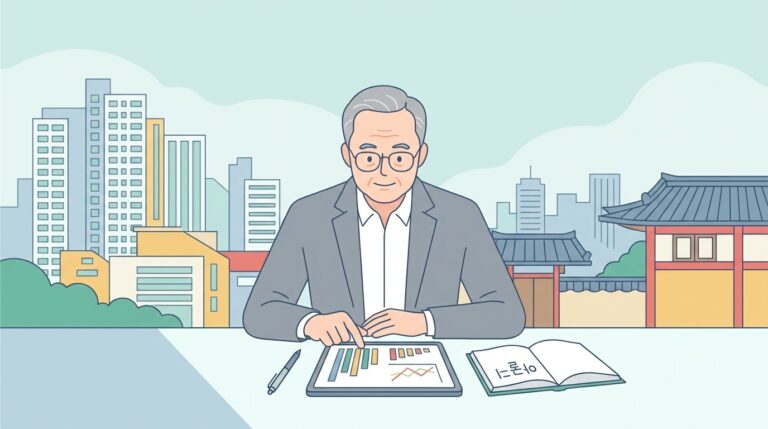
Imagine sitting across from a seasoned Korean fund manager at an upscale cafe in Yeouido, or perhaps listening to the nuanced banter in a high-stakes K-drama like Reborn Rich or Queen of Tears. The topic suddenly pivots from corporate succession to the seismic demographic shift quietly rattling Seoul’s financial markets: the grand retirement of Korea’s primary baby boomer cohort (1955–1963). In native boardrooms and dinner discussions, this isn’t merely about individuals stepping down from their desks; it is about trillions of won tied up in residential brick and mortar suddenly needing liquidation, triggering intense debates over capital reallocation, reverse mortgages, and real estate liquidity.
For advanced learners navigating C2-level professional or academic spheres, nothing exposes a linguistic ceiling faster than demographic and macroeconomic discourse. You might already know standard words like 은퇴 (euntoe, retirement) or 부동산 (budongsan, real estate), but native economic dialogues rely on highly contextualized, idiomatic idioms and sociological metaphors that textbooks consistently omit. Perhaps you have hesitated in business meetings when colleagues casually dropped terms like euntoe jeolbyeok or debated the fate of a ttolttolhan han chae. This guide synthesizes real-world economic observations with sophisticated, native-grade expressions so that you can navigate Seoul’s boardroom analyses and editorial roundtables with unmistakable nuance, elegance, and cultural authority.
Phase 2: Core Expressions In-Depth Analysis
1. 똘똘한 한 채 (Ttolttolhan han chae)
- Pronunciation: [Ttol-ttol-han han chae] (Sounds like: Tohl-tohl-hahn hahn chay)
- Meaning: Literal: “One clever/smart house.” | Actual Nuance: A premier, high-value single residential asset (typically in prime Seoul zones like Gangnam or Yongsan) held intentionally instead of diversifying into multiple vulnerable properties under heavy tax burdens.
- K-Culture Moment: Frequently debated by real estate analysts on SBS Biz or featured in prestige dramas where wealthy patriarchs consolidate their portfolios into a single flagship penthouse to hedge against demographic decline.
- Editor’s Insight: As Korea’s baby boomers retire, multi-homeowners face massive comprehensive property holding taxes. Consequently, boomers liquidate provincial properties to keep just “one bulletproof property,” making this phrase essential in asset management discourse.
- Situation Spectrum: Casual: ✅ | Semi-formal: ✅ | Formal: ✅
- 🤔 Think About It: In many Western markets, portfolio diversification across multiple regions is standard. Why does the Korean demographic squeeze incentivize radical spatial consolidation into a single metropolitan epicenter?
2. 자산 유동화 (Jasan yudonghwa)
- Pronunciation: [Ja-san yu-dong-hwa] (Sounds like: Jah-sahn yoo-dong-hwah)
- Meaning: Literal: “Asset fluidization.” | Actual Nuance: Asset securitization or converting illiquid fixed capital (specifically real estate) into liquid cash flow or steady yield-generating vehicles.
- K-Culture Moment: Heard in finance podcasts and business news segments discussing how Korean retirees are asset-rich but cash-poor, prompting them to unlock home equity via reverse mortgage schemes (jutaek yeongeum).
- Editor’s Insight: At the C2 level, replace pedestrian phrases like 부동산을 팔아서 돈을 마련하다 (budangsaneul paraseo doneul maryeonhada) with 자산 유동화 (jasan yudonghwa). It signals refined analytical fluency.
- Situation Spectrum: Casual: ⚠️ | Semi-formal: ✅ | Formal: ✅
- 🤔 Think About It: Consider how your native language conceptualizes liquidity versus the Sino-Korean root “동(動)” which implies transforming fixed, static weight into active movement.
3. 은퇴 절벽 (Euntoe jeolbyeok)
- Pronunciation: [Eun-toe jeol-byeok] (Sounds like: Eun-tway juhl-byuk)
- Meaning: Literal: “Retirement cliff.” | Actual Nuance: The abrupt demographic reality where a massive demographic bloc exits the labor market simultaneously, facing a catastrophic income drop and triggering an economic ripple effect in the consumption and asset markets.
- K-Culture Moment: Prominently featured on socioeconomic investigative journalism programs such as KBS Sisa Magazine 2580 when reporting on the oversupply of commercial storefronts as newly retired boomers prematurely open franchised cafes.
- Editor’s Insight: Koreans often use jeolbyeok (cliff) to describe abrupt sociological plateaus (e.g., 인구 절벽 – demographic cliff). It vividly captures psychological falling-off without an economic safety cushion.
- Situation Spectrum: Casual: ✅ | Semi-formal: ✅ | Formal: ✅
- 🤔 Think About It: While Western narratives often frame retirement as a gentle “golden sunset,” why does modern Korean vernacular gravitate toward perilous imagery like a “cliff”?
Phase 3: Textbook Korean vs. Real Korean
Situation 1: Explaining how retirees convert real estate to fund their living expenses
- 📖 교과서 한국어 (Textbook Korean): 베이비부머들은 은퇴한 후에 집을 팔아서 생활비를 마련하고 있습니다. (Baby boomers are selling their houses after retiring to prepare living expenses.)
- 🗣️ 진짜 한국어 (Real Korean): 베이비부머 세대가 은퇴 절벽에 직면하면서, 부동산을 유동화해 매달 안정적인 현금 흐름을 확보하는 게 급선무가 되었어요. (As the baby boomer generation faces a retirement cliff, liquidating real estate to secure stable monthly cash flow has become their top priority.)
- 💡 왜 다를까? (Why is it different?): Textbook Korean relies on simplistic subject-object-verb mechanics. Real advanced Korean incorporates specialized conceptual vocabulary (유동화, 현금 흐름, 급선무) to reflect the macroeconomic sophistication of contemporary Korean media.
Situation 2: Analyzing market shift away from speculative capital gains to rental yield
- 📖 교과서 한국어 (Textbook Korean): 이제 사람들은 집값이 오르는 것보다 월세를 받는 것을 더 좋아합니다. (Now people prefer receiving monthly rent over house prices rising.)
- 🗣️ 진짜 한국어 (Real Korean): 단순 시세 차익을 노리기보다는, 배당이나 임대 수익률 중심의 파이프라인으로 자산 구조를 재편하는 추세입니다. (Rather than aiming for simple capital gains, the trend is reshaping asset portfolios toward dividend- and rental-yield-driven pipelines.)
- 💡 왜 다를까? (Why is it different?): Native analysts speak in terms of structural reconfiguration (자산 구조 재편) and sustainable financial mechanisms (파이프라인), elevating transactional statements into strategic business analysis.
Phase 4: K-Culture Deep Dive & Non-Verbal Manners
4-1. 눈치 (Nunchi) & Professional Gestures
When discussing wealth transfer, estate liquidation, or demographic decline with older Koreans (such as executives or senior family members), blunt inquiries into property sales or inheritance taxes are seen as aggressive and disrespectful.
* Maintain a deferential, two-handed posture when presenting documentation, analytical reports, or business cards.
* Avoid using direct words like 유산 (yusan, legacy/inheritance) or 사망 (samang, death); instead, frame the trajectory using euphemisms like 은퇴 후 자산 리밸런싱 (euntoe hu jasan ribaelleonsing, post-retirement asset rebalancing) or 가업 승계 (gaeop seunggye, family business succession).
* Watch their facial tension—if a senior counterpart sighs and taps the table rhythmically, they are processing internal conflict between real-estate sentimental attachment and tax reality. Do not cut in; wait until they voice their philosophical position.
4-2. Cultural Code: The Breakdown of “부동산 불패 신화” (Real Estate Infallibility)
For five decades, South Korea operated on a singular economic dogma: Budongsan Bulpae (부동산 불패, real estate never fails). The baby boomer generation built modern Korea and accumulated wealth primarily through apartment pre-sales (청약) in booming districts. However, as the 7.1-million-strong demographic group ages without sufficient public pensions, their collective wealth remains frozen in non-liquid concrete. Today’s K-culture reflects an unprecedented crisis: the breakdown of this infallibility narrative. From trending YouTube real estate debates to family dramas, younger generations refuse to buy boomer apartments at inflated prices, birthing an intense national obsession with creating diversified cash streams instead.
Phase 5: Real Roleplay Scenario
Setting: A private wealth management suite in Teheran-ro, Gangnam. Financial consultant Kim Tae-ho (30s) is consulting with Mr. Park (62), a retired manufacturing executive evaluating his asset portfolio.
- Turn 1 (Kim Tae-ho): 선배님, 오랜만에 뵙습니다. 은퇴 후 생활은 좀 어떠신지요? (Seonbaenim, oraenmane boepseumnida. Euntoe hu saenghwareun jom eotteosinjiyo?)
🎭 Bows at 45 degrees, pouring a cup of green tea with both hands. - Turn 2 (Mr. Park): 말도 마세요. 현직에 있을 때와 달리 은퇴 절벽이란 게 피부로 와닿더군요. (Maldo maseyo. Hyeonjige isseul ttaewa dalli euntoe jeolbyeogiran ge piburo wadatdeogunyo.)
🎭 Chuckles dryly, crossing his arms and looking down pensively. - Turn 3 (Kim Tae-ho): 아무래도 고정 소득이 끊기면서 자산 재편에 대한 고민이 깊으실 것 같습니다. (Amuraedo gojeong sodeugi kkeunkgimyeonseo jasan jaepyeone daehan gomani gipeusil geot gatseumnida.)
🎭 Nods with genuine empathy, leaning in slightly across the wooden desk. - Turn 4 (Mr. Park): 맞아요. 수도권에 아파트 몇 채 쥐고 있으면 든든할 줄 알았는데, 보유세 부담만 커지고 현금이 통 안 돌아요. (Majayo. Sudogwone apateu myeot chae jwigo isseumyeon deondeunhal jul aranneunde, boyuse budamman keojigo hyeongeumi tong an dorayo.)
🎭 Sighs, rubbing the back of his neck as he admits his asset-rich, cash-poor reality. - Turn 5 (Kim Tae-ho): 최근 다주택자 규제와 인구 구조 변화를 감안하면, 똘똘한 한 채를 제외한 외곽 자산은 과감한 유동화가 필요한 시점입니다. (Choegeun dajutaekja gyujewa ingu gujo byeonhwareul gamanhamyeon, ttolttolhan han chaereul je-oehan oegwak jasaneun gwagamhan yudonghwaga piryohan sijeomimnida.)
🎭 Gently places a tablet showing quarterly real estate liquidity metrics in front of Mr. Park. - Turn 6 (Mr. Park): 똘똘한 한 채만 남기고 털어내라… 솔직히 시세 차익 미련 때문에 손이 쉽게 안 나가네요. (Ttolttolhan han chaeman namgigo teoreonaera… Soljiki sise cha-ik miryeon ttaemune soni swipge an naganeyo.)
🎭 Glares at the floor, torn between historic greed and modern solvency. - Turn 7 (Kim Tae-ho): 시세 차익보다는 월지급식 배당이나 주택연금 연계를 통해 마르지 않는 현금 흐름을 만드는 것이 노후 리스크를 헷지하는 최선책입니다. (Sise cha-ikbodaneun woljigeupsik baedang-ina jutaek-yeon-geum yeon-gyereul tonghae mareuji anneun hyeongeum heureumeul mandeuneun geosi nohu riseukeureul hejjihaneun choeseonchaegimnida.)
🎭 Points to a steady upward trend line representing monthly cash flow allocations. - Turn 8 (Mr. Park): 듣고 보니 일리가 있군요. 막연한 기대감 대신 냉정하게 포트폴리오를 점검해 봅시다. (Deutgo boni illiga itgunyo. Mang-yeonhan gidaegam daesin naengjeonghage poteupollioreul jeomgeomhae bopsida.)
🎭 Uncrosses his arms, straightens his posture, and nods decisively.
🔀 Interactive Decision Branch
How should Kim Tae-ho proceed to finalize the portfolio restructuring plan?
- Option A: “선배님, 지금 당장 모든 부동산을 처분하시고 올인하셔야 합니다.” (Sell every single piece of property immediately and go all-in right now.)
- Option B: “우선 외곽 지역 자산의 매각 타이밍과 세제 혜택을 시뮬레이션한 후, 단계적인 유동화 스케줄을 짜드리겠습니다.” (Let us first simulate the sale timing and tax benefits for peripheral assets, then formulate a step-by-step liquidation schedule.)
- Option C: “시장이 어떻게 되든 그냥 자녀분들에게 전부 미리 상속하시는 건 어떨까요?” (Regardless of market conditions, how about just gifting everything in advance to your children?)
Outcome Feedback:
* Option A (Bad): Far too blunt. Suggesting an abrupt, total liquidation creates panic and dismisses the client’s emotional investment in their real estate.
* Option B (Best): Demonstrates sophisticated C2 consultative demeanor. It blends analytical risk mitigation (seje hyetaek, yudonghwa) with respectful gradualism.
* Option C (Risk): Culturally risky. Premature inheritance often triggers severe gift taxes (jeung-yeose) and strains filial relationships without solving the retiree’s immediate cash-flow deficit.
Phase 6: 10-Second Emotional Shadowing Drill
Practice matching the cadence, professional weight, and breathing markers (/) indicated below.
- Drill 1:
[🧐 차분하고 객관적인 톤]
단순한 시세 차익보다는 / 자산 유동화를 통해 / 안정적인 현금 흐름을 확보하는 것이 / 급선무입니다.
(Dansunhan sise cha-ikbodaneun / jasan yudonghwareul tonghae / anjeongjeogin hyeongeum heureumeul hwakbohaneun geosi / geupseonmu-imnida.)
(Rather than simple capital gains / securing stable cash flow / through asset liquidation / is the top priority.) -
Drill 2:
[😮💨 안타까움과 현실적 한탄]
주변 동료들을 보면 / 은퇴 절벽을 실감하면서도 / 똘똘한 한 채에 대한 집착을 / 쉽게 내려놓지 못해요.
(Jubyeon dongryodeureul bomyeon / euntoe jeolbyeogeul silgamhamyeonseodo / ttolttolhan han chaee daehan jipchageul / swipge naeryeonotji mothaeyo.)
(Looking at my peers / despite acutely feeling the retirement cliff / their fixation on the ‘one smart house’ / is something they cannot easily relinquish.) -
Drill 3:
[💡 단호하면서도 세련된 제언]
이제는 부동산 불패라는 신화에서 벗어나 / 가용 유동성을 바탕으로 / 노후 포트폴리오를 다변화해야 할 때입니다.
(Ijeneun budongsan bulpaeraneun sinhwa-eseo beoseona / gayong yudongseong-eul batangeuro / nohu poteupollioreul dabyeonhwahaeya hal ttae-imnida.)
(It is now time to escape the myth of real estate infallibility / and based on accessible liquidity / diversify our retirement portfolios.)
Phase 7: K-Culture Mini Dictionary
-
하우스푸어 (Hauseu-pureo)
Translation: House Poor.
Usage: Refers to individuals who hold an expensive apartment (often inflated during market peaks) but live in austerity because debt servicing and holding taxes consume the vast majority of their disposable monthly income. -
상가주택 (Sang-ga-jutaek)
Translation: Commercial-residential mixed building.
Usage: A quintessential Korean boomer investment dream where the owner operates or leases commercial shops on floors 1–2 and resides in the penthouse, generating rental yield while owning the underlying land. -
주택연금 (Jutaek-yeon-geum)
Translation: Reverse Mortgage (Government-backed Home Pension).
Usage: A financial instrument operated by Korea Housing Finance Corporation allowing elderly homeowners to pledge their primary residence as collateral in exchange for guaranteed lifelong monthly pension disbursements. -
신노년층 (Sin-no-nyeon-cheung)
Translation: The ‘New Senior’ Generation / Active Seniors.
Usage: Unlike previous Korean seniors who sacrificed all capital for children’s education, this modern demographic asserts independent financial consumption, active leisure, and demanding self-funded senior living communities (silver towns).
Phase 8: Traveler’s Survival Kit (High-End Lifestyle & Business)
Top 3 Executive & Relocation Inquiries
-
이 지역의 실질 임대 수익률과 공실률 추이가 어떻게 됩니까?
(I jiyeogui siljil imdae su-ingnyulgwa gongsilryul chu-iga eotteoke doemnikka?)
Pro Tip: Use this when consulting real estate specialists in Gangnam or Pangyo to gauge true yields beyond headline agent claims. -
주택연금 전환 시 감정 평가액 기준이 어떻게 설정되나요?
(Jutaek-yeon-geum jeonhwan si gamjeong pyeong-ga-aek gijuni eotteoke seoljeongdoenayo?)
Pro Tip: Essential when analyzing public home-pension eligibility for family properties. -
보유세와 양도소득세 중과 부담을 완화할 출구 전략이 있을까요?
(Boyusewa yangdo-sodeukse jung-gwa budameul wanhwahal chulgu jeollyagi isseulkkayo?)
Pro Tip: Standard high-level phrasing for discussing tax mitigation and exit strategies with legal advisors.
Editor’s Travel Note
When conducting on-the-ground market research or exploring properties across Seoul’s changing neighborhoods, don’t rely on standard international maps. Take the time to download the Naver Map application to look up detailed parcel numbers (지번) and public commercial building registrations. For live pricing, transaction volumes, and tax estimations across different apartment complexes, navigate directly using the KB Real Estate Liiv On portal, which is the benchmark tool relied upon by Korea’s institutional lenders and tax accountants.
Phase 9: “한 발 더 깊이” (Step Deeper: Cultural Essay)
Historically, the Korean family was an unbroken intergenerational risk-pooling unit. Baby boomers spent their working primes practicing jasik all-in (자식 올인)—pouring all excess capital into their children’s private tutoring (hagwon) and wedding housing, operating on the unwritten Confucian contract that their offspring would serve as their ultimate retirement pension. Today, that social contract has broken down. Facing their own economic pressures, Generation MZ and Millennials cannot shoulder their parents’ elder care, forcing retiring boomers into an unprecedented existential turn toward strategic self-reliance. This societal rupture explains why phrases like 자산 유동화 (jasan yudonghwa) and 주택연금 (jutaek yeongeum) carry heavy emotional gravity; they represent the structural pivot from Confucian dependency to individualized, market-driven financial survival.
💬 Your Turn: Does your home culture view family real estate as an intergenerational inheritance or a personal liquidation vehicle for senior independence? Share your thoughts below in advanced Korean or English!
Phase 10: FAQ & Common Mistakes
Q: What is the exact difference between “시세 차익” and “현금 흐름” in everyday investment discussions?
A: 시세 차익 (sise cha-ik) refers purely to capital gains (the profit made when selling an appreciated asset at a higher price than its purchase cost). In contrast, 현금 흐름 (hyeongeum heureum) means cash flow—the continuous, predictable influx of operational income such as monthly rents or quarterly stock dividends. Korean baby boomers are moving away from prioritizing sise cha-ik because capital gains cannot pay for monthly healthcare or living costs without liquidating the underlying asset.
Q: Can “똘똘한 한 채” be applied to commercial properties or luxury officetels?
A: Historically, no. The phrase specifically originated to describe prime, Tier-1 residential apartments in blue-chip school districts (like Daechi-dong) or prime riverfront areas (Apgujeong, Banpo) that resist downturns. While colloquially adapted recently to denote any singular, high-performing asset, using it for non-residential commercial land risks diluting its socioeconomic nuance.
Q: Why do Korean commentators use the word “절벽” (cliff) so frequently across demographic debates?
A: Korea’s demographic transformation is the fastest in modern OECD history. Because shifts in fertility rates and retirement are occurring within a compressed 10-to-15-year window rather than across generations, the metaphor of a gradual hill does not apply. Jeolbyeok conveys the structural reality: a sudden, non-linear plunge with immediate systemic fallout.
🚨 Common Mistakes Warning Board
- ❌ Mistake 1: Translating “diversification” literally as da-yang-hwa (다양화).
Correct Action: In financial and asset allocation settings, use 다각화 (dagakhwa) or 다변화 (dabyeonhwa) (e.g., 포트폴리오 다각화). - ❌ Mistake 2: Using euntoe (은퇴) and toejik (퇴직) interchangeably.
Correct Action: 퇴직 (toejik) simply means resigning or stepping down from a specific job or company. 은퇴 (euntoe) denotes permanent retirement from the active labor market. - ❌ Mistake 3: Saying “집을 팔아서 현금을 만들다” in a boardroom or analytical context.
Correct Action: Upgrade your register to 부동산 자산을 유동화하다 (budongsan jasaneul yudonghwahada).
Phase 11: Action Missions
- 🥉 Bronze Mission (Solo Practice): Read the Phase 6 Shadowing Drills aloud three times. Focus on clean distinction between the long vowels in eun-toe and the explosive consonants in ttol-ttol-han.
- 🥈 Silver Mission (Community Engagement): Write a 2-sentence market commentary on LinkedIn or Instagram using the terms
은퇴 절벽and현금 흐름. Tag@DailyHangulso our editors can review your phrasing! - 🥇 Gold Mission (Real-World Application): Watch a segment of SBS Biz or a Korean financial news panel analyzing the housing market. Spot at least two occurrences of the terms taught today and note the speaker’s non-verbal posture during the discussion.
- 🎮 K-Culture Mission: Locate a scene in a family-centered K-drama (such as My Golden Life or Doctor Cha) where the parents discuss their house ownership or retirement plans. Transcribe how their tone shifts when the dialogue touches upon supporting their adult children.
Phase 12: Interactive Quiz Challenge
Test your mastery of Korean macroeconomic and demographic discourse:
1. Situational Judgment:
A retired executive owns three suburban residential villas with mounting tax burdens and negligible rental demand. According to modern asset management trends, what is his most logical strategic move?
* (A) 시세 차익이 날 때까지 무기한 공실로 버틴다.
* (B) 다주택 상태를 정리하고 똘똘한 한 채 위주로 자산을 유동화한다.
* (C) 즉시 모든 부동산을 담보로 사채를 끌어다 쓴다.
2. Fill-in-the-Blank:
베이비부머들이 정년퇴직 후 마주하는 급격한 소득 단절 현상을 일컬어 ‘은퇴 ________’(이)라고 부릅니다.
3. True or False:
In modern Korean wealth management discourse, prioritizing ‘시세 차익’ is considered a safer and more sustainable strategy for retirees than securing ‘현금 흐름.’ (T/F)
👉 Click to reveal answers & explanations!
-
Answer: (B)
Explanation: Holding illiquid suburban villas creates severe property holding tax liabilities. Liquidating peripheral holdings to consolidate into one high-performing asset (똘똘한 한 채) and securing liquid income is the contemporary standard. -
Answer: 절벽 (jeolbyeok)
Explanation: The full composite term is 은퇴 절벽 (euntoe jeolbyeok, retirement cliff). -
Answer: False
Explanation: The entire paradigm shift for aging baby boomers is moving away from speculative capital gains (시세 차익) toward predictable, recurring monthly income yields (현금 흐름) to hedge against health and living expenses.







