

Master the Art of Bargaining and ‘Deom’ in Korean Traditional Markets
Phase 1: 공감 (Story-Driven Opening)
안녕하세요! 매일한글 에디터입니다.
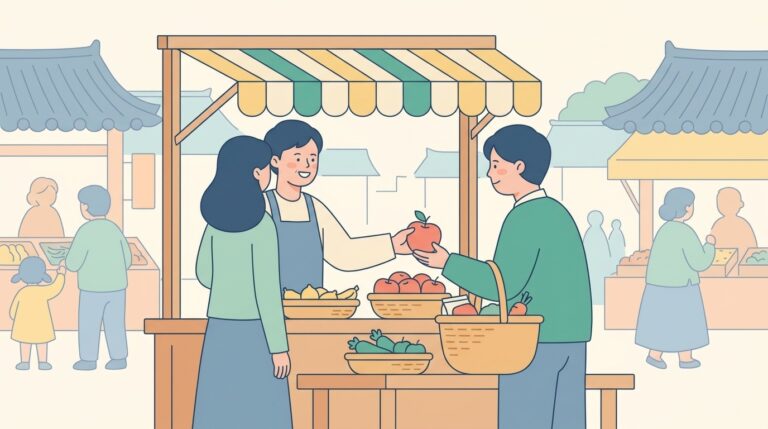
Imagine walking through the bustling alleys of Mangwon Market or Gwangjang Market. The air is thick with the scent of savory bindaetteok (mung bean pancakes) and sweet, freshly picked strawberries. You spot a vibrant fruit stall, and your eyes lock onto a crate of plump Korean shine muscat grapes. You want to ask for a discount or maybe a little something extra, just like you saw in your favorite slice-of-life K-dramas. But suddenly, your palms sweat. “If I ask for a lower price, will the vendor get offended? Do people even bargain in Seoul anymore? What if I sound rude?”
You are not alone. Many intermediate Korean learners tell us that traditional markets feel like a high-stakes exam in unspoken social codes. But here is the secret: market bargaining in Korea isn’t a tense financial negotiation; it is a warm, playful game of connection. When you learn how to ask for 덤 (deom)—the cherished Korean concept of a free bonus tossed in with affection—you stop being just an observer and become part of the neighborhood tapestry. This guide is built on real experiences and vetted by local Seoulites to help you navigate market interactions with natural confidence and cultural grace.
Phase 2: 핵심 표현 3선 심층 분석 (Core Expressions)
1. 좀 깎아주세요 (Jom kkakka-juseyo)
- Pronunciation: [Jom kkak-kka-ju-se-yo] (Think of ‘kkak’ like a crisp snapping sound, followed by gentle melody)
- Meaning: Literal: “Please trim/cut it a little.” | Nuance: “Could you knock a little off the price, please?”
- K-Culture Moment: In retro dramas like Reply 1988, mothers never pay the full initial quote for vegetables. They always tilt their head with a friendly smile and tease, “Aigu, boss, 좀 깎아주세요!”
- Editor’s Insight: The secret weapon here is 좀 (jom), meaning “a little.” In Korean communication, jom acts as a linguistic shock absorber. Saying “깎아주세요” directly can sound blunt, but adding jom softens the request into a gentle, playful plea.
- Situation Spectrum: Casual ⚠️ | Semi-formal (Market Setting) ✅ | Formal 🚫
- 🤔 Think About It: In English-speaking cultures, prices in brick-and-mortar stores are rarely negotiable. Why do you think Korean traditional culture embraces “cutting” the price as a form of social bonding?
2. 덤으로 하나만 더 주시면 안 돼요? (Deomeuro hanaman deo jusimyeon an dwaeyo?)
- Pronunciation: [Deom-eu-ro ha-na-man deo ju-si-myeon an dwae-yo?]
- Meaning: Literal: “As a bonus, if you give me just one more, wouldn’t that work?” | Nuance: “Could you throw in an extra one as a bonus? Pretty please?”
- K-Culture Moment: Think of variety shows like 2 Days & 1 Night where cast members visit provincial seafood or street markets. Instead of asking for cash discounts, they ask the stall auntie for deom, leading to hearty laughs and an extra ladle of warm soup or an extra fish cake.
- Editor’s Insight: Asking for a cash cut can sometimes feel difficult for smaller margins, but asking for 덤 (deom) gives the merchant a chance to show their generosity without losing face or direct cash. Framing it as a negative question (안 돼요? – “Wouldn’t it be okay?”) is an essential B2 nuance that signals modesty and polite deference.
- Situation Spectrum: Casual ⚠️ | Semi-formal (Market Setting) ✅ | Formal 🚫
- 🤔 Think About It: How does asking for an extra physical item differ psychologically from asking for monetary change back?
3. 다음에 또 올게요, 이모! (Daeume tto olgeyo, imo!)
- Pronunciation: [Da-eum-e tto ol-ge-yo, i-mo!]
- Meaning: Literal: “I will come again next time, maternal aunt!” | Nuance: “I’ll definitely be back, auntie! You’ve got a regular customer!”
- K-Culture Moment: In modern K-dramas, university students visiting street food tteokbokki stalls charm the owners by shouting this as they pay, almost always resulting in an unexpected fried dumpling (mandu) sliding onto their plates.
- Editor’s Insight: In Korean commerce, promising repeat visits creates a micro-relationship. Calling a female shopkeeper 이모 (imo – aunt) instead of the generic 사장님 (sajangnim – president/boss) bridges personal distance instantly. Note: Save imo for middle-aged or older women running cozy food or produce stalls.
- Situation Spectrum: Casual ✅ | Semi-formal (Markets/Restaurants) ✅ | Formal 🚫
- 🤔 Think About It: Why does Korean culture treat kinship terms (like ‘aunt’ or ‘older sister’) as commercial terms of endearment?
Phase 3: 교과서 한국어 vs 진짜 한국어 (Textbook vs. Real-Life)
Situation 1: Asking for a discount when buying multiple items
- 📖 교과서 한국어: 가격을 할인해 주시겠습니까? (Gagyeog-eul hal-inhae jusigessseumnikka? – “Would you provide a discount on the price?”)
- 🗣️ 진짜 한국어: 사장님, 많이 샀는데 천 원만 빼주세요~ (Sajangnim, mani sanneunde cheon-wonman bpae-juseyo~ – “Boss, since I bought a lot, could you take off just a thousand won?”)
- 💡 왜 다를까?: Traditional markets are built on oral banter. Textbook Korean sounds like an official corporate procurement request, whereas native speakers use active action verbs like 빼다 (bpaeda – to take out/subtract) alongside a valid social reason (많이 샀는데…).
Situation 2: Asking for a bonus item
- 📖 교과서 한국어: 추가 증정품을 주실 수 있나요? (Chuga jeungjeongpum-eul jusil su innayo? – “Can you provide an additional complimentary item?”)
- 🗣️ 진짜 한국어: 이모, 덤 하나만 쓱 얹어주세요! (Imo, deom hanaman sseuk eonjeo-juseyo! – “Auntie, please toss in a little bonus item on top!”)
- 💡 왜 다를까?: The phrase 추가 증정품 belongs in a department store promo brochure! In traditional settings, the adverb 쓱 (sseuk – smoothly/casually) and the verb 얹다 (eon-da – to place on top) paint a vivid picture of casual market generosity.
Phase 4: K-Culture 딥다이브 & 비언어적 매너 (Deep Dive & Body Language)
4-1. 눈치 (Nunchi) & Non-Verbal Market Etiquette
Bargaining in Korea requires high-level 눈치 (nunchi – situational awareness). Keep these vital physical cues in mind:
* The Cash Clue: Hold crisp cash slightly visible in your hand before asking. Merchants are far more inclined to shave off 1,000 KRW or toss in extra peppers if you pay in cash, which saves them card processing fees.
* The Soft Smile & Nod: Never demand a lower price with a poker face. Tilt your head slightly, widen your eyes, and deliver your line with a playful, friendly lilt in your voice.
* The Walk-Away Boundary: If the vendor firmly says, “남는 거 없어요” (Namneun geo eopseoyo – “I don’t make any profit on this”), let it go immediately with a warm smile: “네, 괜찮아요!” (Ne, gwaenchanayo! – “No problem, that’s totally fine!”) Pushing further breaks harmony.
4-2. Cultural Code: 정 (Jeong) and the Philosophy of 덤 (Deom)
Korea’s 덤 (deom) culture originates from an agricultural communal mindset where sharing abundance reinforced collective survival. To this day, traditional market vendors consider deom an expression of 인심 (insim – warm human generosity) rather than a loss of inventory. When an elder stall keeper throws two extra mandarin oranges into your black plastic bag, they are giving you a tiny piece of their heart (정, Jeong). Appreciate it as a personal gift, not just an economic transaction.
Phase 5: 실전 롤플레이 시나리오 (Real-Life Roleplay)
Setting: Mangwon Market (망원시장) on a crisp Saturday afternoon.
Character: Mrs. Park (박 이모), a sharp-tongued but warm-hearted fruit vendor who has run her stall for 25 years.
- You: 안녕하세요, 이모! 이 사과 얼마예요? (Annyeonghaseyo, imo! I sagwa eolma-yeyo?)
🎭 [Smiling, pointing at a wooden box of red apples]
(Hello, auntie! How much are these apples?) -
Mrs. Park: 어서 와요, 총각/아가씨! 한 바구니에 만 원이에요. 꿀사과야, 꿀사과! (Eoseo wayo, chong-gak/agassi! Han baguni-e man-won-i-eyo. Kkulsagwaya, kkulsagwa!)
🎭 [Dusting an apple with a hand cloth and displaying it proudly]
(Welcome, dear! It’s ten thousand won for a basket. Pure honey apples, so sweet!) -
You: 와, 진짜 신선해 보이네요! 사과 한 바구니 주세요. (Wa, jinjja sinseonhae boineyone! Sagwa han baguni juseyo.)
🎭 [Nodding enthusiastically and pulling out a 10,000 KRW bill]
(Wow, they look really fresh! Please give me one basket.) -
Mrs. Park: 알았어요, 제일 예쁜 놈으로 골라 담아줄게. (Arasseoyo, jeil yeppeun nom-euro golla dama-julge.)
🎭 [Scooping five large apples into a black plastic bag]
(All right, I’ll pick out the prettiest ones for you.) -
You: 이모, 저 오늘 첫 손님인데… 덤으로 하나만 더 주시면 안 돼요? (Imo, jeo oneul cheot sonnim-inde… deomeuro hanaman deo jusimyeon an dwaeyo?)
🎭 [Hands together playfully, tilting head with an aegyo smile]
(Auntie, I’m your first customer today… could you perhaps add one more as a bonus?) -
Mrs. Park: 아이고, 사과 값이 얼마나 올랐는데 그래! 남는 거 하나도 없어~ (Aigo, sagwa gabs-i eolmana ollanneunde geurae! Namneun geo hanado eopseo~)*
🎭 [Shaking her head theatrically, but her eyes are creasing into a smile]
(Oh goodness, do you know how much apple prices have skyrocketed! I make zero margin on this~) -
You: 사장님 너무 미인이셔서 다음에 무조건 또 올게요! (Sajangnim neomu mi-in-isyeoseo da-eume mujogeon tto olgeyo!)
🎭 [Handing over the exact cash with both hands while giggling]
(Boss, you’re so beautiful, I promise I will definitely come back next time!) -
Mrs. Park: 말이나 못하면! 자, 이거 제일 달콤한 놈이야. 맛있게 먹고 또 와! (Marina mothamyeon! Ja, igeo jeil dalkomhan nom-iya. Mas-itge meokgo tto wa!)
🎭 [Laughs aloud and slips a sixth glossy apple into your bag]
(Look at this smooth talker! Here, take this one, it’s the sweetest. Enjoy it and come back!)
🔀 Interactive Decision Point (What would you say next?)
At step 5, imagine Mrs. Park looked a bit tired. How do you respond?
* Option A: “이모, 현금으로 드릴 테니까 덤 하나만 쓱 얹어주세요~ 다음에 또 올게요!” (Imo, hyeongeum-euro deuril tenikka deom hanaman sseuk eonjeo-juseyo~ Daeume tto olgeyo!)
Feedback: [BEST] 🌟 Flawless B2 cultural maneuver. Offering cash softens the deal, and promising return visits seals the warmth.
* Option B: “너무 비싸요. 5,000원에 안 해주시면 안 살래요.” (Neomu bissayo. O-cheon-wone an hae-jusimyeon an sal-raeyo.)
Feedback: [BAD] ❌ Demanding a 50% discount and threatening to walk away is viewed as aggressive and rude in modern Korean markets.
* Option C: “영수증 주시고 할인 쿠폰도 적용해 주세요.” (Yeongsujeung jusigo hal-in kupon-do jeok-yonghae juseyo.)
Feedback: [RISK] ⚠️ Traditional market stalls rarely have barcode coupon systems. You will confuse the vendor and break the local market vibe.
Phase 6: 10초 감정 섀도잉 드릴 (Shadowing Drill)
Practice reading these lines aloud with the emotional rhythm markers (/ represents a micro-pause):
[🥺 아쉽고 애교 섞어서 / Coquettish & Pleading]
이모~ / 천 원만 깎아주시면 / 안 돼요? / 다음에 또 올게요!
(Imo~ / cheon-wonman kkakka-jusimyeon / an dwaeyo? / daeume tto olgeyo!)-
[😊 넉살 좋고 당당하게 / Cheerful & Playful]
사장님! / 제가 현금으로 낼 테니까, / 덤 하나만 / 쓱 얹어주세요!
(Sajangnim! / jega hyeongeum-euro nael tenikka, / deom hanaman / sseuk eonjeo-juseyo!) -
[🙏 감사하고 활기차게 / Grateful & Energetic]
인심 너무 좋으시네요! / 정말 맛있게 먹고 / 친구들이랑 또 올게요!
(Insim neomu joeusineyo! / jeongmal mas-itge meokgo / chin-gudeur-irang tto olgeyo!)
Phase 7: K-Culture 미니 사전 (Mini Dictionary)
-
덤 (Deom)
Literal: An extra bonus addition.
Usage: Used for extra goods given for free at traditional markets or roadside stalls. Cannot be used for official corporate retail promos (which are called 사은품 or 증정품). -
흥정 (Heungjeong)
Literal: Haggling / Bargaining.
Usage: The act of negotiating prices between a customer and vendor. In Korea, 흥정 is regarded as a conversational dance rather than a heated argument. -
이모 / 사장님 (Imo / Sajangnim)
Literal: Maternal Aunt / Business President.
Usage: Social honorifics for small business owners. Sajangnim is respectful and universal for both genders. Imo creates intimate rapport with female stall owners over 40. -
인심 (Insim)
Literal: Human heart / Generosity of people.
Usage: Often praised as 인심 좋다 (generous spirit). It describes places or communities where locals give generously without penny-pinching.
Phase 8: 여행자를 위한 생존 키트 (Traveler’s Survival Kit)
Top 3 Survival Market Phrases
- 현금으로 결제하면 깎아주시나요? (Hyeongeum-euro gyeoljehamyeon kkakka-jusinayo?)
Pro Tip: If you pay in paper notes, vendors often trim off the 500 or 1,000 KRW odd change automatically. - 덤 좀 팍팍 주세요! (Deom jom pak-pak juseyo!)
Pro Tip: 팍팍 (pak-pak) is an onomatopoeia for “generously / in big heaps.” It makes older vendors laugh. - 계좌이체도 가능한가요? (Gyejwa-iche-do ganeunghangayo?)
Pro Tip: If you don’t have physical cash, nearly all Seoul stalls accept local Korean bank transfers via banking apps.
Editor’s Travel Note
- Navigation: Always install the official 네이버 지도 앱 다운로드 before heading to traditional markets; Google Maps does not give accurate walking alley paths in Korea.
- Target Zones: For fresh produce, snacks, and street atmosphere, visit 망원시장 (Mangwon Market) near Hongdae or 서울약령시장 (Seoul Yangnyeong Herb Market) in Dongdaemun for genuine local hospitality.
Phase 9: “한 발 더 깊이” (Cultural Reflection)
Traditional markets exist as the emotional antithesis to Korea’s ultra-modern, hyper-efficient digital landscape. In convenience stores and upscale department stores, automated kiosks and contactless cards rule supreme—fast, silent, and detached. Yet, Koreans flock to traditional alleys precisely to seek friction: the noisy banter, the eye contact, the uncalculated gift of an extra pear. Bargaining in Korea is not about cutting costs; it is an affirmation that human connection still matters in commerce.
💬 Your Turn: Does your home culture have a custom similar to deom? Have you ever tried bargaining in another country? Share your market stories in the comments below!
Phase 10: FAQ & 오해 방지 (FAQ Schema)
Q: Can I haggle at modern chain supermarkets like E-Mart or convenience stores?
A: Absolutely not. Chain stores, department stores, and franchises have fixed POS barcode systems. Attempting to bargain at an E-Mart or CU will only result in an awkward stare.
Q: Is bargaining acceptable for single items under 3,000 KRW?
A: Generally, no. Asking to cut 500 KRW on a 2,000 KRW street snack (like hotteok) can look stingy. Save your bargaining skills for bundled produce, boxes of fruit, seafood, clothing, or when purchasing multiple items.
Q: What if an older vendor calls me ‘아가씨’ (Agassi) or ‘총각’ (Chong-gak)?
A: Don’t panic! While agassi can have outdated undertones in corporate settings, at traditional markets it simply means “young lady” and chong-gak means “young bachelor.” It is used warmly by vendors to flatter you.
🚨 Common Mistakes (흔한 실수) TOP 3
- Aggressive Walking Away: Turning your back coldly expecting the seller to chase you down like in some night markets around the world. (In Korea, vendors will simply let you walk away).
- Calling a Young Female Stallholder ‘아줌마’ (Ajumma): Ajumma can feel offensive. Use 사장님 (sajangnim) or 이모 (imo) instead.
- Demanding Card Payment After Haggling: If you successfully asked to trim the price, paying with a credit card cancels out their goodwill. Always pay cash for discounted amounts.
Phase 11: 액션 미션 & 참여 유도 (Action Missions)
- 🥉 Bronze Mission: Stand in front of your mirror and practice saying “이모, 덤 하나만 쓱 얹어주세요~” with a warm smile three times.
- 🥈 Silver Mission: Next time you order at an authentic Korean restaurant in your city, politely compliment the staff: “사장님, 너무 맛있어요! 다음에 또 올게요!”
- 🥇 Gold Mission: Visit a traditional Korean market in Seoul, buy 2 baskets of fruit or street food, and successfully obtain deom using cash and your charming B2 Korean phrases!
- 🎮 K-Culture Mission: Watch an episode of the variety show Amazing Saturday (놀라운 토요일) and spot how often traditional market vendors give generous food treats to the cast!
Phase 12: 인터랙티브 퀴즈 챌린지 (Interactive Quiz)
Q1. When is it most culturally appropriate to ask for ‘덤’ (deom)?
(A) At an automated self-checkout kiosk in a convenience store
(B) At a traditional market fruit stall when buying two boxes of strawberries with cash
(C) At an upscale luxury department store cosmetics counter
(D) At a subway station automated ticket machine
🔍 Check Answer & Explanation for Q1
Correct Answer: (B)
Explanation: 덤 (deom) belongs strictly to traditional markets, street food stalls, and mom-and-pop local businesses where human discretion and cash transactions flourish. Trying it at corporate chains or automated kiosks will not work.
Q2. Fill in the blank with the most natural colloquial phrase:
“사장님, 3만 원어치 샀는데 천 원만 ________!”
🔍 Check Answer & Explanation for Q2
Correct Answer: 빼주세요 (bpae-juseyo) or 깎아주세요 (kkakka-juseyo)
Explanation: Both ‘빼주세요’ (take off / subtract) and ‘깎아주세요’ (trim / cut down) fit naturally when asking a vendor to trim a specific amount of money from your total purchase.
Q3. [True / False] Korean market vendors consider asking for ‘덤’ to be an insulting personal attack.
🔍 Check Answer & Explanation for Q3
Correct Answer: False
Explanation: When asked with cheerful manners (애교, respectful kinship terms like 이모), requesting ‘덤’ is viewed as an enjoyable, friendly cultural interaction rooted in community generosity (정, Jeong).







