

Is It Destiny? How to Talk About Fate and Soulmates in Korean Like a Native
Phase 1: 공감 (Story-Driven Opening)
안녕하세요! 매일한글 에디터입니다.
Have you ever been binge-watching a favorite K-drama late at night—say, Crash Landing on You or Goblin—watching the two leads lock eyes across a crowded Seoul crosswalk while the OST hits its emotional climax, whispering that their meeting was meant to be? You get chills, and you think: “I want to express that exact sentiment in Korean!”
Then real life happens. You meet an amazing language exchange partner, you discover you both love the exact same indie K-indie band, and you want to say, “I believe this is fate!” But your mind goes blank. Should you use 운명 (unmyeong)? What about that word you heard in songs, 인연 (inyeon)? If you choose the wrong one, do you sound like an ancient Joseon Dynasty philosopher, or worse, like an overly dramatic soap opera character on a first date?
Don’t worry, you are not alone. As a tutor who has guided hundreds of intermediate learners through the delicate world of Korean beliefs and spiritual concepts, I know that discussing fate isn’t just about translating English words. It is about understanding the deep cultural tapestry of connections, destiny, and cosmic timing in modern Korea. Today, we will unpack how to express believing in fate naturally, charmingly, and with total native confidence.
Phase 2: 핵심 표현 3선 심층 분석 (Top 3 Core Expressions)
1. 이것도 다 운명인 것 같아요 (Igeotdo da unmyeong-in geot gatayo)
- Pronunciation: [I-geot-do da un-myeong-in geot ga-ta-yo] (Think: “Ee-got-doh dah oon-myung-een got gah-tah-yo”—glide through the “myeong” softly like the chime of a temple bell.)
- Meaning: Literal: “I think even this is all fate.” | Real Nuance: “I guess this was simply meant to be!”
- K-Culture Moment: Used whenever coincidences stack up—like bumping into the same person three times across Hongdae and Bukchon Hanok Village.
- Editor’s Insight: Koreans rarely say “It is fate!” with absolute finality because strong assertions can sound arrogant or dramatic. Adding -것 같아요 (-geot gatayo, “it seems like / I feel like”) softens the statement into a warm, humble realization.
- Situation Spectrum: Casual: ✅ (as 이것도 다 운명인 것 같아) | Semi-formal: ✅ | Formal: ⚠️
- 🤔 Think About It: In English, saying “It is our destiny” can sound intense or theatrical. Why do you think Korean uses soft probability endings like -것 같아요 to make cosmic claims feel friendly rather than overwhelming?
2. 우리는 보통 인연이 아닌가 봐요 (Urineun botong inyeon-i anin-ga bwayo)
- Pronunciation: [U-ri-neun bo-tong in-yeon-i a-nin-ga bwa-yo] (Think: “Oo-ree-neun boh-tong een-yuhn-ee ah-neen-gah bwah-yoh”)
- Meaning: Literal: “It seems we do not have an ordinary connection.” | Real Nuance: “We must share a truly special bond / karmic tie.”
- K-Culture Moment: Hearing that your new friend lived in the exact same overseas neighborhood ten years ago before meeting you in Seoul.
- Editor’s Insight: 인연 (Inyeon) comes from Buddhist roots referring to karmic ties spun across thousands of lifetimes. While 운명 (Unmyeong) refers to predetermined cosmic destiny, 인연 focuses on human relationships brought together by the universe.
- Situation Spectrum: Casual: ✅ | Semi-formal: ✅ | Formal: ⚠️
- 🤔 Think About It: How does viewing relationships as accumulated karma from past lives change how people treat accidental encounters?
3. 하늘이 맺어준 것 같아요 (Haneul-i maejeojun geot gatayo)
- Pronunciation: [Ha-neul-i mae-jeo-jun geot ga-ta-yo] (Think: “Hah-neul-ee meh-juh-joon got gah-tah-yoh”)
- Meaning: Literal: “It feels like heaven tied us together.” | Real Nuance: “It feels like a match made in heaven.”
- K-Culture Moment: Heartfelt wedding speeches or emotional declarations in romance dramas when reflecting on surviving hardships together.
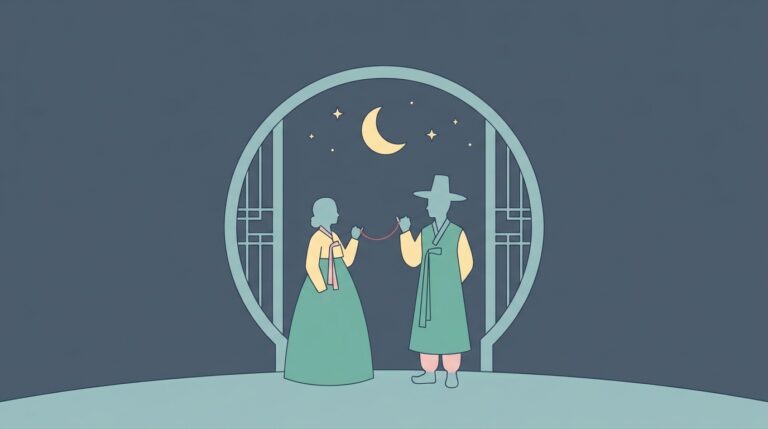
- Editor’s Insight: The verb 맺다 (maetda) means to knot or weave strings together. In Korean folklore, destiny is often envisioned as an invisible red string woven by the heavens.
- Situation Spectrum: Casual: ⚠️ | Semi-formal: ✅ | Formal: ✅
- 🤔 Think About It: Notice that 하늘 (Haneul – Heaven/Sky) functions here as a cultural metaphor for divine fate, transcending specific religious boundaries like Christianity or Buddhism.
Phase 3: 교과서 한국어 vs 진짜 한국어 (Textbook vs. Real-World Korean)
Situation 1: Bumping into a friend unexpectedly in a crowded station
- 📖 교과서 한국어: 우리는 운명적으로 만났습니다. (Urineun unmyeongjeog-euro mannass-eumnida. / “We have met in a fateful manner.”)
- 🗣️ 진짜 한국어: 대박, 여기서 만나다니 진짜 운명이다! (Daebak, yeogiseo mannada-ni jinjja unmyeong-ida! / “No way! Running into you here is totally fate!”)
- 💡 왜 다를까?: Native speakers rarely speak using written adverbial endings like -적으로 in spoken conversation. Instead, exclaiming 대박 (Daebak) combined with the direct exclamation 운명이다! expresses genuine surprise and shared excitement.
Situation 2: Finding out you share an unusual childhood memory with someone
- 📖 교과서 한국어: 이것은 우리의 필연적인 결과입니다. (Igeoseun uri-ui piryeonjeogin gyeolgwa-imnida. / “This is an inevitable outcome of ours.”)
- 🗣️ 진짜 한국어: 와, 우리 진짜 통하는 게 많네요! 인연인가 봐요. (Wa, uri jinjja tonghaneun ge manne-yo! Inyeon-in-ga bwa-yo. / “Wow, we connect on so many things! We must be meant to know each other.”)
- 💡 왜 다를까?: The Sino-Korean word 필연적 (inevitable) sounds like a philosophy dissertation. Spoken Korean prefers the vivid idiom 통하다 (tonghada – to connect/flow together) paired with 인연인가 봐요.
Phase 4: K-Culture 딥다이브 & 비언어적 매너 (K-Culture Deep Dive)
4-1. 눈치 (Nunchi) & Body Language: Handling Fate Conversations
When bringing up destiny in Korean society, your body language dictates whether you sound soulful or creepy.
* The Goosebump Stroke: When coincidences happen, natives lightly rub their forearm and whisper: 소름 돋았어요! (Soreum dodasseoyo! – “I just got goosebumps!”). This validates the magical coincidence without making it uncomfortably intimate.
* Soft Smiles & Eye Smiles: Don’t maintain an intense, unblinking romantic gaze when saying 운명인 것 같아요. Relax your eyes and offer a self-deprecating chuckle so it feels like playful cosmic wonder rather than aggressive pursuit.
4-2. Cultural Code: The Saju & Tarot Phenomenon
In South Korea, destiny isn’t treated as scary dogma; it is an everyday social pastime. Walk through the neon-lit alleyways of Hongdae, Gangnam, or Hyehwa, and you will see dozens of cozy 사주 카페 (Saju Cafes) and tarot tents. Young Koreans frequently visit fortune tellers based on the Four Pillars of Destiny (사주팔자 – birth year, month, day, and hour) to check 궁합 (gunghap – relationship compatibility) before dating, or when deciding whether to switch jobs. Believing in fate is blended with casual coffee culture—a mirror to reflect on one’s hopes and life directions with friends.
Phase 5: 실전 롤플레이 시나리오 (Interactive Roleplay Scenario)
- Setting: A warm, wood-scented traditional tea house in Ikseon-dong on a rainy Saturday afternoon.
- Character: Minji (민지), your Korean language exchange partner who just noticed you both ordered the exact same rare seasonal persimmon tea and have matching phone cases from a local indie market.
민지: 와, 설마 감차 시켰어요? 저도인데! 케이스도 똑같네요?
(Wa, seolma gamcha sikyeosseoyo? Jeodoinde! Keiseudo ttokgatneyo?)
🎭 [눈을 동그랗게 뜨며 놀란 표정으로 핸드폰을 나란히 들어 보인다]
“Wait, did you seriously order the persimmon tea too? Me too! And our phone cases match?”
학습자 (You): 대박, 진짜 신기해요! 우리 취향이 완전 똑같네요.
(Daebak, jinjja sin-gihaeyo! Uri chwihyang-i wanjeon ttokgatneyo.)
🎭 [웃으며 영수증과 케이스를 번갈아 쳐다본다]
“Whoa, that is so surreal! Our tastes are completely identical.”
민지: 그러게요. 이 찻집 골목 찾기도 진짜 힘들었잖아요.
(Geureogeyo. I chatjip golmok chatgido jinjja himdeureotjanhayo.)
🎭 [따뜻한 찻잔을 두 손으로 감싸 쥐며 감탄한다]
“I know, right? And finding this tiny tea house alley was so tricky in the first place.”
학습자 (You): 맞아요. 길 잃어서 우연히 들어온 건데 말이에요.
(Majayo. Gil ireoseo uyeonhi deureoon geonde marieyo.)
🎭 [빗소리를 들으며 고개를 끄덕인다]
“Exactly. I only stumbled into here by accident because I lost my way.”
민지: 우연이 겹치면 필연이라던데, 들어봤어요?
(Uyeon-i gyeopchimyeon piryeon-iradeonde, deureobwasseoyo?)
🎭 [호기심 어린 장난기 가득한 미소로 질문을 던진다]
“They say when coincidences overlap, it becomes inevitability. Have you heard that saying?”
학습자 (You): 들어본 적 있어요! 이것도 다 우리 인연인 것 같아요.
(Deureobon jeok isseoyo! Igeotdo da uri inyeon-in geot gatayo.)
🎭 [부드럽게 미소 지으며 따뜻한 눈빛으로 말한다]
“I have heard that! I feel like this is all our destiny playing out.”
민지: 오, 한국어 표현 진짜 자연스러운데요? 소름 돋았어요!
(O, hangugeo pyohyeon jinjja jayeonseureoundeyo? Soreum dodasseoyo!)
🎭 [자신의 팔을 살짝 문지르며 기분 좋게 웃는다]
“Oh, your Korean expression is so natural! I just got actual goosebumps!”
학습자 (You): 고마워요. 하늘이 맺어준 찻집 데이트네요!
(Gomawoyo. Haneul-i maejeojun chatjip deiteuneyo!)
🎭 [차를 한 모금 마시며 화기애애하게 건배하듯 잔을 살짝 올린다]
“Thanks. It really feels like a teahouse date written in the stars!”
🔀 인터랙티브 분기점 (Choose Your Move!)
When Minji smiles and asks whether coincidences mean something deeper, how do you respond?
- Option A: “우리는 결혼할 운명입니다. 당장 사주 보러 갑시다.” (Urineun gyeolhonhal unmyeong-imnida. Dangjang saju boreo gapsida. – “It is our destiny to marry. Let us go read our Saju right this instant.”)
- Option B: “그러게요! 이렇게 계속 겹치니까 우리 진짜 인연인가 봐요.” (Geureogeyo! Ireoke gyesok gyeopchinikka uri jinjja inyeon-in-ga bwayo. – “Totally! With so many coincidences, we must really share a special connection.”)
- Option C: “운명 같은 건 과학적으로 증명되지 않았어요.” (Unmyeong gateun geon gwahakjeog-euro jeungmyeongdoeji anhasseoyo. – “Destiny hasn’t been scientifically proven.”)
[Feedback Analysis]:
* Option A [RISK]: Way too intense for a language partner! While 사주 is fun, jumping straight to marriage (결혼) will trigger major social alarm bells.
* Option B [BEST]: Warm, witty, and perfectly natural. Using 인연인가 봐요 strikes the ideal balance between playful bonding and cultural sensitivity.
* Option C [BAD]: Instant atmosphere killer! Even if you are a strict rationalist, dismissive debate shatters the cozy communal 정 (Jeong) of the moment.
Phase 6: 10초 감정 섀도잉 드릴 (10-Second Emotional Shadowing Drill)
Read these aloud while mimicking the emotional tone marks and following the breath pause slashes (/):
[😲 깜짝 놀라며 / Wide-eyed astonishment]
“대박! / 여기서 너를 만난 건 / 진짜 운명이다!”
(Daebak! / yeogiseo neoreul mannan geon / jinjja unmyeong-ida!)
(“No way! / Bumping into you right here / is totally destiny!”)-
[✨ 설레고 진지하게 / Warm, gentle wonder]
“우리가 이렇게 만난 것도 / 다 깊은 인연인 것 같아요.”
(Uriga ireoke mannan geotdo / da gipeun inyeon-in geot gatayo.)
(“The fact that we met like this / really feels like a deep karmic bond.”) -
[😆 웃으며 장난스럽게 / Playful teasing]
“우연치고는 너무 신기하잖아 / 혹시 하늘이 정해준 거 아니야?”
(Uyeon-chigoneun neomu sin-gihajanha / hoksi haneul-i jeonghaejun geo aniya?)
(“This is way too surreal for a coincidence / didn’t heaven orchestrate this?”)
Phase 7: K-Culture 미니 사전 (Mini Dictionary)
- 운명 (Un-myeong) | Fate / Destiny
Usage: Refers to macro-level destiny or major life crossroads that feel inescapable (e.g., life missions, finding a soulmate). - 인연 (In-yeon) | Karmic Connection / Human Ties
Usage: Specific to interpersonal relationships. Anyone who crosses your path—from lifelong partners to kind taxi drivers—shares inyeon. - 사주 (Sa-ju) | The Four Pillars of Destiny
Usage: Traditional divination analyzing birth year, month, date, and hour to map life fortune, personality, and career paths. - 궁합 (Gung-hap) | Relational Harmony / Compatibility
Usage: Originally meant astrological marital harmony; now casually used for food combinations (e.g., 삼겹살과 소주는 찰떡궁합! – Pork belly and soju are a match made in heaven!).
Phase 8: 여행자를 위한 생존 키트 (Traveler’s Survival Kit)
Top 3 Survival Expressions for Fortune Streets
- 사주 한번 봐보고 싶어요. (Saju hanbeon bwabogo sipeoyo.)
“I would like to get my Saju fortune read.”
💡 Pro Tip: Look for tents in Hongdae or Insadong with signs reading “외국어 가능” (Foreign languages available) if your Korean isn’t fluent yet. - 저희 둘 궁합이 잘 맞나요? (Jeohi dul gunghabi jal mannayo?)
“Do the two of us have good compatibility?”
💡 Pro Tip: Say this with a bright smile when visiting a divination cafe with your partner or close friend. - 이건 그냥 우연이 아니에요. (Igeon geunyang uyeon-i anieyo.)
“This isn’t just a mere coincidence.”
💡 Pro Tip: Great for building instant rapport when sharing unexpected hometown connections.
Editor’s Travel Note: Navigating Fortune Alleys
When exploring fortune-telling booths in areas like Hongdae Eoulmadang-ro or Sinchon, remember that traditional booths often prefer cash or direct bank transfer (계좌이체). Before venturing out, prepare your routes using the Naver Map app navigation guide to search for reputable 사주 테라피 (Saju therapy) or 타로 카페 (Tarot cafes) with high local ratings!
Phase 9: “한 발 더 깊이” (Cultural Essay)
In Western philosophy, fate is often conceptualized as a static script carved in stone—think of Oedipus helplessly marching toward tragedy. In Korean thought, however, fate (운명) is flexible and deeply relational. While heaven may deal the initial hand through birth and timing, human bonds (인연) are tended and nurtured through 정 (Jeong – affectionate loyalty) and sincere effort (정성). To believe in fate in Korea is not to surrender your agency; it is to celebrate the miracle that out of billions of people in the cosmos, you and another soul managed to share a single pot of tea in Seoul today.
💬 Your Turn: Have you ever experienced an uncanny coincidence while traveling in Korea or meeting Korean friends that made you feel it was 운명? Tell me your story in the comments below!
Phase 10: FAQ & 오해 방지 (FAQ & Common Mistakes)
Q: Can I use “운명” for inanimate objects, like finding my favorite shoes on sale?
A: While it is grammatically possible to joke “이 신발은 내 운명이야!” (These shoes are my destiny!), native speakers prefer the phrase 내 스타일 (My style) or 인생템 (Insaeng-tem – Life-defining holy grail item). Overusing 운명 for consumer goods can sound a bit melodramatic unless done intentionally for comedy.
Q: What is the exact difference between “인연” (Inyeon) and “연인” (Yeonin)?
A: Be very careful with this anagram! 인연 (Inyeon) means karmic connection/destiny in relationships, whereas 연인 (Yeonin) means a romantic partner/sweetheart. If you tell a casual acquaintance “우리는 연인이에요”, you are mistakenly saying “We are lovers!”
Q: Is talking about Saju considered strictly religious in Korea?
A: Not at all! While grounded in ancient Taoist and Buddhist cosmology, modern Koreans view Saju primarily as cultural counseling, psychological entertainment, and social bonding rather than strict dogmatic faith.
🚨 Common Mistakes Board
| Incorrect Usage | Why It’s Awkward | Correct Action |
|---|---|---|
| 우리는 숙명이에요 (Urineun sungmyeong-ieyo) | 숙명 (Sungmyeong) means fatalistic, doomed destiny (often tragic in historical epics). | Use 인연이에요 (Inyeon-ieyo) for human bonds. |
| 너는 나의 연인이다 to mean “You are my fate” | Confusing 연인 (lover) with 인연 (destiny/bond). | Say 우린 진짜 인연인가 봐요 (Urin jinjja inyeon-in-ga bwayo). |
| 하느님이 정했습니다 in casual dating | Sounds like an overt evangelical declaration rather than poetic fate. | Say 하늘이 맺어준 것 같아요 (Haneul-i maejeojun geot gatayo). |
Phase 11: 액션 미션 & 참여 유도 (Action Missions)
- 🥉 Bronze Mission (Solo Drill): Stand in front of your mirror and deliver the line: “이것도 다 운명인 것 같아요!” with a surprised gasp and a forearm touch three times.
- 🥈 Silver Mission (Social Connection): Drop a comment under your favorite K-pop idol or actor’s latest post saying: “우리가 팬으로 만난 것도 소중한 인연이에요!” (Meeting as fan and artist is a precious inyeon too!)
- 🥇 Gold Mission (Real-World Execution): Next time an unexpected coincidence happens with a Korean friend, skip “신기해요” and say: “와, 우리 보통 인연이 아닌가 봐요!”
🎮 K-Culture Mission: Watch an episode of any fantasy K-drama (like My Love from the Star or Tale of the Nine-Tailed) and spot how many times the leads say 운명 versus 인연 in their dialogue!
Phase 12: 인터랙티브 퀴즈 챌린지 (Interactive Quiz Challenge)
Q1. [Context Judgment] You and a colleague accidentally booked seats next to each other on the KTX bullet train to Busan without planning it. Which expression is the most natural to break the ice?
* A) 우리는 숙명적으로 피할 수 없는 관계입니다.
* B) 대박, 여기서 이렇게 만나다니 진짜 운명이다!
* C) 우리는 연인인 것 같아요.
Q2. [Fill-in-the-Blank] Complete the sentence with the traditional concept of karmic ties:
* “우리가 이렇게 친구가 된 것도 다 깊은 ( ) 덕분이에요.”
Q3. [True or False] In Korea, visiting a Saju cafe to check compatibility (궁합) is strictly restricted to orthodox religious practitioners.
* (True / False)
🔍 Click here to reveal the answers and explanations!
- Answer: B — 대박, 여기서 이렇게 만나다니 진짜 운명이다! captures the authentic native excitement. Option A is too fatalistic and theatrical; Option C accidentally confesses that you are romantic lovers!
- Answer: 인연 (Inyeon) — This classic word expresses that your friendship is born from meaningful cosmic connections.
- Answer: False — Saju is a widespread secular cultural pastime enjoyed casually by friends, dating couples, and curious travelers across South Korea!







