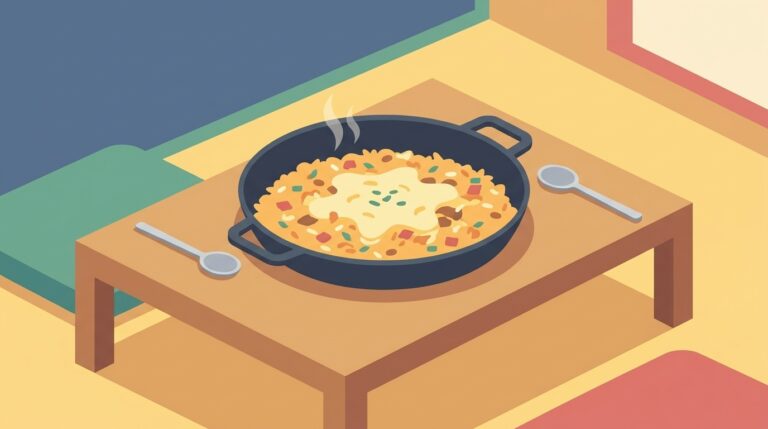
Phase 1: Empathy (Immersive Story Opening)
안녕하세요! 매일한글 에디터입니다. (Hello! I’m your Daily Hangul editor.)
Picture this: You are sitting at a bustling Korean barbecue or spicy dakgalbi (stir-fried chicken) spot in Hongdae with your Korean friends. The table is packed, the grill has done its delicious duty, and you are leaning back in your chair, patting your stomach. You say, “I’m so stuffed, I can’t eat another bite!”
Suddenly, your Korean friend catches the server’s eye and shouts with intense determination: “여기 밥 하나 볶아주세요!” (Yeogi bap hana bok-a juseyo! / Please fry one bowl of rice here!)
You freeze. Rice? Now? Didn’t we just finish a marathon of meat and side dishes? Your friend turns to you with a wide grin and proudly announces: “In Korea, fried rice isn’t a meal—it’s dessert!”
If you’ve ever felt completely bewildered by this carb-on-carb finale, you are definitely not alone. For many intermediate learners, dining out in Korea comes with a hidden layer of unwritten cultural rituals. Understanding why Koreans insist on finishing savory meals with crispy fried rice—and mastering the precise phrasing to order, customize, and savor it like a true local—will instantly transform your social dining game. This guide is crafted directly from our classroom dining workshops and real field experiences, giving you the natural B2-level language to navigate Korea’s beloved culinary climax with confidence.
Phase 2: Deep Dive into 3 Core Expressions
1. 볶음밥 하나 볶아 주세요 (Bokkeumbap hana bok-a juseyo)
- Pronunciation: [Bok-keum-bap ha-na bok-ah joo-seh-yo] (Think of ‘bok’ snapping like ‘pop’, and ‘bap’ like ‘bop’ with a closed-lip finish)
- Meaning: Literal: “Please stir-fry one fried rice.” / Actual Nuance: “We’re ready for the grand finale! Let’s wrap this up with fried rice.”
- K-Culture Moment: You’ll see this in almost every food mukbang or drama gathering (like in Weightlifting Fairy Kim Bok-joo or Hospital Playlist), right as the main hot plate looks nearly empty.
- Editor’s Insight: Notice that even if there are four people at the table, Koreans often order “하나” (one) or “두 개” (two). Why? Because everyone admits they are technically full, but societal rules demand a ceremonial taste!
- Situation Spectrum: Casual ✅ | Semi-formal ✅ | Formal ⚠️ (Best suited for restaurants with hot plates or grills)
- 🤔 Think About It: In many Western courses, dessert is sweet and sugar-based. Why do you think Korean culinary culture chose savory grains cooked in remaining meat juices as the ultimate satisfying closure?
2. 배부른데 이건 또 들어가네 (Baebureunde igeon tto deureogane)
- Pronunciation: [Bae-boo-reun-deh ee-geon ttoh deu-reo-gah-neh] (The ‘tto’ has a tense ‘tt’ sound like the ‘t’ in ‘stop’)
- Meaning: Literal: “I’m full, but this goes in again.” / Actual Nuance: “I thought I reached my limit, but somehow I have an extra stomach for this!”
- K-Culture Moment: The relatable comedic pause in variety shows where a cast member groans in fullness, smells the toasted sesame oil, and picks up their spoon again.
- Editor’s Insight: This sentence uses the grammatical connective -는데 (background contrast) and the spontaneous discovery ending -네. It’s the ultimate polite compliment to the chef and your dining companions, signaling pure gastronomic joy.
- Situation Spectrum: Casual ✅ | Semi-formal ✅ | Formal 🚫 (Used informally among friends, colleagues, or dining buddies)
- 🤔 Think About It: Do you have an expression in your native language that captures the mystery of finding room for food even when you’re 100% full?
3. 누룽지 긁어먹는 게 진짜지 (Nurungji geulgeo-meongneun ge jinjjaji)
- Pronunciation: [Noo-roong-jee geul-gaw-meong-neun geh jeen-jjah-jee] (Rhyme ‘jee’ with ‘see’, and pronounce ‘geul’ smoothly without rolling the ‘r’)
- Meaning: Literal: “Scraping and eating the scorched rice is the real thing.” / Actual Nuance: “The crispy bits stuck to the bottom are the real reason we ordered this.”
- K-Culture Moment: The iconic sound of two or three metal spoons clattering rhythmically against an iron cast-iron pan to scrape off the golden crust.
- Editor’s Insight: In Korean cooking, texture is flavor. 누룽지 (Nurungji) refers to scorched, toasted rice. Saying “~게 진짜지” marks you as a culinary insider who understands that food is an interactive texture journey, not just fuel.
- Situation Spectrum: Casual ✅ | Semi-formal ✅ | Formal 🚫
- 🤔 Think About It: How does your home culture treat food that gets slightly burned or stuck to the pan? Is it viewed as an error or a delicacy?
Phase 3: Textbook Korean vs. Real Korean
Situation 1: Suggesting fried rice when the meat or stew is almost finished
- 📖 교과서 한국어 (Textbook):
“고기를 다 먹었으니 이제 볶음밥을 주문할까요?”
(Gogireul da meogeosseuni ije bokkeumbabeul jumunhalkkayo? / Since we finished the meat, shall we order fried rice now?) - 🗣️ 진짜 한국어 (Real-life Native):
“우리 슬슬 밥 볶을까?”
(Uri seulseul bap bokkeulkka? / Shall we go ahead and fry the rice now?) - 💡 왜 다를까? (Why is it different?):
Textbooks overcomplicate with sequential conjunctions like “~으니”. Natives naturally say “밥 볶다” (literally ‘fry rice’ as a verbal action) combined with the cozy adverb 슬슬 (seulseul), meaning gently transitioning to the next step.
Situation 2: Telling your friend to wait for the rice to get crispy
- 📖 교과서 한국어 (Textbook):
“밥이 팬에 눌을 때까지 기다려야 합니다.”
(Babi paene nureul ttaekkaji gidaryeoya hamnida. / You must wait until the rice adheres to the pan.) - 🗣️ 진짜 한국어 (Real-life Native):
“조금만 눌어붙게 뒀다 먹자!”
(Jogeumman nureobeutge dwotda meokja! / Let it stick and crisp up a bit before we dig in!) - 💡 왜 다를까? (Why is it different?):
Natives use compound descriptive verbs like 눌어붙다 (nureobeutda) to describe the golden caramelization process. Saying “뒀다 먹자” (leave it, then eat) sounds relaxed and authentically conversational.
Phase 4: K-Culture Deep Dive & Non-Verbal Manners
4-1. 눈치 (Nunchi) & Table Manners for the “Dessert Rice”
- The Sacred Scraping Etiquette: When scraping nurungji, do not hold the hot metal pan with your bare hand! Grab a thick napkin or use the provided silicone tongs.
- Leaving Some Sauce/Meat Behind: Crucial nunchi rule: Never clear the pan completely! The server needs 15–20% of the sauce, diced onions, and tiny meat scraps to season the fried rice. If you eat every drop of sauce, the server will stare at the dry pan in heartbreak.
- The Collective Spoon Entry: Once the server says “드셔도 돼요” (You may eat now), it’s polite to pause for 30–60 seconds to let the base crisp up. Then, everyone dives in with their spoons together—no small individual bowls required unless requested!
4-2. Culture Code: The Meaning of “K-Dessert”
Why do Koreans call fried rice a “dessert” (디저트)? Historically, Korea is deeply rooted in an agrarian, rice-centric identity. For older generations, a meal wasn’t formally recognized as a complete meal unless steamed rice (bap) entered the body. Even after eating lavish barbecues or spicy seafood stews, there was an instinctive psychological void until rice was consumed.
Today, this historical craving has evolved into playful irony among young Koreans: “K-디저트의 완성은 볶음밥” (The perfection of K-dessert is fried rice). It symbolizes unity, celebration, and culinary thrift—gathering the communal essence of the meal into one sizzling pan.
Phase 5: Real-Life Roleplay Scenario
Setting: A vibrant, noisy Chuncheon Dakgalbi specialty restaurant in Sinchon.
Characters:
* 민지 (Min-ji): Your enthusiastic Korean university classmate and foodie captain.
* 직원 (Server): The swift, experienced grill master wearing an apron.
* 나 (You): An intermediate Korean learner who just ate two servings of spicy chicken.
- 나: (배를 두드리며) “와, 민지야. 닭갈비 진짜 맛있었는데 배 터질 것 같아.”
(Wa, Min-ji-ya. Dakgalbi jinjja masisseotneunde bae teojil geot gata.)
🎭 Leaning back, rubbing belly with an exhausted but happy face.
“Wow, Min-ji. That dakgalbi was so good, but I feel like my stomach’s gonna burst.” -
민지: (단호한 눈빛으로 집게를 내려놓으며) “무슨 소리야! 아직 디저트 안 먹었잖아.”
(Museun soriya! Ajik dijeoteu an meogeotjana.)
🎭 Putting down her metal tongs with mock seriousness.
“What are you talking about! We haven’t had dessert yet.” -
나: (어리둥절한 표정으로) “디저트? 근처에 빙수 먹으러 가려고?”
(Dijeoteu? Geuncheoe bingsu meogeureo garyeogo?)
🎭 Tilting head in genuine confusion.
“Dessert? Are we going nearby to eat shaved ice?” -
민지: (웃음을 터뜨리며 손을 번쩍 든다) “사장님! 여기 밥 하나 볶아주세요! 치즈 추가요!”
(Sajangnim! Yeogi bap hana bok-a juseyo! Chijeu chugayo!)
🎭 Raising her hand energetically toward the kitchen.
“Boss! Please fry one rice here! Add cheese!” -
직원: (김가루와 참기름 그릇을 들고 오며) “양념 조금만 남기고 덜어낼게요. 치즈는 가운데 넣어드릴까요?”
(Yangnyeom jogeumman namgigo deoreonaelgeyo. Chijeuneun gaunde neoheodeurilkkayo?)
🎭 Skillfully scraping extra cabbage to the side with twin spatulas.
“I’ll scoop out the extra and leave a little sauce. Shall I put the cheese in the middle?” -
민지: “네! 치즈 화산으로 만들어 주세요. 감사합니다!”
(Ne! Chijeu hwasaneuro mandeureo juseyo. Gamsahamnida!)
🎭 Smiling widely at the server’s dazzling spatula speed.
“Yes! Please make it a cheese volcano. Thank you!” -
직원: (밥을 얇게 펴며) “1분 뒤에 불 끄고 긁어드시면 됩니다.”
(Il-bun dwie bul kkeugo geulgeo-deusimyeon doemnida.)
🎭 Spreading the rice thin and flat across the entire circumference.
“Turn off the heat in one minute and scrape it up.” -
나: (숟가락을 들며 침을 꼴깍 삼킨다) “배부른데 냄새 맡으니까 또 들어가네…”
(Baebureunde naemsae mateunikka tto deureogane…)
🎭 Holding spoon at the ready, eyes locked on the melting cheese.
“I’m full, but smelling this makes room for more…”
🔀 Interactive Choice Point
The rice has been sizzling on the pan for 45 seconds. The cheese in the middle is bubbling, and the bottom is getting toasted. What do you say to Min-ji right now?
- Choice A: “민지야, 지금 먹으면 안 돼! 밑에 좀 더 눌어붙어야 제맛이지!”
- Choice B: “나 진짜 못 먹겠어. 그냥 계산하고 나갈까?”
- Choice C: “불 타니까 지금 바로 가스레인지 불 끄고 밥그릇에 덜어먹자.”
💡 Branching Feedback
- Choice A (Best! 🌟): Perfection! You used the native expression “눌어붙어야 제맛이지” (It has to stick and crisp up to taste best). Min-ji will be thoroughly impressed and might ask if you secretly have a Korean passport.
- Choice B (Bad 🙅): Danger zone! Refusing the ceremonial fried rice at the final stage is like walking out of a concert before the encore. You might break the social flow of the group dining vibe!
- Choice C (Risk ⚠️): Over-cautious! While preventing burning is good, scraping from the shared pan is the heart of the experience. Scooping it into separate bowls ruins the nurungji fun.
Phase 6: 10-Second Emotion Shadowing Drill
Read these aloud while acting out the bracketed emotional cues. Pay attention to the pauses marked by /.
[😋 기대에 찬 목소리로 / Filled with bubbly anticipation]
“우리 / 고기 조금 남았을 때 / 슬슬 밥 볶을까?”
(Uri / gogi jogeum namasseul ttae / seulseul bap bokkeulkka?)-
[🔥 비장하고 단호하게 / Deadpan serious, like a mission commander]
“잠깐, / 숟가락 내려놔. / 조금만 눌어붙게 뒀다 먹어야 돼.”
(Jamkkan, / sutgarak naeryeonwa. / jogeumman nureobeutge dwotda meogeoya dwae.) -
[😌 감탄하며 흐뭇하게 / Blissful sigh, savoring the crispy crunch]
“역시 / 한국인의 마무리는 / 누룽지 긁어먹는 거지!”
(Yeoksi / hanguk-in-ui mamurineun / nurungji geulgeo-meongneun geoji!)
Phase 7: K-Culture Mini Dictionary
-
탄수화물 폭탄 (Tansuhwamul Poktan)
- Literal translation: Carbohydrate bomb.
- Real-world usage: Playfully self-deprecating term used when eating noodles, followed by rice, finished with sweet bread. You will hear friends say, “오늘 완전 탄수화물 폭탄이네!” (Today is a total carb bomb!).
- 국룰 (Guk-rul)
- Literal translation: National rule / Unspoken national law.
- Real-world usage: Refers to universally agreed habits across Korean culture. For example: “닭갈비 먹고 볶음밥은 국룰이지!” (Eating fried rice after spicy chicken is the unspoken law!).
- 눌은밥 (Nureunbap) / 누룽지 (Nurungji)
- Literal translation: Scorched rice / crust.
- Real-world usage: While nurungji is traditional dried scorched rice, 눌은밥 in restaurant settings is the prized thin layer baked onto the grill. It’s considered the tastiest part of any stir-fry.
- 디저트배 (Dijeoteu-bae)
- Literal translation: Dessert stomach.
- Real-world usage: The magical secondary stomach humans suddenly discover when savory main dishes end and sweets—or in Korea’s case, fried rice—arrive.
Phase 8: Traveler’s Survival Kit
🧰 Survival Expressions TOP 3
- “여기 밥 하나 볶아주세요!” (Yeogi bap hana bok-a juseyo!)
- Pro Tip: Keep your fingers raised with one finger (“하나”) so the server clearly sees your order over the loud restaurant background noise.
- “치즈 사리 추가해 주세요!” (Chijeu sari chugahae juseyo!)
- Pro Tip: “사리 (sari)” means an add-on or topping. Asking for cheese (chijeu) or seaweed (gim-garu) elevates your rice tenfold.
- “불 언제 꺼요?” (Bul eonje kkeoyo?)
- Pro Tip: Means “When should we turn off the stove?” Servers appreciate you asking so the food doesn’t burn to ash.
🗺️ Editor’s Travel Note
- How to Spot Fried Rice Spots on Naver Maps: Search for categories like 닭갈비 (Dakgalbi), 감자탕 (Gamjatang), 즉석떡볶이 (Instant Tteokbokki), or 곱창 (Gopchang). When reading local reviews, check the photo tab—if the last 3 photos show fried rice pressed flat into the pan, you have found an authentic spot!
- Payment & Grills: Never try to scrape the rice with your hands directly touching the pan handles; Korean restaurant tables frequently feature built-in butane burners with intensely hot cast iron rims.
Phase 9: “One Step Deeper” (Reflective Thought)
In Korean society, eating is seldom an individualistic performance; it is an act of shared harmony (정, Jeong). When four people place their spoons together into the single remaining circular pan to pick at the golden nurungji, the boundaries between individuals dissolve. Fried rice is the great culinary equalizer: regardless of rank or age, everyone gathers around the same heat source, waiting patiently for the same sizzle. It is not just about eating calories—it is the ritualistic conclusion to shared human time.
💬 Your Turn: In your home culture, what is the ultimate “social food” that people eat together straight from the cooking dish? Let us know in the comments below!
Phase 10: FAQ & Avoiding Misunderstandings
Q: Can I order fried rice at ANY restaurant in Korea?
A: No! It is specifically available at restaurants that cook on tabletop grills, large flat pans, or shallow stone pots (e.g., Dakgalbi, Samgyeopsal with stone plates, Gamjatang, Tteokbokki, Gopchang). Traditional noodle shops or barbecue places using wire mesh charcoal grills generally do not offer tabletop fried rice.
Q: What if I finished all the meat and vegetables completely? Can I still order it?
A: Technically yes, because restaurants have basic kimchi, seaweed, and sesame oil ready in the kitchen. However, the flavor will be 50% less rich without the juices! Always leave 3–4 pieces of meat and some vegetable sauce behind.
Q: Do I have to stir it myself, or will the server do it?
A: In 90% of sit-down places, the server will bring a cart, stand over your table, and stir-fry it with dramatic rhythm using two spatulas. Do not touch the pan while they are cooking—just watch and enjoy the show!
🚨 Common Mistakes Alert!
- Mistake 1: Eating the fried rice the very second the server leaves.
- Fix: Give it at least 45–60 seconds on low flame so the moisture evaporates and the bottom forms that heavenly crunch.
- Mistake 2: Using your chopsticks to eat fried rice.
- Fix: Fried rice requires a flat Korean stainless-steel spoon (숟가락). Chopsticks make it impossible to leverage the leverage needed for nurungji scraping!
- Mistake 3: Ordering one portion per person after a full meal.
- Fix: If you are a group of 4, order 2 portions (밥 두 개). If you order 4 portions of fried rice after 4 servings of meat, you will drown in carbs!
Phase 11: Action Mission & Engagement
- 🥉 Bronze Mission (Solo Mastery): Practice saying “여기 밥 하나 볶아주세요!” out loud 5 times using confident restaurant projection.
- 🥈 Silver Mission (Social Connection): Take a photo of your favorite rice dish or your next Korean dining trip, post it to Instagram, and tag
@DailyHangulwith the caption: “K-디저트는 역시 볶음밥!” - 🥇 Gold Mission (Real-Life Conquest): Next time you visit a Korean hot-pot or K-BBQ spot, intentionally leave a spoonful of sauce and order fried rice in fluent Korean without switching to English!
🎮 K-Culture Mission: Watch any episode of the popular Korean variety show Delicious Rendezvous (맛남의 광장) or Three Meals a Day (삼시세끼). Spot the moment the cast members scrape the pan at the end of the meal, and observe the specific words they use to describe the sound!
Phase 12: Interactive Quiz Challenge
Test your intermediate dining reflexes! Choose the best answer for each situation below.
1. Situation Judgment:
You are at a Gamjatang (pork backbone stew) restaurant with Korean colleagues. The soup has boiled down, and the bones are finished. What is the most natural B2-level way to ask your group if they want fried rice?
* A) “고기 없으니까 이제 나가서 커피 마실까요?”
* B) “우리 국물 조금 남았는데 슬슬 밥 볶을까요?”
* C) “밥을 빨리 주문하지 않으면 큰일 납니다.”
2. Fill-in-the-Blank:
“조금만 더 기다려 봐. 밑에 바삭바삭하게 ( ) 긁어먹어야 진짜 맛있어!”
* A) 비벼서
* B) 식혀서
* C) 눌어붙게
3. True or False (Culture Knowledge):
True or False: In Korea, asking for fried rice at the end of a meal means you were unhappy with the main portion size.
👉 Click to reveal answers & explanations!
- Answer: B
- Explanation: “우리 국물 조금 남았는데 슬슬 밥 볶을까요?” is natural, polite, and displays great intermediate fluency using “슬슬” and “~ㄹ까요?”.
- Answer: C (눌어붙게)
- Explanation: “눌어붙다” specifically means allowing the rice to adhere slightly to the bottom to achieve that crispy nurungji texture. (A = mixed, B = cooled down).
- Answer: False
- Explanation: Quite the opposite! Ordering fried rice is the highest sign of dining enjoyment—it shows the sauce and meal were so good that you want to enjoy every last drop!
- Explanation: Quite the opposite! Ordering fried rice is the highest sign of dining enjoyment—it shows the sauce and meal were so good that you want to enjoy every last drop!