

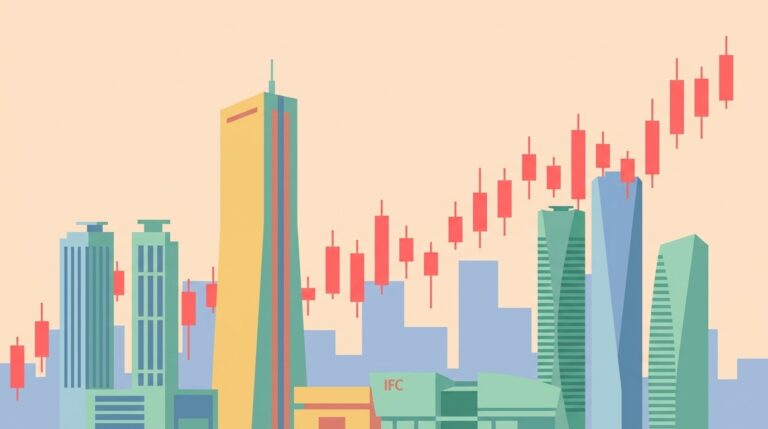
Talk Macroeconomics & Stocks Like a Yeouido Pro: Your Advanced C1 Korean Guide
Phase 1: Empathy (Immersive Story Opening)
안녕하세요! 매일한글 에디터입니다. (Hello! It’s your Daily Hangul editor.)
Picture this: It is 11:45 AM on a brisk Tuesday in Yeouido (여의도)—the pulsating financial heart of Seoul, often crowned the ‘Wall Street of Korea.’ You are sitting inside a bustling glass-walled café with your Korean colleagues. Everyone is holding an icy cup of Ah-Ah (아이스 아메리카노 / Iced Americano). Suddenly, your team leader checks his phone, furrows his brow, and mutters, “미국 연준이 빅스텝 밟는다더니, 환율 튀고 코스피 바로 밀리네. 선반영된 줄 알았는데…” (The U.S. Fed took a ‘big step’ rate hike, the won-dollar exchange rate jumped, and the KOSPI index slipped right away. I thought it was already priced in…).
You instinctively nod along, but internally, your brain is spinning. You passed your advanced TOPIK exams and can order anything or discuss K-dramas with ease, but the nuanced, lightning-fast banter of macroeconomic dynamics and equity valuation feels like an impenetrable fortress. Why does a rate hike in Washington shake up retail investors (개미) in Seoul? And more importantly, how do you express complex macroeconomic cause-and-effect relationships without sounding like an outdated 1990s textbook?
Navigating macroeconomic discourse in Korean is not just about translating financial jargon—it is about mastering the communal pulse of modern Korean corporate society. In Korea, macroeconomic shifts directly dictate daily water-cooler chatter, dinner debates, and personal wealth strategies. Today, drawn from real-world coaching sessions with expatriate investment analysts and multinational executives living in Seoul, we will bridge that gap. By the end of this guide, you will dissect interest rates, foreign capital flows, and market valuations with absolute natural flair.
Phase 2: Core Expressions Deep Dive (핵심 표현 3선)
1. 금리 인상이 시장에 이미 선반영되었어요 (Geum-ri in-sang-i si-jang-e i-mi seon-ban-yeong-doe-eoss-eo-yo)
- Pronunciation: Geum-ri in-sang-i shi-jang-e ee-mee seon-bahn-young-dwe-oss-eo-yo (Think: “Geum” rhymes with gum, “ri” sounds like reed without the d, and “seon” sounds like sun).
- Meaning: “The interest rate hike has already been priced into the market.”
- K-Culture Moment: You will hear this exact phrase on top Korean financial YouTube channels like 삼프로TV (SamproTV) or 슈카월드 (Syuka World) whenever analysts debate whether upcoming Bank of Korea announcements will trigger a selloff or a relief rally.
- Editor’s Insight: 선반영 (seon-ban-yeong) combines 선 (先 – pre/advance) and 반영 (反映 – reflection). It is the gold-standard Korean equivalent of the Wall Street idiom “priced in.” Using this word instantly signals that you understand market psychology—namely, that smart money moves before macroeconomic headlines materialize.
- Situation Spectrum: Casual ⚠️ | Semi-formal ✅ | Formal ✅
- 🤔 Think About It: In English, we say “priced in” (focusing on the numerical price). In Korean, the focus is on reflection (반영 – reflecting market psychology beforehand). How does this mirror Korea’s analytical emphasis on holistic market sentiment?
2. 환율 급등으로 외인들이 순매도로 돌아섰네요 (Hwan-yul geup-deung-eu-ro oe-in-deul-i sun-mae-do-ro do-ra-seot-ne-yo)
- Pronunciation: Hwan-yul geup-deung-eu-ro we-in-deul-ee soon-mae-do-ro do-ra-seot-neh-yo (“Hwan” like Juan, “geup” like up with a g).
- Meaning: “Foreign institutional investors have flipped to net sellers due to the soaring exchange rate.”
- K-Culture Moment: Seen in boardroom scenes of K-dramas like Reborn Rich (재벌집 막내아들) or corporate thrillers where fund managers track foreign capital flight during economic shocks.
- Editor’s Insight: Notice the abbreviation 외인 (oe-in) for 외국인 투자자 (foreign investors) and 순매도 (sun-mae-do) for net selling. When the USD/KRW exchange rate climbs, foreign capital often pulls out to preserve dollar returns. Saying 돌아섰다 (turned around/flipped) conveys dynamic market action far better than textbook verbs like 변경되었습니다.
- Situation Spectrum: Casual ✅ | Semi-formal ✅ | Formal ✅
- 🤔 Think About It: Why do Koreans affectionately and pragmatically categorize market participants into three clean groups: 외인 (foreigners), 기관 (domestic institutions), and 개미 (retail ants)? What does this say about collective identities in Korean society?
3. 경기 침체 우려가 지수의 상단을 제한하고 있어요 (Gyeong-gi chim-che u-ryeo-ga ji-su-ui sang-dan-eul je-han-ha-go iss-eo-yo)
- Pronunciation: Gyeong-gi chim-che oo-ryeo-ga jee-soo-eui sang-dahn-eul je-hahn-hah-go eess-eo-yo (“Gyeong” like young with a hard G).
- Meaning: “Recession fears are capping the ceiling of the market index.”
- K-Culture Moment: Morning economic briefing podcasts during periods of macroeconomic stagflation or earnings compressions.
- Editor’s Insight: 상단 (sang-dan – upper bound/ceiling) and 하단 (ha-dan – lower bound/floor) are indispensable C1-level terms. Instead of saying “The market cannot go up,” high-level professionals say that macroeconomic friction limits the index ceiling (상단을 제한하다).
- Situation Spectrum: Casual ⚠️ | Semi-formal ✅ | Formal ✅
- 🤔 Think About It: Contrast the visual metaphor of “capping the ceiling” (상단을 제한하다) with Western market terms like “resistance level” (저항선). Notice how Korean corporate parlance prefers spatial balance metaphors.
Phase 3: Textbook Korean vs. Real Native Korean (교과서 한국어 vs. 진짜 한국어)
Scenario 1: Describing a sudden index drop after macroeconomic data release
- 📖 교과서 한국어 (Textbook):
거시 경제 지표가 악화되어 주식 시장의 주가가 대단히 큰 폭으로 하락했습니다.
(Geosi gyeongje jipyoga akhwadoeeo jusik sijang-ui jugaga daedanhi keun pog-euro harakhaesseumnida. / The macroeconomic indicators deteriorated, and stock market prices decreased by a very large margin.) - 🗣️ 진짜 한국어 (Real Native):
매크로 지표 쇼크 때문에 지수가 장 초반부터 와르르 무너졌어요.
(Maekeuro jipyo syokeu ttaemune jisuga jang chobanbuteo wareureu muneojyeosseoyo. / Due to the macro indicator shock, the index completely tumbled right from market open.) - 💡 왜 다를까? (Why is it different?):
Native professionals rarely repeat 거시 경제 every sentence; they frequently borrow the industry loanword 매크로 (Macro). Furthermore, instead of academic descriptors like 대단히 큰 폭으로 하락하다, real speakers use evocative onomatopoeia like 와르르 무너지다 (to collapse like a house of cards) to capture market panic.
Scenario 2: Discussing potential market rebound following rate stabilization
- 📖 교과서 한국어 (Textbook):
중앙은행의 금리 동결 조치가 취해지면 시장의 투자 심리가 회복될 가능성이 있습니다.
(Jung-ang-eunhaeng-ui geumri donggyeol jochiga chwihaeji-myeon sijang-ui tuja simriga hoebokdoel ganeungseong-i itsseumnida. / If the central bank freezes interest rates, there is a possibility that investor sentiment will recover.) - 🗣️ 진짜 한국어 (Real Native):
금리 불확실성만 걷히면 투자 심리가 금방 살아나서 반등 모멘텀 받을 거예요.
(Geumri bulhwaksilseongman geochimyeon tuja simriga geumbang saranaseo bandeung momenteom badeul geoyeyo. / Once rate uncertainty clears up, investor sentiment will quickly revive and pick up rebound momentum.) - 💡 왜 다를까? (Why is it different?):
C1 native speech uses dynamic metaphors. Uncertainty does not just “end”; it “clears away like fog” (불확실성이 걷히다). Markets do not merely “recover”; sentiment “comes alive” (살아나다) and “catches momentum” (모멘텀을 받다).
Phase 4: K-Culture Deep Dive & Non-Verbal Manners
4-1. 눈치 (Nunchi) & Non-Verbal Etiquette in Financial Settings
- The Color Inversion Shock: In Western markets, red means falling and green means rising. In South Korea, it is strictly reversed: Red (빨간불) indicates surging prices, while Blue (파란불) indicates falling prices. Showing up to an office meeting smiling while pointing at a screen covered in deep blue will cause instant panic among your colleagues! When discussing market downturns, maintain a sober tone and a slightly lowered gaze.
- The Humility Pause: When your portfolio is thriving during turbulent macro conditions, never boast openly. Practice 겸손 (modesty). If someone asks how your holdings are doing despite the high-interest rates, tilt your head slightly and say: “운이 좋아서 겨우 방어만 하고 있어요” (Un-i jo-a-se seo gyeo-u bang-eo-man ha-go iss-eo-yo / I got lucky and am barely defending my positions).
4-2. Cultural Code: The ‘Donghak Ant’ Revolution & Macro Literacy
In Korea, retail investors are universally known as 개미 (Gaemi – Ants) due to their diligent, collective nature. During global market disruptions, the domestic retail movement was hailed as the Donghak Ant Movement (동학개미운동), referencing a historical peasant revolt. Because a staggering percentage of Korean salaried workers actively invest in equities, macroeconomic updates—such as FOMC press conferences or export-import balance data—are not niche Wall Street topics; they are mainstream cultural dinner table conversations. Being able to discuss macro trends is essential social currency.
Phase 5: Real-World Roleplay Scenario
Setting: A calm, wood-paneled soup restaurant near Yeouido Station at 12:15 PM. You are eating alongside Manager Min-jun (민준 과장), a sharp investment veteran who closely tracks Korean macroeconomic shifts.
[민준 과장] (한숨을 푹 쉬며 스마트폰을 내려놓는다)
오늘 미국 소비자물가지수(CPI) 나온 거 봤어요? 생각보다 너무 높게 나왔네요.
(Oneul miguk sobijamul-gajisu(CPI) naon geo bwasseoyo? Saeng-gakboda neomu nopge nawanne-yo.)
"Did you see today's US CPI release? It came out much higher than expected."
🎭 Action: Sighs deeply and sips his water with a weary expression.

[학습자 (You)]
네, 확인했어요. 인플레이션 압력이 여전해서 연준이 긴축 기조를 이어갈 것 같아요.
(Ne, hwagin-haesseoyo. Inpeulleisyeon amnyeog-i yeojeonhaeseo yeonjuni ginchuk gijoreul ieogal geot gat-ayo.)
"Yes, I checked it. Since inflationary pressure remains strong, it seems the Fed will continue its monetary tightening stance."
🎭 Action: Nods calmly while adjusting posture.

[민준 과장]
맞아요. 우리 한국은행도 기준금리를 안 올릴 수가 없는 상황이 되어버렸어요.
(Majayo. Uri han-guk-eunhaeng-do gijungeumrireul an ollil suga eomneun sanghwang-i doe-eobeoryeosseoyo.)
"Exactly. The Bank of Korea has now been pushed into a corner where they have no choice but to raise the base rate too."
🎭 Action: Knits eyebrows and taps his chopsticks on the table.

[학습자 (You)]
한미 금리 격차가 더 벌어지면 외환시장에서 원화 약세가 심화될 테니까요.
(Hanmi geumri gyeokchaga deo beoreo-jimyeon oehwansijang-eseo wonhwa yaksega simhwadoel tenikkayo.)
"Because if the interest rate gap between Korea and the US widens further, the weakening of the won in the FX market will intensify."
🎭 Action: Speaks in an even, measured analytical tone.

[민준 과장] (눈을 반짝이며 당신을 쳐다본다)
정확해요! 환율이 튀면 결국 외인 매도세로 이어질 텐데, 우리 증시가 버텨줄까요?
(Jeonghwakhaeyo! Hwanyuri twimyeon gyeolguk oein maedosero ieojil tende, uri jeungsiga beotyeojulkkayo?)
"Precisely! If the FX rate spikes, it will lead to foreign selling pressure. Can our domestic stock market endure it?"
🎭 Action: Leans in across the table with genuine curiosity.

[학습자 (You)]
단기적으로는 지수 하방 압력이 크겠지만, 실적 탄탄한 반도체 대형주는 선반영된 측면도 있어 보여요.
(Dangijeog-euroneun jisu habang amnyeogi keugessjiman, siljeok tantanhan bandoche daehyeongjuneun seonbanyeongdoen cheungmyeondo isseo boyeoyo.)
"In the short term, downward pressure on the index is strong, but solid blue-chip semiconductor stocks seem to have already priced much of it in."
🎭 Action: Smiles subtly and gestures with an open palm.

[민준 과장] (미소를 지으며 숟가락을 든다)
와, 역시 통찰력이 대단하시네요. 오늘 점심은 제가 사야겠어요!
(Wa, yeoksi tongchallyeogi daedanhasineyo. Oneul jeomsim-eun jega sayagess-eoyo!)
"Wow, your market insight is incredible. Lunch is definitely on me today!"
🎭 Action: Chuckles warmly and picks up his spoon.

[학습자 (You)]
감사합니다 과장님! 그래도 이번 주는 포트폴리오 비중 조절하면서 보수적으로 지켜보려고요.
(Gamsahamnida gwajangnim! Geuraedo ibeon juneun poteupolrio bijung jojeolhamyeonseo bosujeog-euro jikyeoboryeogoyo.)
"Thank you, Manager Min-jun! Still, this week I plan to stay conservative and rebalance my portfolio weights while monitoring the situation."
🎭 Action: Bowls head respectfully with an appreciative smile.
🔀 Interactive Decision Branching Point
Manager Min-jun asks: “이번 한국은행 금리 발표 앞두고, 우리 포트폴리오 어떻게 대응해야 할까요?” (Ahead of this BOK rate announcement, how should we position our portfolio?)
- Option A: “금리 올리면 주식 다 떨어지니까 무조건 전량 매도하고 인버스 타야죠!” (Rates up means stocks crash, so sell 100% and buy inverse ETFs!)
- Option B: “거시 변수의 불확실성이 크니까 현금 비중을 늘리고 분할 매수 타이밍을 노리는 게 안전해 보입니다.” (Since macro uncertainties are high, increasing our cash reserves and waiting for staged dollar-cost-averaging seems safest.)
- Option C: “한국은행 정책은 주가랑 아무 상관 없으니 그냥 가만히 있으면 됩니다.” (The Bank of Korea’s policy has zero relationship with stock prices, so doing nothing is fine.)
🎯 Choice Feedback
- Option A (High Risk / Rash): Tone is overly aggressive and reckless. In Korean corporate investing culture, gambling on extreme downside leverage (인버스) sounds immature and alarming to superiors.
- Option B (BEST CHOICE): Analytical, composed, and structurally impeccable C1 phrasing. Shows risk management savvy and professional balance (현금 비중 확보, 분할 매수).
- Option C (WORST / Uninformed): Demonstrates a complete misunderstanding of the fundamental relationship between central bank monetary policy and capital liquidity.
Phase 6: 10-Second Emotion Shadowing Drill
Master your cadence and delivery by mimicking these professional stress-pause patterns (/ marks a micro-pause).
[🧐 진지하고 분석적으로 / Serious & Analytical]
미국 연준의 기준금리 인상은 / 신흥국 자본 유출과 / 원화 약세를 자극할 수밖에 없습니다.
(Miguk yeonjun-ui gijungeumri insang-eun / sinheungguk jabon yuchul-gwa / wonhwa yaksereul jageukhal subakke eopseumnida.)
“The U.S. Federal Reserve’s rate hike / inevitably stimulates emerging market capital outflows / and won currency depreciation.”-
[📉 한숨 쉬며 걱정스럽게 / Sighing with Concern]
환율이 전고점을 돌파하면서 / 코스피 지수의 하방 압력이 / 갈수록 거세지고 있네요.
(Hwanyuri jeon-gojeom-eul dolpahamyonseo / koseupi jisu-ui habang amnyeogi / galsurok geosejigo inne-yo.)
“As the exchange rate breaks above its previous peak / downward pressure on the KOSPI index / is growing relentlessly fierce.” -
[💡 확신을 가지고 차분하게 / Confident & Composed]
매크로 악재는 / 이미 시장에 상당 부분 선반영되었으니 / 이제는 개별 기업 실적에 집중할 때입니다.
(Maekeuro akjaeneun / imi sijang-e sangdang bubun seon-banyeong-doeeosseuni / ijeneun gae-byeol gieop siljeog-e jipjunghal ttae-imnida.)
“Since macro headwinds / have already been largely priced into the market / now is the time to focus on individual company earnings.”
Phase 7: K-Culture Mini Dictionary (핵심 키워드 4선)
- 빨간불 / 파란불 (Ppal-gan-bul / Pa-ran-bul)
- Translation: Red Light (Bullish Surge) / Blue Light (Bearish Decline)
- Usage: While Western monitors flash red during crashes, in Korea, your screen glowing red means you are celebrating profits (계좌에 빨간불 들어왔다). A sea of blue (파란불) means prices plummeted.
- 개미 (Gae-mi)
- Translation: Ant (Individual Retail Investor)
- Usage: Used universally in business dailies and colloquial talk. Often elevated as 동학개미 (Donghak Ants) or 서학개미 (Seohak Ants – Korean retail investors who buy U.S. equities).
- 빅스텝 (Bik-seu-tep)
- Translation: Big Step (A 50-basis-point interest rate increase)
- Usage: Adopted from macroeconomic financial English directly into everyday Korean headlines: “한국은행, 사상 첫 빅스텝 단행” (Bank of Korea takes historic first ‘Big Step’).
- 킹달러 (King-dal-leo)
- Translation: King Dollar (An excessively strong US Dollar against the Korean Won)
- Usage: Coined by Korean retail and business media to describe macroeconomic periods where the U.S. Dollar index surges uncontrollably, pressuring domestic import prices.
Phase 8: Investor & Business Traveler Survival Kit
Survival Expressions TOP 3
- 지금 환율 우대 쿠폰 적용되나요? (Jigeum hwan-yul u-dae ku-pon jeok-yong-doena-yo?)
- Meaning: “Can I apply an FX spread preferential discount coupon right now?”
- Pro Tip: When exchanging dollars for won at major Korean commercial banks (KB, Shinhan, Hana), always request 환율 우대 (preferential exchange spread rate, often up to 80-90%).
- 해외 주식 양도소득세 신고는 어떻게 하나요? (Hae-oe jusik yang-do-so-deuk-se sin-go-neun eotteoke hana-yo?)
- Meaning: “How do I report capital gains tax on overseas stock holdings?”
- Pro Tip: Crucial if you are a foreign resident working in Korea trading international shares through local brokerages.
- 국내 증시 장 마감 시간이 몇 시예요? (Gung-nae jeung-si jang ma-gam si-gan-i myeot si-ye-yo?)
- Meaning: “What time does the domestic Korean stock market close?”
- Pro Tip: The regular KOSPI/KOSDAQ market operates from 09:00 to 15:30 KST.
Editor’s Travel Note: Financial Mobility in Seoul
- If you want to check real-time Korean market consensus and macroeconomic indicators on the go, visit the 네이버 증권 모바일 웹페이지 (Naver Securities Web Portal). It is the undisputed daily dashboard for all Korean investors.
- For physical currency exchanges at peak market rates, bypass airport desks and explore authorized exchange booths in central Myeongdong (명동 환전소) using your passport.
Phase 9: “한 발 더 깊이” (One Step Deeper)
In many Western cultures, personal finances and stock market maneuvers are guarded as strictly private, solitary matters. In Korea, however, investing carries an intensely communal narrative. From the 1997 Asian Financial Crisis Gold-Collecting Campaign to the recent Donghak Ant Movement, Koreans have historically viewed financial markets not merely as abstract capital casinos, but as collective battlegrounds where citizens band together to sustain national economic sovereignty. When you discuss macroeconomics and stock indices in Korean, you are tapping into a deeply shared cultural consciousness shaped by resilience, rapid industrialization, and collective ambition.
💬 Your Turn: How does your native culture view the relationship between central bank interest rates and individual stock investments? Do coworkers openly talk about market charts at lunch, or is it taboo? Share your thoughts in the comments below!
Phase 10: FAQ & Avoiding Misunderstandings
Q: Why do Korean news outlets constantly talk about the U.S. Federal Reserve (연준) instead of just the Bank of Korea?
A: South Korea operates an export-oriented, open economy. When the U.S. Fed changes its Federal Funds Rate, it instantly impacts the USD/KRW exchange rate, foreign institutional liquidity, and the export margins of key conglomerates like Samsung and Hyundai. Therefore, 연준의 입 (the mouth of the Fed) is watched just as intensely in Seoul as it is in New York.
Q: Is it considered rude to ask a Korean coworker which stocks they own?
A: While bluntly asking “How much money did you make?” (얼마 벌었어요?) is crass, asking general market opinions is a universal icebreaker: “요즘 금리 때문에 장이 안 좋은데, 어떤 섹터 눈여겨보고 계세요?” (With high rates hurting the market, which sectors are you keeping an eye on?).
Q: What is the difference between 코스피 (KOSPI) and 코스닥 (KOSDAQ)?
A: Think of KOSPI as Korea’s Dow Jones/S&P 500—home to large-cap legacy conglomerates (대형주). KOSDAQ is Korea’s tech-heavy NASDAQ equivalent, featuring small-to-mid cap biotech, semiconductor equipment, and entertainment companies.
🚨 흔한 실수 (Common Mistakes) Warning Board
- ❌ Mistake 1: Wearing green to celebrate a stock gain or using green emojis for bull runs in Korean corporate chatrooms.
- Correct Action: Use red arrows (🔺) and the term 빨간불 (Red light) for gains!
- ❌ Mistake 2: Saying “이자율이 올랐어요” in professional finance discussions.
- Correct Action: While 이자율 is understood, C1 speakers use 기준금리 (Base interest rate) or simply 금리 when discussing macro policy.
- ❌ Mistake 3: Translating “priced in” literally as 가격이 안에 들어갔다.
- Correct Action: Always use the proper Hanja-derived term 선반영되었다.
Phase 11: Action Missions & Community Engagement
- 🥉 Bronze Mission (Solo Mastery): Read aloud the 3 shadowing sentences from Phase 6 three times while focusing on pausing precisely at the
/marks. - 🥈 Silver Mission (Social Engagement): Leave a comment under this post in Korean analyzing today’s market conditions using the words 금리 (interest rate) and 선반영 (priced in).
- 🥇 Gold Mission (Real-World Application): Watch a 5-minute market morning brief on YouTube from 삼프로TV or 슈카월드, spot 3 macroeconomic keywords, and share how the host interpreted the exchange rate!
🎮 K-Culture Mission: Watch Episode 1 of the K-drama Reborn Rich (재벌집 막내아들) or Misaeng (미생) and spot moments where characters adjust their business decisions based on macro FX or interest rate shifts!
Phase 12: Interactive Quiz Challenge
Test your C1 financial Korean intuition! Choose your answers before opening the toggles.
Question 1: Situation Judgement
During a market downturn caused by unexpected inflation figures, which of the following comments shows the most natural, C1-level professional empathy?
* A) “주식이 파란불이라 기분이 너무 신나네요!”
* B) “인플레이션 쇼크로 지수 하방 압력이 커졌지만, 보수적으로 분할 매수 기회를 봐야겠어요.”
* C) “어차피 금리는 주가에 아무 영향도 못 미쳐요.”
Question 2: Fill-in-the-Blank
“시장의 모든 악재는 이번 분기 지수에 이미 ( )되었다고 봅니다.”
* Hint: Meaning “already priced in / reflected in advance.”
Question 3: True or False (K-Culture)
In the Korean stock exchange, when stock prices skyrocket to the upper limit, the stock chart displays a bright green color.
* (True / False)
🔍 Click to Reveal Answers & Explanations
- Question 1 Answer: B
Explanation: Option B uses advanced vocabulary (지수 하방 압력, 보수적 분할 매수) to express a balanced and culturally tactful market assessment. Option A mistakenly equates blue with happiness (remember, blue is negative in Korea!), and Option C is economically inaccurate. -
Question 2 Answer: 선반영 (seon-ban-yeong)
Explanation: The full phrase is 이미 선반영되었다고 봅니다 (I believe it has already been priced in). -
Question 3 Answer: False
Explanation: In Korea, soaring stock prices and upper limits (상한가) are displayed in RED (빨간색), not green!







