

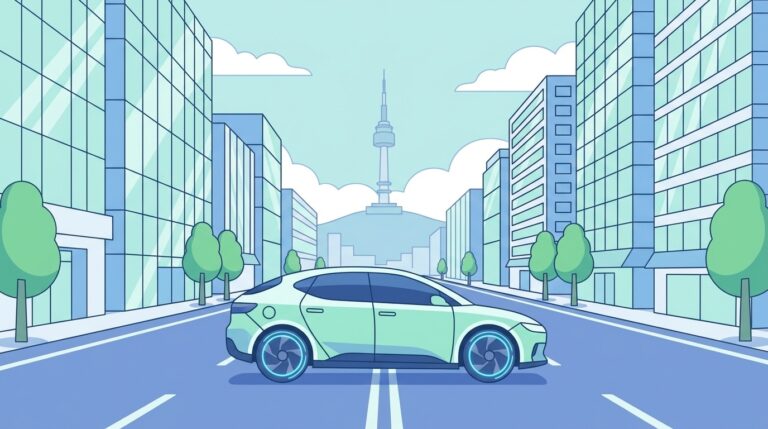
Why Driving a Hydrogen Car in Seoul Sparks the Ultimate Tech Debate
Phase 1: 공감 (Story-Driven Opening)
안녕하세요! 매일한글 에디터입니다.
Picture this: You are cruising along the Gangbyeon Expressway in Seoul inside a whisper-quiet Hyundai Nexo, a hydrogen fuel cell vehicle (수소전기차). Looking out the window, you see modern skyscrapers juxtaposed against the Han River. Your Korean colleague, gazing at the dashboard, sighs and mutters, “차는 정말 좋은데… 충전할 때마다 피가 마르네요.” You understand the word for “car” and “charging,” but why is their blood drying up?
When we reach an advanced C1 stage in Korean, the real challenge is no longer just ordering an iced Americano or asking for directions in Hongdae. It is stepping into real-time, nuanced social debates—like whether South Korea’s aggressive national push for a “Hydrogen Economy” (수소경제) is a visionary leap forward or an impractical bottleneck. Many advanced learners freeze when conversations turn to high-tech mobility, sustainability, and industrial policy because textbooks simply do not teach the idiomatic, socio-technical vocabulary native Koreans use over dinner or during corporate coffee breaks. Based on feedback from hundreds of advanced Daily Hangul learners working in tech, business, and policy, this guide will equip you with sophisticated, natural Korean to debate the promises and pitfalls of hydrogen mobility like a seasoned insider.
Phase 2: 핵심 표현 3선 심층 분석 (Core Expressions)
1. 인프라 구축이 시급해요 (Inpeura guchugi sigeupaeyo)
- Pronunciation: In-peu-ra goo-chu-gi shee-geup-hae-yo (Think of “in-fra” with a soft Korean rolled ‘r’, followed by “goo-chook”).
- Meaning: Literal: “Infrastructure construction is urgent.” / Nuanced: “Rolling out the foundational infrastructure is an absolute priority before we can even talk about scaling.”
- K-Culture Moment: Heard constantly on Korean business news segments (like SBS Biz or JTBC Newsroom) whenever experts debate electric vs. hydrogen vehicles or renewable grid expansions.
- Editor’s Insight: The word 시급하다 (to be urgent/pressing) combined with 인프라 구축 elevates your speech instantly to a refined, boardroom-ready level. It moves your tone from simple complaints (“충전소가 없어요”) to systemic analysis.
- Situation Spectrum: Casual ⚠️ | Semi-formal ✅ | Formal ✅
- 🤔 Think About It: In Korean policy discussions, “인프라” (infrastructure) often implies a public-private joint responsibility. How does this compare to how green initiatives are framed in your home country?
2. 양날의 검이에요 (Yangnarui geom-ieyo)
- Pronunciation: Yang-na-reui geom-ee-ye-yo (“Yang-nal” flows together as yang-nal, sounding crisp like “young-knife”).
- Meaning: Literal: “It is a double-edged sword.” / Nuanced: “It holds immense revolutionary potential, but the accompanying risks and drawbacks are equally massive.”
- K-Culture Moment: Used by CEOs, drama protagonists in corporate thrillers (such as Reborn Rich or Agency), and tech vloggers analyzing cutting-edge gadgets.
- Editor’s Insight: C1 speakers use this idiomatic phrase to show balance. When discussing hydrogen cars, the fast refueling time and zero tailpipe emissions are balanced against high production costs and storage volatility.
- Situation Spectrum: Casual ✅ | Semi-formal ✅ | Formal ✅
- 🤔 Think About It: Why do Koreans prefer metaphorical idioms like 양날의 검 instead of straightforward analytical transitions like “하지만 단점도 있습니다”? Notice how metaphors make debate less confrontational.
3. 상용화까지는 갈 길이 멀어요 (Sang-yonghwakkajineun gal giri meoreoyo)
- Pronunciation: Sahng-yong-hwa-kka-jee-neun gal gee-ree meo-reo-yo (Enunciate the double consonant ㄲ tightly).
- Meaning: Literal: “Until commercialization, the road to travel is far.” / Nuanced: “It’s a viable concept on paper, but mass market adoption is still a distant milestone.”
- K-Culture Moment: Frequently featured on tech review channels like Autogear (오토기어) or Motorgraph when evaluating next-gen battery tech and hydrogen fuel-cell pilot trucks.
- Editor’s Insight: 갈 길이 멀다 (to have a long way to go) softens a critique. Rather than declaring a project an outright failure (실패), this phrase politely grounds expectations while leaving the door open for future breakthroughs.
- Situation Spectrum: Casual ✅ | Semi-formal ✅ | Formal ✅
- 🤔 Think About It: Korean workplace communication prizes optimistic pragmatism. How does saying “the path is long” preserve harmony compared to “it won’t work anytime soon”?
Phase 3: 교과서 한국어 vs 진짜 한국어 (Textbook vs. Real-World)
Situation 1: Describing the scarcity of hydrogen charging stations
- 📖 교과서 한국어: 수소 충전소가 매우 적어서 이용하기 불편합니다. (Suso chungjeonsoga maeu jeogeoseo iyonghagi bulpyeonhamnida.) — Hydrogen charging stations are very few, so it is inconvenient to use.
- 🗣️ 진짜 한국어: 충전 인프라가 워낙 열악해서 ‘충전 난민’ 소리까지 나오잖아요. (Chungjeon inpeuraga wonak yeorahkaeseo ‘chungjeon nanmin’ sorikkaji naojanhayo.) — The charging infrastructure is so scarce that people literally call themselves ‘charging refugees.’
- 💡 왜 다를까? While textbook Korean relies on descriptive adjectives like ‘불편하다’ (inconvenient), real Koreans use vivid socio-cultural buzzwords like 충전 난민 (charging refugee) to describe the anxiety of hunting down sparse charging points.
Situation 2: Predicting whether hydrogen will replace electric vehicles
- 📖 교과서 한국어: 앞으로 수소차가 전기차를 대체할 것인지 의문입니다. (Ap-euro susochaga jeongichareul daechehal geosinji uimun-imnida.) — I question whether hydrogen cars will replace electric cars in the future.
- 🗣️ 진짜 한국어: 아직은 시기상조지만, 대형 상용차 시장에서는 판도를 뒤집을 수도 있어요. (Ajigeun sigisangjojiman, daehyeong sang-yongcha sijang-eseoneun pandoreul dwijibeul sudo isseoyo.) — It is still premature, but in the heavy-duty commercial vehicle sector, it could completely flip the game.
- 💡 왜 다를까? C1 native speakers avoid simple question patterns like “의문이다”. Instead, they combine four-character idioms like 시기상조 (時期尙早 – premature) with colorful idioms like 판도를 뒤집다 (to flip the board/game-changer).
Phase 4: K-Culture 딥다이브 & 비언어적 매너 (Deep Dive & Non-Verbal Nuance)
4-1. 눈치 (Nunchi) & Polite Intellectual Debate
When discussing contentious economic or technological topics in Korean, a blunt “I disagree with you” (제 생각은 다릅니다) can feel jarringly direct. Master these subtle non-verbal cues:
1. The Reflective Head Tilt & Throat-Clearing: When an interlocutor argues that hydrogen is completely pointless due to green electric vehicles, do not interrupt immediately. Tilt your head slightly, pause, and preface your point with “글쎄요… 일리 있는 말씀이지만 (Well… you make a valid point, but…)”.
2. Hand Framing: When articulating a balanced perspective (like Phase 2’s “양날의 검”), slightly raise both palms at chest level alternately, demonstrating that you are weighing both technological merit and market friction.
4-2. Cultural Code Analysis: The Chaebol Horizon & Blue License Plates
If you have walked along the streets of Gangnam or Mapo, you have certainly noticed vehicles with distinct sky-blue license plates (하늘색 번호판). These are designated for eco-friendly vehicles (친환경 자동차). Korea is one of the world’s few testing grounds where the government and domestic automotive conglomerates (재벌, like Hyundai Motor Group) poured immense capital into passenger hydrogen cars like the Nexo.
However, public opinion remains split. Tech-forward drivers love the state subsidies and rapid 5-minute fueling times, while realists dread long queues at broken refueling pumps in Mapo or Yangjae. Bringing up this tension shows that you understand not just Korean grammar, but the heartbeat of contemporary Korean socio-economics.
Phase 5: 실전 롤플레이 시나리오 (Interactive Roleplay)
Setting: A hip cafe near Hyundai Motorstudio in Goyang. You are discussing future mobility over cold brews with Min-woo, a senior mobility researcher at an automotive tech startup.
- 민우 (Min-woo): [☕ 커피를 한 모금 마시며 창밖의 수소 버스를 바라본다] 요즘 정부에서 친환경 버스를 다 수소차로 바꾼다는데, 솔직히 현실성이 있는지 모르겠어요. (Yojeum jeongbueseo chinhwangyeong beoseureul da susocharo bakkundaneunde, soljikhi hyeonsilseong-i inneunji moreugesseoyo. / The government says they are converting all eco-buses to hydrogen, but honestly, I don’t know how realistic that is.)
- 나 (You): [🤔 턱을 괴며 신중한 표정으로] 인프라 구축이 시급한 건 맞지만, 장기적으로는 불가피한 선택 아닐까요? (Inpeura guchugi sigeuphan geon matjiman, janggijeog-euroneun bulgapihan seontaek anilkkayo? / Infrastructure rollout is definitely urgent, but isn’t it an inevitable choice in the long run?)
- 민우 (Min-woo): [고개를 끄덕이며] 물론 대형 트럭이나 버스처럼 주행거리가 긴 상용차에는 수소가 제격이긴 하죠. 배터리 무게를 감당하기 힘드니까요. (Mullon daehyeong teureog-ina beoseucheoreom juhaeng-georiga gin sang-yongcha-eneun susoga jeogyeog-igin hajyo. Baeteori muge-reul gamdanghagi himdeunikkayo. / Of course, for heavy commercial vehicles with long driving ranges like buses and trucks, hydrogen is ideal. Batteries are simply too heavy.)
- 나 (You): [💡 맞장구를 치며] 맞아요. 하지만 아직은 충전 단가도 불안정하고 부품 수급 문제도 있잖아요. (Majayo. Hajiman ajigeun chungjeon dang-gado buranjeonghago bupum sugeup munjedo itjanhayo. / Exactly. But right now, refueling unit prices are unstable, and there are still component supply chain issues.)
- 민우 (Min-woo): [한숨을 내쉬며] 맞습니다. 결국 생산 단가를 낮추는 기술 혁신이 관건인데, 상용화까지는 갈 길이 멉니다. (Matsumnida. Gyeolguk saengsan dang-gareul natchuneun gisul hyeoksini gwangeon-inde, sang-yonghwakkajineun gal giri meomnida. / Indeed. Ultimately, tech innovation to slash production costs is the key, but full commercialization has a long way to go.)
- 나 (You): [⚖️ 손으로 저울질하는 시늉을 하며] 정말 양날의 검이네요. 청정 에너지라는 매력 뒤에 천문학적인 비용이 숨어 있으니까요. (Jeongmal yangnarui geom-ineyo. Cheongjeong eneojiraneun maeryeok dwie cheonmunhakjeogin biyong-i sumeo isseunikkayo. / It really is a double-edged sword. Behind the allure of clean energy hides astronomical expenses.)
- 민우 (Min-woo): [미소를 지으며 눈을 맞춘다] 역시 예리하시네요! 혹시 다음 주에 열리는 모빌리티 엑스포 같이 가실래요? (Yeoksi yerihasineyo! Hoksi daeum jue yeollineun mobilliti ekseupo gachi gasillaeyo? / As expected, you’re sharp! Would you like to check out the Mobility Expo with me next week?)
- 나 (You): [😄 환하게 웃으며] 좋아요! 현장에서 직접 실물도 보고 인프라 현황도 확인해 보죠. (Jowayo! Hyeonjang-eseo jikjeop silmuldo bogo inpeura hyeonhwangdo hwaginhae bojyo. / Sounds great! Let’s examine the actual vehicles in person and check the infrastructure status.)
🔀 Interactive Decision Fork
Imagine Min-woo asks you: “수소 승용차를 지금 당장 개인 자가용으로 구매하는 건 어떨까요?” (What do you think about buying a personal hydrogen sedan right now?)
- Option A: “충전 인프라가 턱없이 부족해서 지금 구매하는 건 시기상조 같아요.” (Chungjeon inpeuraga teog-eopsi bujokhaeseo jigeum gumaehaneun geon sigisangjo gat-ayo.)
- Outcome (Best): 🌟 Perfectly analytical, culturally nuanced, polite, and uses advanced vocabulary (턱없이 부족하다, 시기상조).
- Option B: “수소차는 위험해서 절대 사면 안 돼요.” (Susochaneun wiheomhaeseo jeoldae samyeon an dwaeyo.)
- Outcome (Bad): ❌ Overly simplistic and dogmatic. It lacks technological understanding and kills the conversation abruptly.
- Option C: “친환경이니까 무조건 지금 사야 나라 발전에 도움이 되죠!” (Chinhwangyeong-inikka mujogeon jigeum saya nara baljeone doumi doejo!)
- Outcome (Risk): ⚠️ Overly nationalistic and ignores practical consumer bottlenecks, coming off as naive or patronizing.
Phase 6: 10초 감정 섀도잉 드릴 (Emotion Shadowing Drill)
Read these aloud, hitting the pauses (/) and channeling the emotional indicators:
[🤔 진지하고 분석적으로 / Serious & Analytical]
친환경 모빌리티의 취지는 공감하지만, / 충전 인프라 구축이 / 여전히 발목을 잡고 있어요.
(Chinhwangyeong mobillitiui chwijineun gonggamhajiman, / chungjeon inpeura guchugi / yeojeonhi balmog-eul japgo isseoyo.)
“I empathize with the goal of green mobility, / but building charging infrastructure / is still holding it back.”-
[💡 통찰력 있고 균형감 있게 / Insightful & Balanced]
궁극적인 친환경차라는 점은 분명하지만, / 대중화 관점에서는 / 분명한 양날의 검이에요.
(Gunggeukjeogin chinhwangyeongcharaneun jeomeun bunmyeonghajiman, / daejunghwa gwanjeom-eseoneun / bunmyeonghan yangnarui geom-ieyo.)
“It’s clear that it is the ultimate eco-friendly vehicle, / but from the viewpoint of mass adoption, / it is undeniably a double-edged sword.”
Phase 7: K-Culture 미니 사전 (Mini Dictionary)
- 수소경제 (Suso-gyeongje) | Hydrogen Economy
A state-level policy initiative aimed at moving away from hydrocarbon reliance toward hydrogen for transportation, power generation, and industry. - 충전 난민 (Chungjeon nanmin) | Charging Refugee
A trendy journalistic slang describing EV or hydrogen drivers who drive aimlessly between broken or congested charging stations. - 상용차 (Sang-yongcha) | Commercial Vehicles (Buses, Trucks, Heavy Machinery)
Unlike passenger cars (승용차), mobility experts view this category as the prime sector where hydrogen outperforms electric batteries. - 시기상조 (Sigi-sangjo) | Premature / Too Early
A four-character idiom (四字成語) expressing that conditions have not yet matured to launch or adopt something.
Phase 8: 여행자를 위한 생존 키트 (Traveler’s Survival Kit)
Top 3 On-the-Go Phrases for Mobility Tech Buffs
- 근처에 수소 충전소가 정상 운영 중인가요?
(Geuncheoe suso chungjeonsoga jeongsang un-yeong jung-in-gayo?)
Pro Tip: Hydrogen pumps frequently undergo pressure resets or routine maintenance. Always check before driving there! - 이 택시 혹시 수소차인가요? 승차감이 정말 조용하네요.
(I taeksi hoksi susocha-in-gayo? Seungchagami jeongmal joyonghaneyo.)
Pro Tip: Seoul operates dedicated hydrogen electric taxis. Striking up a chat with the driver using this line will immediately trigger a passionate local lecture! - 친환경차 전용 주차 구역 할인 혜택이 적용되나요?
(Chinhwangyeongcha jeonyong jucha guyeok harin hyetaegi jeog-yongdoenayo?)
Pro Tip: Hydrogen and electric vehicles enjoy up to a 50% discount at Korean public parking facilities.
Editor’s Travel Note
If you plan to rent an eco-car or explore Korea’s high-tech transportation hubs, do not rely on standard international maps. Search for 네이버 지도 앱 다운로드 (Naver Map app download) and inspect the 무공해차 통합누리집 확인 (Zero-emission Vehicle Integrated Portal) to view real-time hydrogen station statuses (operating hours, hydrogen pressure, and current queues).
Phase 9: “한 발 더 깊이” (Deep Reflection Prompt)
South Korea’s modern history is defined by the “빨리빨리” (hurry-hurry) developmental mindset that built high-speed trains, shipyards, and semiconductor fabs overnight. Yet, the energy transition toward hydrogen requires patient, deliberate systemic safety engineering and massive capital accumulation that cannot be rushed. In this gap between speed and systemic patience lies the fascinating friction of modern Korean tech culture.
💬 Your Turn: In your home country, is green mobility viewed primarily as an individual lifestyle choice, or as an ambitious state-led industrial crusade like it is in South Korea? Share your perspective in the comments below!
Phase 10: FAQ & 오해 방지 (FAQ & Common Pitfalls)
Q: Can I use the word “인프라” (Inpeura) in everyday casual Korean?
A: Absolutely! While it originated as a loanword for infrastructure, Koreans use it colloquially beyond civil engineering. For instance, people often say “우리 동네는 맛집 인프라가 좋아” (Our neighborhood has great food infrastructure/plenty of great eateries).
Q: What is the exact difference between 전기차 and 수소차?
A: 전기차 (EV) runs strictly on chemical lithium-ion battery packs charged via the electric grid. 수소차 (Hydrogen FCV) generates its own electricity on board by combining compressed hydrogen gas from a tank with oxygen from ambient air, emitting only pure water droplets.
Q: Does calling someone’s plan “시기상조” sound rude?
A: Not at all, provided it is delivered with a respectful tone! It is considered a polished, objective analytical critique, widely respected in academic, professional, and debate contexts.
🚨 흔한 실수 (Common Mistakes)
- Mistake 1: Saying “수소 카” instead of “수소차” or “수소 자동차”.
Correct Action: While “전기차” and “수소차” use the Sino-Korean root 차 (車), combining it with English “Car” sounds unnatural. - Mistake 2: Confusing 충전 (Chungjeon – charging/fueling) with 주유 (Juyu – pumping petrol/gasoline).
Correct Action: For hydrogen cars, Koreans typically say 수소 충전 rather than 수소 주유. - Mistake 3: Using “문제가 커요” repeatedly during an advanced discussion.
Correct Action: Replace it with C1 level expressions like “극복해야 할 과제입니다” (It is an obstacle that must be overcome).
Phase 11: 액션 미션 & 참여 유도 (Action Missions)
- 🥉 Bronze Mission: Practice shadowing the 10-second drills in Phase 6 three times. Focus on your head tilt and intonation on the pause markers (
/). - 🥈 Silver Mission: Write a one-sentence opinion in Korean about eco-friendly vehicles using the phrase “양날의 검이에요” and post it in the comments below.
- 🥇 Gold Mission: Next time you take a taxi in Korea or meet a Korean friend in business or engineering, ask them: “한국에서는 수소차 상용화가 언제쯤 본격화될까요?”
- 🎮 K-Culture Mission: Search YouTube for “현대 넥쏘 시승기” (Hyundai Nexo Test Drive) and try spot at least two of our key vocabulary words in the comment section!
Phase 12: 인터랙티브 퀴즈 챌린지 (Interactive Quiz)
1. [상황 판단] A Korean tech colleague mentions that hydrogen fueling stations frequently run out of fuel during peak hours. What is the most sophisticated, natural response?
* (A) 충전소가 없으니 자동차를 버리세요.
* (B) 인프라 구축이 기술 개발 속도를 못 따라가는 모양이네요.
* (C) 저는 전기차가 더 좋아요.
👉 정답과 해설 확인하기 (Click to reveal)
정답: (B)
해설: Option (B) demonstrates C1 fluency: “It seems the infrastructure rollout is struggling to keep pace with technological development.” Option (A) is overly dramatic and awkward, while Option (C) deflects the topic immaturely.
2. [빈칸 채우기] Complete the sentence with the correct Sino-Korean idiom:
“획기적인 기술인 것은 분명하지만, 지금 당장 대중화하기에는 아직 (________)입니다.”
👉 정답과 해설 확인하기 (Click to reveal)
정답: 시기상조 (Sigisangjo)
해설: 시기상조 means “too early/premature.” It perfectly fits nuanced C1 technology assessments.
3. [True or False] In Korea, hydrogen vehicles are distinguished by having green-colored license plates like traditional commercial trucks.
👉 정답과 해설 확인하기 (Click to reveal)
정답: False
해설: Eco-friendly cars (친환경차), including hydrogen and electric vehicles, are issued distinct sky-blue license plates (하늘색 번호판), not green!







