

안녕하세요! 매일한글 에디터입니다.
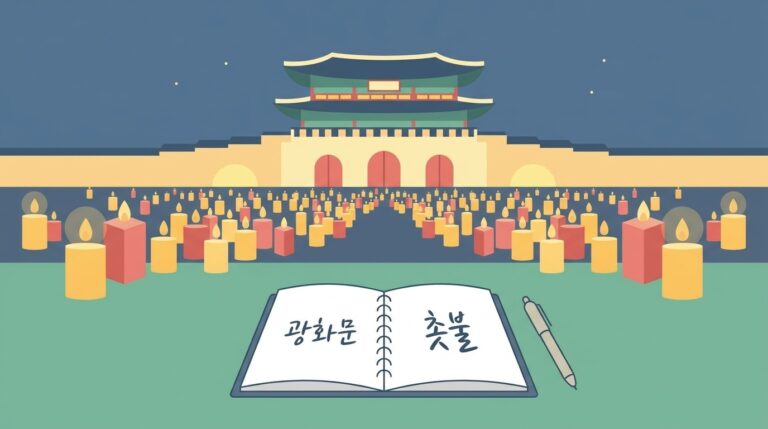
Have you ever stood in the center of Gwanghwamun Plaza on a crisp Saturday evening? If you have lived in or followed South Korea over the past decade, you have undoubtedly witnessed a breathtaking sight: hundreds of thousands of citizens filling the ten-lane boulevard, not with fury or chaos, but with a tranquil sea of glowing candles. From the historic 2016-2017 Candlelight Vigils (촛불 집회) that peacefully reshaped the nation’s political landscape to cultural rallies today, this phenomenon often leaves international observers in awe.
However, when discussing these profound moments with Korean friends or colleagues, many advanced Korean learners hit a wall. In Korean language textbooks, political vocabulary often sounds like a rigid 1980s radio broadcast, or worse, aggressive and confrontational. In real life, Korean civic discourse is nuanced, communitarian, and deeply tied to the philosophical concept of simin uisik (civic consciousness). Learning to articulate these ideas at a C1 level allows you to transition from casual daily chat to meaningful, thought-provoking dialogue about what makes modern Korean society tick. Based on real feedback from C1-level students who wanted to discuss contemporary history without sounding like an editorial newspaper bot, this guide is your definitive cultural navigation kit.
Phase 2: Core Expressions Deep Dive
1. 목소리를 내다 (Moksorireul naeda)
- Pronunciation: [Mok-so-ri-reul nae-da] (Sounds like “Moke-so-ree-reul neh-dah”, rhythmically flowing like the English idiom “speaking up”)
- Meaning: Literally “to emit a voice”; idiomatically “to speak out, take a stand, or articulate a collective demand.”
- K-Culture Moment: Frequently heard in investigative documentaries, socially conscious dramas like Argon or Stranger (비밀의 숲), and news reports when citizens or workers advocate for systemic change.
- Editor’s Insight: At the C1 level, don’t just say “의견을 말하다” (to say an opinion). 목소리를 내다 carries moral courage and active civic participation. When combined with “한목소리로” (with one voice), it captures the collective harmony central to Korean grassroots movements.
- Situation Spectrum: Casual ⚠️ | Semi-formal ✅ | Formal ✅
- 🤔 Think About It: In Western individualism, “speaking up” often highlights the personal right to dissent. In Korean, does 목소리를 내다 feel like an isolated assertion or an invitation to join a collective chorus?
2. 성숙한 시민 의식 (Seongsukhan simin uisik)
- Pronunciation: [Seong-suk-han si-min ui-sik] (Think “Sung-sook-hahn see-min wee-sheek”, where ‘ui’ blends smoothly into an ‘ee’ sound)
- Meaning: Mature civic consciousness / responsible citizenship.
- K-Culture Moment: Prominently highlighted in international journalism and Korean media when protestors systematically clean up trash after massive rallies or safely guide emergency ambulances through dense crowds.
- Editor’s Insight: This is the golden C1 term to encapsulate why Korean protests remain remarkably peaceful. It refers not merely to obeying laws, but to an unwritten social pact: showing mutual respect, maintaining public order, and exercising democratic agency simultaneously.
- Situation Spectrum: Casual ⚠️ | Semi-formal ✅ | Formal ✅
- 🤔 Think About It: What qualifies as “mature” civic behavior in your home culture compared to the Korean emphasis on collective spatial order and shared responsibility?
3. 평화 시위의 새 지평을 열다 (Pyeonghwa siwiui sae jipyeongeul yeolda)
- Pronunciation: [Pyeong-hwa si-wi-ui sae ji-pyeong-eul yeol-da] (Flows like “Pyung-hwa she-wee-ee seh jee-pyung-eul yul-dah”)
- Meaning: To open a new horizon for peaceful demonstration.
- K-Culture Moment: Used by historians, journalists, and civic leaders to characterize how modern candlelight vigils replaced tear gas and violent clashes with musical performances, LED candles, and festival-like solidarity.
- Editor’s Insight: 지평을 열다 is a high-yield C1 figurative expression meaning “to open new possibilities” or “pioneer a new standard.” Using this phrase demonstrates literary fluency and conceptual depth.
- Situation Spectrum: Casual 🚫 | Semi-formal ✅ | Formal ✅
- 🤔 Think About It: How does changing the visual medium of protest (from clenched fists to gentle candlelight) transform the moral authority of a movement?
Phase 3: Textbook Korean vs. Real Korean
Situation 1: Expressing public discontent and demanding political accountability
- 📖 교과서 한국어 (Textbook): 우리는 정부의 정책에 강력하게 반대합니다. (Uri-neun jeongbu-ui jeongchaek-e gangryeokhage bandaehapnida.) — “We strongly oppose the government’s policy.”
- 🗣️ 진짜 한국어 (Real-World C1): 시민들이 광장에 모여 한목소리로 책임을 묻고 있어요. (Simin-deuri gwangjang-e moyeo han-moksori-ro chaek-im-eul mutgo isseoyo.) — “Citizens are gathering in the square, calling for accountability with one voice.”
- 💡 Why it differs: The textbook sentence sounds like an aggressive official party manifesto. Native Koreans favor expressions like 책임을 묻다 (demand accountability) and 한목소리로 (in unison), framing protest as legitimate civic oversight rather than raw hostility.
Situation 2: Describing the atmosphere of a candlelight gathering
- 📖 교과서 한국어 (Textbook): 시위대 사람들이 큰 소리로 구호를 외쳤습니다. (Siwidae saram-deuri keun sori-ro guho-reul oechyeosseupnida.) — “The protesters chanted slogans loudly.”
- 🗣️ 진짜 한국어 (Real-World C1): 분노에 휩쓸리기보다는, 축제처럼 질서정연하면서도 결연한 분위기였어요. (Bunno-e hwipsseulligi-bodaneun, chukje-cheoreom jilseo-jeong-yeon-hamyeonseo-do gyeol-yeon-han bun-wi-gi-yeosseoyo.) — “Rather than being swept away by rage, it was resolute yet orderly, almost like a festival.”
- 💡 Why it differs: Describing modern Korean protests purely as loud shouting misses the defining cultural characteristic: the blend of solemn determination (결연함) and festive solidarity (축제 문화).
Phase 4: K-Culture Deep Dive & Non-Verbal Etiquette
4-1. 눈치 (Nunchi) & Spatial Etiquette at Korean Assemblies
If you find yourself near Gwanghwamun or City Hall during a candlelight gathering, your non-verbal cues matter as much as your words:
* The Candleholder’s Grip: Whether holding a real paraffin candle encased in a paper cup (종이컵 촛불) or an LED candle, hold it upright with two hands or rested close to your chest. Waving it wildly like a concert glowstick during solemn speeches breaks the solemn decorum.
* The Trash Pouch Reflex: You will notice citizens quietly carrying plastic garbage bags, actively collecting cardboard mats, empty hot packs, and drink containers. Leaving waste behind is viewed as a direct failure of simin uisik.
* Physical Space and Family Zones: Korean candlelight rallies are intergenerational; strollers and elderly citizens are common. Pushing through crowds without bowing slightly and murmuring “죄송합니다, 지나가겠습니다” (Excuse me, passing through) is considered exceedingly ill-mannered.
4-2. Cultural Code Analysis: The Plaza (광장) as the Heart of Korean Democracy
In Seoul, the plaza—particularly Gwanghwamun Plaza and Seoul Plaza—is not merely urban architecture; it is the spiritual stage of modern Korean history. From the March 1st Movement of 1919 and the June Democratic Struggle of 1987 (movingly depicted in the film 1987: When the Day Comes) to the 2002 World Cup street cheering, the plaza represents the historical moment when private individuals morph into “the sovereign people” (주권자).
Even popular music plays a pivotal role here. During recent assemblies, iconic songs like Girls’ Generation’s Into the New World (다시 만난 세계) and folk anthems like Like a Rock (바위처럼) were sung collectively. Pop songs transform into modern anthems of mutual resilience and democratic agency.
Phase 5: Real-World Roleplay Scenario
Setting: A cozy cafe in Seochon overlooking the distant glow of Gwanghwamun Plaza on a Saturday night. Rain taps against the window.
Character: Ji-won (지원), an insightful 32-year-old documentary director editing archival footage of civic movements.
- 턴 1 (Ji-won): 🎭 따뜻한 아메리카노 잔을 감싸 쥐며 창밖을 응시한다. 창밖 좀 봐요. 오늘도 광장에 촛불이 꽤 많이 모였네요. (Chang-bak jom bwayo. Oneul-do gwangjang-e chotbul-i kkwae mani moyeonneyo.) — Look outside. Quite a lot of candles have gathered in the square again today.
- 턴 2 (You): 🎭 창밖의 불빛 행렬을 조용히 바라보며 고개를 끄덕인다. 네, 비가 오는데도 많은 분들이 직접 목소리를 내러 나오셨네요. (Ne, bi-ga oneun-de-do maneun bun-deuri jikjeop moksori-reul nae-reo na-osyeonneyo.) — Yes, even though it’s raining, so many people have come out to make their voices heard in person.
- 턴 3 (Ji-won): 🎭 씁쓸한 듯 옅은 미소를 지으며. 사실 몇 년 전 광화문 촛불 집회 때 매주 카메라를 들고 나갔거든요. 그때 느꼈던 전율이 아직도 생생해요. (Sasil myeot nyeon jeon Gwanghwamun chotbul jiphoe ttae maeju kamera-reul deulgo nagatgeodeunyo. Geuttae neukkyeotdeon jeon-yul-i ajik-do saengsaenghaeyo.) — To be honest, during the candlelight vigils years ago, I went out every week with my camera. The goosebumps I felt back then are still vivid.
- 턴 4 (You): 🎭 흥미로운 눈빛으로 몸을 앞으로 기울이며. 그때 가장 인상 깊었던 장면은 어떤 거였어요? (Geuttae gajang insang gipeotdeon jangmyeon-eun eotteon geoyeosseoyo?) — What was the most memorable scene for you back then?
- 턴 5 (Ji-won): 🎭 손가락으로 테이블을 가볍게 두드리며 회상한다. 수백만 명이 모였는데도 깨진 유리창 하나 없었다는 점이에요. 서로 배려하며 질서를 지키는 모습이었죠. (Subaek-man myeong-i moyeonneun-de-do kkaejin yurichang hana eopseotdaneun jeom-ieyo. Seoro baeryeohamyeo jilseo-reul jikineun moseub-ieotjyo.) — The fact that millions gathered, yet not a single glass window was broken. The way everyone cared for one another and kept order.
- 턴 6 (You): 🎭 진지한 톤으로 공감하며. 그게 바로 한국의 성숙한 시민 의식을 상징하는 대표적인 사례인 것 같아요. (Geuge baro Hanguk-ui seongsukhan simin uisik-eul sangjinghaneun daepyyojeogin sarye-in geot gatayo.) — I think that is the quintessential example symbolizing Korea’s mature civic consciousness.
- 턴 7 (Ji-won): 🎭 깊이 공감하며 고개를 크게 끄덕인다. 맞아요. 민주주의는 법전에만 있는 게 아니라 광장에서 함께 만들어가는 것임을 체감했죠. (Majayo. Minjujuui-neun beopjeon-e-man inneun ge anira gwangjang-eseo hamkke mandeureoganeun geosim-eul chegambaetjyo.) — Exactly. I experienced firsthand that democracy isn’t just in law codes, but something built together in the plaza.
- 턴 8 (You): 🎭 따뜻한 미소로 대화를 정리한다. 평화적인 방식으로 연대하는 모습이 정말 큰 울림을 주네요. (Pyeonghwajeogin bangsik-euro yeondaehaneun moseub-i jeongmal keun ullim-eul juneyo.) — The way people stand in solidarity through peaceful means resonates deeply.
🔀 Interactive Decision Point
How would you conclude this thought when Ji-won asks: “외국인의 시선에서 볼 때, 한국의 이런 촛불 문화가 어떻게 다가오나요?” (From an international perspective, how does Korea’s candlelight culture look to you?)
- Option A: 솔직히 시끄럽고 교통만 불편해서 왜 저러는지 이해가 안 가요. (Soljikhi sikkeureopgo gyotongman bulpyeonhaeseo wae jeoreoneunji ihaega an gayo.)
- Feedback [Bad]: Extremely dismissive and culturally insensitive. While traffic congestion is real, phrasing it this bluntly trivializes democratic civic engagement and shuts down a deep conversation.
- Option B: 갈등을 폭력 대신 평화로운 연대로 승화시키는 성숙한 시민 의식이 참 경이롭게 느껴집니다. (Galdeung-eul pongnyeok daesin pyeonghwaroun yeondae-ro seunghwasikineun seongsukhan simin uisik-i cham gyeong-iropge neukkyeojipnida.)
- Feedback [Best]: Outstanding C1 eloquence. Terms like 승화시키다 (sublimate/elevate), 연대 (solidarity), and 경이롭다 (wondrous) display refined philosophical vocabulary and deep cultural respect.
- Option C: 그냥 외국처럼 과격하게 해야 정부가 말을 잘 듣지 않나요? (Geunyang oeguk-cheoreom gwagyeokhage haeya jeongbu-ga mar-eul jal deutji annayo?)
- Feedback [Risk]: High cultural risk. Modern Koreans take enormous pride in having achieved peaceful democratic transitions without riots; suggesting violence can appear aggressive or unaware of Korean historical trauma.
Phase 6: 10-Second Emotion Shadowing Drill
Practice matching the exact rhythm, intonation, and breath control using the pause markers (/).
[🔥 비장하고 당당하게 - Resolute and dignity]- 우리는 결코 침묵하지 않고 / 당당하게 우리의 목소리를 낼 것입니다.
- Uri-neun gyeolko chimmukhaji anko / dangdanghage uri-ui moksori-reul nael geosimnida.
- (We will never remain silent / and will boldly raise our voice.)
[🕊️ 차분하고 성숙한 어조로 - Calm and reflective]- 성숙한 시민 의식이야말로 / 민주주의를 지탱하는 / 가장 단단한 뿌리입니다.
- Seongsukhan simin uisik-iyamallo / minjujuui-reul jitaenghaneun / gajang dandanhan ppuri-imnida.
- (A mature civic consciousness / is indeed the firmest root / upholding democracy.)
[✨ 벅차오르는 감동으로 - Moved and inspired]- 어둠 속에서 밝힌 수많은 촛불이 / 마침내 거대한 희망의 물결이 되었어요.
- Eodum sog-eseo balkhin sumaneun chotbul-i / machimnae geodaehan huimang-ui mulgyeor-i doeeosseoyo.
- (The countless candles lit in the dark / finally became a colossal wave of hope.)
Phase 7: K-Culture Mini Dictionary
- 광장 문화 (Gwangjang munhwa) | Plaza Culture
- Usage: Refers to the sociopolitical phenomenon where public squares transform into civic forums for debate, cultural art, and direct participatory democracy.
- 촛불 민심 (Chotbul minsim) | The Sentiment of the Candlelight
- Usage: The collective political consensus and ethical demand expressed by the populace during candlelit assemblies. Politicians frequently invoke this to gauge public legitimacy.
- 질서정연 (Jilseo-jeong-yeon) | Impeccable Orderliness
- Usage: A four-character idiom (사자성어) describing scenes where massive crowds move methodically, avoid property destruction, and keep communal spaces tidy.
- 연대 (Yeondae) | Solidarity
- Usage: In civic discourse, this denotes standing together across social classes, generations, and identities to advocate for social justice (연대의 힘 = the power of solidarity).
Phase 8: Traveler’s Survival Kit
Survival Expressions TOP 3
- 지금 집회 때문에 이쪽 도로는 통제 중인가요?
- Jigeum jiphoe ttaemune i-jjok doro-neun tongje jung-in-gayo?
- Pro Tip: Use this with bus drivers or taxi operators when approaching central Seoul on weekend afternoons to check for street closures.
- 지하철역 입구가 어디 쪽으로 열려 있나요?
- Jihacheollyeok ipgu-ga eodi jjok-euro yeollyeo innayo?
- Pro Tip: During major rallies, subway exits directly facing Gwanghwamun or City Hall Plaza may be temporarily closed for crowd dispersion.
- 평화롭게 질서를 유지하는 모습이 참 인상적이네요.
- Pyeonghwaropge jilseo-reul yujihaneun moseub-i cham insangjeogineyoe.
- Pro Tip: A courteous, intellectually flattering comment when conversing with Korean acquaintances about weekend events.
Editor’s Travel Note
- Navigation Guide: When assemblies are scheduled around Sejong-daero, avoid buses and taxis altogether. Subway lines 1, 2, and 5 are your best lifelines. Always check real-time traffic notices directly via the Naver Map app download for transit alerts.
- Emergency Exit Etiquette: If you are caught in the crowd and feel overwhelmed, do not push against the current. Seek the nearest building lobby or step into an underground shopping corridor smoothly by walking along the building edges.
Phase 9: “One Step Deeper” (Humanities Essay)
In Western political philosophy, protest is often conceptualized as the individual rights-bearer resisting state intrusion. However, in Korea’s modern history, the candlelight vigil is anchored in the relational ethics of “우리” (we/us). From the April 19 Revolution of 1960 to the June Democratic Struggle of 1987, democratic milestones in South Korea have never been top-down gifts; they were forged by ordinary citizens stepping into the cold night together. The candle itself is symbolic: fragile alone, easily extinguished by the wind, but invincible when multiplied across millions of hands.
💬 Your Turn: What symbol represents peaceful social unity in your home country? Have you ever witnessed a moment where citizens gathered to create history? Share your reflections in Korean below!
Phase 10: FAQ & Common Mistakes
Q: Are foreigners allowed to participate in or observe Korean candlelight rallies?
A: Foreign residents and travelers can freely observe the cultural events, performances, and public discussions in public plazas. However, South Korea’s Immigration Act prohibits foreign nationals from engaging in formal political activities. Observing, soaking in the cultural atmosphere, or holding a peace candle as a spectator is common, but leading chants or taking formal political roles should be avoided.
Q: Why do people hold candles instead of signs or banners?
A: Historically, candlelight vigils gained national momentum in 2002 during memorials for two schoolgirls (Shim Mi-sun and Shin Hyo-sun). The candle embodies peace, non-violence, and remembrance. It visually disarms state authorities—how can police justify riot shields against soft wax lights? It reframes protest from confrontation to moral witness.
Q: Is it considered rude to photograph people at the rally?
A: While rallies are public events, ordinary Korean citizens value privacy and portrait rights (초상권). Photographing panoramic crowd shots or performance stages is completely fine, but avoid taking close-up portrait photos of individuals or children without clear verbal permission.
🚨 흔한 실수 (Common Mistakes) Warning Board
- Mistake 1: Conflating 집회 (Assembly) with 폭동 (Riot)
- Wrong: 어제 광화문에서 폭동이 일어났어요. (A riot broke out at Gwanghwamun yesterday.)
- Correct Action: Say “어제 광화문에서 평화로운 촛불 집회가 열렸어요” (A peaceful candlelight rally was held at Gwanghwamun yesterday). Using 폭동 is factually incorrect and deeply offensive.
- Mistake 2: Calling participants 데모꾼 (Agitators/Demo-goers)
- Wrong: 데모꾼들이 많았어요. (There were many agitators.)
- Correct Action: 데모꾼 carries a derogatory connotation from older authoritarian regimes. Use “집회 참가자들” (rally participants) or “시민들” (citizens).
- Mistake 3: Over-using English loan words like ‘Protest’ without context
- Correct Action: Distinguish between 평화 시위 (peaceful protest), 촛불 문화제 (candlelight cultural festival), and 기자회견 (press conference) to demonstrate your refined C1 vocabulary.
Phase 11: Action Missions & Engagement
- 🥉 Bronze Mission (Solo Shadowing): Record yourself reciting the 3 sentences in Phase 6 with emotional cadence on your phone’s voice memo app.
- 🥈 Silver Mission (SNS Reflection): Post a photo of Gwanghwamun Plaza or an evening cityscape on Instagram with the caption: “성숙한 시민 의식과 평화의 힘을 되새기며. #매일한글 #광화문”
- 🥇 Gold Mission (Real Conversation): Ask a Korean language exchange partner or friend: “촛불 집회에 직접 가보신 적이 있나요? 그때 분위기가 어땠는지 궁금해요.” (Have you ever attended a candlelight vigil in person? I’d love to know what the atmosphere was like.)
- 🎮 K-Culture Mission: Watch the acclaimed historical film 1987: When the Day Comes (1987) or A Taxi Driver (택시운전사). Spot how the themes of ordinary citizenship and solidarity paved the way for modern candlelight assemblies.
Phase 12: Interactive Quiz Challenge
1. Situation Judgment: You are having an intellectual dinner discussion about modern Korean society. Which sentence most eloquently conveys why candlelight assemblies earned global respect?
* A) 사람들이 법을 무시하고 소리를 질렀기 때문입니다.
* B) 성숙한 시민 의식을 바탕으로 평화 시위의 새 지평을 열었기 때문입니다.
* C) 그냥 촛불 사진이 인스타그램에서 예쁘게 나왔기 때문입니다.
2. Fill-in-the-Blank:
시민들이 광장에 모여 사회적 문제에 대해 함께 [_________]를 내기 시작했습니다. (Hint: Idiom meaning ‘to speak out / voice demands’)
3. True or False: During Korean candlelight vigils, it is normal cultural practice to leave cardboard mats and trash on the street for municipal workers to handle.
* True / False
🔍 Click here to view Answers & Explanations
- Answer: B | 성숙한 시민 의식을 바탕으로 평화 시위의 새 지평을 열었기 때문입니다. (This sentence combines two quintessential C1 expressions to explain the sociopolitical significance with high stylistic precision.)
- Answer: 목소리 | 목소리를 내다 is the classic idiom for expressing public agency and speaking out collectively.
- Answer: False | Modern candlelight vigils are famous for their collective cleanup culture (쓰레기 되가져가기), where participants systematically sort and clean up after assemblies before leaving.







