

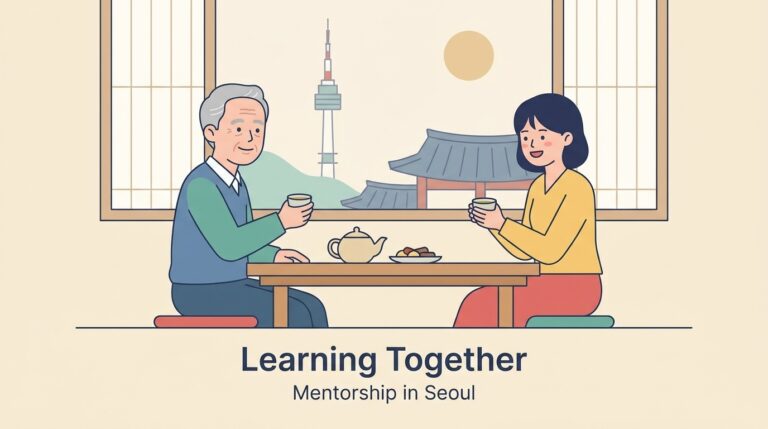
Phase 1: 공감 (Story-Immersive Opening)
안녕하세요! 매일한글 에디터입니다. (Annyeonghaseyo! I’m your Daily Hangul editor.)
Picture this: You are seated at a lively samgyeopsal (pork belly) restaurant in Gangnam for an after-work company dinner (hoesik). Across the grill sits the department director. The air is slightly tense. Suddenly, instead of launching into a 40-minute monologue about how tough his youth was in the 1990s, he quietly cuts the meat, places a perfectly grilled piece on your plate, smiles, and says: “요즘 많이 힘들죠? 제가 도울 수 있는 게 있으면 언제든 말해요.” (Yojeum mani himdeuljyo? Jega doul su inneun ge isseumyeon eonjedeun malhaeyo. / “It’s tough these days, right? Let me know anytime if there is anything I can help with.”)
In that single heartbeat, the room relaxes. Everyone smiles. He isn’t a dreaded kkondae (an authoritarian elder); he is what Koreans admire as a true 어른 (eoreun)—a respected adult.
Navigating Korea’s generational gap (sedae chai) is notoriously tricky for intermediate Korean learners. When does respect end and patronizing begin? How do you distinguish between forced obedience and genuine maturity? Today, drawing on hundreds of real feedback sessions from our learners working and living in Korea, we will unpack the exact linguistic patterns, non-verbal cues, and cultural keys needed to understand—and become—a truly respected figure across generations.
Phase 2: 핵심 표현 3선 심층 분석 (Core Expressions Deep-Dive)
1. 말보다 행동으로 보여주다 (Malboda haengdong-euro boyeojuda)
- Pronunciation: [Mal-bo-da haeng-dong-eu-ro bo-yeo-ju-da] (Think: “Mahl-bo-dah hang-dong-oo-roh bo-yuh-joo-dah”)
- Meaning: Literal: “To show through actions rather than words.” / Nuance: “To lead by example” or “walk the walk.”
- K-Culture Moment: Seen frequently in workplace K-dramas like Misaeng (Incomplete Life), where a manager stays late to help clean up spreadsheets without boasting.
- Editor’s Insight: Respected seniors never lecture juniors about passion (yeoljeong). Instead, they demonstrate diligence through action.
- Situation Spectrum: Casual ✅ | Semi-formal ✅ | Formal ✅
- 🤔 Think About It: In your culture, do people value inspirational speeches or quiet deeds more when evaluating leadership?
2. 귀를 기울이다 (Gwireul giurida)
- Pronunciation: [Gwi-reul gi-u-ri-da] (Think: “Gwee-reul gee-oo-ree-dah”)
- Meaning: Literal: “To tilt one’s ear.” / Nuance: “To listen attentively and empathetically.”
- K-Culture Moment: In Hospital Playlist, when senior doctors validate the anxieties of first-year residents by sitting down and listening quietly.
- Editor’s Insight: True authority in modern Korea comes from listening first. Telling someone “귀를 기울여 들어주셔서 감사합니다” (Thank you for listening so closely) expresses profound respect.
- Situation Spectrum: Casual ⚠️ | Semi-formal ✅ | Formal ✅
- 🤔 Think About It: Why does tilting one’s ear symbolize empathy in Korean, rather than simply having sharp hearing?
3. 나잇값을 하다 (Naikgapseul hada)
- Pronunciation: [Na-it-gap-seul ha-da] (Sounds like: “Nah-eet-gahp-seul hah-dah”)
- Meaning: Literal: “To pay the price of one’s age.” / Nuance: “To act one’s age / To behave with maturity and grace.”
- K-Culture Moment: Heard when characters criticize older figures who throw tantrums or fail to take responsibility in dramas like The Glory.
- Editor’s Insight: Be cautious: using this in the negative (“나잇값 좀 해라!”) is a direct confrontation. However, saying “진짜 나잇값 하는 멋진 사람” praises someone who possesses emotional maturity matching their years.
- Situation Spectrum: Casual ✅ | Semi-formal ⚠️ | Formal 🚫
- 🤔 Think About It: Does your native tongue equate age directly with a moral debt to society like Korean does?
Phase 3: 교과서 한국어 vs 진짜 한국어 (Textbook vs. Real Korean)
Situation 1: Advising someone to listen to the younger generation
- 📖 교과서 한국어 (Textbook Korean): 후배들의 의견을 경청하는 태도를 가지십시오. (Hubaedeurui uigyeoneul gyeongcheonghaneun taedoreul gajisipsio. / “Please adopt an attitude of attentively listening to juniors’ opinions.”)
- 🗣️ 진짜 한국어 (Real-World Korean): 꼰대 소리 안 들으려면 일단 후배 말부터 끝까지 들어봐야죠. (Kkondae sori an deureuryeomyeon ildan hubae malbuteo kkeutkkaji deureobwayajyo. / “If you don’t want to be called a kkondae, you need to listen to your juniors all the way through first.”)
- 💡 왜 다를까? (Why the difference?): While formal essays use 경청 (listening intently), modern Koreans frame healthy generational relationships around avoiding authoritarian kkondae attitudes.
Situation 2: Praising an older colleague for picking up the bill gracefully
- 📖 교과서 한국어 (Textbook Korean): 선배님께서 식사 비용을 지불하셨습니다. (Seonbaenimkkeseo siksa biyongeul jibulhasyeotseumnida. / “The senior paid for the meal expenses.”)
- 🗣️ 진짜 한국어 (Real-World Korean): 선배가 지갑은 열고 입은 닫으니까 다들 진짜 좋아하더라고요. (Seonbaega jigabeun yeolgo ibeun dadeunikka dadeul jinjja joahadeoragoyo. / “Because the senior opened his wallet and kept his mouth shut, everyone genuinely liked it.”)
- 💡 왜 다를까? (Why the difference?): There is a famous modern Korean saying among office workers: “지갑은 열고 입은 닫아라” (Open your wallet, keep your mouth shut). It highlights that respected elders provide support without demanding praise.
Phase 4: K-Culture 딥다이브 & 비언어적 매너 (Deep-Dive & Body Language)
4-1. 눈치(Nunchi) & Non-Verbal Gestures
- The Two-Handed Pour & Receive: When interacting across generations, holding your cup or pouring with both hands is basic etiquette. However, a respected adult subtly levels the playing field: they often touch their own elbow gently while pouring for a junior to signal warmth and mutual respect.
- Eye Contact Regulation: Don’t stare unblinkingly into an elder’s eyes (perceived as defiant), but don’t gaze at the floor either (perceived as dishonest). Aim for the necktie knot or collarbone, shifting gently to their eyes when acknowledging key points.
- The Empathetic Nod (Gogae Kkeudeogim): Slow, rhythmic nods accompanied by light vocal affirmations like “그렇죠” (Geureochyo / “Right”) validate the speaker’s emotional state.
4-2. Cultural Code: The Evolution of the ‘Eoreun’ (어른)
In traditional Confucian culture, age granted automatic authority. But in fast-paced modern Korea, age without empathy is dismissed as kkondae. The acclaimed drama My Mister (나의 아저씨) resonated nationwide because the protagonist Park Dong-hoon embodies the ideal modern elder: weary yet resilient, offering quiet shelter to younger people without judgment. Becoming an eoreun is no longer about birth year; it is an earned moral milestone.
Phase 5: 실전 롤플레이 시나리오 (Interactive Roleplay)
Setting: A quiet draft beer pub (hof) in Yeouido after a grueling project deadline. Senior Manager Park (52) is sitting across from Alex (31), a foreign marketing specialist.
- Turn 1 (Manager Park): 알렉스 씨, 오늘 발표 정말 수고 많았어요. 프로젝트 끝나니까 속이 다 시원하네요. (Alex-ssi, oneul balpyo jeongmal sugo manasseoyo. Peurojekteu kkeutnanikka sogi da siwonhaneyo.)
🎭 행동: 따뜻한 미소를 지으며 시원한 맥주잔을 건넨다.(Alex, great job on the presentation today. Now that the project is over, I feel so relieved. Passes a cold beer glass with a warm smile.) - Turn 2 (Alex): 팀장님이 피드백을 잘 주셔서 무사히 마칠 수 있었습니다. 감사합니다! (Timjangnigi pideubaekeul jal jusyeoseo musahi machil su isseotseumnida. Gamsahamnida!)
🎭 행동: 두 손으로 맥주잔을 받으며 가볍게 목례한다.(It was thanks to your great feedback that we finished safely. Thank you! Receives glass with two hands and bows slightly.) - Turn 3 (Manager Park): 에이, 내가 한 게 뭐 있나요. 젊은 직원들 아이디어가 워낙 참신했지. (Ei, naega han ge mwo innayo. Jeolmeun jigwondeul aodieoga wonak chamsinhaetji.)
🎭 행동: 손사래를 치며 겸손하게 웃는다.(Come on, what did I do? The younger staff’s ideas were so fresh and creative. Waves hand dismissively with a modest laugh.) - Turn 4 (Alex): 솔직히 처음엔 저희 세대 의견을 안 들어주실까 봐 조금 걱정했었어요. (Soljiki cheoeumen jeohui sedae uigyeoneul an deureojusilkka bwa jogeum geokjeonghaesseosseoyo.)
🎭 행동: 솔직한 눈빛으로 잔을 살짝 돌린다.(Honestly, at first I was worried you wouldn’t listen to our generation’s input. Swirls the glass gently with an honest gaze.) - Turn 5 (Manager Park): 하하, 나도 모르게 ‘라떼는 말이야’ 할까 봐 나 스스로도 조심해요. 나이 들수록 듣는 법을 배워야 하더라고요. (Haha, nado moreuge ‘latte-neun mariya’ halkka bwa na seuseurodo josimhaeyo. Nai deulsurok deunneun beobeul baewoya hadeoragoyo.)
🎭 행동: 머리를 긁적이며 진심 어린 표정을 짓는다.(Haha, I watch myself carefully so I don’t accidentally preach ‘Back in my day’. As you get older, you have to learn how to listen. Scratches head with a sincere look.) - Turn 6 (Alex): 팀장님처럼 열린 마음을 가진 선배를 만난 건 정말 행운이에요. (Timjangnimcheoreom yeollin maeumeul gajin seonbaereul mannan geon jeongmal haengunieyo.)
🎭 행동: 잔을 부딪히며 공감의 눈빛을 보낸다.(Meeting a senior with an open mind like yours is truly lucky for us. Clinks glasses with empathetic eyes.) - Turn 7 (Manager Park): 고마워요. 혹시 내가 나도 모르게 실수하는 게 보이면 언제든 편하게 말해줘요. (Gomawoyo. Hoksi naega nado moreuge silsuhaneun ge boimyeon eonjedeun pyeonhage malhaejwoyo.)
🎭 행동: 편안하게 어깨를 툭 치며 맥주를 들이켠다.(Thank you. If you ever see me slipping up without realizing it, please feel comfortable telling me anytime. Pats Alex’s shoulder comfortably and takes a sip.) - Turn 8 (Alex): 네, 팀장님! 끝까지 믿고 따르겠습니다. (Ne, timjangnim! Kkeutkkaji mitgo ttareugesseumnida.)
🎭 행동: 맥주를 마실 때 고개를 살짝 옆으로 돌려 예의를 표한다.(Yes, Manager Park! I will trust and follow your lead. Turns head slightly to the side while drinking out of respect.)
🔀 Your Interactive Decision Point
Suppose Manager Park asks: “요즘 2030 세대가 생각하는 진짜 멋진 어른은 어떤 사람이에요?” (What kind of person does your generation think is a truly cool adult?)
* Option A: “무조건 밥 잘 사주고 일찍 퇴근시켜 주는 사람입니다!” (Best / Playful yet honest): Breaks the tension with a classic office truth while setting a cheerful vibe.
* Option B: “나이 많다고 아는 척 안 하고 조용히 계시는 분이요.” (Risk): Honest, but borders on rude depending on your closeness. Could sound dismissive.
* Option C: “선배님들은 그냥 아무 말도 안 하시는 게 제일 좋습니다.” (Bad): A conversation killer that alienates the senior completely.
Phase 6: 10초 감정 섀도잉 드릴 (10-Second Emotional Shadowing)
Practicing pausing (/) and feeling the nuance:
[😊 온화하고 신뢰감 있게 / Warm and reassuring]
말보다 / 행동으로 보여주는 사람이 / 진짜 어른이죠.
(Malboda / haengdong-euro boyeojuneun sarami / jinjja eoreun-ijyo.)
“Someone who shows through actions rather than words / is a true adult.”-
[🤔 진지하고 솔직하게 / Sincere and reflective]
나이가 많다고 / 무조건 옳은 건 / 아니더라고요.
(Naiga mantago / mujogeon oreun geon / anideoragoyo.)
“Just because someone is older / doesn’t mean / they are always right.” -
[🤝 존경과 감사를 담아 / Respectful and deeply appreciative]
항상 / 제 이야기에 귀를 기울여 주셔서 / 진심으로 감사합니다.
(Hangsang / je iyagie gwireul giuryeo jusyeoseo / jinsimeuro gamsahamnida.)
“Thank you from the bottom of my heart / for always lending an attentive ear / to my stories.”
Phase 7: K-Culture 미니 사전 (Mini-Dictionary)
- 꼰대 (Kkondae): Slang for an inflexible, condescending older person or superior who enforces obsolete ideas.
- 진짜 어른 (Jinjja Eoreun): “A true adult.” Used to describe mature leaders who take accountability and mentor without arrogance.
- 라떼는 말이야 (Latte-neun mariya): Pun on “나 때는 말이야” (Back in my day). Used humorously to poke fun at generational lecturing.
- 솔선수범 (Sol-seon-su-beom): A formal four-character idiom (Sajaseong-eo) meaning “taking the initiative and setting an example for others.”
Phase 8: 여행자를 위한 생존 키트 (Traveler’s Survival Kit)
Survival Expressions Top 3
- 어르신, 먼저 앉으세요. (Eoreusin, meonjeo anjeuseyo. / “Elder, please take this seat first.”)
- Pro Tip: Use this on the Seoul subway to offer your seat to older citizens. Eoreusin is the most respectful term for seniors.
- 인생 경험에서 나오는 지혜네요! (Insaeng gyeongheom-eseo naoneun jihyeneyo! / “That is true wisdom born from life experience!”)
- Pro Tip: A golden compliment when an older guesthouse owner or taxi driver shares life stories.
- 제가 한 수 배웠습니다. (Jega han su baewotseumnida. / “I’ve learned a valuable lesson from you.”)
- Pro Tip: Borrowed from Baduk (Go), this expression expresses gratitude for wisdom gained from an elder.
Editor’s Travel Note
When navigating Korea across generations, download the Naver Map transit planner to coordinate group dining near subway stations with escalator access for older colleagues. Also, when splitting bills at team dinners, the senior will almost always pay the first round (1cha); it is customary for juniors to invite them for coffee or dessert (2cha) using the KakaoPay payment service.
Phase 9: “한 발 더 깊이” (A Step Deeper)
In classical Confucian philosophy, filial piety (hyo) and respect for elders (jangyuyuseo) were built on reciprocity: elders offered wisdom and protection, while the youth offered devotion and duty. The modern friction between generations in South Korea does not stem from disrespect, but from an imbalance: younger people feel older generations often demand the privileges of seniority without assuming the responsibility of care. Becoming a respected adult in Korea today means revitalizing that original contract—earning authority through quiet sacrifice rather than demanding it through age.
💬 Your Turn: Who is someone in your life that you view as a “true adult” (진짜 어른)? What specific action made you respect them? Share your story in the comments below!
Phase 10: FAQ & 오해 방지 (FAQ Schema & Pitfalls)
Q: Can I call any elderly person “할아버지” (Grandfather) or “할머니” (Grandmother)?
A: While common in markets, it can sometimes feel too casual or suggest frailty. In public or service settings, “어르신” (Eoreusin) is much more respectful and universally appreciated.
Q: What should I do if a Korean senior starts talking about “라떼는 말이야” (Back in my day)?
A: Do not argue or interrupt. Nod gently, use reactive phrases like “아, 그때는 그러셨군요” (Ah, so it was like that back then), and subtly pivot the conversation back to the present.
Q: Is calling someone a 꼰대 (Kkondae) considered swearing?
A: It is not a swear word (yok), but it is a sharp social insult. Calling someone a kkondae directly to their face will permanently damage your relationship. Use it only when discussing social phenomena.
🚨 Common Mistakes Board
- ❌ Mistake 1: Drinking straight ahead while facing a senior.
- 👉 Correction: Turn your head and upper body slightly to the side (away from the senior) and cover your mouth with your hand.
- ❌ Mistake 2: Using 반말 (informal speech) because the senior spoke to you casually.
- 👉 Correction: Maintain 존댓말 (honorific speech) until a deep, long-standing mutual agreement is established.
- ❌ Mistake 3: Refusing food or drinks offered by an elder too bluntly.
- 👉 Correction: Accept the first offer with both hands, take a small polite taste, and gently set it down if you cannot consume more.
Phase 11: 액션 미션 & 참여 유도 (Action Missions)
- 🥉 Bronze Mission (Solo Shadowing): Read the 3 Shadowing Drill sentences in Phase 6 out loud three times, matching the intonation cuts (
/). - 🥈 Silver Mission (Social Sharing): Post your favorite quote about maturity or mentorship on Instagram or Threads using the hashtag
#DailyHanguland#진짜어른. - 🥇 Gold Mission (Real Interaction): Next time you speak with a Korean mentor or language exchange partner, use: “이야기에 귀를 기울여 주셔서 감사합니다.”
- 🎮 K-Culture Mission: Watch Episode 1 of My Mister or Misaeng, and spot the exact moment a senior coworker either acts like a kkondae or a true adult.
Phase 12: 인터랙티브 퀴즈 챌린지 (Interactive Quiz)
- Situational Judgment: You are at dinner with a senior manager who repeatedly brags about working 80-hour weeks in 1998. What is the most culturally adept response?
- A) “그건 옛날 방식이고 지금은 비효율적이에요.” (That’s old and inefficient.)
- B) “와, 그때는 정말 치열하게 사셨네요. 덕분에 회사가 튼튼해진 것 같아요.” (Wow, you lived so intensely back then. Thanks to that, the company grew strong.)
- C) “저 지금 퇴근 시간인데요.” (It’s my clock-out time right now.)
- Fill in the Blank:
말보다 ________으로 보여주는 사람이 존경받습니다. (A person who shows through ________ rather than words is respected.) -
True / False: In modern Korea, simply being older automatically makes someone an “어른” in people’s hearts.
👉 Click to reveal answers & explanations!
- Answer: B. Validating their effort while keeping the mood pleasant demonstrates high Nunchi.
- Answer: 행동 (Haengdong / Action). Expression: 말보다 행동으로 보여주다.
- Answer: False. While age warrants formal language etiquette, true moral respect (eoreun) must be earned through behavior.







