

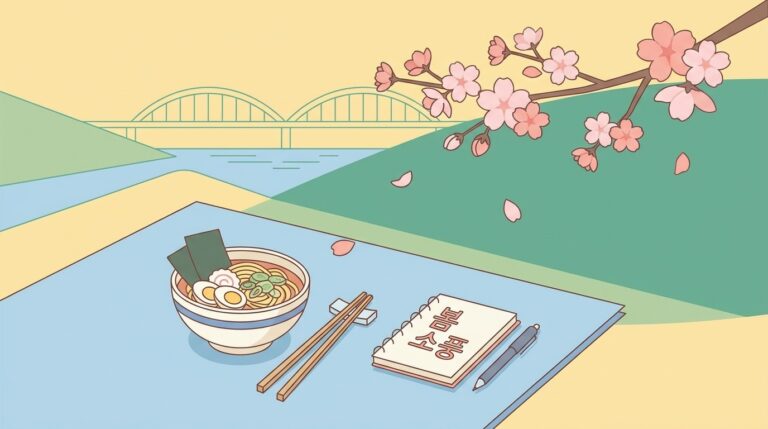
Master the Han River Spring Picnic: Essential Korean Phrases and Local Culture
Phase 1: Empathy (Story-Driven Opening)
안녕하세요! 매일한글 에디터입니다. (Hello! I am your Daily Hangul editor.)
Picture this: It’s late April in Seoul. The warm afternoon breeze carries sweet cherry blossom petals across the glittering Han River. You step out at Yeouido Hangang Park, pumped to live out your dream K-drama picnic scene. But the moment you walk out of subway exit 2, reality hits: street vendors thrust rental flyers into your face, groups of college students quickly claim the best shady spots under the willow trees, and your phone buzzes with an alert from a food delivery app asking for a specific “Delivery Zone number.” Panic sets in. How do you rent that cute picnic set? Where do you order crispy chimaek (chicken and beer)? And how do you brew that famous bubbling foil-pan ramen without looking completely lost?
You’re not alone! Many of our intermediate learners tell us that their first Han River picnic felt more like an obstacle course than a relaxing holiday. But don’t settle for sitting on a damp patch of grass eating a cold triangular gimbap. Today, drawing directly from real student experiences and local Seoulite habits, I’ll walk you through the essential survival expressions, social etiquette, and cultural secrets you need to enjoy the Han River like an authentic local.
Phase 2: Deep Dive into 3 Key Expressions
1. 돗자리 빌릴 수 있어요? (Dotjari billil su isseoyo?)
- Pronunciation: Dot-ja-ri bil-lil su i-sseo-yo? (Think of “Dot” like a polka dot, and “jari” like the beginning of safari.)
- Meaning: Literal: “Can I borrow a picnic mat?” / Real Nuance: “Can I rent a picnic mat here?”
- K-Culture Moment: Seen outside subway exits near Yeouido or Banpo, where vendors offer carts loaded with mats, wagons, small tables, and mood lamps.
- Editor’s Insight: In Korean, the verb 빌리다 (billida) means both “to borrow (for free)” and “to rent (for a fee).” In this outdoor commercial context, everyone understands it means paying a rental fee.
- Situation Spectrum: Casual: ⚠️ (Only with friends) | Semi-formal: ✅ (Perfect for vendors) | Formal: 🚫 (Too stiff)
- 🤔 Think About It: In many Western parks, people sit directly on towels or bare grass. Why do Koreans consider the dotjari (picnic mat) an absolute must-before-you-sit item?
2. 배달존에서 만나요. (Baedaljon-eseo mannayo.)
- Pronunciation: Bae-dal-jon-e-seo man-na-yo. (Sounds like Bae + dull + zone + man-nah-yo.)
- Meaning: Literal: “Let’s meet at the delivery zone.” / Real Nuance: “I will pick up the food at the designated park delivery point.”
- K-Culture Moment: In K-dramas, characters get piping-hot fried chicken delivered straight to a massive grassy park. This magical spot is the official Baedal Zone.
- Editor’s Insight: Han River parks are vast public grounds where motorbikes cannot drive onto the lawns. Seoul city solved this by creating numbered pick-up stations (Baedalzone 1, 2, 3). Always check the nearest zone marker before placing your order!
- Situation Spectrum: Casual: ✅ | Semi-formal: ✅ | Formal: ⚠️
- 🤔 Think About It: How does the concept of a “Delivery Zone” reflect the balance between Korea’s hyper-fast delivery culture and public safety in shared parks?
3. 한강 라면 먹고 갈래? (Hangang ramyeon meokgo gallae?)
- Pronunciation: Han-gang ra-myeon meok-go gal-lae? (Han-gang + rah-myun + muk-goh + gahl-lae?)
- Meaning: Literal: “Do you want to eat Han River ramen and go?” / Real Nuance: “Shall we make instant ramen by the river before we wrap up?”
- K-Culture Moment: Similar to the playful flirting trope “라면 먹고 갈래?” (Do you want to come over for ramen?), this phrase has become the quintessential romantic date invitation for Seoul youth.
- Editor’s Insight: Instant ramen cooked in automated induction dispensers inside Han River convenience stores tastes distinctly better due to precise water ratios and high heat. Suggesting this shows you know the real soul food experience.
- Situation Spectrum: Casual: ✅ (Close friends/dates) | Semi-formal: ⚠️ (Use -ㄹ까요? instead) | Formal: 🚫
- 🤔 Think About It: Why has simple instant convenience store food become a symbol of leisure and emotional connection in modern Korea?
Phase 3: Textbook Korean vs Real Korean
Situation 1: Giving park directions to a delivery rider
- 📖 교과서 한국어 (Textbook Korean): “여기로 음식을 배달해 주세요.” (Yeogiro eumsigeul baedalhae juseyo. – Please deliver the food here.)
- 🗣️ 진짜 한국어 (Real Korean): “여의도 2번 배달존으로 와주세요.” (Yeouido ibeon baedaljoneuro wajuseyo. – Please come to Yeouido Delivery Zone 2.)
- 💡 왜 다를까? (Why is it different?): Saying “here” (yeogi) in a park covering over 200,000 square meters is impossible for riders to pinpoint. Real Koreans always state the specific zone number immediately.
Situation 2: Choosing where to spread your picnic mat
- 📖 교과서 한국어 (Textbook Korean): “저기 잔디밭에 앉읍시다.” (Jeogi jandibate anjeupsida. – Let us sit on that lawn over there.)
- 🗣️ 진짜 한국어 (Real Korean): “저기 그늘 쪽에 자리 잡자!” (Jeogi geuneul jjoge jari japja! – Let’s grab a spot over there in the shade!)
- 💡 왜 다를까? (Why is it different?): The phrase 자리(를) 잡다 (to claim/secure a spot) is universally used when navigating crowded public venues, and hunting for tree shade (geuneul) is the key priority during sunny afternoons.
Phase 4: K-Culture Deep Dive & Non-Verbal Manners
4-1. 눈치 (Nunchi) & Gestures on the Mat
- Shoe Etiquette on the Mat: A picnic mat in Korea is considered an outdoor extension of the home living room. Never step onto the mat with your shoes on! Leave your shoes facing outward at the edge of the mat.
- Anchor the Corners: Spring river winds can be deceptively gusty. Use your shoes, water bottles, or backpacks to weigh down the four corners of the mat right away so it doesn’t flip over onto your neighbors.
- Quiet Consideration: Han River is a communal oasis. Avoid blasting personal Bluetooth speakers on full volume. Keep background music low and conversation volume moderate.
4-2. Cultural Code: Chimaek & Automated Foil Ramen
- Chimaek (치맥): The holy union of chicken and maekju (beer). In spring, you will find countless brand choices (BHC, Kyochon, Goobne). Ordering boneless (sunsal, 순살) makes park dining mess-free.
- Hangang Ramyeon (한강라면): You buy a foil container and instant noodle packet at the convenience store (CU, GS25, or 7-Eleven). Scan the barcode on the automatic cooking machine, push start, and watch boiling water and induction heat cook your noodles in exactly 3 minutes. Stir occasionally with wooden chopsticks!
Phase 5: Real-Life Roleplay Scenario
Setting: Yeouido Hangang Park at 5:30 PM. The golden hour sun reflects off the river. You are meeting your Korean friend Minji (민지), who brought a picnic basket.
- 민지 (Minji): 날씨 진짜 좋다! 우리 먼저 돗자리부터 펼까?
(Nalssi jinjja jota! Uri meonjeo dotjaributeo pyeolkka?)
“The weather is incredible! Shall we unfold the picnic mat first?”
🎭 [Unzipping her backpack and scanning the grass] -
나 (You): 응, 좋아! 저기 나무 그늘 쪽에 자리 잡자.
(Eung, joa! Jeogi namu geuneul jjoge jari japja.)
“Yeah, sounds good! Let’s claim a spot over there under the tree shade.”
🎭 [Pointing toward a grassy area overlooking the water] -
민지 (Minji): 오, 명당이네! 신발 벗고 올라와.
(O, myeongdang-ine! Sinbal beotgo ollawa.)
“Oh, that’s a prime spot! Take off your shoes and come on up.”
🎭 [Spreading the yellow checkered mat smoothly onto the grass] -
나 (You): 바람 부니까 가방으로 모서리 눌러둘게.
(Baram bunikka gabangeuro moseori nulleodulge.)
“It’s breezy, so I’ll weigh down the corners with our bags.”
🎭 [Placing a backpack firmly on the edge] -
민지 (Minji): 센스 대박! 슬슬 배고픈데 치킨 시킬까?
(Senseu daebak! Seulseul baegopeunde chikin sikilkka?)
“Such good sense! I’m getting hungry—shall we order fried chicken?”
🎭 [Opening a food delivery app on her phone] -
나 (You): 배달존에서 만나야 하지? 몇 번 배달존이 가까워?
(Baedaljon-eseo mannaya haji? Myeot beon baedaljoni gakkawo?)
“We need to meet at the delivery zone, right? Which zone is closest?”
🎭 [Looking around for the big blue signage] -
민지 (Minji): 저기 표지판 보니까 2번 배달존이 바로 앞이야.
(Jeogi pyojipan bonikka ibeon baedaljoni baro apiya.)
“Looking at that sign, Delivery Zone 2 is right in front of us.”
🎭 [Checking the GPS map pin] -
나 (You): 완벽하다. 치킨 오기 전에 편의점 가서 라면도 사 올까?
(Wanbyeokhada. Chikin ogi jeone pyeon-uijeom gaseo ramyeondo sa olkka?)
“Perfect. Before the chicken gets here, shall we run to the convenience store and grab ramen too?”
🎭 [Smiling with excitement]
🔀 Interactive Decision Point
The delivery driver calls your phone right as you reach the convenience store! What do you say?
* Option A: “지금 잔디밭에 있으니까 여기로 오세요.” (I’m on the grass right now, so come here.)
* Option B: “여의도 2번 배달존으로 갈 테니 5분만 기다려 주세요!” (I’ll head to Yeouido Delivery Zone 2, please give me 5 minutes!)
* Option C: “몰라요, 민지한테 전화해 보세요.” (I don’t know, please call Minji.)
Feedback:
* Option A (Bad): Delivery drivers cannot drive into the park grounds. They will be frustrated because “on the grass” gives zero location data.
* Option B (Best!): Explicit, polite, and mentions the exact delivery zone while setting a realistic time expectation.
* Option C (Risk): Rude and leaves the driver hanging, risking cold chicken or a canceled order.
Phase 6: 10-Second Emotion Shadowing Drill
Practice speaking these phrases with real emotion. Pay attention to pauses marked with /.
[😊 설레고 들뜬 목소리로 - Excited and bright]
“날씨 진짜 좋다! / 우리 저기 그늘에 / 자리 잡자!”
(Nalssi jinjja jota! / Uri jeogi geuneure / jari japja!)
“The weather is so good! / Let’s grab a spot / over there in the shade!”-
[🤤 군침 돌며 기대감 가득하게 - Mouth-watering anticipation]
“치킨 오기 전에 / 한강 라면부터 / 하나 끓여 올까?”
(Chikin ogi jeone / Hangang ramyeonbuteo / hana kkeulryeo olkka?)
“Before the chicken arrives / shall we go boil / a bowl of Han River ramen first?” -
[📱 침착하고 또박또박하게 - Calm and clear phone voice]
“기사님, / 여의도 2번 배달존 앞이에요. / 지금 나갈게요!”
(Gisanim, / Yeouido ibeon baedaljon apieyo. / Jigeum nagalgeyo!)
“Driver-nim, / I’m in front of Yeouido Delivery Zone 2. / I’m heading out now!”
Phase 7: K-Culture Mini Dictionary
- 돗자리 (Dotjari)
- Meaning: Picnic mat / Ground sheet.
- Real-life Usage: The staple equipment of any Korean outing. Rental shops offer waterproof, cushioned foam versions that protect your clothes from damp soil.
- 배달존 (Baedaljon)
- Meaning: Delivery pick-up zone.
- Real-life Usage: Designated meeting areas equipped with bright banners and numbers where riders and customers hand over food without getting lost.
- 한강라면 (Hangang ramyeon)
- Meaning: Han River instant convenience store ramen cooked in automated machines.
- Real-life Usage: A culinary cultural trademark of Seoul. The combination of aluminum bowl, induction timer, and river breeze turns ordinary ramen into gourmet comfort food.
- 텐트존 (Tenteujon)
- Meaning: Designated pop-up shade tent zone.
- Real-life Usage: Areas where personal small pop-up shade tents are legally allowed. Note: Regulations mandate keeping at least two sides open for visibility!
Phase 8: Survival Kit for Travelers
Top 3 Survival Expressions
- “돗자리 세트 대여 얼마예요?” (Dotjari seteu daeyeo eolmayeyo? – How much to rent a picnic mat set?)
- Pro Tip: Most rental packages run between 10,000 to 20,000 KRW for 3-4 hours, including a mat, wagon, and wet wipes.
- “젓가락 두 개만 더 주실 수 있어요?” (Jeotgarak du gaeman deo jusil su isseoyo? – Could you give me two more pairs of wooden chopsticks?)
- Pro Tip: Essential when sharing ramen or snacks at the park convenience store.
- “쓰레기 분리수거 어디서 해요?” (Sseuregi bunrisugeo eodiseo haeyo? – Where do I sort and throw away the trash?)
- Pro Tip: Parks have strict recycling bins separated into plastics, cans, food waste, and general waste.
Editor’s Travel Note
- Transport: Take Line 5 to Yeouinaru Station (여의나루역), Exit 2. The moment you step outside, the park spreads before you.
- Essential Navigation: Use the Naver Map public transit navigation to check real-time crowd alerts and find nearby public restrooms.
- Crucial Park Rule: Shaded pop-up tents are only allowed in authorized zones until 7:00 PM or 8:00 PM depending on the season, and you must keep two sides unzipped. Mats (dotjari), however, can stay out all night!
Phase 9: “One Step Deeper” (Reflective Humanities Essay)
In a high-density metropolis dominated by compact studio apartments and towering high-rises, the Han River park acts as Seoul’s communal living room. Unfolding a dotjari is a subtle cultural ritual: within seconds, a shared public lawn transforms into an intimate private sanctuary. Here, people shed their workplace hierarchies, slip off their shoes, and eat warm comfort food side-by-side with strangers. It represents Korea’s unique harmony between communal closeness and individual sanctuary.
💬 Your Turn: Have you ever experienced an open-air public picnic in Korea or your own country? What is the one comfort food you would bring to the Han River? Tell us in the comments below!
Phase 10: FAQ & Avoiding Misunderstandings
Q: Can foreigners order delivery food to Han River parks without a Korean credit card?
A: Yes! While native delivery apps like Baemin or Yogiyo often require local resident authentication, you can use services like Shuttle Delivery or order through convenience stores, or simply walk to the restaurants lined up near the station exits for take-out.
Q: Can we drink beer or wine at Han River parks?
A: Yes, drinking alcohol is currently permitted in Han River parks. However, disorderly conduct, excessively loud shouting, and leaving cans behind can lead to fines. Moderation is key.
Q: What time do the ramen cooking machines close?
A: Most park convenience stores operate 24 hours, but some standalone kiosks close around 10:00 PM to 11:00 PM on weekdays. Check the store hours on the door when you arrive.
🚨 흔한 실수 (Common Mistakes) Warning Board
- Mistake 1: Stepping on the mat with shoes on.
- Correct Action: Always slip shoes off at the perimeter. Keep the mat surface pristine.
- Mistake 2: Dumping leftover ramen soup in the regular trash.
- Correct Action: Convenience stores have specialized liquid food waste collectors (gukmul beorineun got). Pour the broth there first, then dispose of the paper bowl in recyclables.
- Mistake 3: Closing all zippers on your shade tent.
- Correct Action: City regulations enforce fines for fully enclosed tents. Leave at least two opposing mesh screens wide open.
Phase 11: Action Missions & Engagement
- 🥉 Bronze Mission (Self-Practice): Practice saying “여의도 2번 배달존으로 와주세요” out loud three times until you can say it fluently in under 4 seconds.
- 🥈 Silver Mission (Social Media): Post a photo of your favorite picnic spot on Instagram or Threads and tag your caption with
#매일한글 #한강피크닉using the phrase 자리 잡자! - 🥇 Gold Mission (Real Life): When visiting Seoul, walk up to a park kiosk, purchase a foil bowl, scan the ramen barcode yourself, and boil your first Han River ramen without asking for help!
- 🎮 K-Culture Mission: Watch an episode of I Live Alone (나 혼자 산다) or Hospital Playlist where characters sit by the Han River. Spot whether they are on a dotjari or sitting on benches!
Phase 12: Interactive Quiz Challenge
Test your Han River knowledge! Click each question to reveal the correct answer.
Q1. Situation Challenge: You want to ask a rental vendor for a picnic mat set near Yeouinaru Exit 2. What is the most natural sentence?
Correct Answer: “돗자리 세트 빌릴 수 있어요?” (Dotjari seteu billil su isseoyo?)
Explanation: In casual commercial rentals, billil su isseoyo is the natural, polite way to ask if rental sets are available.
Q2. Fill in the Blank: 치킨 배달시킬 때 “_____ 1번에서 만나요”라고 해야 한다. (When ordering chicken delivery, you should say ‘Let’s meet at _____ No. 1’.)
Correct Answer: 배달존 (Baedaljon)
Explanation: Han River parks have clearly numbered meeting spots dedicated solely to food pick-ups called Baedal Zones.
Q3. True or False: You can fully zip up all four sides of a small camping tent at Han River park as long as it is daylight.
Correct Answer: False (X)
Explanation: Seoul Metropolitan Government regulations strictly require at least two sides of shade tents to remain open at all times for safety and public decency.







