

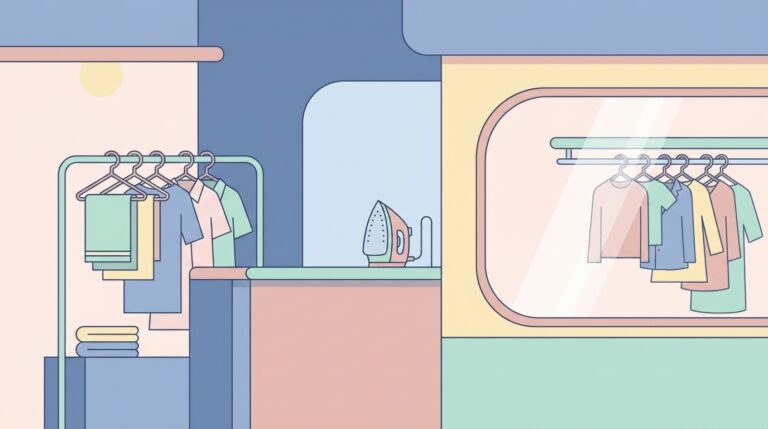
Never Fear the Local Korean Dry Cleaner: Drop Off Clothes in 3 Easy Phrases
Phase 1: Empathy (Story-Immersive Opening)
안녕하세요! 매일한글 (Daily Hangul) editor here!
Picture this: You are having an incredible evening in Seoul, savoring bubbling hot tteokbokki or crispy Korean fried chicken. Suddenly, disaster strikes—a bright red drop of spicy sauce lands straight on your favorite beige winter coat! Your heart sinks. You know you can’t just toss a delicate wool coat into a coin laundromat washer. You need a real Korean dry cleaner (세탁소 – setakso).
You locate a cozy neighborhood shop tucked between an alleyway and a convenience store. As you push open the sliding door, the warm scent of pressed cotton and steam envelops you. Behind the counter stands a friendly Korean elder (세탁소 사장님 – shop owner) looking up from a heavy steam iron. Your mind goes completely blank. How do you say “dry clean”? What if they ask a question you can’t understand?
Take a deep breath! Visiting a neighborhood dry cleaner is one of the most heartwarming, authentic Korean experiences you can have once you know the ropes. This beginner guide is curated from real feedback from hundreds of our A1 learners who went from terrified stammering to picking up pristine, fresh-smelling clothes like seasoned Seoulites. Let’s make you confident in less than five minutes!
Phase 2: Core 3 Expressions In-Depth Analysis
1. 드라이해 주세요
- Pronunciation: [Deu-ra-i-hae ju-se-yo] (Sounds like: “Doo-rye-heh joo-say-yo” – think of “dry” pronounced with three syllables: de-ra-ee)
- Meaning: Literally “Please do dry [cleaning]” / Real nuance: “I’d like this dry-cleaned, please.”
- K-Culture Moment: In K-dramas, you often see characters rushing into a small neighborhood cleaner holding a dramatic designer trench coat saying this exact sentence before an important job interview or date.
- Editor’s Insight: Koreans love shortening English loanwords! Nobody says the full textbook tongue-twister 드라이클리닝 (deuraikeullining) in daily life. Simply say 드라이 (deurai) followed by 해 주세요 (please do).
- Situation Spectrum: Casual: ⚠️ | Semi-formal: ✅ | Formal: ✅
- 🤔 Think About It: Notice how English loanwords get adapted into Korean verbs by adding 하다 (hada – to do). Does your language borrow English words and bend them to fit daily speech?
2. 여기 얼룩이 있어요
- Pronunciation: [Yeo-gi eol-lu-gi i-sseo-yo] (Sounds like: “Yaw-gee ull-loo-gee ee-ssuh-yo”)
- Meaning: Literally “Here stain exists” / Real nuance: “There is a stain right here.”
- K-Culture Moment: That classic scene where someone tries to conceal a coffee spill on their shirt at work before sheepishly pointing it out to the dry-cleaning master.
- Editor’s Insight: 여기 (yeogi) means “here”, and 얼룩 (eolluk) means “stain”. Pair this phrase with a gentle point toward the spot, and the dry cleaner will know immediately to apply specialized stain remover before the main wash.
- Situation Spectrum: Casual: ⚠️ | Semi-formal: ✅ | Formal: ✅
- 🤔 Think About It: In Korean, stating the existence of a problem (stain is here) is much more natural and polite than commanding someone directly (remove this stain). Why do you think Korean communication favors indirect statements?
3. 언제 찾을 수 있어요?
- Pronunciation: [Eon-je cha-jeul su i-sseo-yo?] (Sounds like: “Un-jay cha-jeul soo ee-ssuh-yo?”)
- Meaning: Literally “When can I find/retrieve it?” / Real nuance: “When can I pick it up?”
- K-Culture Moment: The anticipation of picking up an outfit right before a big weekend trip to Jeju Island or a family holiday.
- Editor’s Insight: In English, we say “pick up” or “collect”. In Korean, the verb is 찾다 (chatda), which literally means “to find” or “to reclaim”. At A1 level, 언제 (when) is your ultimate magic question word!
- Situation Spectrum: Casual: ⚠️ | Semi-formal: ✅ | Formal: ✅
- 🤔 Think About It: Reclaiming your clothes is expressed as “finding” them (찾다). Isn’t it charming to think of your cleaned laundry as being safely recovered?
Phase 3: Textbook Korean vs. Real Korean
Situation 1: Asking for dry cleaning
- 📖 Textbook Korean: 이것을 드라이클리닝 해 주시겠습니까? (Igeoseul deuraikeullining hae jusigesseumnikka? – “Would you be so kind as to dry clean this object?”)
- 🗣️ Real Korean: 이거 드라이해 주세요. (Igeo deurai-hae juseyo. – “Dry clean this, please.”)
- 💡 Why is it different? Textbook phrases are often overly formal, making you sound like a historical drama scholar. Real locals drop long object particles and use friendly, polite -요 (-yo) endings.
Situation 2: Asking when to come back
- 📖 Textbook Korean: 작업이 언제 완료됩니까? (Jageobi eonje wanryodoemnikka? – “When will the operation be completed?”)
- 🗣️ Real Korean: 언제 찾으러 와요? (Eonje chajeureo wayo? – “When should I come pick it up?”) or 언제 나와요? *(Eonje nawayo? – “When will it be ready?”)
- 💡 Why is it different? Words like “operation completed” sound like factory logistics! In daily life, casual neighborhood owners use active verbs like “come to get” (찾으러 오다) or “come out” (나오다).
Phase 4: K-Culture Deep Dive & Non-Verbal Manners
4-1. 눈치 (Nunchi) & Gestures
- The Two-Handed Handover: Never fling your clothes across the counter with one hand! Hand your garments over holding them gently with both hands or supporting your right wrist with your left hand. It shows respect to the craftsperson.
- Pocket Check Courtesy: Before stepping into the shop, inspect every pocket. Leaving cash, train passes, or lip balm in pockets makes extra work for the owner. Emptying them beforehand shows great 눈치 (tact/situational awareness).
- Polite Pointing: When indicating a stain, avoid aggressively stabbing your finger near the owner’s face. Point downward toward the fabric with two fingers or an open palm.
4-2. Cultural Code: The Neighborhood 세탁소 (Setakso)
In Korea, local dry cleaners are not sterile corporate chains; they are neighborhood institutions often run by an elderly couple (사장님 – boss/master) for 20 to 30 years. You will spot them surrounded by towering racks of plastic-wrapped clothes, an old CRT television playing daily drama reruns, and a friendly kettle brewing barley tea (보리차). Treating the owner with warm politeness will often earn you lightning-fast service, free button repairs, or a complimentary piece of candy!
Phase 5: Real-Life Roleplay Scenario
Setting: A chilly Tuesday afternoon inside 행복 세탁소 (Happiness Cleaners) in Mapo-gu, Seoul. Steam hisses gently as the kind-eyed owner looks up over half-rim reading glasses.
Turn 1:
* You: 안녕하세요! 이거 드라이해 주세요. (Annyeonghaseyo! Igeo deurai-hae juseyo.)
* English: Hello! Please dry clean this.
* 🎭 Action: Smile warmly and hand over your wool jacket with both hands.
Turn 2:
* Owner: 네, 코트네요. 어디 특별히 더러운 데 있어요? (Ne, koteuneyo. Eodi teukbyeolhi deoreoun de isseoyo?)
* English: Sure, it’s a coat. Anywhere particularly dirty?
* 🎭 Action: Unfolds the coat on the inspection counter and looks at you.
Turn 3:
* You: 네, 여기 얼룩이 있어요. (Ne, yeogi eollugi isseoyo.)
* English: Yes, there is a stain right here.
* 🎭 Action: Point with an open hand to the sleeve cuff.
Turn 4:
* Owner: 아, 커피 얼룩이네! 깨끗하게 지워 줄게요. (A, keopi eollugine! Kkaekkeuthage jiwo julgeyo.)
* English: Ah, a coffee stain! I will clean it spotless for you.
* 🎭 Action: Nods approvingly and writes a note on a small paper tag.
Turn 5:
* You: 감사합니다! 언제 찾을 수 있어요? (Gamsahamnida! Eonje chajeul su isseoyo?)
* English: Thank you! When can I pick it up?
* 🎭 Action: Tilt head slightly in polite inquiry.
Turn 6:
* Owner: 목요일 오후에 와요. 전화번호 뒷자리 뭐예요? (Mogyoil ohue wayo. Jeonhwabeonho dwitjari mwoyeyo?)
* English: Come on Thursday afternoon. What are the last four digits of your phone number?
* 🎭 Action: Glances at his receipt ledger with pen ready.
Turn 7:
* You: 일-이-삼-사예요. 영수증 주세요. (Il-i-sam-sa-yeyo. Yeongsujeung juseyo.)
* English: It is 1-2-3-4. Please give me a receipt.
* 🎭 Action: Recite your numbers clearly and hold out your hand.
Turn 8:
* Owner: 여기 보관증 있어요. 목요일에 봐요! (Yeogi bogwanjeung isseoyo. Mogyoile bwayo!)
* English: Here is your claim slip. See you on Thursday!
* 🎭 Action: Hands you the paper slip with a friendly grin.
🔀 Interactive Decision Point!
The owner asks: “선불로 하시겠어요, 후불로 하시겠어요?” (Would you like to pay now or when you pick up?) How do you respond?
- Option A: 지금 계산할게요! (Jigeum gyesanhalgeyo! – I will pay now!)
- 👉 Feedback [Best]: Perfect! Neighborhood shops love upfront payments (선불 – seonbul). It keeps things hassle-free when picking up.
- Option B: 싫어요. (Sireoyo. – I don’t want to.)
- 👉 Feedback [Bad]: Ouch! This sounds blunt and rude to an elder. If you want to pay later, say 나중에 낼게요 (Najunge naelgeyo – I’ll pay later).
- Option C: 카카오페이 돼요? (Kakaopei dwaeyo? – Do you take Kakao Pay?)
- 👉 Feedback [Risk]: High risk of confusion! While modern franchises accept QR codes, traditional mom-and-pop shops usually prefer a physical credit card or cash.
Phase 6: 10-Second Emotion Shadowing Drill
Practice matching these rhythm breaks (/) and tones:
[😊 Bright & Polite]
안녕하세요! / 이거 / 드라이해 주세요.
(Annyeonghaseyo! / Igeo / deurai-hae juseyo.)-
[🥺 Slightly Worried & Attentive]
여기 / 소매에 / 얼룩이 있어요.
(Yeogi / somae-e / eollugi isseoyo.) -
[✨ Curious & Cheerful]
감사합니다! / 언제 찾을 수 있어요?
(Gamsahamnida! / Eonje chajeul su isseoyo?)
Phase 7: K-Culture Mini Dictionary
- 세탁소 (Se-tak-so): Dry cleaners / Laundromat. While coin laundry is called 코인 빨래방 (koin ppallaebang), a 세탁소 is where professional dry cleaning and pressing happens.
- 얼룩 (Eol-luk): Stain or spot. Essential word whenever you need food, sauce, or ink treated.
- 영수증 / 보관증 (Yeong-su-jeung / Bo-gwan-jeung): Receipt / Claim tag. Many local shops give you a small numbered ticket that you trade back for your clothing.
- 수선 (Su-seon): Alteration or clothing repair. Almost all Korean dry cleaners also shorten pants, replace broken zippers, and tailor fits!
Phase 8: Survival Kit for Travelers
Top 3 Survival Phrases
- 빨리 돼요? (Ppalli dwaeyo?) – “Can it be done quickly / expedited?”
- Pro Tip: If you have an urgent flight or event tomorrow, ask this with a polite bow.
- 얼마예요? (Eolmayeyo?) – “How much is it?”
- Pro Tip: Winter padding jackets and long wool coats cost more than dress shirts (usually 8,000 to 15,000 KRW).
- 카드 돼요? (Kadeu dwaeyo?) – “Can I pay by credit card?”
- Pro Tip: 99% of Korean urban cleaners accept foreign Visa/Mastercard credit cards!
Editor’s Travel Note
- Finding Cleaners Nearby: Don’t rely on Google Maps in Korea because map data is limited. Use the Naver Map app download for English navigation and search “세탁소”. Look for the blue hanger icons!
- Pick-up Hours: Most independent shops close around 7:00 PM or 8:00 PM and take Sundays off. Take a photo of the shopfront sign with your phone camera so you have their contact number handy.
Phase 9: “A Step Deeper”
In many Western cultures, laundry services are purely transactional commercial spaces. In Korea, however, a neighborhood 세탁소 is an anchor of 정 (Jeong)—the warm, unspoken bond of community affection. When an elderly owner inspects your garment, scolds the stubborn sauce stain, and promises to make it like new, they are offering hospitality, not just labor. Speaking just two sentences of polite Korean honors their lifelong craft.
💬 Your Turn: Have you ever experienced a sudden clothing emergency while traveling? How did you handle it? Share your story in the comments below!
Phase 10: FAQ & Avoiding Misunderstandings
Q: Can I drop off shoes or sneakers at a Korean dry cleaner?
A: Yes! Most Korean dry cleaners offer 운동화 세탁 (sneaker cleaning). They will hand-scrub sneakers and return them sanitized and fresh for around 4,000–6,000 KRW.
Q: What if I lose my paper claim ticket (보관증)?
A: Don’t panic! Neighborhood shops always ask for your Korean cell phone number (or your foreign number’s last four digits) as a secondary backup index. Just state your number and name when picking up.
Q: Can I get my clothes back on the same day?
A: Standard dry cleaning takes 1 to 2 business days. If you need same-day service, ask first thing in the morning: 오늘 돼요? (Oneul dwaeyo? – Is today possible?). Some franchise cleaners (like Clean-Aid or Cleantopia) offer express fees.
🚨 Common Mistakes Warning Board
- Mistake: Confusing a coin laundromat with a dry cleaner.
- Correction: Don’t bring wool coats to a 코인 빨래방 (coin laundromat)! Look strictly for the word 세탁소.
- Mistake: Forgetting to point out stains immediately.
- Correction: Once a garment goes through high heat, stains set permanently. Always say “여기 얼룩이 있어요” right upon arrival.
- Mistake: Using ultra-formal speech endings like -십시오 (-sipsio).
- Correction: Stick to standard polite -요 (-yo) endings. It sounds naturally warm and respectful without being awkward.
Phase 11: Action Mission & Engagement
- 🥉 Bronze Mission: Stand in front of your mirror holding a jacket and practice saying: “안녕하세요! 이거 드라이해 주세요!” 3 times out loud.
- 🥈 Silver Mission: Save a screenshot of the phrase “언제 찾을 수 있어요?” into your Korea Travel Notes app folder.
- 🥇 Gold Mission: Walk into a real Korean 세탁소 or practice with a Korean friend using the 3-step conversation flow!
- 🎮 K-Culture Mission: In your next K-drama binge, keep your ears open during neighborhood street scenes. Count how many times you spot a green or blue hanger sign saying 세탁!
Phase 12: Interactive Quiz Challenge
Q1. (Situation Judgment) You drop red chili oil on your down coat. You walk into the dry cleaner. What should you say first while pointing to the spot?
* A) 이거 버려 주세요. (Please throw this away.)
* B) 여기 얼룩이 있어요. (There is a stain here.)
* C) 물 주세요. (Please give me water.)
👉 Click to reveal answer & explanation
Correct Answer: B
Explanation: B (여기 얼룩이 있어요) alerts the cleaner to pretreat the stain. A means throwing it in the trash, and C is asking for drinking water!
Q2. (Fill in the Blank) Complete the pickup question:
“언제 ______ 수 있어요?” (When can I pick it up?)
* A) 먹을 (meogeul – eat)
* B) 찾을 (chajeul – retrieve/find)
* C) 갈 (gal – go)
👉 Click to reveal answer & explanation
Correct Answer: B (찾을)
Explanation: 찾다 means to find or retrieve. Combined with -(을) 수 있어요 (can do), 찾을 수 있어요 translates naturally to “can pick up”.
Q3. (True or False) In Korea, you should hand your clothes to the dry cleaning owner using only one hand to show confidence.
* [ ] True
* [ ] False
👉 Click to reveal answer & explanation
Correct Answer: False!
Explanation: In Korean culture, handing items across a counter with two hands demonstrates politeness and mutual respect.







