

Phase 1: Empathy (Real-Life Opening)
안녕하세요! 매일한글 에디터입니다. (Hello! I am your Daily Hangul editor.)
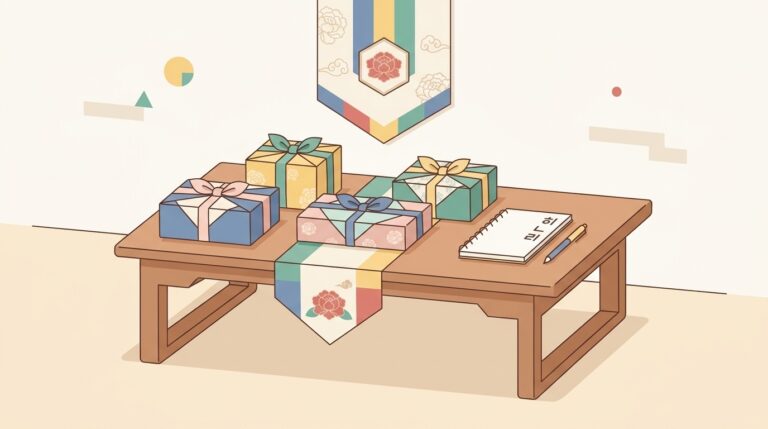
Picture this: You just attended your Korean colleague’s baby’s first birthday party—a vibrant, heartwarming Doljanchi (돌잔치). You enjoyed the feast, cheered during the high-stakes Doljabi (돌잡이) fortune-telling game, and handed over your gift envelope. But as you head toward the exit, you spot a lavishly decorated table lined with matching, beautifully wrapped pastel boxes and bespoke ribbon tags. Guests are smiling, picking up a box, and exchanging warm nods with the glowing parents.
You freeze. Are those gifts free for everyone? Do I just take one, or must I wait to be handed one? What if I take two by accident? What magic Korean phrase do I say so I don’t look greedy or awkward?
If you’ve ever felt that subtle wave of social panic at a Korean formal event, you are not alone! Many intermediate learners tell us: “I know textbook greetings, but the moment I leave a Korean gathering, my mind goes blank on the exit etiquette.” Grabbing your Dangnyepum (답례품 – return gift) is actually a cherished communal tradition designed to send you home with blessings. Today, we’re going to break down the exact words, body language, and cultural codes so you can receive your favor with effortless confidence and warmth.
Phase 2: Core Expressions in Depth
Here are three essential expressions you will need at the exit table.
1. 답례품 하나 챙겨가도 될까요? (Dangryepum hana chaenggyeogado doelkkayo?)
- Pronunciation: Dahng-nyeh-poom hah-nah cheng-gyuh-gah-doh dwel-kkah-yoh? (Think of “Dahng” like “song” with a D, and “poom” like “boom” with a P).
- Meaning:
- Literal: “May I pack and take one return gift?”
- Real Nuance: “May I take one of these lovely favors?” (A polite, modest way to show interest without sounding entitled).
- K-Culture Moment: You will hear this in family-centric K-dramas (like Once Again or My Golden Life) whenever thoughtful guests check in at the banquet exit table.
- Editor’s Insight: The verb 챙기다 (chaenggida) is one of the most uniquely Korean words in existence. It means to look after, pack, take care of, or make sure not to miss something. Asking to “chaenggida” the favor sounds far more warm and proactive than merely saying “gajyeogada” (to take).
- Situation Spectrum: Casual ⚠️ | Semi-formal ✅ | Formal ✅
- 🤔 Think About It: In many Western parties, you grab a party favor without asking, or hosts drop them into your bag. Why does Korean etiquette prioritize asking permission even when something is clearly meant for you?
2. 정성스런 선물 정말 감사해요. (Jeongseongseureon seonmul jeongmal gamsahaeyo.)
- Pronunciation: Juhng-sung-seu-run sun-mool jung-mahl gahm-sah-heh-yoh. (“Jeong” sounds like “young” with a soft J).
- Meaning:
- Literal: “Thank you so much for this heartfelt/sincere gift.”
- Real Nuance: “Thank you for putting so much thought and love into this gift!”
- K-Culture Moment: Seen in lifestyle vlogs when guests receive customized artisanal salts, engraved cutlery, or premium towels and express heartfelt gratitude to the hosts.
- Editor’s Insight: 정성 (Jeongseong) means wholehearted devotion and effort. Using this adjective compliments the parents’ preparation rather than just the object itself.
- Situation Spectrum: Casual ⚠️ | Semi-formal ✅ | Formal ✅
- 🤔 Think About It: How does complimenting the effort behind a gift change the relationship between the giver and the receiver?
3. 선물 너무 예뻐요, 잘 쓸게요! (Seonmul neomu yeppeoyo, jal sseulgeyo!)
- Pronunciation: Sun-mool nuh-moo yeh-bbuh-yoh, jahl ssul-geh-yoh!
- Meaning:
- Literal: “The gift is so pretty, I will use it well!”
- Real Nuance: “This is so lovely, I’ll definitely put it to good use!”
- K-Culture Moment: When younger guests or peers congratulate the mother after admiring the modern, chic wrapping aesthetics.
- Editor’s Insight: Saying 잘 쓸게요 (jal sseulgeyo) is the quintessential Korean way of promising the gift will not be wasted. It brings immense joy to the host.
- Situation Spectrum: Casual ✅ | Semi-formal ✅ | Formal ⚠️
- 🤔 Think About It: In English, we often say “You shouldn’t have!” In Korean, acknowledging that you will actively use the gift is the highest form of appreciation.
Phase 3: Textbook Korean vs. Real Korean
Situation 1: Asking if you can take a favor
- 📖 Textbook Korean: 이 선물을 가져가도 됩니까? (I seonmureul gajyeogado doebnikka? – “Am I permitted to take this gift?”)
- 🗣️ Real Native Korean: 답례품 하나 챙겨갈게요! (Dangryepum hana chaenggyeogalgeyo! – “I’ll make sure to take one of the favors!”)
- 💡 Why is it different? The textbook phrase sounds like a military inquiry or a legal check. Native speakers use the friendly intention marker -(으)ㄹ게요 with 챙기다, turning an awkward permission-seeking question into a delightful, cooperative statement.
Situation 2: Acknowledging the parents’ generosity
- 📖 Textbook Korean: 답례품을 주셔서 대단히 감사합니다. (Dangryepumeul jusyeoseo daedanhi gamsahamnida. – “Thank you exceedingly for bestowing the return gift upon me.”)
- 🗣️ Real Native Korean: 이런 것까지 준비하시고… 정말 감사해요! (Ireon geotkkaji junbihasigo… Jeongmal gamsahaeyo! – “You even prepared something like this… thank you so much!”)
- 💡 Why is it different? Koreans frequently show appreciation through sympathetic humility—acknowledging the host’s burden with 이런 것까지 (“even going this far”). It conveys deep empathy for the tired parents.
Phase 4: K-Culture Deep Dive & Non-Verbal Manners
4-1. 눈치 (Nunchi) & Physical Gestures
- The Two-Handed Rule (두 손): Even if the favor is a tiny box of macarons or a single tea tin, always reach out with both hands, or support your right forearm with your left hand. Grabbing a party favor with one hand while holding your phone in the other looks dismissive.
- The 1-Box-Per-Family Rule: Unless the hosts specifically insist: “하나 더 가져가세요!” (Please take another one!), the golden rule is one favor per household/invitation, not necessarily per person.
- The Eye-Level Nod: As you pick up your box, make brief, warm eye contact with the hosts or the reception attendant, tilt your head slightly in a 15-degree bow, and say your parting words.
4-2. The Secret Code of Doljanchi Favors
In modern Korea, return gifts have evolved, but their symbolic core remains rooted in deep traditional wishes:
* Custom Towels (수건): The all-time classic. Towels symbolize longevity, abundance, and smooth wiping away of misfortunes. Koreans use these towels at home for years, keeping the child’s name embroidered in daily memory!
* Artisanal Salt & Mixed Grains (소금/잡곡): Salt represents purification and essential value (“the salt of the earth”), while grains wish for financial abundance.
* Modern Lifestyle Items: Eco-friendly tumblers, luxury hand washes, and custom cookies are trending among younger parents.
Phase 5: Real-World Roleplay Scenario
- Setting: The exit foyer of a bright banquet hall in Gangnam. Soft jazz plays. Minho (the baby’s father) is holding a sleepy one-year-old baby Si-woo while seeing guests off.
-
Turn 1 (Minho – Dad): 오늘 바쁘신데 와주셔서 정말 감사합니다! (Oneul bappeusinde wajusyeoseo jeongmal gamsahamnida! / 🎭 Bows politely while holding baby Si-woo / “Thank you so much for coming today despite your busy schedule!”)
- Turn 2 (You): 아니에요, 시우 첫 생일 진심으로 축하드려요! (Anieyo, Si-u cheot saeng-il jinsimeuro chukhadeuryeoyo! / 🎭 Smiles warmly and makes soft eye contact with the baby / “Not at all, happy first birthday to Si-woo from the bottom of my heart!”)
- Turn 3 (Minho – Dad): 감사해요. 가시기 전에 여기 답례품 꼭 챙겨가세요! (Gamsahaeyo. Gasigi jeone yeogi dangryepum kkok chaenggyeogaseyo! / 🎭 Gestures with an open palm toward the gift table / “Thank you. Please make sure to grab a return gift over here before you leave!”)
- Turn 4 (You): 와, 포장이 너무 고급스러워요. 하나 챙겨가도 될까요? (Wa, pojangi neomu gogeupseureowoyo. Hana chaenggyeogado doelkkayo? / 🎭 Looks at the table with admiration / “Wow, the wrapping is so elegant. May I take one?”)
- Turn 5 (Minho – Dad): 그럼요! 저희 아내가 정성껏 준비했어요. (Geureomyo! Jeohui anaega jeongseongkkeot junbihaesseoyo. / 🎭 Chuckles proudly / “Of course! My wife prepared them with all her heart.”)
- Turn 6 (You): 정성스런 선물 정말 감사해요. 잘 쓸게요! (Jeongseongseureon seonmul jeongmal gamsahaeyo. Jal sseulgeyo! / 🎭 Receives the box using both hands with a gentle bow / “Thank you so much for this thoughtful gift. I’ll put it to great use!”)
- Turn 7 (Minho – Dad): 조심히 들어가시고, 조만간 또 봬요! (Josimhi deureogasigo, jomangan tto bwaeyo! / 🎭 Waves gently with the baby’s little hand / “Get home safely, and let’s catch up soon!”)
- Turn 8 (You): 네, 민호 씨도 푹 쉬세요! (Ne, Minho ssido puk swiseyo! / 🎭 Steps back with a warm smile / “Yes, please get some good rest too, Minho!”)
🔀 Interactive Decision Point
Minho says: “가족분 것도 하나 더 가져가세요!” (Please take one more for your family!)
What do you say?
- Option A: “싫어요, 하나면 충분해요.” (Sireoyo, hanamyeon chungbunhaeyo. – “No, one is enough.”)
- Option B: “어머, 정말 그래도 돼요? 감사히 잘 쓸게요!” (Eomeo, jeongmal geuraedo dwaeyo? Gamsahi jal sseulgeyo! – “Oh my, is that really okay? I’ll accept it thankfully and use it well!”)
- Option C: “두 개 주시면 저야 개이득이죠!” (Du gae jusimyeon jeoya gae-ideug-ijyo! – “If you give me two, that’s totally jackpot profit for me!”)
Feedback:
* Option A [Bad]: Using “싫어요” (I dislike/refuse) is way too blunt and rejects the host’s generosity harshly.
* Option B [Best]: Polite hesitation followed by genuine gratitude. Perfect cultural harmony!
* Option C [Risk]: Slang like 개이득 (huge gain/score) is funny among college buddies, but completely inappropriate for a family celebration.
Phase 6: 10-Second Emotion Shadowing Drill
Practice these with natural rhythm and pauses (/ marks pauses):
[😊 Warm & Appreciative]- “답례품 하나 / 챙겨가도 될까요?”
- (Dangryepum hana / chaenggyeogado doelkkayo?)
[🤲 Respectful & Impressed]- “정성스런 선물 / 정말 감사해요.”
- (Jeongseongseureon seonmul / jeongmal gamsahaeyo.)
[💖 Cheerful & Enthusiastic]- “선물이 너무 예뻐요, / 집에서 잘 쓸게요!”
- (Seonmuri neomu yeppeoyo, / jib-eseo jal sseulgeyo!)
Phase 7: K-Culture Mini Dictionary
- 답례품 (Dang-rye-pum) | Noun
- Meaning: A return gift given to guests as an expression of gratitude for attending an event.
- Usage: Essential for weddings (결혼식), first birthdays (돌잔치), and milestone 60th/70th birthdays.
- 돌잡이 (Dol-ja-bi) | Noun
- Meaning: The traditional ceremony where the baby picks an item (thread for long life, money for wealth, pencil for intellect) predicting their destiny.
- Usage: Guests often place raffle tickets guessing what item the baby will choose.
- 금반지 (Geum-ban-ji) | Noun
- Meaning: A 24K pure gold baby ring traditionally gifted by close relatives and friends.
- Usage: Today, cash envelopes (축의금) are often given instead due to soaring gold prices.
- 품앗이 (Pum-a-si) | Noun
- Meaning: Ancient communal labor-exchange and mutual support system.
- Usage: Explains why Koreans record who gave what at life events to return identical or greater support in the future.
Phase 8: Traveler Survival Kit
Top 3 Survival Phrases
- 답례품 어디서 받아요? (Dangryepum eodiseo badayo? / “Where can I pick up the return gift?”)
- Pro Tip: Useful in large hotel banquet halls where the gift station is placed in an outer lobby.
- 봉투 어디에 넣으면 돼요? (Bongtu eodie neoeumyeon dwaeyo? / “Where should I submit the gift envelope?”)
- Pro Tip: Ask this at the registration desk when you first arrive.
- 오늘 초대해 주셔서 감사해요. (Oneul chodaehae jusyeoseo gamsahaeyo. / “Thank you for inviting me today.”)
- Pro Tip: The smoothest all-purpose greeting when parting.
Editor’s Travel Note
- If you are invited to a banquet hall in Seoul, avoid public parking stress! Be sure to download the Naver Map application to find banquet halls to check the best subway exits and walking paths.
- Always prepare fresh paper bills for your gift envelope. Crisp bank notes show sincere respect in Korean tradition.
Phase 9: “One Step Deeper” (Critical Thinking)
In many individualistic cultures, celebrations mark personal milestones. In Korea, however, a baby’s first birthday historically marked a triumphant communal victory: surviving the harsh first year before modern medicine existed. The Dangnyepum is not a transactional souvenir; it is the child’s very first act of sharing blessings with the village that will help raise them. When you accept that small box with both hands, you are affirming your role in that child’s lifelong village.
💬 Your Turn: Does your culture have a tradition of sending party guests home with symbolic favors? What is the most memorable party favor you’ve ever received? Share with us in the comments below!
Phase 10: FAQ & Common Mistakes
Q: Can I take more than one return gift if there are leftovers on the table?
A: It is polite to take only one gift per invitation or family unless the baby’s parents or banquet staff explicitly tell you, “많이 남았으니 하나 더 챙겨가세요!” (There are plenty left, please take another one!). Grabbing multiples without an invitation can be seen as lacking nunchi.
Q: What if I didn’t prepare a cash envelope? Can I still take the return gift?
A: Absolutely yes. If you were invited, you are an honored guest. The hosts want you to receive the baby’s blessing. Never decline the gift because of feelings of guilt; accepting it graciously is the proper courtesy.
Q: Is it rude to open the return gift immediately in front of the parents?
A: Yes, it is generally considered bad manners. In Korea, opening gifts immediately in front of the giver can imply you are evaluating its monetary worth. Wait until you get home or are in your car to unwrap it.
🚨 Common Mistakes TOP 3
- Grabbing with one hand: Reaching out lazily while talking to someone else.
- Correct Action: Receive with both hands, nod, and say: “감사히 잘 쓸게요!”
- Ignoring the parents at the exit: Sneaking out with a favor box while the parents are distracted.
- Correct Action: Always wait 15 seconds to catch their eye, bow, and bid them farewell.
- Saying “이거 공짜예요?” (Is this free?):
- Correct Action: Never ask if it is “free.” Use the respectful phrase: “답례품 하나 챙겨가도 될까요?”
Phase 11: Action Missions & Engagement
- 🥉 Bronze Mission (Solo Practice): Stand in front of your mirror, hold out both hands, and say “선물 너무 예뻐요, 잘 쓸게요!” three times with a bright smile.
- 🥈 Silver Mission (Social Share): Leave a comment below using the word 정성 (Jeongseong) in your own English sentence describing someone’s cooking or gift.
- 🥇 Gold Mission (Real Life): Next time a Korean acquaintance hands you even a small candy or drink, use “잘 먹을게요!” or “잘 쓸게요!” instead of a plain “Gamsahamnida.”
- 🎮 K-Culture Mission: Watch any Korean variety show episode celebrating a 100-day or 1-year birthday (like The Return of Superman) and spot what gift items are packed into the guest favor bags!
Phase 12: Interactive Quiz Challenge
Test your Doljanchi instincts!
Q1. Situation: You are leaving the Doljanchi hall and the parents offer you a gift box. What is the most culturally graceful response?
A) “이거 얼마짜리예요?” (How much is this worth?)
B) “선물 너무 예뻐요, 감사히 잘 쓸게요!” (The gift is so pretty, I’ll thankfully use it well!)
C) “가져가기 귀찮은데 그냥 둘게요.” (It’s a hassle to carry, so I’ll leave it.)
👉 Click to view Answer & Explanation
Correct Answer: B
Explanation: Complimenting the gift’s appearance and promising to make good use of it (잘 쓸게요) is the peak of warm Korean etiquette. Asking the price (A) or saying it’s a hassle (C) will break the parents’ hearts!
Q2. Fill in the Blank:
“가시기 전에 여기 ________ 꼭 챙겨가세요!” (Please make sure to take your return gift before you leave!)
👉 Click to view Answer & Explanation
Correct Answer: 답례품 (Dangryepum)
Explanation: 답례품 refers specifically to return favors given to guests who attend celebrations.
Q3. True or False:
In Korea, custom embroidered towels are given at first birthdays to represent a long, clean, and healthy life.
👉 Click to view Answer & Explanation
Correct Answer: True (T)
Explanation: Towels (수건) are long, soft, and woven, symbolizing the wish that the child will enjoy longevity and health!







