

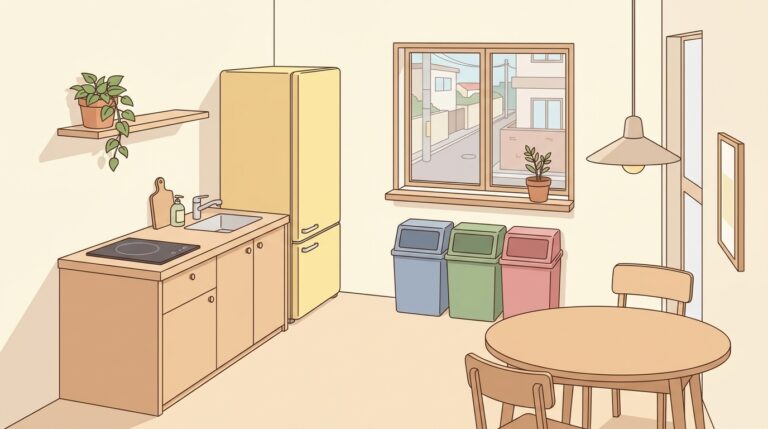
Stop Struggling with Korean Trash: Natural Chores Korean for Housemates
Phase 1: Empathy (Story Immersion Opening)
안녕하세요! 매일한글 에디터입니다. (Hello! This is your Daily Hangul editor.)
Picture this: You just settled into your cozy Seoul studio or shared apartment. You made a delicious meal, wiped down the counter, and felt proud of your independent life in Korea. But then, reality strikes. You look under the sink, and the trash can is overflowing with empty ramyeon cups, snack wrappers, and delivery napkins. You reach for a random plastic shopping bag, tie it up, and head for the door—only for your Korean roommate or neighbor to gasp in genuine horror: “잠깐만요! (Wait a second!) You can’t toss that out like that!”
If you have ever felt completely paralyzed by Korea’s color-coded municipal bags, strict sorting stations, or simply did not know how to tell your housemate “Hey, could you take out the bin on your way down?”, you are certainly not alone. Waste disposal and chores in Korea are practically a communal sport governed by strict etiquette, neighborhood rules, and specific colloquial phrases you will never find in standardized grammar books. Based on feedback from hundreds of intermediate learners who survived roommate chore negotiations and apartment inspections, this guide will equip you with natural, native B1-level expressions to handle domestic chores like a seasoned local.
Phase 2: 3 Core Expressions Deep Dive
1. 쓰레기통 좀 비워 줄래? (Sseuregitong jom biwo jullae?)
- Pronunciation: [Sseu-reh-gi-tong jom bee-wo jool-lae?] (Think: Say-reggy-tong, jom bee-war jool-lay)
- Meaning: Literal: “Will you empty the trash can a bit?” | Nuance: A warm, natural, and low-pressure request between friends or housemates asking someone to empty the bin without sounding bossy.
- K-Culture Moment: In the classic college-roommate K-Drama Hello, My Twenties! (청춘시대), the housemates constantly balance chore charts on the kitchen fridge using this exact phrase when the common bin starts piling up.
- Editor’s Insight: Notice the magical particle 좀 (jom). It literally means “a little,” but in Korean conversational pragmatics, it acts as a social buffer. Dropping “좀” into a chore request immediately turns a harsh command into a friendly favor.
- Situation Spectrum:
- Casual (Friends/Roommates): ✅ 쓰레기통 좀 비워 줄래?
- Semi-formal (Polite/Acquaintances): ⚠️ 쓰레기통 좀 비워 줄래요? (Sseuregitong jom biwo jullaeyo?)
- Formal (Workplace/Elderly): 🚫 (Use: 쓰레기통을 비워 주시겠습니까?)
- 🤔 Think About It: In English, politeness often relies on modal verbs like “Could you…” or “Would you mind…”. In Korean, softening adverbs like “좀” (a bit) carry that entire emotional load. How does recognizing this change how you deliver domestic favors?
2. 쓰레기 버리고 올게. (Sseuregi beorigo olge.)
- Pronunciation: [Sseu-reh-gi beo-ri-go ol-ge] (Think: Say-reggy buh-ree-go ohl-gay)
- Meaning: Literal: “I will throw away the trash and come back.” | Nuance: “I’m taking out the trash, be right back!”
- K-Culture Moment: A staple trope in slice-of-life romance K-dramas! The male lead uses “taking out the trash” (쓰레기 버리고 올게) as the ultimate sneaky excuse to step outside into the night breeze and answer a secret phone call.
- Editor’s Insight: The grammatical frame -고 올게 (-go olge) expresses departing with the explicit promise of return. It signals that your absence is temporary and domestic, keeping your companions informed without unnecessary drama.
- Situation Spectrum:
- Casual (Close friends/Family): ✅ 쓰레기 버리고 올게.
- Semi-formal (Host/In-laws): ⚠️ 쓰레기 버리고 올게요. (Sseuregi beorigo olgeyo.)
- Formal (Official setting): 🚫
- 🤔 Think About It: Why do Koreans emphasize “coming back” (-올게) even when they are just running down the stairs for two minutes? It reveals a deeply collective mindset where personal presence inside a shared space is always consciously accounted for.
3. 종량제 봉투 꽉 찼어. (Jongnyangje bongtu kkwak chasseo.)
- Pronunciation: [Jong-nyang-je bong-tu kkwak chas-seo] (Think: Jong-nyang-jay bong-too kwahk cha-ssuh)
- Meaning: Literal: “The standard volume-rate garbage bag is tightly full.” | Nuance: “The prepaid trash bag is packed to the brim—time to take it out!”
- K-Culture Moment: On reality variety shows like I Live Alone (나 혼자 산다), single celebrities often showcase their hilarious thrifty habits, playing human Tetris to compress every last tissue into a 10L bag until it is literally bulging.
- Editor’s Insight: 꽉 (kkwak) is an expressive mimetic adverb describing something packed airtight, with zero room to spare. Using “꽉 찼어” communicates that nobody can procrastinate taking out the trash any longer.
- Situation Spectrum:
- Casual: ✅ 종량제 봉투 꽉 찼어.
- Semi-formal: ⚠️ 종량제 봉투 꽉 찼어요. (Jongnyangje bongtu kkwak chasseoyo.)
- Formal: 🚫
- 🤔 Think About It: Korean municipal bags cost real money, making space-efficiency a shared social virtue. Does your culture treat everyday trash liners as valuable commodities?
Phase 3: Textbook Korean vs. Real Korean
Situation 1: Asking someone to toss the trash on their way out
- 📖 교과서 한국어 (Textbook Korean):
“외출할 때 쓰레기를 외부 배출 장소에 버려 주십시오.”
(Oechulhal ttae sseuregireul oebu baechul jangsoe beoryeo jusipsio.)
“Please discard the garbage at the outdoor disposal site when going outside.” - 🗣️ 진짜 한국어 (Real Korean):
“나가는 길에 쓰레기 좀 버려줘!”
(Naganeun gire sseuregi jom beoryeojwo!)
“Hey, toss this trash out on your way out!” - 💡 왜 다를까? (Why is it different?):
Textbooks rely on formal civic administration vocabulary like “외부 배출 장소” (outdoor discharge point). Real Korean speakers leverage situational flow: “나가는 길에” (on the path of leaving) highlights that the chore requires minimal extra effort.
Situation 2: Noting that the trash can is overflowing
- 📖 교과서 한국어 (Textbook Korean):
“휴지통의 용량이 초과되어 넘치고 있습니다.”
(Hyujitongui yongryangi chogwadoeeo neomchigo itseumnida.)
“The wastebasket’s capacity is exceeded and overflowing.” - 🗣️ 진짜 한국어 (Real Korean):
“쓰레기통 터지기 직전이야!”
(Sseuregitong teojigi jikjeoniya!)
“The trash can is literally about to burst!” - 💡 왜 다를까? (Why is it different?):
Native speakers prefer evocative, sensory-driven metaphors. “터지기 직전” (on the verge of exploding) instantly injects urgency, humor, and visual drama into an otherwise mundane household chore.
Phase 4: K-Culture Deep Dive & Non-verbal Manners
4-1. 눈치 (Nunchi) & Domestic Body Language
- The Foot-Compression Technique: You will often see Koreans using their knee or foot to gently stomp down dry trash inside the 종량제 봉투 (standard bag) before tying it. Leaving large air pockets is seen as wasteful. However, never compress food waste—that will create an unpleasant disaster!
- The Neat Tie Knot: Korean garbage bags feature specialized plastic straps or wing handles. Tying these tightly in a double-knot is crucial etiquette. Leaving bags gaping open in communal hallways invites odors and serious disapproval from building managers (경비 아저씨).
- The Elevator Nod: When riding the elevator with a trash bag, hold it down low near your legs, away from other passengers. If you encounter a neighbor, exchange a quick 15-degree head bow to acknowledge shared communal consideration.
4-2. Culture Code: The Science of 분리수거 (Bunri-sugeo)
South Korea maintains one of the world’s most sophisticated recycling systems, initiated nationwide in 1995. You cannot simply throw everything into a single bin.
1. 일반 쓰레기 (General Waste): Anything non-recyclable goes into official prepaid bags bought at convenience stores, specific to your district (구).
2. 분리수거 (Recyclables): PET plastic bottles must have their plastic film labels completely peeled off and caps separated.
3. 음식물 쓰레기 (Food Waste): A golden rule of thumb in Korea: “If a farm animal cannot easily eat or digest it, it is not food waste.” Clam shells, chicken bones, onion skins, and peach pits belong in General Waste!
Phase 5: Real-life Roleplay Scenario
Setting: A bright Saturday morning inside a shared modern flat in Sinchon, Seoul. Min-woo (a fastidious Korean roommate) is cleaning the kitchen counter, while Alex (an international exchange student) is putting on sneakers near the front door.
- Turn 1 (Min-woo):
알렉스, 거실 쓰레기통 꽉 찼는데 이것 좀 묶어줄래?
(Alex, geosil sseuregitong kkwak channeunde igeot jom mukkeojullae?)
🎭 Tossing a spare yellow garbage tie across the counter with a hopeful look
“Alex, the living room trash is packed full. Could you tie this up for me?” -
Turn 2 (Alex):
응, 알겠어! 꾹꾹 눌러서 묶으면 되지?
(Eung, algesseo! Kkuk-kkuk nulleoseo mukkeumyeon doeji?)
🎭 Crouching down beside the bin and pressing down the dry paper carefully
“Yeah, sure thing! I just press it down firmly and tie it, right?” -
Turn 3 (Min-woo):
맞아. 근데 잠깐만! 플라스틱 병은 분리수거함에 따로 넣어야 해.
(Maja. Geunde jamkkanman! Peullaseutik byeongeun bunrisugeohame ttaro neoeoya hae.)
🎭 Peeking over and pointing gently to an empty coffee bottle inside the bin
“That’s right. But wait! Plastic bottles need to go separately into the recycling bin.” -
Turn 4 (Alex):
아, 비닐 라벨도 떼고 버려야 하는 거지?
(A, binil rabeldo ttego beoryeoya haneun geoji?)
🎭 Peeling the perforated wrapper off the plastic bottle with a satisfying click
“Ah, I have to rip off the vinyl label too, right?” -
Turn 5 (Min-woo):
완벽해! 라벨은 일반 쓰레기, 투명 페트병은 여기 전용 자루에 담아줘.
(Wanbyeokhae! Rabereun ilban sseuregi, tumyeong peteubyeongeun yeogi jeonyong jarue damajwo.)
🎭 Grinning and handing Alex a clear mesh sorting hamper
“Spot on! The label goes to regular waste, and the clear PET bottle goes into this bag.” -
Turn 6 (Alex):
다 묶었어! 내가 나가는 길에 1층에 버리고 올게.
(Da mukkeosseo! Naega naganeun gime ilcheunge beorigo olge.)
🎭 Hoisting the tightly sealed volume bag by both loop handles
“All tied up! Since I’m heading out anyway, I’ll dump it on the first floor and come back.” -
Turn 7 (Min-woo):
고마워! 음식물 쓰레기는 카드 찍고 버리는 거 잊지 마.
(Gomawo! Eumsikmul sseuregineun kadeu jjikgo beorineun geo itji ma.)
🎭 Giving an appreciative double thumbs-up from the sink
“Thanks a ton! Don’t forget you have to tap the RFID key card for the food waste bin.” -
Turn 8 (Alex):
걱정 마, 카드 주머니에 챙겼어. 금방 다녀올게!
(Geokjeong ma, kadeu jumeonie chaenggyeosseo. Geumbang danyeoolge!)
🎭 Tapping his jacket pocket reassuringly and opening the front door
“Don’t worry, card is already in my pocket. I’ll be back in a flash!”
🔀 Interactive Decision Fork
As Alex reaches the door, he realizes the handle of the garbage bag has a tiny tear. What should Alex say to Min-woo?
- Option A: “손잡이가 찢어졌는데 테이프로 붙이거나 새 봉투 덧씌울까?” (The handle tore slightly. Should I tape it or double-bag it with a fresh one?)
- Outcome: [Best] Shows exceptional nunchi, domestic maturity, and protects the building hallway from messy accidents.
- Option B: “에이, 괜찮아. 그냥 엘리베이터까지 뛰어가면 돼!” (Whatever, it’s fine. I can just sprint to the elevator!)
- Outcome: [Risk] If the bag splits inside the elevator or lobby, you will face cleaning fines and upset neighbors.
- Option C: “이거 봉투가 왜 이래? 네가 잘못 산 거 아니야?” (Why is this bag like this? Did you buy a defective one?)
- Outcome: [Bad] Blames your roommate unfairly over a cheap thin plastic handle, breaking household trust.
Phase 6: 10-Second Emotion Shadowing Drill
Practice reading these out loud, focusing on natural pauses at the slashes (/) and channeling the specified emotion!
[😊 배려하며 다정하게 / Considerate & Warm]
“쓰레기통 좀 / 비워 줄래?”
(Sseuregitong jom / biwo jullae?)-
[🏃♂️ 씩씩하고 경쾌하게 / Cheerful & Energetic]
“나가는 길에 / 내가 버리고 올게!”
(Naganeun gire / naega beorigo olge!) -
[😱 깜짝 놀라며 다급하게 / Shocked & Urgent]
“헐, / 쓰레기통 터지기 직전이야!”
(Heol, / sseuregitong teojigi jikjeoniya!)
Phase 7: K-Culture Mini Dictionary
- 종량제 봉투 (Jongnyangje bongtu): Volume-rate waste bag. Official government-mandated garbage bags categorized by liter size (5L, 10L, 20L). You must buy them behind the cash register at neighborhood marts.
- 분리수거 (Bunri-sugeo): Waste sorting / Material segregation. The civic practice of separating recyclable cardboard, glass, metals, and plastics.
- 음식물 쓰레기 (Eumsikmul sseuregi): Food waste. Organic waste processed into animal feed or compost. Disposed of via prepaid food stickers, yellow mini-bags, or electronic RFID bins.
- 대형 폐기물 스티커 (Daehyeong pyegimul seutikeo): Bulky waste disposal sticker. Official stickers bought online or at convenience stores required to legally discard chairs, desks, or mattresses.
Phase 8: Traveler Survival Kit
Top 3 Survival Phrases
- 종량제 봉투 10리터짜리 두 장 주세요.
(Jongnyangje bongtu sip-riteo-jjari du jang juseyo.)
Pro Tip: Say this directly to the clerk at CU, GS25, or 7-Eleven. They keep them folded behind the register counter! - 이 쓰레기는 어디에 버려요?
(I sseuregineun eodie beoryeoyo?)
Pro Tip: Use this at Han River picnic zones or food markets where designated sorting bins are slightly hidden. - 플라스틱은 씻어서 버려야 해요?
(Peullaseutikeun ssiseoseo beoryeoya haeyo?)
Pro Tip: Great for showing respect when staying at a Korean Airbnb or guesthouse.
Editor’s Travel Note
Need to verify your neighborhood’s garbage pickup schedule? Different wards collect general trash only on specific nights (e.g., Sunday, Tuesday, Thursday). Check the official district portal via the [Seoul Smart City Life Services Portal] or consult your guesthouse bulletin board. Discarding garbage on unauthorized days can lead to civil fines!
Phase 9: “One Step Deeper” (Reflective Cultural Insight)
In Korean society, taking out the trash transcends basic sanitation—it is an outward extension of 우리 (Uri – “We / Our”) culture. When people live in high-density residential towers (아파트 or 빌라), personal hygiene directly affects communal harmony. Properly washing out a milk carton, folding cardboard boxes flat, and taking out the trash before odors develop is regarded as basic civic empathy. By speaking comfortably about these chores, you signal that you respect shared spaces not as an outsider, but as an active, considerate member of the community.
💬 Your Turn: What household chore rule surprised you the most when you first encountered Korean apartments or dorms? Share your funny or confusing experiences in the comments below!
Phase 10: FAQ & Avoiding Misunderstandings
Q: Can I use a standard garbage bag purchased in Mapo-gu if I moved to Gangnam-gu?
A: No, you cannot! Standard volume-rate bags (종량제 봉투) are district-specific. Bags from one district will be rejected by collection crews in another. If you relocate, you must visit your local Community Center (주민센터) to receive a transfer validation sticker, or simply use them up before moving.
Q: Do eggshells, onion skins, and chicken bones count as food waste?
A: No! They count as General Waste (일반 쓰레기). As a general Korean guideline: if it cannot be consumed and digested by livestock, it must never be placed into the food waste container.
Q: What is the most polite way to ask my Korean roommate to do their share of chores?
A: Rather than saying “청소해” (Clean up), frame the activity collaboratively: “우리 청소 당번 정할까?” (Shall we set up a cleaning roster?) or add “좀” (jom) to your request: “이것 좀 치워 줄래?” (Could you tidy this up a bit?).
🚨 Common Mistakes Alert Board
- ❌ Mistake 1: Discarding beverage cups with plastic straws still attached into general recycling.
- 👉 Correct Action: Throw the dirty straw and plastic film into General Waste, and place the rinsed clear cup into Plastic recycling.
- ❌ Mistake 2: Leaving shipping labels and packing tape on cardboard boxes.
- 👉 Correct Action: Always peel off shipping stickers and clear plastic tape before flattening cardboard boxes into the paper bin.
- ❌ Mistake 3: Discarding trash onto street curbs during broad daylight.
- 👉 Correct Action: Most residential areas only allow trash placement outside after 7:00 PM on designated days. Keep bags indoors until the evening!
Phase 11: Action Missions
- 🥉 Bronze Mission (Solo Practice): Stand in front of your bedroom or kitchen bin and practice saying out loud: “나가는 길에 쓰레기 좀 버리고 올게!” 3 times with a breezy, energetic rhythm.
- 🥈 Silver Mission (Social Sharing): Take a photo of your local Korean recycling corner or volume bag, post it on social media, and tag
#DailyHangulwith the caption: “종량제 봉투 꽉 찼어!” - 🥇 Gold Mission (Real-world Challenge): Next time you walk into a local convenience store, skip the automatic checkout and say to the clerk: “종량제 봉투 10리터짜리 한 장 주세요!”
- 🎮 K-Culture Mission: Watch an episode of a modern slice-of-life K-drama (like My Liberation Notes or Hospital Playlist), spot a scene where someone dumps household trash, and look out for whether they carry an RFID card or a colored bag!
Phase 12: Interactive Quiz Challenge
1. Situation Judgment
Your Korean flatmate looks at the overflowing living room bin and sighs heavily. What is the most natural B1 response to offer your help?
* A) 쓰레기 배출을 금지합니다. (Discharging garbage is prohibited.)
* B) 내가 나가는 길에 버리고 올게! (I’ll toss it out on my way out!)
* C) 쓰레기통을 사지 마세요. (Please do not buy a trash can.)
2. Fill-in-the-Blank
Complete the sentence with the softening adverb that makes domestic requests polite:
* “쓰레기통 _____ 비워 줄래?” (Could you empty the trash can for me?)
3. True or False
* In Korea, watermelon rinds and banana peels must be thrown into General Waste (일반 쓰레기) bags.
👉 Click here for Answers & Explanations
- Answer: B
Explanation: “내가 나가는 길에 버리고 올게!” uses natural B1 conversational flow, showing willingness to handle the chore seamlessly. - Answer: 좀 (jom)
Explanation: Adding “좀” softens the imperative mood into a warm, polite favor. - Answer: False
Explanation: Soft fruit peels like watermelon rinds and banana peels are soft enough for livestock feed and must be chopped and placed into Food Waste (음식물 쓰레기)!







