

Phase 1: 공감 (Story-Driven Opening)
안녕하세요! 매일한글 에디터입니다.
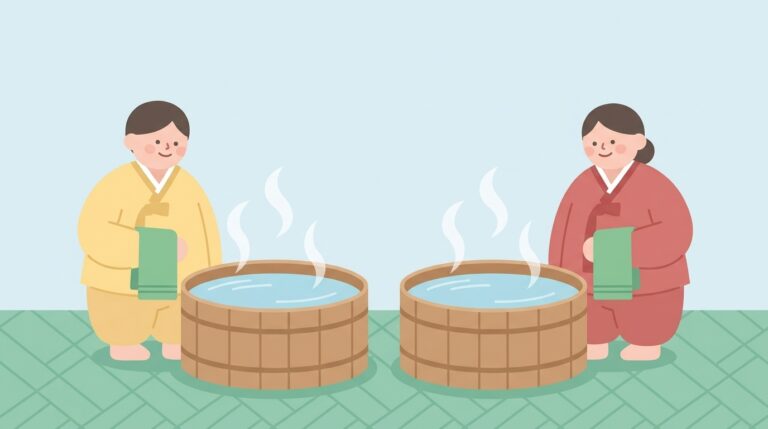
Imagine stepping into a traditional Korean bathhouse (mokyoktang) for the very first time. Surrounded by gentle clouds of aromatic steam and the soothing sound of splashing water, you notice something deeply fascinating: pairs of friends, fathers and sons, or mothers and daughters sitting on low plastic stools, taking turns vigorously scrubbing each other’s backs with small, bright green cloths. It looks intimate, remarkably comforting, and quintessentially Korean.
Then, the moment arrives. Your Korean friend smiles, slips on that iconic textured towel, and asks if you would like your back scrubbed too. Suddenly, your mind freezes. How do you accept politely? What if it hurts? And how do you ask to return the favor without sounding stiff or awkward?
Don’t worry—you are not alone. As a cultural navigator who has guided hundreds of international learners through their first Korean sauna journey, I have seen even confident Korean speakers panic in this exact situation. In this guide, you will master the exact A2-level conversational phrases and etiquette needed to handle back-scrubbing (deung milgi) like a true local.
Phase 2: 핵심 표현 3선 심층 분석 (Top 3 Core Expressions)
1. 등 좀 밀어줄래? (Deung jom mireojullae?)
- Pronunciation: [Deung jom mi-reo-jul-lae] (“Deung” rhymes with “sung”, “jom” sounds like “chom”, and “mi-reo” rhymes with “mirror”)
- Meaning: Literal: “Can you push my back a little?” | Real Nuance: “Could you scrub my back?”
- K-Culture Moment: Just like in the nostalgic neighborhood scenes of Reply 1988, close buddies sit by the water faucets and naturally ask each other for a quick back scrub before soaking in the hot tub.
- Editor’s Insight: The secret hero here is 좀 (jom), meaning “a little” or “please.” Without 좀, the phrase can sound like an order. Adding 좀 instantly softens your tone into a warm, friendly request.
- Situation Spectrum: Casual (Friends/Peers): ✅ | Semi-formal: ⚠️ (Use 등 좀 밀어주실 수 있어요?) | Formal (Strangers/Elders): 🚫
- 🤔 Think About It: In many Western cultures, touching a friend’s bare back is strictly off-limits. Why do you think Korean culture views this physical act as an expression of everyday trust and friendship?
2. 시원하다! (Siwonhada!)
- Pronunciation: [Si-won-ha-da] (Sounds like “See-won-ha-da”)
- Meaning: Literal: “It is cool/cold.” | Real Nuance: “That feels so refreshing and relieving!”
- K-Culture Moment: In countless K-dramas, you will see a character sink into a steaming 42°C hot tub or get their back scrubbed and let out a deep, contented sigh: “Ah, siwonhada!”
- Editor’s Insight: While beginners learn 시원하다 as “cool weather,” native speakers use it whenever physical tension leaves the body—whether drinking hot soup, soaking in warm water, or exfoliating dead skin.
- Situation Spectrum: Casual: ✅ | Semi-formal: ✅ | Formal: ✅ (Natural emotional exclamation)
- 🤔 Think About It: Does your native language have a single word that describes both cold temperature and physical emotional relief?
3. 아프면 말해줘. (Apeumyeon malhaejwo.)
- Pronunciation: [Ah-peu-myeon mal-hae-jwo] (“Ah-poo-myun mal-heh-jwo”)
- Meaning: Literal: “If it hurts, tell me.” | Real Nuance: “Let me know if I am scrubbing too hard.”
- K-Culture Moment: On variety shows like Running Man, cast members often tease each other during sauna games, warning their teammates with a playful “아프면 말해!” right before a firm scrub.
- Editor’s Insight: Korean exfoliating towels can feel abrasive on unaccustomed skin. Saying this phrase demonstrates 정 (jeong)—warm communal care—assuring your partner they can speak up comfortably.
- Situation Spectrum: Casual: ✅ | Semi-formal: ⚠️ (Use 아프시면 말씀해 주세요) | Formal: 🚫
- 🤔 Think About It: How do you signal care and physical comfort when helping a friend in your own culture?
Phase 3: 교과서 한국어 vs 진짜 한국어 (Textbook vs. Real-Life Korean)
Situation 1: Asking someone to scrub your back
- 📖 교과서 한국어 (Textbook): 제 등을 밀어 주시겠습니까? (Je deung-eul mireo jusigesseumnikka? – “Would you be willing to scrub my back?”)
- 🗣️ 진짜 한국어 (Real-life): 등 한 번만 밀어줄래? (Deung han beon-man mireojullae? – “Can you scrub my back real quick?”)
- 💡 왜 다를까?: The textbook sentence sounds like you are requesting a formal business contract in the shower! Real bathhouse conversation uses 한 번만 (just once / real quick) to keep requests casual and comfortable.
Situation 2: Checking if the scrubbing pressure is painful
- 📖 교과서 한국어 (Textbook): 통증이 있거나 불편하십니까? (Tongjeungi itgeona bulpyeonhasimnikka? – “Do you experience pain or discomfort?”)
- 🗣️ 진짜 한국어 (Real-life): 안 아파? 괜찮아? (An apa? Gwaenchana? – “Doesn’t it hurt? You okay?”)
- 💡 왜 다를까?: Native speakers do not use clinical words like “pain (통증)” with friends. Two quick questions—안 아파? 괜찮아?—show instant empathy without disrupting the relaxing mood.
Phase 4: K-Culture 딥다이브 & 비언어적 매너 (Deep Dive & Manners)
4-1. 눈치 (Nunchi) & Gestures
- The Relaxed Curve: When sitting on the plastic stool for your partner, lean slightly forward and round your back. This stretches the skin, making scrubbing smoother and far less painful.
- Gaze Direction: Bathhouse etiquette requires calm, respectful eye control. Look down toward the floor tiles or straight ahead at the wall. Staring directly at others is considered a serious breach of nunchi.
- The Reciprocity Golden Rule: If someone scrubs your back, you should always offer to return the favor immediately: “이제 내가 밀어줄게!” (Now let me scrub yours!).
4-2. Cultural Code: The Italy Towel (이태리 타월) & Naked Bonding
Did you know the famous green, abrasive washcloth is called an 이태리 타월 (Italy Towel)? Invented in Busan during the 1960s using imported Italian viscose fabric, it quickly became an essential household item.
In Korean culture, visiting a bathhouse together represents 벌거벗은 우정 (naked friendship). Stripping away clothes means stripping away social titles, designer logos, and professional hierarchies. Taking care of the one part of the body a person cannot reach on their own—their back—is an enduring symbol of reciprocal trust.
Phase 5: 실전 롤플레이 시나리오 (Interactive Roleplay)
Setting: Inside a warm neighborhood bathhouse in Seoul. You and your Korean close friend, Minho, are seated on small blue stools by the washing stations after soaking in the warm tub.
- Turn 1 (민호): 몸 다 불렸어? 이제 등 밀자! (Mom da bullyeosseo? Ije deung milja!)
🎭 Slips on his green Italy towel with an excited smile.(Your skin softened up in the hot tub? Let’s scrub backs!) - Turn 2 (나): 응, 좋아! 등 한 번만 밀어줄래? (Eung, joa! Deung han beon-man mireojullae?)
🎭 Turns around and sits hunched forward on the stool.(Yeah, sounds great! Can you scrub my back real quick?) - Turn 3 (민호): 당연하지. 아프면 바로 말해줘! (Dangyeonhaji. Apeumyeon baro malhaejwo!)
🎭 Splashes warm water onto the towel and starts scrubbing your shoulders.(Of course. Tell me right away if it hurts!) - Turn 4 (나): 으아, 진짜 시원하다! (Eua, jinjja siwonhada!)
🎭 Lets out a deeply relaxed breath.(Whoa, that feels so refreshing!) - Turn 5 (민호): 안 아파? 살살 밀고 있어. (An apa? Salsal milgo issewo.)
🎭 Checks your posture with caring eyes.(Doesn’t it hurt? I’m doing it gently.) - Turn 6 (나): 응, 딱 좋아. 완전 개운해! (Eung, ttak joa. Wanjeon gae-un-hae!)
🎭 Smiles with relief.(Yeah, it’s just right. Feels completely clean!) - Turn 7 (민호): 좋아, 끝났다! 이제 교대하자. (Joa, kkeutnatda! Ije gyodaehaja.)
🎭 Rinses the towel clean and offers it to you.(Nice, all done! Now let’s switch.) - Turn 8 (나): 고마워! 이번엔 내가 밀어줄게. (Gomawo! Ibeonen naega mireojulge.)
🎭 Takes the towel with both hands and sits upright.(Thank you! My turn to scrub yours.)
🔀 Interactive Choice Point: Minho just finished scrubbing your back. What do you do?
- Choice A: Take the towel and say: “고마워! 이번엔 내가 시원하게 밀어줄게, 앉아!”
- Feedback [Best]: 🌟 Perfect Korean etiquette! You acknowledged his effort and promptly returned the favor with energy.
- Choice B: Say “땡큐! (Thank you!)”, stand up, and immediately head toward the cold plunge pool alone.
- Feedback [Bad]: ❌ Cultural faux pas! Leaving your friend without offering to scrub his back leaves him hanging.
- Choice C: Take the towel silently and scrub his back with maximum force without checking in.
- Feedback [Risk]: ⚠️ Danger! Even friends have different skin sensitivity. Always check with “안 아파?” first.
Phase 6: 10초 감정 섀도잉 드릴 (10-Second Emotional Shadowing Drill)
Practice these natural rhythm pauses (/) and emotional cues aloud:
[😊 Casual & Friendly]
등 / 한 번만 / 밀어줄래? ↗
(Deung / han beon-man / mireojullae?)-
[😌 Relieved & Blissful]
으아… / 진짜 / 시원하다! ↘
(Eua… / jinjja / siwonhada!) -
[🤝 Caring & Attentive]
안 아파? / 아프면 / 꼭 말해줘! ↗
(An apa? / apeumyeon / kkok malhaejwo!)
Phase 7: K-Culture 미니 사전 (Mini Dictionary)
- 세신사 (Sesinsa) | Professional Bathhouse Scrub Specialist
A licensed professional at the bathhouse who provides full-body exfoliation on a dedicated vinyl table for a set fee. - 이태리 타월 (Itaeri Tawol) | Italy Towel
The iconic rectangular textured scrubbing mitt (usually green, yellow, or pink) used throughout Korea for exfoliating. - 때 (Ttae) | Dead Skin Residue
The grey or white rolls of exfoliated skin that come off during a thorough scrub. Far from being “dirty,” seeing 때 is viewed as proof of a successful, healthy bath. - 식혜 (Sikhye) | Sweet Malt Rice Drink
The ultimate post-bath chilled beverage, often enjoyed alongside sauna-baked brown eggs (maekbanseok gyeran).
Phase 8: 여행자를 위한 생존 키트 (Traveler’s Survival Kit)
Top 3 Survival Phrases
- 살살 해주세요. (Salsal hae-juseyo. / “Please do it gently.”)
- Pro Tip: Essential when hiring a professional sesinsa or if a friend’s scrub feels too intense.
- 세게 해주세요. (Sege hae-juseyo. / “Please scrub harder/stronger.”)
- Pro Tip: Use this if you enjoy deep tissue stimulation and firmer pressure.
- 수건 한 장 더 주세요. (Sugeon han jang deo juseyo. / “Please give me one more towel.”)
- Pro Tip: Say this at the front counter if you need an extra towel before heading inside.
Editor’s Travel Note
Before heading out, search for terms like “스파” or “사우나” on the Naver Map app download for Korean travel. When entering, you will receive an electronic locker key wristband. This wristband acts as your digital wallet inside the facility—use it to tap for snacks, drinks, or professional scrub services, and pay the balance at the exit counter.
Phase 9: “한 발 더 깊이” (Cultural Essay)
In modern urban society, we spend our days shielded behind social masks, professional honorifics, and curated online feeds. The Korean bathhouse strips away those layers completely. When you sit on a modest stool and entrust your back to someone else, you enter a rare space of shared vulnerability. It is a quiet social agreement: nobody is superior, nobody is inferior, and everyone deserves to feel renewed and clean.
💬 Your Turn: Have you ever experienced a traditional public bathhouse or communal spa in another country? How did it feel compared to your usual routine? Share your story in the comments below!
Phase 10: FAQ & 오해 방지 (FAQ Schema)
Q: Do I have to scrub a stranger’s back if they ask me?
A: No. Asking to scrub backs is strictly an activity between friends, family members, or acquaintances. Strangers will not approach you to scrub their backs. If you are solo, you can scrub your own back or hire a professional sesinsa (세신사).
Q: What if my skin gets red during the scrub?
A: Mild temporary redness is completely normal due to increased blood circulation and physical exfoliation. However, if it stings or hurts, immediately say: “조금 아파요, 살살 해주세요” (It hurts a bit, please go gently).
Q: Should I wash with soap before scrubbing backs?
A: Soak in warm water for at least 15 to 20 minutes first to soften the dead skin cells, but do not use soap or body wash before scrubbing. Soap makes the skin too slippery for the Italy towel to exfoliate properly.
🚨 Common Mistakes Board
- Mistake 1: Scrubbing dry skin without soaking.
- Correct Action: Always soak in the warm hot tub (on-tang) for 15 minutes before scrubbing.
- Mistake 2: Standing up and walking away after receiving a scrub.
- Correct Action: Always offer reciprocity by saying “이번엔 내가 밀어줄게!”.
- Mistake 3: Staring directly at other bathers.
- Correct Action: Keep your gaze relaxed toward the tiles or straight forward to respect everyone’s privacy.
Phase 11: 액션 미션 & 참여 유도 (Action Missions)
- 🥉 Bronze Mission (Solo): Practice saying “등 한 번만 밀어줄래?” and “진짜 시원하다!” aloud 3 times in front of your bathroom mirror.
- 🥈 Silver Mission (Community): Leave a comment below using the word 시원하다 to describe your favorite way to unwind after a tiring day.
- 🥇 Gold Mission (Real Life): Visit a local Korean sauna (jjimjilbang) with a friend or classmate and use these phrases by the washing stalls!
- 🎮 K-Culture Mission: Watch Episode 2 of Reply 1988 and spot the neighborhood characters walking home holding their bath baskets (mokyok-baguni)!
Phase 12: 인터랙티브 퀴즈 챌린지 (Interactive Quiz Challenge)
1. Situation Quiz: Your friend just finished scrubbing your back, and it felt wonderfully relaxing. What should you exclaim?
* A) 아파요! (Apayo!)
* B) 진짜 시원하다! (Jinjja siwonhada!)
* C) 저리 가세요! (Jeori gaseyo!)
2. Fill-in-the-Blank: Complete the caring question you ask while scrubbing someone’s back:
* “안 _______? 아프면 말해줘!”
3. True or False: You should cover your body in shower gel/soap before using the Italy towel to exfoliate.
* (True / False)
Click here to reveal answers & explanations!
- Answer: B) 진짜 시원하다!
- Explanation: Expresses wonderful relief and satisfaction! Choice A means “It hurts!” and Choice C means “Go away!”
- Answer: 아파 (apa)
- Sentence: “안 아파? 아프면 말해줘!” (Doesn’t it hurt? Tell me if it hurts!)
- Answer: False
- Explanation: Soap makes the skin slippery, preventing the textured cloth from rolling away exfoliated dead skin. Soak in plain warm water first, scrub, and wash with soap afterward!
- Explanation: Soap makes the skin slippery, preventing the textured cloth from rolling away exfoliated dead skin. Soak in plain warm water first, scrub, and wash with soap afterward!







