

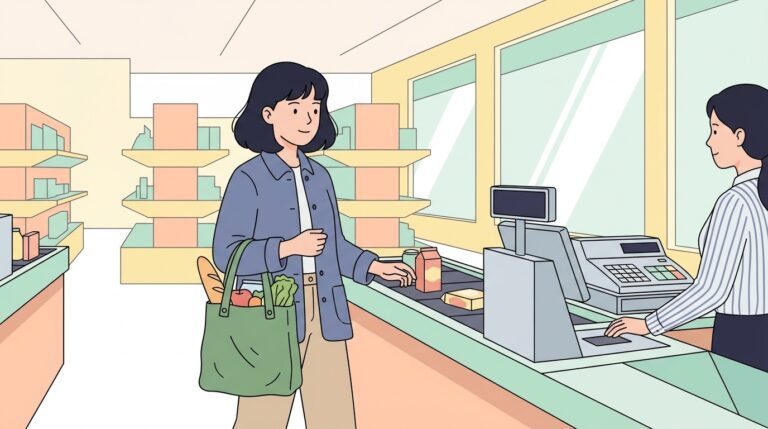
Mastering Eco-Friendly Shopping in Korea: How to Decline Plastic Bags Like a Local
Phase 1: Empathy (Story-Driven Opening)
안녕하세요! 매일한글 에디터입니다.
Picture this: You are standing in line at an E-Mart or a trendy neighborhood convenience store in Hongdae on a Friday evening. The cashier scans your Shin Ramyun, iced coffee pouches, and snacks with Olympic-level speed. Suddenly, without missing a beat, they look up and fire a rapid-fire question: “봉투 필요하세요?” (Bongtu piryohaseyo?).
Your mind freezes. You know you don’t need a bag because you shoved a cute tote bag into your jacket pocket earlier, but the words get stuck in your throat. You hesitate for two seconds, give an awkward nod, and end up paying 100 won for a crinkly, single-use plastic bag you feel guilty about taking. Or worse, you vigorously shake your head “No,” but the cashier is already stuffing your purchases into a bag because your hesitation signaled uncertainty!
South Korea takes environmental regulations and recycling extremely seriously. Since the nationwide ban on single-use plastic bags at large supermarkets and department stores, knowing how to decline or replace plastic bags isn’t just about saving pocket change—it is a core social etiquette that instantly marks you as an informed, respectful cultural insider. Based on feedback from hundreds of intermediate learners who felt flustered at Korean cash registers, this comprehensive B2 guide will equip you with the linguistic finesse and street smarts needed to breeze through any checkout line while caring for the planet.
Phase 2: Core Expressions Deep Dive
Here are the three must-know expressions every intermediate speaker should have loaded and ready at checkout:
1. 장바구니 챙겨왔어요. (Jangbaguni chaeng-gyeowasseoyo.)
- Pronunciation: [Jangbaguni chaeng-gyeo-wa-sseo-yo] (Sounds like: “Jahng-bah-goo-nee cheng-gyuh-wah-ssuh-yo”)
- Meaning: Literal: “I packed and brought a market basket.” / Real Nuance: “I brought my own shopping bag, so I’m completely set!”
- K-Culture Moment: Seen frequently on variety shows like I Live Alone (나 혼자 산다) whenever self-sufficient solo residents unpack their chic canvas bags at local traditional markets.
- Editor’s Insight: The verb 챙기다 (chaenggida) is an essential B2 verb denoting active preparation and mindfulness. Saying this shows you planned ahead, which Korean store clerks deeply appreciate.
- Situation Spectrum: Casual ⚠️ | Semi-formal ✅ | Formal ✅
- 🤔 Think About It: In English, we simply say “I have my own bag.” Why does Korean highlight the action of having brought it with you (챙겨오다) rather than just possession (있어요)?
2. 비닐봉투는 따로 안 주셔도 돼요. (Binilbongtuneun ttaro an jusyeodo dwaeyo.)
- Pronunciation: [Bi-nil-bong-tu-neun tta-ro an ju-syeo-do dwae-yo] (Sounds like: “Bee-neel-bong-too-neun ttah-ro ahn joo-syuh-doh dweh-yo”)
- Meaning: Literal: “As for plastic bags, you do not need to give me one separately.” / Real Nuance: “No need for a plastic bag, thank you!”
- K-Culture Moment: The polite, effortless line used by sophisticated urbanites in K-dramas when grabbing skincare items at Olive Young.
- Editor’s Insight: Using ~안 주셔도 돼요 (-an jusyeodo dwaeyo) is infinitely softer and more considerate than saying “주지 마세요” (Do not give me), which sounds like an abrupt command.
- Situation Spectrum: Casual ⚠️ | Semi-formal ✅ | Formal ✅
- 🤔 Think About It: How does phrasing refusals in terms of relieving the other person’s obligation (“you don’t have to”) reflect Korean interpersonal harmony?
3. 종량제 봉투로 한 장 주세요. (Jongnyangje bongturo han jang juseyo.)
- Pronunciation: [Jong-nyang-je bong-tu-ro han jang ju-se-yo] (Sounds like: “Jong-nyang-jeh bong-too-roh hahn jahng joo-seh-yo”)
- Meaning: Literal: “Please give me one volume-rate garbage bag.” / Real Nuance: “I need a bag, but make it the official district trash bag!”
- K-Culture Moment: The ultimate local life hack! When Korean characters in sitcoms make a late-night mart run, they buy a local garbage bag to carry groceries home, killing two birds with one stone.
- Editor’s Insight: In Korea, general single-use shopping bags cannot easily be thrown away. By asking for a 종량제 봉투, your grocery bag doubles as your household trash bag for your specific district (구).
- Situation Spectrum: Casual 🚫 | Semi-formal ✅ | Formal ✅
- 🤔 Think About It: How does Korea’s strict “Pay-As-You-Throw” garbage system incentivize shoppers to be pragmatic at checkout?
Phase 3: Textbook Korean vs. Real Korean
Elevate your fluency from stiff classroom dialogue to natural street-smart Korean.
Situation 1: Declining a bag because you have only 1 or 2 small items
- 📖 Textbook Korean: 저는 비닐봉지를 원하지 않습니다. (Jeoneun binilbongjireul wonhaji anseumnida. – “I do not desire a plastic bag.”)
- 🗣️ Real Korean: 그냥 손으로 들고 갈게요! (Geunyang soneuro deulgo galgeyo! – “I’ll just carry it in my hands!”)
- 💡 Why It Differs: Koreans rarely use “원하다” (to desire/want) for mundane everyday transactions. Phrasing it around how you plan to transport the goods (“I will hold it in my hands”) sounds breezy, warm, and natural.
Situation 2: Asking if the supermarket provides reusable rental shopping bags
- 📖 Textbook Korean: 재사용 가능한 가방을 판매합니까? (Jaesayong ganeunghan gabang-eul panmaehapnikka? – “Do you sell reusable bags?”)
- 🗣️ Real Korean: 혹시 다회용 쇼핑백 대여 되나요? (Hoksi dahoeyong syopingbaek daeyeo doenayo? – “By any chance, can I rent a reusable shopping bag?”)
- 💡 Why It Differs: Major chains (like E-Mart, Lotte Mart, Homeplus) allow you to deposit 500–3,000 KRW to borrow heavy-duty woven bags (다회용 쇼핑백) and return them later for a full refund. Asking about “대여” (rental) shows true local insider knowledge.
Phase 4: K-Culture Deep Dive & Non-Verbal Manners
4-1. 눈치 (Nunchi) & Physical Etiquette
Korean checkout lanes run on lightning speed. Demonstrating high nunchi means showing your intentions before words are even required:
* The Preventive Bag Display: As you place items on the counter or conveyor belt, unfold your reusable bag and place it beside your items. This signals immediately: Don’t bother offering a bag.
* The Gentle Two-Hand Wave (손사래): If the cashier instinctively reaches for a plastic bag, gently wave one hand (palm facing them at chest level) while saying “괜찮아요!” (Gwaenchanayo!). Do not make a sharp dismissive gesture; keep it smooth and polite.
4-2. The Cultural Code: “Yong-gi-nae” & Eco-Consciousness
In modern Korea, environmentalism has merged with hip lifestyle aesthetics. You will encounter the #용기내챌린지 (Yongginae Challenge)—a witty pun on the word 용기 (which means both “courage” and “container”). Influencers and K-pop idols bring their own multi-use containers (락앤락 / Lock&Lock) to bakeries, tteokbokki stalls, and cafes to refuse disposable packaging. Eco-responsibility is no longer seen as a chore; it is considered trendy (힙하다).
Phase 5: Real-World Roleplay Scenario
Setting: Saturday afternoon at an E-Mart in Mapo-gu. The cashier, Cashier Park (박 여사님), has thirty people in queue and processes items at lightning speed.
- Cashier Park: 어서 오세요. 포인트 카드 있으세요? (Eoseo oseyo. Pointeu kadeu isseuseyo?)
🎭 Action: Beeps three ramyeon packs in one second without breaking eye contact with the screen.
(Welcome. Do you have a store point card?) - Learner: 아니요, 없어요. 현금영수증만 해주세요. (Aniyo, eopseoyo. Hyeon-geum-yeongsujeungman haejuseyo.)
🎭 Action: Prepares payment card.
(No, I don’t. Just a cash receipt, please.) - Cashier Park: 봉투 필요하세요? 100원 추가되세요. (Bongtu piryohaseyo? Baek-won chugadoeseyo.)
🎭 Action: Hand hovers over the plastic bag rack beneath the till.
(Do you need a bag? It’s an extra 100 won.) - Learner: 아, 비닐봉투는 안 주셔도 돼요. 장바구니 챙겨왔어요! (A, binilbongtuneun an jusyeodo dwaeyo. Jangbaguni chaeng-gyeowasseoyo!)
🎭 Action: Opens a foldable nylon eco-bag on the counter ledge.
(Ah, you don’t need to give me a plastic bag. I brought my own shopping bag!) - Cashier Park: 어머, 준비 잘해 오셨네! 이쪽에 담으시면 돼요. (Eomeo, junbi jalhae osyeonne! Ijjoge dameusimyeon dwaeyo.)
🎭 Action: Smiles approvingly and pushes scanned groceries toward your bag.
(Oh my, you came well prepared! You can pack them right here.) - Learner: 감사합니다. 혹시 이거 테이프로 묶어 주실 수 있나요? (Gamsahamnida. Hoksi igeo teipeuro mukkeo jusil su innayo?)
🎭 Action: Points to a bundle of two drink bottles.
(Thank you. By any chance, could you tape these together?) - Cashier Park: 네, 묶어 드릴게요. 총 2만 4천 원입니다. (Ne, mukkeo deurilgeyo. Chong iman sacheon-won-imnida.)
🎭 Action: Swiftly tapes the handles together and accepts the card.
(Sure, I’ll tape them. That’s 24,000 won in total.) - Learner: 수고하세요! 안녕히 계세요. (Sugohaseyo! Annyeonghi gyeseyo.)
🎭 Action: Bows politely with both hands securing the shopping bag.
(Keep up the good work! Goodbye.)
🔀 Interactive Decision Point
If the cashier accidentally starts packing your items into a paid bag before you could speak, what do you say?
- Choice A: “저기요, 그거 쓰지 마세요!” (Jeogiyo, geugeo sseuji maseyo!)
Feedback: ❌ Bad. Overly blunt and confrontational. It sounds like an accusatory reprimand. - Choice B: “아, 죄송한데 저 가방 있어서 그냥 담아갈게요!” (A, joesonghande jeo gabang isseoseo geunyang damagalgeyo!)
Feedback: 🏆 Best! Super natural and considerate. The soft apology softens the interruption, and you explain your alternative effortlessly. - Choice C: “봉투 환불해 주세요.” (Bongtu hwanbulhae juseyo!)
Feedback: ⚠️ Risk. Grammatically correct, but asking for a 100-won refund mid-scan will hold up a fast-moving Seoul line and create awkward friction.
Phase 6: 10-Second Emotion Shadowing Drill
Practice matching native rhythm, cadence, and emotion markers. The slash (/) indicates a natural micro-pause.
[😊 Cheerful and polite]
“아, / 봉투는 괜찮아요! / 장바구니 있어요.”
(A, / bongtuneun gwaenchanayo! / jangbaguni isseoyo.)-
[🤝 Cooperative and considerate]
“따로 안 주셔도 돼요, / 그냥 손으로 들고 갈게요!”
(Ttaro an jusyeodo dwaeyo, / geunyang soneuro deulgo galgeyo!) -
[💡 Clever local life-hack tone]
“혹시 / 여기 종량제 봉투 / 제일 작은 거 있나요?”
(Hoksi / yeogi jongnyangje bongtu / jeil jageun geo innayo?)
Phase 7: K-Culture Mini Dictionary
- 장바구니 (Jangbaguni) | Reusable grocery/market bag
Usage: From aesthetic canvas tote bags to foldable nylon bags, this refers to any bag dedicated to carrying food and mart shopping. - 종량제 봉투 (Jongnyangje bongtu) | Pay-as-you-throw standardized waste bag
Usage: The only legal trash bags accepted by municipal garbage trucks in Korea. Asking for one at checkout saves you from buying regular plastic waste. - 다회용기 (Dahoeyonggi) | Reusable food container
Usage: Frequently seen on delivery apps (like Baedal Minjok) and restaurants participating in eco-friendly packaging initiatives. - 손사래 (Sonsarae) | Polite hand-waving gesture of refusal
Usage: The non-verbal gesture used to decline extras (straws, receipts, bags) without appearing rude or ungrateful.
Phase 8: Traveler’s Survival Kit
Top 3 Survival Phrases
- “그냥 가져갈게요.” (Geunyang gajyeogalgeyo.)
Pro Tip: Use this when buying 1-2 small drinks or snacks at a 7-Eleven or CU. It tells the clerk, “Don’t bag it; I’m walking out with it as is.” - “영수증은 버려주세요.” (Yeongsujeungeun beoryeojuseyo.)
Pro Tip: Paper receipt reduction is part of Korea’s green drive. Cashiers will gladly discard it if you say this. - “쇼핑백 보증금 환불되나요?” (Syopingbaek bojeunggeum hwanbuldoenayo?)
Pro Tip: When returning large woven rental bags at E-Mart customer service, this phrase gets your 500-1,000 KRW deposit back in cash.
Editor’s Travel Note
Before heading out for grocery shopping in Seoul, download the official Naver Map store navigation app to find local traditional markets (재래시장) or mega-marts nearby. When ordering takeout, look out for the green multi-use container option on major Korean food delivery platforms to experience zero-waste dining in Korea firsthand.
Phase 9: A Step Deeper (Reflective Essay)
In many Western cultures, asking for a bag is an individual consumer choice framed around convenience. In Korea, however, waste management is intimately tied to the concept of 우리 (Uri – “We / Our Community”). Because South Korea is a densely populated country with limited landfill space, environmental compliance is not viewed merely as personal virtue, but as a non-negotiable civic duty. When you carry your own jangbaguni, you are participating in a communal pact of mutual respect that every Korean citizen honors daily.
💬 Your Turn: What is eco-shopping etiquette like in your home country? Do cashiers charge for bags, or are they handed out freely? Share your checkout stories in the comments below!
Phase 10: FAQ & Common Mistakes
Q: Can I buy a standard white plastic bag at large marts in Seoul?
A: No. Under South Korea’s Resource Recycling Act, large discount marts, department stores, and major supermarkets are legally forbidden from distributing or selling single-use plastic bags for shopping. You can only rent reusable woven bags, purchase paper bags, or buy a local district jongnyangje trash bag.
Q: Why did the cashier look confused when I asked for a “가방” (gabang)?
A: While 가방 technically means bag, it almost exclusively refers to personal accessories like backpacks, purses, or messenger bags. For shopping, always specify 장바구니 (market bag), 쇼핑백 (shopping tote), or 봉투 (convenience bag).
Q: Can I use a 종량제 봉투 bought in Mapo-gu to throw away trash in Gangnam-gu?
A: Generally, no! Jongnyangje bags are strictly tied to specific local autonomous districts (구). A bag bought in Mapo can only be disposed of within Mapo-gu. If you are staying at an Airbnb, make sure the trash bag matches your accommodation’s district.
🚨 Common Mistakes Warning Board
- Mistake: Shouting “필요 없어요!” (Piryo eopseoyo! – “I don’t need it!”)
Correct Action: Say “괜찮아요, 그냥 들고 갈게요.” (It’s okay, I’ll just hold it.) 필요 없어요 sounds harsh and dismissive. - Mistake: Taking the free plastic produce rolls (롤백) at supermarkets and stuffing all your groceries into them at checkout.
Correct Action: Free thin plastic rolls in produce sections are legally restricted to wet, unpackaged meats and fresh vegetables only. Using them to bag dry groceries violates store policy. - Mistake: Assuming paper bags are always free.
Correct Action: Paper bags (종이 쇼핑백) also carry a small fee (usually 100-300 won). State clearly if you want one.
Phase 11: Action Missions
- 🥉 Bronze Mission (Self-Practice): Stand in front of your mirror with a canvas tote bag and repeat “비닐봉투는 따로 안 주셔도 돼요!” five times until it rolls off your tongue in under three seconds.
- 🥈 Silver Mission (Social Connection): Snap a flat-lay photo of your favorite reusable tote bag, post it on your Instagram Story or Korean study account, and caption it with: “오늘 장바구니 챙겼어요! 🌿 #매일한글 #제로웨이스트”.
- 🥇 Gold Mission (Real-World Test): Visit a Korean grocery mart or convenience store (or an H-Mart/Korean grocery abroad) and successfully decline a bag using one of today’s B2 phrases!
- 🎮 K-Culture Media Mission: Watch the latest vlog of your favorite K-pop idol or Korean lifestyle YouTuber doing grocery shopping. Spot how many seconds into the checkout conversation the cashier asks about bags!
Phase 12: Interactive Quiz Challenge
1. Real-Life Situation Judgment
You are checking out at a CU convenience store with an iced coffee and a sandwich. The clerk asks: “봉투 담아드릴까요?” (Shall I put it in a bag for you?). You brought a bag. What is the most natural B2 response?
* A) 비닐봉지를 주지 마시오.
* B) 아니요, 장바구니에 담아갈게요!
* C) 저는 환경주의자입니다.
2. Fill-in-the-Blank
Fill in the missing particle and verb:
“다회용 쇼핑백을 빌렸는데, 보증금 ________ 되나요?” (I borrowed a reusable bag; can I get my deposit refunded?)
3. True or False Cultural Quiz
Large supermarkets in Seoul are legally permitted to give out free single-use plastic bags if your purchase exceeds 50,000 KRW. (True / False)
👉 Click here to reveal Answers & Explanations!
-
Answer: B
Explanation: “아니요, 장바구니에 담아갈게요!” (No, I’ll pack it in my market bag!) is polite, natural, and helpful. Option A is an archaic historical command, and Option C sounds overly philosophical for a simple grocery run! -
Answer: 환불 (hwanbul) or 환불이
Complete Sentence: “다회용 쇼핑백을 빌렸는데, 보증금 환불 되나요?” (I borrowed a reusable shopping bag; can I get a deposit refund?) -
Answer: False
Explanation: Under South Korean law, single-use plastic grocery bags are strictly banned from distribution at large supermarkets, regardless of purchase amount. Only reusable, paper, or regional trash bags are permitted.







