

Phase 1: 공감 (Story-Driven Opening)
안녕하세요! 매일한글 에디터입니다.
Picture this: You just pulled off the most flawless self-introduction in Seoul. You smiled, bowed at the exact 15-degree angle you practiced in front of the mirror, and delivered: “안녕하세요, 저는 마이클이에요. 미국에서 왔어요. 만나서 반갑습니다!” You exhale, internally high-fiving yourself.
And then… it happens. The Korean speaker’s eyes light up with pure warmth and curiosity. They lean in and launch a lightning-fast barrage of questions: “한국에는 언제 오셨어요? 매운 거 잘 드세요? MBTI가 어떻게 되세요?”
Suddenly, the room spins. Your mind blanks. That rehearsed self-introduction script didn’t prepare you for what comes after! You freeze like a K-drama character caught in a dramatic freeze-frame cliffhanger.
Don’t panic! Receiving questions is actually the ultimate sign of success. In Korea, asking follow-up questions means: “I find you fascinating, and I want to welcome you into my circle.” Drawing from over a decade of coaching global learners and navigating real-life interactions in Seoul, this guide will transform that deer-in-the-headlights terror into effortless, charming banter. By the end of this post, you won’t just survive follow-up questions—you’ll own the conversation.
Phase 2: 핵심 표현 3선 심층 분석 (Top 3 Core Expressions)
Here are the three foundational power phrases every A2 learner needs when handling follow-up questions.
1. 다시 한번 말씀해 주시겠어요? (Dasi hanbeon malsseumhae jusigesseoyo?)
- Pronunciation: [Dah-shee hahn-beon mahl-sseum-hae joo-shee-get-sseo-yo?] (Think: “Dah-she” like the broth dashi + “hahn” like Han river + “beon” like a hamburger bun)
- Meaning: Literal: “Could you speak once again?” | Real Nuance: “I’m really listening, but could you please say that one more time?”
- K-Culture Moment: Seen constantly on variety shows like You Quiz on the Block when a guest speaks too softly or quickly, and the host politely asks for a repeat without breaking rapport.
- Editor’s Insight: Simply saying “네? (Ne?)” with rising intonation can sound blunt or confused. Using this polite honorific phrasing signals tremendous respect and instantly makes native speakers slow their speech down for you.
- Situation Spectrum: Casual ⚠️ | Semi-formal ✅ | Formal ✅
- 🤔 Think About It: In English, we often blurt out “What?” or “Sorry?” When Korean speakers ask for repetition, they elevate the speaker’s words (말씀 instead of 말). How does choosing honorific vocabulary change the emotional temperature of a conversation?
2. 네, 맞아요! 어떻게 아셨어요? (Ne, majayo! Eotteoke asyeosseoyo?)
- Pronunciation: [Ne, mah-jah-yo! Uh-tteo-keh ah-syeot-sseo-yo?]
- Meaning: Literal: “Yes, correct! How did you know?” | Real Nuance: “Spot on! Wow, you’re so sharp!”
- K-Culture Moment: The classic line used in K-dramas when someone correctly guesses the protagonist’s hometown, job, or favorite food during a casual get-to-know-you dinner.
- Editor’s Insight: This turns an interrogation into a two-way connection. Instead of just answering “Yes,” throwing back “어떻게 아셨어요?” delights the other person and gives you a 10-second breather while they explain how they guessed.
- Situation Spectrum: Casual ⚠️ | Semi-formal ✅ | Formal ⚠️
- 🤔 Think About It: Notice how this phrase bounces the spotlight back onto the other person. Why do you think Korean communication values bouncing reactions over giving long monologues?
3. 아직 한국어가 서툴러요. (Ajik hangugeo-ga seotulleoyo.)
- Pronunciation: [Ah-jeek hahn-goo-guh-gah suh-tool-luh-yo.] (The “seot” sounds like “shut” with a softer s)
- Meaning: Literal: “My Korean is still clumsy/unpolished.” | Real Nuance: “Please bear with me—I’m trying my best!”
- K-Culture Moment: Foreign idols (like TWICE’s Sana or SEVENTEEN’s Jun in their debut days) using modesty during variety show interviews, immediately triggering affectionate support from the MCs.
- Editor’s Insight: Avoid saying “한국어 못해요” (I can’t speak Korean)—it sounds overly self-deprecating and stops the conversation cold. “서툴러요” acknowledges your current beginner stage while showing humility and willingness to try.
- Situation Spectrum: Casual ✅ | Semi-formal ✅ | Formal ✅
- 🤔 Think About It: Korean culture places high value on modest understatement (겸손). How does admitting imperfection create warmer relationships compared to feigning complete confidence?
Phase 3: 교과서 한국어 vs 진짜 한국어 (Textbook vs. Real Korean)
Situation 1: Asking someone to repeat what they asked
- 📖 교과서 한국어: 무엇이라고 하셨습니까? (Mueos-irago hasyeosseumnikka? / What did you say?)
- 🗣️ 진짜 한국어: 죄송한데, 다시 말씀해 주시겠어요? (Joesonghande, dasi malsseumhae jusigesseoyo? / I’m sorry, could you please say that again?)
- 💡 왜 다를까? Nobody outside of a 19th-century historical drama or a military briefing says “무엇이라고 하셨습니까?”. In natural Seoul speech, softening your sentence with 죄송한데 (excuse me/I’m sorry, but…) makes you sound incredibly considerate and modern.
Situation 2: Confirming a simple question (e.g., “Are you a student?”)
- 📖 교과서 한국어: 그렇습니다. 저는 학생입니다. (Geureotseumnida. Jeoneun haksaeng-imnida. / That is correct. I am a student.)
- 🗣️ 진짜 한국어: 네, 맞아요! 학생이에요. (Ne, majayo! Haksaeng-ieyo. / Yes, that’s right! I’m a student.)
- 💡 왜 다를까? 그렇습니다 sounds like you’re testifying in a courtroom! Everyday Korean thrives on 네, 맞아요!, which carries upbeat, collaborative energy.
Phase 4: K-Culture 딥다이브 & 비언어적 매너 (Deep Dive & Non-Verbal Manners)
4-1. 눈치 (Nunchi) & Gestures: The Art of the Listening Body
When fielding questions in Korea, what your body does matters just as much as what your tongue does:
* The Attentive Head Tilt: Tilt your head slightly forward and offer steady, gentle nods (끄덕끄덕). It signals active engagement without aggressive staring.
* The Two-Handed Reception: If they hand you a business card or show you something on their phone while asking a question, hold your hands together or support your right forearm with your left hand.
* The Modest Chuckle: If you don’t understand the vocabulary, give a polite, slightly embarrassed smile. Korean speakers will instantly read your nunchi and simplify their phrasing.
4-2. Cultural Code: The Korean Curiosity Checklist
Don’t be startled if personal questions come flying at you immediately! Within five minutes of meeting you, Koreans often ask:
1. Age / Birth Year: Not to judge you, but to calibrate the proper politeness level (존댓말 vs. 반말).
2. MBTI: Today’s quintessential Korean social icebreaker.
3. Food tolerance: Specifically, “매운 거 잘 드세요?” (Can you handle spicy food?).
Think of this not as an interrogation, but as a cultural welcoming ritual—they are looking for common ground to bond with you over food and shared traits.
Phase 5: 실전 롤플레이 시나리오 (Real-Life Roleplay Scenario)
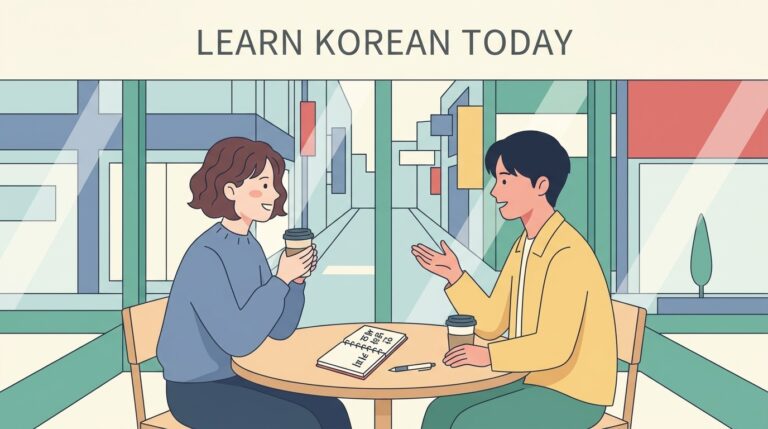
Setting: A trendy, sunlit cafe in Yeonnam-dong. You just sat down for your first one-on-one session with your language partner, Min-jun (민준).
- 민준: 지우 씨, 한국에 온 지 얼마나 됐어요?
(Jiwoo ssi, Hanguge on ji eolmana dwaesseoyo?)
“Jiwoo, how long has it been since you came to Korea?”
🎭 따뜻한 미소를 지으며 아이스 아메리카노를 내려놓는다. -
당신: 한 달 됐어요! 아직 모든 게 새로워요.
(Han dal dwaesseoyo! Ajik modeun ge saerowoyo.)
“It’s been one month! Everything is still new.”
🎭 두 손으로 컵을 쥐며 수줍게 웃는다. -
민준: 와, 한 달이요? 그런데 발음이 진짜 좋으시네요! 혹시 한국 음식 좋아해요?
(Wa, han dariyo? Geureonde bareumi jinjja joeusineyo! Hoksi Hanguk eumsik joahaeyo?)
“Wow, one month? But your pronunciation is really great! By any chance, do you like Korean food?”
🎭 깜짝 놀라며 눈을 동그랗게 뜬다. -
당신: 네, 완전 좋아해요. 특히 김치찌개 좋아해요!
(Ne, wanjeon joahaeyo. Teukhi gimchijjigae joahaeyo!)
“Yes, I totally love it. Especially kimchi stew!”
🎭 신나서 고개를 끄덕인다. -
민준: 매운 거 잘 드시네요! 그럼 순대나 곱창도 드셔 보셨어요?
(Maeun geo jal deusineyo! Geureom sundaena gopchangdo deusyeo bosyeosseoyo?)
“You handle spicy food well! Then have you tried sundae (blood sausage) or gopchang (intestines) yet?”
🎭 장난기 가득한 표정으로 묻는다. -
당신: 음… 죄송한데, 곱창이 뭐예요?
(Eum… joesonghande, gopchangi mwoyeyo?)
“Um… excuse me, but what is gopchang?”
🎭 고개를 살짝 갸웃하며 묻는다. -
민준: 아! 소나 돼지의 내장 요리예요. 쫄깃쫄깃하고 맛있어요. 나중에 같이 먹으러 갈까요?
(A! Sona dwaeji-ui naejang yoriyeyo. Jjolgitjjolgithago masisseoyo. Najunge gachi meogeureo galkkayo?)
“Ah! It’s beef or pork intestines. Chewy and delicious. Shall we go eat it together later?”
🎭 손동작으로 쫄깃함을 흉내 내며 제안한다. -
당신: 좋아요! 꼭 도전해 보고 싶어요.
(Joayo! Kkok dojeonhae bogo sipeoyo.)
“Sounds great! I definitely want to give it a try.”
🎭 활짝 웃으며 엄지를 척 들어 올린다.
🔀 인라인 인터랙티브 분기점 (Choose Your Next Response!)
Min-jun suddenly asks: “혹시 MBTI가 어떻게 되세요? (By the way, what is your MBTI?)”
- Option A: “몰라요. 관심 없어요.” (I don’t know. I’m not interested.)
- 👉 Feedback [Bad]: Ouch! This completely cuts off the friendly energy and sounds dismissive.
- Option B: “제 MBTI는 ENFP예요! 민준 씨는요?” (My MBTI is ENFP! How about you, Min-jun?)
- 👉 Feedback [Best]: Perfect score! You answered clearly and tossed the conversational ball right back to keep the dialogue rolling.
- Option C: “저는 그것을 잘 모릅니다만 당신의 생각은 어떻습니까?” (I do not know that well, but what is your opinion?)
- 👉 Feedback [Risk]: Grammatically correct, but way too stiff and robotic for a casual cafe setting!
Phase 6: 10초 감정 섀도잉 드릴 (Emotion Shadowing Drill)
Practice these aloud! Pay close attention to pauses (/) and pitch inflections:
[🥺 조금 당황했지만 정중하게]
죄송한데, / 다시 한번 / 말씀해 주시겠어요? ↗
(Joesonghande, / dasi hanbeon / malsseumhae jusigesseoyo?)-
[😊 반갑고 신나게]
네, 맞아요! / 어떻게 / 아셨어요? ↗
(Ne, majayo! / Eotteoke / asyeosseoyo?) -
[✨ 겸손하지만 자신감 있게]
아직 서툴지만, / 열심히 배우고 있어요! ↘
(Ajik seotuljiman, / yeolsimhi baeugo isseoyo!)
Phase 7: K-Culture 미니 사전 (Mini Dictionary)
-
호구조사 (Hogu-josa)
Literal Translation: Census / Household check
Everyday Usage: Humorous slang for when someone asks lots of personal questions (age, hometown, relationship status) upon first meeting. Knowing this term helps you smile through rapid-fire questions! -
리액션 (Reaction)
Literal Translation: Reaction
Everyday Usage: In Korea, good conversation relies on generous “reaction” (nodding, saying 진짜요?, gasping). Giving good reactions makes native speakers adore talking to you. -
티엠아이 (TMI)
Literal Translation: Too Much Information
Everyday Usage: Used casually when you share a tiny, fun, unprompted personal detail during an intro (e.g., “저 민트초코 좋아해요… TMI지만!”). -
티키타카 (Tiki-taka)
Literal Translation: Fast short passing in soccer
Everyday Usage: Smooth, witty conversational banter that bounces naturally back and forth between two people.
Phase 8: 여행자를 위한 생존 키트 (Traveler’s Survival Kit)
Top 3 Emergency Phrases When Overwhelmed with Questions
-
조금만 천천히 말씀해 주세요. (Jogeumman cheoncheonhi malsseumhae juseyo.)
Meaning: Please speak just a little bit slower.
Pro Tip: Pair this with a gentle downward press of your hands to physically signal slowing down. -
한국어 공부한 지 얼마 안 됐어요. (Hangugeo gongbuhan ji eolma an dwaesseoyo.)
Meaning: I haven’t been studying Korean for very long.
Pro Tip: Instantly sets realistic expectations and invites encouragement. -
이해했어요! 감사해요. (Ihaehaesseoyo! Gamsahaeyo.)
Meaning: I understood! Thank you.
Pro Tip: Use this once they explain or rephrase something to wrap up the clarification warmly.
Editor’s Travel Note
When chatting in real-life Korean cafes or social meetups, always keep helpful tools handy. If you get completely stuck on a vocabulary word, rely on the 네이버 파파고 번역 앱 다운로드 for natural contextual translations, or use the 네이버 지도 길찾기 앱 다운로드 when locals eagerly recommend neighborhood culinary spots during your conversation!
Phase 9: “한 발 더 깊이” (Deep Cultural Reflection)
In Western cultures, direct questions about marital status, age, or daily routines can feel like an invasion of personal boundaries. In Korea, however, curiosity is affection. Korea’s foundational social fabric rests on 우리 (woori – “we/us”) and 정 (jeong – emotional attachment). When a Korean asks you five personal questions in a row, they aren’t cross-examining you; they are searching for threads to knit you into their social tapestry.
💬 Your Turn: What is the most surprising or unexpected question you’ve ever received when meeting someone new? Share your story in the comments below!
Phase 10: FAQ & 흔한 실수 (FAQ & Common Mistakes)
Q: What should I do if someone asks my age right after my self-introduction?
A: Don’t take offense! Simply state your international age or birth year using: “저는 [Year]년생이에요” (e.g., “저는 1998년생이에요”). This is simply their polite way of determining honorific speech levels.
Q: Is it rude to say “뭐라고요? (Mworagoyo?)” when I don’t catch a question?
A: Yes, it can sound quite sharp or combative, similar to barking “Say what?!” Always opt for “죄송한데 다시 말씀해 주시겠어요?”.
Q: How do I respond if they ask a question I genuinely don’t want to answer?
A: You can deflect gracefully with a smile and say: “그건 비밀이에요! (Geugeon bimirieyo! / That’s a secret!)”. It keeps the mood light and playful while holding your boundary.
🚨 흔한 실수 (Common Mistakes) Warning Board
- Mistake: Freezing in total silence while racking your brain for vocab.
Correct Action: Use filler sounds like “음… 잠깐만요! (Eum… jamkkanmanyo! / Um… just a second!)” to show you are thinking. - Mistake: Answering questions with just a flat “네” or “아니요”.
Correct Action: Add a confirming sentence or return question: “네, 맞아요. [Name] 씨는요?”. - Mistake: Panicking when you don’t recognize every word.
Correct Action: Listen for the core noun and repeat it with rising intonation (“아, 김치찌개요?”) to check if you’re on the right track.
Phase 11: 액션 미션 & 참여 유도 (Action Missions)
- 🥉 Bronze Mission (Solo Practice): Stand before a mirror and practice saying “다시 말씀해 주시겠어요?” with a gentle smile three times.
- 🥈 Silver Mission (Social Share): Post your favorite self-introduction follow-up phrase on Instagram or Threads and tag your language study buddies.
- 🥇 Gold Mission (Real Life): The next time a Korean speaker asks you a question, respond with “네, 맞아요! 어떻게 아셨어요?”.
🎮 K-Culture Mission: Watch any Korean variety show episode (like Running Man or Omniscient Interfering View). Spot the exact moment a guest responds to a question with “맞아요!” and mimic their tone of voice!
Phase 12: 인터랙티브 퀴즈 챌린지 (Interactive Quiz Challenge)
Test your knowledge before you hit the streets of Seoul!
1. Situation Judgment:
Your Korean language partner asks you: “한국 드라마 좋아하세요? (Do you like Korean dramas?)” What is the warmest, most natural A2 response?
(A) 상관없습니다.
(B) 네, 완전 좋아해요! 혹시 추천해 주실 드라마 있어요?
(C) 왜 그런 걸 물어보세요?
2. Fill in the Blank:
“I couldn’t hear well. Please say that one more time.”
잘 못 들었어요. 다시 [ ] 말씀해 주세요.
3. Cultural True or False:
True or False: When Koreans ask personal questions right after meeting you, it means they are trying to judge your social status negatively.
👉 Click to reveal answers & explanations!
1. Answer: (B)
Explanation: Option (B) warmly confirms your enthusiasm and keeps the conversation flowing naturally by asking for their recommendation. (A) is cold, and (C) is confrontational!
2. Answer: 한번 (hanbeon)
Explanation: 다시 한번 (dasi hanbeon) means “once again / one more time”.
3. Answer: False
Explanation: In Korean culture, follow-up questions are an expression of warmth, personal interest, and a desire to build jeong (connection).







