

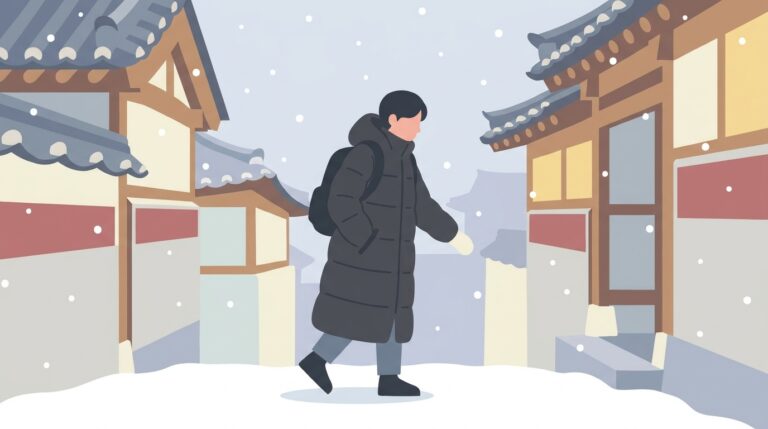
Don’t Slip on Seoul Streets: Essential Korean for Snowy and Icy Roads
Phase 1: Empathy (Welcome & The Seoul Slush Reality)
안녕하세요! 매일한글 에디터입니다. (Hello! This is your Daily Hangul editor.)
Picturing winter in Korea usually conjures up dreamy K-drama frames: soft white flakes tumbling from the sky, twinkling fairy lights lining the trendy cafes of Seongsu-dong, and couples sharing a single umbrella. But let me paint you the unfiltered real-life picture: you step out of your heated apartment or boutique hotel in Hongdae wearing your most stylish boots, take two proud steps on an unassuming incline, and suddenly—whoosh! Your feet fly into the air, your arms flail in a frantic windmill dance, and you narrowly escape landing flat on your back in front of a group of grandmothers who are navigating the icy slope like seasoned Himalayan sherpas.
Seoul is famous for its hills, and when fresh powder turns into hard, compacted ice, getting around becomes an Olympic balancing event. Many of our intermediate learners tell us they know how to say “It is snowing” (눈이 와요), but freeze up when trying to warn a friend, explain why they are running late, or express sympathy to a coworker braving the treacherous morning commute. Learning how to say “눈이 와서 길이 미끄러워요” (It’s snowing, so the street is slippery) and its companion survival phrases will protect your joints, save your social dignity, and prove that you have real-world situational fluency in Korean!
Phase 2: Core Expressions Deep Dive
1. 눈이 와서 길이 너무 미끄러워요 (Nuni waseo giri neomu mikkeureowoyo)
- Pronunciation: [Noo-nee wah-suh kee-ree nuh-moo mee-kku-ruh-wo-yo] (Sound analogy: Think of “new knee” for nuni, “gear-y” with a soft g for giri, and double-tap the ‘k’ sound in mikkeureowoyo like clicking a ballpoint pen).
- Meaning: Literal: “Because snow came, the road is very slippery.” | Actual Nuance: “Watch your step out there—the sidewalks are slick and dangerous today!”
- K-Culture Moment: That classic scene in winter rom-coms where the lead character slips on an icy hill, gets dramatically caught by the waist, and is told softly: “눈이 와서 길이 미끄러우니까 조심해요.”
- Editor’s Insight: At the B1 level, you want to move beyond robotic sentences. The “-아서/어서” connector naturally weaves cause and effect together, making your speech sound mature and observant.
- Situation Spectrum: Casual: ⚠️ (To close friends: “눈 와서 길 너무 미끄러워”) | Semi-formal: ✅ | Formal: ✅ (눈이 와서 길이 매우 미끄럽습니다)
- 🤔 Think About It: Notice how Koreans state the environmental cause (눈이 와서) before the consequence (길이 미끄러워요). How does stating the natural context first influence how we perceive accidents?
2. 조심해서 걸으세요 (Josimhaeseo georeuseyo)
- Pronunciation: [Cho-sheem-hae-suh guh-reu-seh-yo] (Sound analogy: “Cho-sheem” sounds like “choose him” spoken quickly; “georeu” sounds like a relaxed “guru”).
- Meaning: Literal: “Please walk carefully.” | Actual Nuance: “Mind your footing / Take small, safe steps on the ice!”
- K-Culture Moment: A protective parent or elder slipping a hand warmer (핫팩) into your padded coat pocket before you head outside into a snowstorm.
- Editor’s Insight: The verb “조심하다” (to be careful) paired with the connective “-해서” turns an imperative instruction into an affectionate safety blessing.
- Situation Spectrum: Casual: ⚠️ (조심해서 걸어) | Semi-formal: ✅ | Formal: ✅ (조심해서 걸으십시오)
- 🤔 Think About It: In English, people frequently say “Take care!” as a generic goodbye. In Korea, goodbyes are dynamically adapted to the day’s physical environment.
3. 빙판길 조심하세요 (Bingpangil josimhaseyo)
- Pronunciation: [Bing-pahn-geel cho-sheem-hah-seh-yo] (Sound analogy: “Bing” like the search engine, “pahn” like a frying pan, and “geel” like a fish gill).
- Meaning: Literal: “Beware of ice-sheet roads.” | Actual Nuance: “Be careful of black ice and hard-packed snow!”
- K-Culture Moment: Subway station monitors and evening news chyrons flashing urgent weather warnings as sub-zero temperatures hit the peninsula.
- Editor’s Insight: “빙판길” refers specifically to that treacherous, glossy layer of ice on concrete. Using this compound noun shows that you understand Korean winter terminology.
- Situation Spectrum: Casual: ⚠️ (빙판길 조심해) | Semi-formal: ✅ | Formal: ✅
- 🤔 Think About It: Why does Korean feature distinct standalone nouns for different road conditions (눈길, 빙판길, 빗길)? What does this reveal about Korea’s seasonal walking lifestyle?
Phase 3: Textbook Korean vs Real Korean
Situation 1: Telling a friend about icy sidewalks outside the cafe
- 📖 교과서 한국어: “눈이 내렸기 때문에 보도가 대단히 미끄럽습니다.” (Nuni naeryeotgi ttaemune bodoga daedanhi mikkeureopseumnida. – Because snow has fallen, the pedestrian path is extremely slippery.)
- 🗣️ 진짜 한국어: “밖에 눈 쌓여서 완전 빙판이야. 미끄러우니까 조심해!” (Bakke nun ssahyeoseo wanjeon bingpaniya. Mikkeureounikka josimhae! – Snow piled up outside, so it’s total ice. It’s slippery, so be careful!)
- 💡 왜 다를까? Textbooks use rigid, formal words like “보도” (walkway) and “대단히” (extremely). Real Koreans talk about snow “piling up” (눈 쌓이다) and describe hazardous surfaces casually as “완전 빙판” (total sheet of ice).
Situation 2: Saying goodbye to a colleague heading home during a blizzard
- 📖 교과서 한국어: “안전하게 귀가하시기를 바랍니다.” (Anjeonhage gwigahasigireul baramnida. – I hope you return home safely.)
- 🗣️ 진짜 한국어: “길 많이 미끄러우니까 천천히 들어가세요! 내일 봬요.” (Gil mani mikkeureounikka cheoncheonhi deureogaseyo! Naeil bwaeyo. – The roads are super slippery, so take your time heading in! See you tomorrow.)
- 💡 왜 다를까? “귀가하다” (returning home) is stiff administrative vocabulary. Native speakers prefer “들어가세요” (literally: enter safely) and add “천천히” (slowly) to convey heartfelt consideration.
Phase 4: K-Culture Deep Dive & Non-verbal Manners
4-1. Nunchi & Gestures: The Seoul Penguin Walk (펭귄 걸음)
When walking on icy Seoul slopes, reading the environment through Nunchi (눈치) is an essential physical survival skill. The biggest mistake visitors make is walking with both hands jammed deep inside their oversized coat pockets. If your foot catches black ice, you have zero reflexes to stabilize your center of gravity! Keep your hands out, grab a heat pack, and practice the time-honored “Penguin Walk” (펭귄 걸음): lean your torso slightly forward, take shorter steps, and place your feet down flatly. If you spot a slick, glistening tile ahead, point your toe at it and warn your companions with a quick: “어, 여기 미끄럽다!” (Eo, yeogi mikkeureopda! – Whoa, it’s slippery here!).
4-2. Cultural Code: Romantic Drama Tropes vs Rush Hour Reality
Korean media loves snow as an instrument of romance—think of the breathtaking winter scenery in Goblin or Crash Landing on You. But in urban Korean reality, winter snow spells anxiety for the morning commute. In steep districts like Gangnam, Oksu, or Itaewon, commuters band together in ankle-length down coats (“롱패딩”), cautiously treading along cleared paths. Mentioning “눈 와서 출근길 힘들었죠?” (The commute was tough because of the snow, wasn’t it?) is one of Korea’s most empathetic winter workplace icebreakers.
Phase 5: Real-Life Roleplay Scenario
Setting: You and your Korean coworker Minho (민호) are stepping out of your Yeouido office building into an unexpected heavy snowfall at 6:30 PM.
- 민호: 와, 벌써 눈이 이렇게 쌓였네요! (Wa, beolsseo nuni ireohge ssahyeotneyo! – Wow, snow has already piled up like this!)
🎭 눈을 올려다보며 감탄하는 표정을 짓는다 / Looks up at the falling snow in awe - 학습자: 진짜 예쁘네요. 그런데 바닥이 좀 얼어붙은 것 같아요. (Jinjja yeppeuneyo. Geureonde badagi jom eoreobuteun geot gatayo. – It’s really pretty. But it looks like the ground is already freezing.)
🎭 발끝으로 조심스럽게 길바닥을 툭툭 쳐본다 / Taps the pavement cautiously with the tip of their boot - 민호: 맞아요. 기온이 뚝 떨어져서 눈이 얼었어요. 길이 너무 미끄러워요. (Majayo. Gioni ttuk tteoreojyeoseo nuni eoreosseoyo. Giri neomu mikkeureowoyo. – Exactly. The temperature plummeted, so the snow froze. The road is very slippery.)
🎭 롱패딩 지퍼를 목까지 올리며 주위를 둘러본다 / Zips up his long puffer jacket to the chin while scanning the sidewalk - 학습자: 그러게요. 우리 넘어지지 않게 조심해서 걸어요. (Geureogeyo. Uri neomeojiji anhge josimhaeseo georeoyo. – Absolutely. Let’s walk carefully so we don’t fall.)
🎭 팔을 살짝 벌려 균형을 잡으며 천천히 걷기 시작한다 / Spreads arms slightly to maintain balance and begins walking slowly - 민호: 네, 특히 저기 대리석 계단 쪽은 완전 빙판길이에요! (Ne, teukhi jeogi daeriseok gyedan jjogeun wanjeon bingpangirieyo! – Yes, especially over there near the marble steps, it’s total black ice!)
🎭 손가락으로 건물 출입구의 반짝이는 바닥을 가리킨다 / Points to the glossy marble floor near the building entrance - 학습자: 으악! 방금 저도 모르게 미끄러질 뻔했어요. (Euak! Banggeum jeodo moreuge mikkeureojil ppeonhaesseoyo. – Whoa! I almost slipped just now without realizing it.)
🎭 엉덩방아를 찧을 뻔하다가 가까스로 중심을 잡는다 / Nearly falls backward, narrowly catching their footing - 민호: 괜찮으세요? 제 팔 잡고 걸으세요. (Gwaenchaneuseyo? Je pal japgo georeuseyo. – Are you okay? Take my arm and walk.)
🎭 걱정스러운 눈빛으로 팔꿈치를 내민다 / Offers an elbow with genuine concern - 학습자: 고마워요, 민호 씨. 덕분에 살았어요! (Gomawoyo, Minho ssi. Deokbune sarasseoyo! – Thank you, Minho. You saved my life!)
🎭 안도하며 민호의 팔을 살짝 붙잡는다 / Holds Minho's arm lightly with relief
🔀 Interactive Decision Point
You are about to navigate a steep downhill street to reach the subway station. What do you do?
* Option A: “민호 씨, 눈 오니까 달리기 시합할래요?” (Minho, wanna race through the snow?)
* Feedback (Bad): An orthopedic emergency waiting to happen! Koreans will look at you in sheer horror. Running on frozen Seoul slopes is never recommended.
* Option B: “주머니에서 손 빼고, 펭귄처럼 천천히 걸어가요.” (Let’s take our hands out of our pockets and walk slowly like penguins.)
* Feedback (Best): Perfect cultural fluency! It displays safety awareness, light humor, and street smarts. Minho will nod admiringly and smile.
* Option C: “한국은 왜 제설 작업을 빨리 안 해요?” (Why doesn’t Korea clear the snow faster?)
* Feedback (Risk): Sounds needlessly complainy. Municipal teams actually spread eco-friendly de-icer rapidly, but rapid freeze cycles make hilly streets tough to manage. Keep the mood positive!
Phase 6: 10-Second Emotion Shadowing Drill
[😨 조심스럽고 걱정스럽게 / Cautious and protective]
“눈이 와서 / 길이 너무 미끄러우니까 / 조심해서 걸으세요.”
(Nuni waseo / giri neomu mikkeureounikka / josimhaeseo georeuseyo.)-
[😱 깜짝 놀라며 아찔하게 / Startled and wide-eyed]
“어머! / 방금 얼음 밟고 / 넘어질 뻔했잖아!”
(Eomeo! / banggeum eoreum balpgo / neomeojil ppeonhaetjana!) -
[ 따뜻하고 다정하게 / Warm and affectionate]
“밖이 완전 빙판길이에요. / 꼭 주머니에서 손 빼고 / 천천히 다녀오세요.”
(Bakki wanjeon bingpangirieyo. / Kkok jumeonieseo son ppaego / cheoncheonhi danyeo-oseyo.)
Phase 7: K-Culture Mini Dictionary
- 빙판길 (Bingpan-gil) | Black Ice / Frozen Glaze Street | A compound of 빙판 (sheet of ice) and 길 (road). Heard in emergency broadcast notifications and subway announcements warning commuters of invisible ice.
- 롱패딩 (Long Padding) | Full-length Down Puffer Coat | South Korea’s iconic winter survival armor. Reaching from neck to ankle, it turns every commuter into an insulated sleeping bag against the Siberian wind.
- 붕어빵 (Bungeoppang) | Fish-shaped Sweet Red Bean Pastry | The ultimate hot winter street food reward. Buying a warm paper bag of three or four to share while carefully trudging through snow is pure bliss.
- 엉덩방아 (Eongdeongbanga) | Landing Flat on One’s Tailbone | A colorful native compound describing slipping on ice and landing hard on your backside (e.g., “엉덩방아 찧었어요” – I landed right on my butt).
Phase 8: Survival Kit for Travelers
Top 3 Survival Expressions
- 1. 미끄러우니까 조심하세요! (Mikkeureounikka josimhaseyo!)
- Pro Tip: Use this to warn anyone walking behind you or nearby if you spot a patch of slick tile near a subway entrance.
- 2. 여기 바닥 얼었어요! (Yeogi badak eoreosseoyo!)
- Pro Tip: Great shorthand for alerting friends before they step off a curb into treacherous slush.
- 3. 눈길에 미끄러졌어요. (Nungire mikkeureojyeosseoyo.)
- Pro Tip: Essential if you slip, arrive late to a reservation, or need to ask a pharmacy for pain relief patches (파스).
Editor’s Travel Note
- Transit & Maps: Winter weather causes bus reroutes and traffic jams. Use the Naver Map app download to track real-time bus arrivals and subway delays, or hail a licensed cab via the Kakao T app download rather than standing outside.
- Gear Tip: If sudden heavy snow hits Seoul, walk into any local Daiso or convenience store to buy attachable shoe slip-prevention grips (도시형 아이젠) and adhesive warmers (핫팩).
Phase 9: “One Step Deeper” (Cultural Reflection)
In Korean culture, warning someone with “길 미끄러우니까 조심해요” is far more than simple advice; it is a manifestation of Jeong (정)—the unspoken, communal warmth that binds society together. In a fast-paced urban environment where personal boundaries can seem guarded on crowded trains, severe weather opens a window for mutual care. When local shopkeepers step outside to sweep snow off the curb in front of neighboring doors, they are participating in a quiet tradition of collective safety.
💬 Your Turn: Have you ever had a memorable, funny, or terrifying slip on an icy street while traveling? How do people in your home culture warn each other when bad weather strikes? Share your winter story in the comments below!
Phase 10: FAQ & Avoiding Misunderstandings
Q: What is the grammatical difference between “미끄러워요” and “미끄러졌어요”?
A: “미끄러워요” (mikkeureowoyo) is an adjective describing the current condition of a surface (“It is slippery”). “미끄러졌어요” (mikkeureojyeosseoyo) is the past-tense active verb describing what happened to your body (“I slipped”). Remember: a street cannot “미끄러졌어요”—only people slip!
Q: Can I say “조심하세요” to an older person or stranger on the street?
A: Yes, absolutely! Saying “눈길 조심하세요” (Please be careful on the snowy roads) or “계단 미끄러우니 조심하세요” (The stairs are slippery, please be careful) is seen as thoughtful, warm-hearted, and socially respectful.
Q: What distinguishes “눈길” (nungil) from “빙판길” (bingpan-gil)?
A: “눈길” refers to roads covered with powdery, soft, or newly fallen snow. “빙판길” refers to hardened, melted-and-refrozen glaze ice or black ice, which has almost zero friction.
🚨 Common Mistakes Warning Board
- Mistake: Saying “눈이 와서 길을 미끄러워요.” (Using the object particle 을 with an adjective).
- -> Correct Action: Use the subject particle: “길이 미끄러워요.” (Descriptive verbs take 이/가).
- Mistake: Translating “Watch your step” literally into “당신의 걸음을 보세요.”
- -> Correct Action: Say “발밑 조심하세요” (Watch under your feet) or “조심해서 걸으세요.”
- Mistake: Walking with both hands wedged into coat pockets while looking at your smartphone.
- -> Correct Action: Keep at least one hand free to react to slips, look slightly downward, and use a pocket hand warmer instead.
Phase 11: Action Missions
- 🥉 Bronze Mission (Solo Practice): Stand up and practice saying: “눈이 와서 길이 미끄러워요, 조심해서 걸으세요” 3 times while performing the flat-footed penguin walk.
- 🥈 Silver Mission (Social Share): Snap a winter photo (or use a cozy winter beverage) and post it to Instagram or your study journal with the Korean caption: “다들 빙판길 조심하세요! ❄️”
- 🥇 Gold Mission (Real-world Challenge): Next time you chat with a Korean friend, language partner, or store clerk during bad weather, send this farewell: “오늘 눈 와서 미끄러우니까 조심해서 들어가세요!”
- 🎮 K-Culture Mission: Watch any winter episode of a drama like Weightlifting Fairy Kim Bok-joo or When the Weather Is Fine and identify how characters dress and walk when traversing snowy alleys.
Phase 12: Interactive Quiz Challenge
1. Situational Judgment: You see an elder about to step onto a wet, slippery marble ramp outside a subway exit. What is the most polite and natural Korean phrase to say?
* A) “빨리 뛰어가세요!”
* B) “어르신, 여기 미끄러우니까 조심하세요!”
* C) “눈이 정말 맛있어요!”
2. Fill-in-the-Blank:
“어젯밤에 눈이 많이 와서 아침 출근길이 완전 ( )이에요.”
(Yesterday night it snowed a lot, so this morning’s commute road is a complete sheet of ice.)
Hint: A 3-syllable noun starting with ㅂ.
3. Cultural True or False:
True or False: Asking your Korean coworker “눈 와서 오시는 길 미끄럽지 않았어요?” (Was your way in not slippery because of the snow?) is considered intrusive personal prying.
👉 Click here to reveal the answers and explanations!
1. Answer: B (“어르신, 여기 미끄러우니까 조심하세요!”)
Explanation: Option A encourages running on ice, and Option C talks about eating snow! Option B shows caring, respectful etiquette.
2. Answer: 빙판길 (Bingpan-gil)
Explanation: When snow freezes overnight, the roadway turns into dangerous black ice, known as 빙판길.
3. Answer: False
Explanation: Asking about a colleague’s winter commute is considered an attentive, friendly, and quintessential Korean office greeting!







