

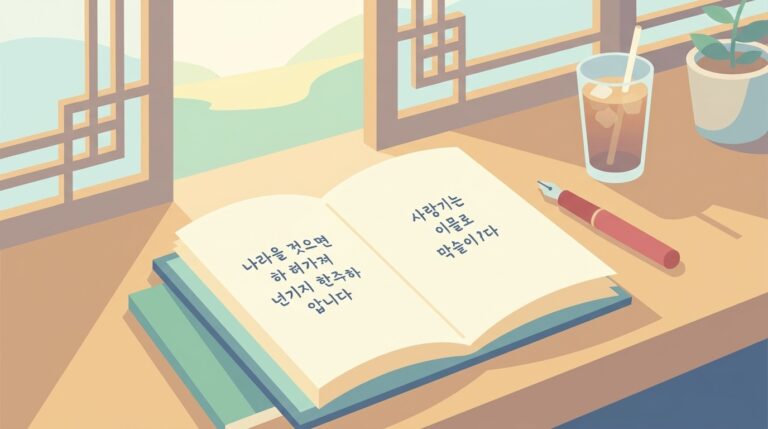
Mastering the Art of the Hook: How to Captivate Korean Readers in a Single Sentence
Phase 1: Empathy (A Story-Immersive Opening)
안녕하세요! 매일한글 에디터입니다. (Hello! This is your Daily Hangul editor.)
Picture this: You are sitting at a sun-drenched wooden table in a quiet café tucked inside the alleyways of Samcheong-dong. Your laptop is open, your iced Americano is sweating against the coaster, and you have finally gathered the courage to write your very first Korean essay for Brunch Story (브런치스토리) or draft an editorial pitch to a Korean publishing editor. Your grammar is impeccable; you have conquered TOPIK Level 6, and you know your subjunctive and indirect speech patterns by heart.
Yet, your cursor blinks mockingly on a blank white document. You type:
“저는 오늘 현대 사회의 인간관계에 대해 이야기하고자 합니다.”
(Today, I intend to talk about human relationships in modern society.)
Be honest—did your eyelids just droop? If that sentence were the opening line of a K-Drama, would you binge-watch the next sixteen episodes? Absolutely not. Korean readers are notorious for their razor-sharp intuition and high-context cultural radar. In a literary and digital landscape shaped by the breathless pacing of webtoons, the visceral prologues of K-Dramas like My Liberation Notes (나의 해방일지), and the poetic, understated essays of Seoul’s indie presses, your first sentence isn’t just an introduction—it is your contract with the reader’s soul.
Over the past decade mentoring advanced international scholars, creative writers, and bilingual journalists, I have witnessed countless brilliant minds stumble at this precise hurdle. They translate their thoughts flawlessly, but they miss the elusive rhetorical heartbeat that makes a native Korean reader stop scrolling and whisper, “와, 필력 대단하다” (Wow, what incredible prose).
Today, we are moving past dry textbook templates. We are diving into C2-level rhetorical craftsmanship: the psychology, linguistic rhythm, and cultural subtext behind unforgettable Korean opening hooks. Let’s transform your opening line into an irresistible magnetic pull.
Phase 2: Core Expressions (3 In-Depth Analyses)
1. 단언컨대, [주장/명제]. (Danneonkeonde, [Claim/Proposition].)
- Pronunciation: [Dan-eon-keon-dae] (Think: “Dahn-un-kuhn-deh”—crisp, authoritative, with a sharp snap at the end)
- Meaning: Literally “If I dare to declare with conviction,” but practically functions as: “Without a shadow of a doubt…” or “Mark my words…”
- K-Culture Moment: You will hear this dramatic framing in elite investigative journalism, high-stakes political thriller dramas (like Stranger / 비밀의 숲), or iconic corporate manifesto essays where the author stakes their entire professional ethos on a single, daring thesis.
- Editor’s Insight: At the C2 level, rhetorical courage commands immediate respect. Standard learners rely on timid hedgers like “~라고 생각합니다” (I think that…). In contrast, beginning with 단언컨대 creates instant tension. It signals an author who is not here to summarize common knowledge, but to overturn a prevailing myth.
- Situation Spectrum:
- Casual Social Media: ⚠️ (Can sound overly theatrical unless used playfully)
- Op-Eds & Critical Essays: ✅
- Formal Speeches & Pitches: ✅
- 🤔 Think About It: In Western rhetoric, bold claims often appear at the end of an introductory paragraph after contextual buildup. Why does high-context Korean prose value opening with an emotionally charged, definitive verdict first?
2. 만약 그날 [사건/선택]을(를) 하지 않았더라면? (Manyak geunal [Event/Choice]-eul haji anatdeoramyeon?)
- Pronunciation: [Mah-nyak geu-nal… ha-ji a-nat-deo-ra-myeon] (Flows softly like an internal whisper, trailing off into a reflective pause)
- Meaning: Literally “What if I hadn’t done [that] on that day?” but practically functions as: “A counterfactual narrative hook that pulls the reader directly into a fateful turning point.”
- K-Culture Moment: The hallmark opening device of celebrated memoirists and cinematic scriptwriters. Recall the mesmerizing voiceover intros in shows like Twenty-Five Twenty-One (스물다섯 스물하나), where a single retrospective question bridges past youth and present reality.
- Editor’s Insight: This structure leverages the retrospective conditional -았/었더라면. It instantly plunges the reader in media res (into the middle of things). Instead of explaining background facts chronologically, you evoke a sensory atmosphere drenched in poignant nostalgia or impending suspense.
- Situation Spectrum:
- Casual Blogs / Personal Essays: ✅
- Creative Nonfiction / Novels: ✅
- Hard Academic Dissertations: 🚫 (Too subjective for formal technical papers)
- 🤔 Think About It: How does phrasing a hook as an open-ended retrospective question engage the Korean reader’s innate empathy (정, Jeong) compared to a neutral chronological statement?
3. 어쩌면 시작은 [사소한 은유/관찰]이었을지도 모른다. (Eojjeomyeon sijageun [Metaphor/Observation]-ieosseuljido moreunda.)
- Pronunciation: [Uh-jjeo-myeon si-ja-geun… i-eot-seul-ji-do mo-reun-da] (A gentle, contemplative cadence; almost philosophical, mimicking thought in real time)
- Meaning: Literally “Perhaps the beginning was [a minor detail/fracture],” practically meaning: “Tracing an immense, life-altering transformation back to an imperceptible, everyday catalyst.”
- K-Culture Moment: Frequently opens best-selling Korean healing essays (힐링 에세이) and highbrow cultural critiques in publications like The Hankyoreh or Cine21.
- Editor’s Insight: True C2 Korean avoids bombast when exploring profound existential themes. This pattern uses the delicate modal adverb 어쩌면 (perhaps/perchance) paired with the epistemic ending -(으)ㄹ지도 모른다 (might have been). It lures the reader in by suggesting an intimate revelation rather than shouting for attention.
- Situation Spectrum:
- Literary Essays / Reflective Columns: ✅
- Creative Brand Storytelling: ✅
- Direct Business Proposals: ⚠️ (May feel too poetic for bottom-line metrics)
- 🤔 Think About It: Why is an understated, philosophical opening often perceived as having greater “literary depth” (필력의 무게) in Korea than loud, sensational clickbait?
Phase 3: Textbook Korean vs. Real Korean
Scenario 1: Proposing a New Perspective on Urban Life
- 📖 교과서 한국어 (Textbook):
“저는 오늘 서울이라는 도시에 대해 글을 쓰려고 합니다. 서울은 매우 복잡한 곳입니다.”
(Jeoneun oneul seouriraneun dosie daehae geureul sseuryeogo hamnida. Seoureun maeu bokjapan gosimnida. / Today, I am going to write about the city of Seoul. Seoul is a very crowded place.) - 🗣️ 진짜 한국어 (C2 Master Class):
“화려한 네온사인 뒤편, 서울은 누군가의 숨죽인 눈물을 먹고 자란다.”
(Hwaryeohan neonsain dwipyeon, seoureun nugungaui sumjugin nunmureul meokgo jaranda. / Behind its brilliant neon signage, Seoul feeds upon the muted tears of someone’s quiet struggle.) - 💡 왜 다를까? (Cultural & Linguistic Rationale):
Textbook Korean relies on meta-discourse (“I will write about…”), treating the reader like an evaluator grading an exam. Real native prose employs sensory personification (눈물을 먹고 자란다) and visual contrast (네온사인 vs. 숨죽인 눈물), immersing the reader instantly into a visceral emotional landscape.
Scenario 2: Starting a Business Opinion Piece or Tech Trend Editorial
- 📖 교과서 한국어 (Textbook):
“인공지능의 발전은 우리의 삶을 크게 변화시키고 있으며, 이는 중요한 문제입니다.”
(Ingongjineung-ui baljeoneun uriui salmeul keuge byeonhwasikigo isseumyeo, ineun jung-yohan munjemnida. / The development of AI is greatly changing our lives, and this is an important problem.) - 🗣️ 진짜 한국어 (C2 Master Class):
“기술이 인간의 고유성을 집어삼키는 순간, 우리는 무엇으로 남을 것인가.”
(Gisuri ingan-ui goyuseong-eul jibeosamkineun sungan, urineun mueoseuro nameul geosinga. / The moment technology devours human uniqueness, what will remain of us?) - 💡 왜 다를까? (Cultural & Linguistic Rationale):
Stating that an issue is “important” (중요한 문제입니다) is passive and bland. Elite Korean essayists formulate an existential provocation with vivid verbal metaphors (집어삼키다 – to swallow whole) and rhetorical interrogatives (무엇으로 남을 것인가), commanding intellectual engagement from word one.
Phase 4: K-Culture Deep Dive & Non-Verbal Manners
4-1. 눈치 (Nunchi) & The Breathing Rhythm of Korean Prose (호흡 조절)
Writing in Korean is not merely a typographical exercise; it is an act of communal Nunchi (social and sensory tact). Native readers do not read words in isolation—they feel the 호흡 (Ho-heup: rhythmic breathing) of your sentence.
- Sentence Pacing: Notice how modern Korean authors avoid endless, multi-clause subordinate chaining in their opening lines. A hook that drags on with ~하고, ~하며, ~해서, ~하므로 suffocates the reader before they finish the first sentence.
- The Visual Pause (여백의 미): Advanced Korean writers strategically hit the enter key after a potent first sentence. The physical blank line below your hook functions like an intentional pause in a theatrical monologue—it grants the reader space to let the impact settle before continuing.
4-2. Cultural Code Analysis: The “3-Second Rule” of Web Novels & Brunch Story
In contemporary South Korea, the digital storytelling ecosystem (such as KakaoPage web novels and Brunch Story essays) operates under the brutal 3초 컷 (3-Second Cut) rule. A commuter on Seoul Metro Line 2 glances at their phone screen between Gangnam and Yeoksam stations. If the opening line fails to ignite intrigue within three seconds, they swipe away.
Successful Korean writers harness this by borrowing structural techniques from K-Drama cold opens: begin at the climax, evoke a sudden sensory contrast, or challenge a cultural taboo right in sentence one. Respectability in modern Korean writing is no longer measured by stiff formality; it is defined by psychological resonance and narrative economy.
Phase 5: Real-World Roleplay Scenario
Setting: A minimalist editorial office in Seongsu-dong. You are reviewing your draft with Editor Jiwoo (지우 편집장), a veteran publisher known for shaping award-winning modern Korean essays.
Characters:
* 지우 (Jiwoo): Discerning, sharp-eyed, passionate about poignant storytelling.
* You: A C2-level non-native writer preparing a flagship publication.
Dialogue:
- 지우: “작가님, 본문 서술은 나무랄 데 없는데… 솔직히 첫 문장에서 손가락이 멈추질 않아요.” (🎭 원고 첫 장을 펜 끝으로 툭툭 두드리며)
(Jakganim, bonmun seosureun namural de eomneunde… soljiki cheot munjang-eseo songaragi meomchujil anayo. / Author, the body of your essay is flawless… but honestly, the first sentence doesn’t make my finger pause on the screen.) -
You: “아, 역시 첫 문장의 힘이 부족했군요. ‘저는 이 글에서 기억의 가치를 다루고자 합니다’는 너무 진부했죠?” (🎭 겸허하게 고개를 끄덕이며 메모장을 펼친다)
(A, yeoksi cheot munjang-ui himi bujokaetgunyo. ‘Jeoneun i geureseo gieogui gachireul darugoja hamnida’neun neomu jinbuhaetjyo? / Ah, I knew the hook lacked punch. Was ‘In this text, I aim to address the value of memory’ too cliché?) -
지우: “네. 교과서 보고서 같잖아요. 독자는 작가님의 의도에 관심 없어요. 작가님의 ‘시선’에 끌리는 거지.” (🎭 안경을 고쳐 쓰며 당신의 눈을 똑바로 응시한다)
(Ne. Gyogwaseo bogoseo gatjanayo. Dokjaneun jakganimui uidowe gwansim eopseoyo. Jakganimui ‘siseon’e kkeullineun geoji. / Yes. It reads like a textbook report. Readers don’t care about your intentions; they are drawn to your unique ‘gaze’.) -
You: “그렇다면 기억이라는 추상적 개념을 감각적인 사물로 치환해 보면 어떨까요?” (🎭 가만히 턱을 괴고 골똘히 생각에 잠긴다)
(Geureotamyeon gieogiraneun chusangjeok gaenyeomeul gamgakjeogin samullo chihwanhae bomyeon eotteolkkayo? / Then what if I substitute the abstract concept of memory with a sensory object?) -
지우: “좋은 접근이에요! 예를 들면요? 지금 머릿속에 스치는 첫 문장을 던져보세요.” (🎭 흥미롭다는 듯 상체를 테이블 앞으로 기울이며)
(Joeun jeopgeunieyo! Yereul deulmyeon-yo? Jigeum meoritsoge seuchineun cheot munjang-eul deonjyeoboseyo. / Excellent approach! For example? Throw me whatever first sentence just crossed your mind.) -
You: “‘먼지 쌓인 서랍 구석, 잊힌 흑백 사진 한 장이 나를 노려보고 있었다.'” (🎭 낮고 단단한 어조로 한 글자씩 또박또박 읊는다)
(Meonji ssain seorap guseok, ichin heukbaek sajin han jangi nareul noryeobogo isseotda. / ‘In the corner of a dust-covered drawer, a forgotten black-and-white photograph was glaring back at me.’) -
지우: “와… 바로 그거예요! ‘노려보고 있었다’라는 의인화가 긴장감을 단숨에 끌어올리네요.” (🎭 손뼉을 짝 치며 환하게 미소 짓는다)
(Wa… baro geugeoyeyo! ‘Noryeobogo isseotda’raneun uiinhwaga ginjanggameul dansume kkeureoollineyo. / Wow… that is exactly it! The personification of ‘glaring at me’ ramps up the tension in a single heartbeat.) -
You: “편집장님 피드백 덕분에 글의 호흡이 살아났습니다. 서두를 이 톤으로 전면 수정하겠습니다!” (🎭 안도감과 자신감이 담긴 표정으로 미소 짓는다)
(Pyeonjipjangnim pideubaek deokbune geurui hoheubi saranatseumnida. Seodureul i toneuro jeonmyeon sujeonghagetseumnida! / Thanks to your feedback, editor, the breath of the essay came alive. I’ll completely revise the opening in this tone!)
🔀 Interactive Branching Choice
Now imagine Editor Jiwoo turns to you and asks: “If we were writing the opening sentence for an essay about the burnout culture of young professionals in Gangnam, which angle would you pitch?”
- Option A: “새벽 두 시의 테헤란로, 꺼지지 않는 불빛들은 누구의 청춘을 태워 빛나는가.”
- Option B: “강남에서 일하는 것은 매우 피곤하고 스트레스가 많은 일이다.”
- Option C: “한국 직장인 여러분, 퇴사하고 싶다면 지금 당장 이 글을 클릭하세요!”
— Editor’s Evaluation:
* Option A (Best Choice – Literary Masterclass): Superb. Uses sensory contrast (2:00 AM darkness vs. unyielding skyscraper lights), evocative metaphor (청춘을 태워), and a profound rhetorical question. Immediate goosebumps for Korean readers.
* Option B (Bad Choice – Textbook Elementary): Complete flatline. It describes an obvious fact with dry, juvenile vocabulary (매우 피곤하고). Readers will skip immediately.
* Option C (Risk Choice – Cheap Clickbait / 어그로): High CTR on cheap tabloids, but damages your credibility (신뢰도) in serious editorial circles. It feels manipulative and lacks literary dignity.
Phase 6: 10-Second Emotion Shadowing Drill
To master C2-level cadence, you must practice speaking the sentences aloud with rhythmic pauses (/) and authentic emotional delivery. Read these three variations aloud:
- [🔥 강렬하고 도발적으로 – Bold & Provocative Assertion]
“단언컨대, / 우리가 믿어온 상식은 / 모두 정교한 거짓이었다.”
(Danneonkeonde, / uriga mideoon sangsigeun / modu jeonggyohan geojisieotda.)
“Mark my words: / the common sense we believed in / was an exquisitely crafted lie.” -
[🤫 은밀하고 미스터리하게 – Introspective & Atmospheric Suspense]
“모든 비극은 / 문을 잠그지 않은 / 그 사소한 방심에서 / 태어났다.”
(Modeun bigeugeun / muneul jamgeuji aneun / geu sasohan bangsim-eseo / tae-eonatda.)
“All tragedies / were born from that minute carelessness / of leaving the door unlocked.” -
[🥺 아련하고 깊은 회한을 담아 – Poignant & Nostalgic Yearning]
“그 계절의 끝자락, / 우리는 왜 서로의 상처를 / 그토록 집요하게 / 할퀴었을까.”
(Geu gyejeorui kkeutjarak, / urineun wae seoroui sangcheoreul / geutorok jibyohage / halkwieosseulkka.)
“At the trailing edge of that season, / why did we claw at each other’s wounds / with such stubborn cruelty?”
Phase 7: K-Culture Mini Dictionary
- 서두 (Seodu – 緖頭): The Opening Gambit / Preface. Literally the “head of the tangled thread.” In Korean rhetoric, crafting a flawless 서두 is considered half the battle (시작이 반이다).
- 필력 (Pillyeok – 筆力): Prose Power / Literary Prowess. Literally “the force of the writing brush.” Used constantly in modern Korea to praise authors who command language with captivating elegance and psychological depth.
- 후킹 (Hooking / 어그로 vs. 품격 있는 훅): While modern slang borrowed the English “hooking,” Koreans sharply distinguish between low-class clickbait (어그로) and an aesthetically elevated hook (품격 있는 도입부).
- 여운 (Yeoun – 餘韻): Lingering Resonance / Aftertaste. The poetic resonance that vibrates in the reader’s mind long after a sentence ends. A master hook generates curiosity not by telling everything, but by leaving deliberate 여운.
Phase 8: Writer & Traveler Survival Kit
When exploring Korea’s thriving independent bookstores, writing cafés, or literary forums, these phrases will help you converse with local book lovers and professionals:
- Survival Expression 1:
“이 책은 첫 문장부터 몰입감이 장난 아니네요.”
(I chaekeun cheot munjangbuteo moripgami jangnan anineyyo. / This book’s sense of immersion from the very first sentence is unbelievable.)- Pro Tip: Use 몰입감 (sense of immersion) when praising novels, webtoons, or K-Dramas.
- Survival Expression 2:
“도입부의 문체와 호흡이 정말 인상 깊습니다.”
(Doipbu-ui munche-wa hoheubi jeongmal insang gipseumnida. / The style and rhythmic breathing of the introduction are truly impressive.)- Pro Tip: Use this at literary lectures or book talks to instantly earn respect from the speaker.
- Survival Expression 3:
“혹시 조용히 글쓰기 좋은 북카페 추천해 주실 수 있나요?”
(Hoksi joyonghi geulsseugi joeun buk-kape chucheonhae jusil su innayo? / Could you perhaps recommend a quiet book café good for writing?)- Pro Tip: Perfect for finding hidden writing sanctuaries in Hapjeong or Hyehwa.
🧭 Editor’s Travel & Study Note:
If you want to observe what modern Koreans are reading and writing in real-time, visit the flagship Kyobo Book Centre in Gwanghwamun. Wander into the essay and humanities sections, take out a notebook, and analyze the first sentences of the current top ten bestsellers. To locate titles, check store stock, and map your literary tour across Seoul, make sure to install the 네이버 지도 앱 다운로드 and utilize the 교보문고 통합 도서 검색 서비스 before heading out.
Phase 9: “A Step Deeper” (한 발 더 깊이)
Traditional Korean aesthetics celebrate 여백의 미 (the beauty of empty space), where what remains unsaid resonates louder than what is spoken. For centuries, classical Korean prose prioritized subtlety and cyclical harmony over aggressive confrontation. Yet, contemporary Korean digital culture demands immediate impact.
The true mastery of C2 Korean writing lies in synthesizing these two opposing forces: launching your piece with an assertive, arresting hook without sacrificing the emotional vulnerability and understated elegance (은근한 멋) that native readers cherish. You are not simply grabbing their collar; you are inviting them into an intimate intellectual partnership.
💬 Your Turn: What is the opening sentence of your current project or your favorite Korean drama? Drop it in the comments below, and let’s polish its rhetorical rhythm together!
Phase 10: FAQ & Common Mistakes
Q: Can I use conversational endings like -잖아요 or -거든요 in an essay hook?
A: Only if your genre is an intimate, first-person confession or a modern conversational lifestyle column (생활 에세이). For formal columns, critiques, and serious op-eds, stick to the objective literary declarative ending -다 (해라체) (e.g., ~것이다, ~에 불과하다). This establishes intellectual distance and stylistic authority.
Q: How long should an ideal Korean opening sentence be?
A: As a rule of thumb, keep your hook under 35–45 Korean characters (자). Long, multi-clause opening sentences that require three lines of text cause cognitive fatigue before the reader has even invested in your world.
Q: Is it acceptable to begin with a proverb or famous quote (격언/사자성어)?
A: Beware! In contemporary Korean writing, starting with “‘시작이 반이다’라는 말이 있다” (There is a saying that ‘Well begun is half done’) is considered the ultimate hallmark of a middle school essay. Unless you subvert or deconstruct the proverb ironically, native editors view it as a lack of original thought.
🚨 Common Mistakes Alert (흔한 실수 TOP 3)
- The Self-Introduction Trap: Starting an essay with “안녕하세요, 저는 ~입니다” or “오늘 쓸 글은 ~입니다”.
- Correct Action: Cut the meta-announcement entirely. Begin directly inside the scene, question, or assertion.
- Overusing Passive Hedging: Stacking weak hedges like “~인 것 같다고 생각되어집니다” (double passive + tentative thought).
- Correct Action: Own your voice. Use definitive declarative structures: “~임에 틀림없다” or “~인 셈이다”.
- Grammar Translation Syndrome: Translating English rhetorical idioms word-for-word (e.g., translating “Every cloud has a silver lining” literally as “모든 구름은 은색 테두리를 가진다”).
- Correct Action: Replace foreign idioms with evocative, natural Korean sensory imagery.
Phase 11: Action Missions & Cultural Challenge
- 🥉 Bronze Mission (Solo Practice): Take a paragraph you previously wrote in Korean. Strike out the first two sentences entirely. Craft a brand-new, one-line hook using either 단언컨대 or an introspective question ending in -(으)ㄹ까.
- 🥈 Silver Mission (Social Sharing): Post your freshly polished hook on your social media or language exchange app (e.g., HelloTalk/Threads) with the hashtag
#매일한글_첫문장챌린지. Ask native speakers: “이 문장을 보면 다음 문장이 궁금해지나요?” (Does this sentence make you curious about the next?) - 🥇 Gold Mission (Real-World Execution): Submit a short draft or comment to a Korean writing platform like Brunch Story, an open forum, or a Naver Blog, employing the “sensory contrast” technique analyzed in Phase 3.
- 🎮 K-Culture Mission: Watch the first five minutes of three different K-Dramas on your watchlist tonight. Transcribe the very first spoken line of voiceover or dialogue. Analyze which of our three rhetorical archetypes it aligns with!
Phase 12: Interactive Quiz Challenge
Test your C2 instincts! Review the questions below and click the spoiler toggles to reveal the detailed explanations.
Quiz 1: Situation Judgment
Which of the following is the most compelling opening hook for a serious cultural essay exploring the decline of traditional regional villages in Korea?
* (A) 오늘은 한국의 시골 마을들이 왜 사라지고 있는지 그 이유를 살펴보도록 하겠습니다.
* (B) 버스가 하루 두 번만 서는 정류장, 녹슨 시간표 위로 마지막 주민의 이름이 지워져 간다.
* (C) 여러분 시골 좋아하시나요? 요즘 시골에 사람이 없어서 큰일이라고 합니다.
👉 Click to view the Answer & Explanation
Correct Answer: (B)
- Why (B) is brilliant: It paints an immediate, poignant sensory picture (버스가 하루 두 번만 서는 정류장, 녹슨 시간표) and uses symbolic personification (마지막 주민의 이름이 지워져 간다) to convey profound demographic tragedy without a single dry statistic.
- Why (A) fails: It is an uninspired procedural announcement (“Today we will examine…”).
- Why (C) fails: Too childish and colloquial for a nuanced cultural analysis.
Quiz 2: Fill in the Blank
Complete the opening hook to create a tense, provocative assertion:
“[ ], 자본주의가 우리에게 베푼 가장 큰 친절은 소비할 수 있는 자유가 아니라 포기할 수 없는 빚이었다.”
(Without a doubt, the greatest kindness capitalism bestowed upon us was not the freedom to consume, but the debt we cannot renounce.)
👉 Click to view the Answer & Explanation
Correct Answer: 단언컨대 (Danneonkeonde)
- Explanation: When making an unapologetic, high-conviction philosophical indictment, 단언컨대 sets an authoritative, uncompromising tone that electrifies the reader’s attention.
Quiz 3: True or False Cultural Nuance
“In high-level Korean essay writing, opening with a bold, provocative question is considered rude because Korean culture emphasizes harmony and modest consensus.”
👉 Click to view the Answer & Explanation
Correct Answer: False (F)
- Explanation: While politeness markers govern face-to-face interpersonal hierarchy, the modern Korean essay and editorial tradition deeply honors sharp, courageous intellectual inquiry (지적 긴장감). A provocative rhetorical hook demonstrates literary vitality and respect for the reader’s intelligence, provided it is handled with stylistic elegance rather than vulgar slang.







