

Phase 1: 공감 (Immersive Opening)
안녕하세요! 매일한글 에디터입니다.
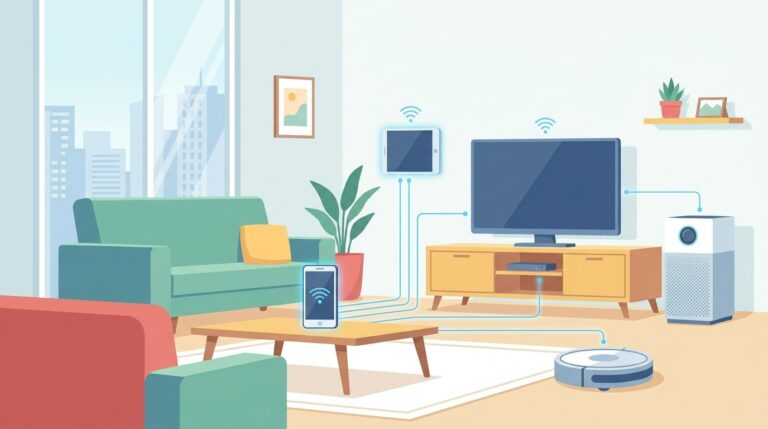
Imagine this: You’ve just moved into a brand-new officetel in Pangyo—Korea’s booming Silicon Valley—or perhaps you’re setting up a sleek Airbnb in Mapo. The agent hands you a digital tablet wall pad, points at your air conditioner, curtains, lighting, and robotic vacuum, and cheerfully says, “스마트싱스나 월패드로 기기 연동해 두시면 퇴근 시간에 맞춰 자동화 루틴 실행돼요!” You freeze for a second. You know textbook Korean words like 컴퓨터 (computer) or 인터넷 (internet), but when it comes to conversational Internet of Things (IoT) terminology—words like device pairing, cross-system interoperability, or setting up condition-based automation routines—your brain draws a blank.
Many of our advanced learners at Daily Hangul tell us: “I can discuss politics and literature in Korean, but the moment I need to explain a software glitch or configure a smart home appliance at work or home, I sound like an elementary school student.” Korea is currently one of the most hyper-connected, IoT-saturated societies in the world, where everything from apartment ventilation systems to trash bins runs on networked sensors.
Mastering IoT vocabulary is no longer just for software engineers; it is an essential C1 competency for surviving modern urban life and navigating tech-forward Korean workplaces. Based on our 10-year coaching field notes with foreign tech professionals in Seoul and Pangyo, this guide will transform your technical jargon into natural, native-level Korean that bridges high-level precision with conversational elegance.
Phase 2: 핵심 표현 3선 심층 분석 (Top 3 C1 Expressions)
1. 기기 간 연동이 매끄럽다 (Gigi gan yeondong-i maekkeureopda)
- Pronunciation: [Gi-gi gan yeon-dong-i maek-keu-reop-da] (Think: “Gee-gee” + “gahn” + “yawn-dong-ee” + “make-kuh-rawp-da”)
- Meaning: Literal: “Inter-device link/coupling is smooth.” | Real Nuance: “Cross-device integration is completely seamless.”
- K-Culture Moment: In tech-startup K-Dramas like Start-Up (스타트업), you frequently hear developers evaluate user experience (UX) during sprint reviews by asking whether the sensor hardware and mobile app 연동 (integrate) smoothly without latency.
- Editor’s Insight: The noun 연동 (Yeondong) means coupling or interlocking. When evaluating modern IoT ecosystems (like Samsung SmartThings or LG ThinQ), native speakers rarely say “연결이 잘 된다” (connecting well). Instead, they praise “연동성” (interoperability/seamless linkage).
- Situation Spectrum:
- Casual: ✅ (“이 앱이랑 조명 연동 진짜 매끄럽네!”)
- Semi-formal: ✅ (“태블릿과 월패드 연동이 아주 매끄럽습니다.”)
- Formal: ✅ (“기기간 데이터 연동의 안정성을 지속적으로 검증하고 있습니다.”)
- 🤔 Think About It: In English, we often say “it pairs well” or “it syncs effortlessly.” Korean emphasizes the dynamic, continuous linkage (연동) rather than just the initial pairing event. How does your native language conceptualize network connection?
2. 자동화 루틴을 설정하다 / 맞춰두다 (Jadonghwa rutineul seoljeonghada / matchwoduda)
- Pronunciation: [Ja-dong-hwa ru-tin-eul seol-jeong-ha-da / mat-chwo-du-da] (Sounds like: “Jah-dong-hwah roo-teen-eul soul-jung-hah-dah”)
- Meaning: Literal: “To set / configure an automation routine.” | Real Nuance: “To program smart triggers (e.g., geo-fencing, sunset automations).”
- K-Culture Moment: In modern lifestyle vlogs (Vlog 브이로그) of urban Korean professionals, you often see influencers saying, “퇴근길에 맞춰서 보일러 돌아가게 자동화 루틴 맞춰뒀어요” (I set up an automation routine so the heater turns on right on my commute home).
- Editor’s Insight: While 설정하다 is the standard formal term for “configure,” in conversational C1 Korean, pairing the auxiliary verb construction -어/아 두다 (to do something in advance for future convenience) creates 맞춰두다 (to set in place). This demonstrates both technical precision and native naturalness.
- Situation Spectrum:
- Casual: ✅ (“퇴근할 때 에어컨 켜지게 루틴 맞춰뒀어.”)
- Semi-formal: ✅ (“외출 모드에 맞춰 자동화 루틴을 설정해 두었습니다.”)
- Formal: ✅ (“고객 맞춤형 IoT 자동화 루틴 설정 기능을 구현했습니다.”)
- 🤔 Think About It: Notice the compound word 맞춰두다 (fit + leave prepared). Korean culture places huge value on preemptive action (미리미리) to prevent discomfort.
3. 원격으로 제어하다 (Won-gyeog-euro jeeohada)
- Pronunciation: [Won-gyeo-geu-ro je-eo-ha-da] (Sounds like: “One-g’yuck-oo-roh jay-uh-hah-dah”)
- Meaning: Literal: “To control remotely.” | Real Nuance: “To operate via cloud/mobile access from anywhere outside the home.”
- K-Culture Moment: In modern apartment ads or lifestyle entertainment shows like I Live Alone (나 혼자 산다), celebrities flex their smart homes by unlocking their digital door locks or opening electric blinds for pets from across town using voice or smartphone commands.
- Editor’s Insight: At the C1 level, avoid using simplistic verbs like 끄다/켜다 (turn off/on) when talking about broad systems. 제어하다 encompasses dimming, temperature modulation, status diagnostics, and access control.
- Situation Spectrum:
- Casual: ⚠️ (A bit stiff for casual chat; casually, people prefer “밖에서 폰으로 켜다/조절하다”)
- Semi-formal: ✅ (“스마트폰으로 실내 온도를 원격 제어할 수 있어요.”)
- Formal: ✅ (“서버 장애 발생 시 원격 제어 시스템으로 자동 전환됩니다.”)
- 🤔 Think About It: Why does Korean technical discourse preserve Sino-Korean roots (원격 – 遠隔 / 제어 – 制御) for high-level concepts rather than pure native Korean words?
Phase 3: 교과서 한국어 vs 진짜 한국어 (Textbook vs. Real-World C1)
Situation 1: Remotely warming up the floor heating (Ondol) before arriving home
- 📖 교과서 한국어 (Textbook Korean):
- 스마트폰 애플리케이션을 사용하여 보일러를 원격 조작하겠습니다. (Seumateupon aepeullikeisyeoneul sayonghayeo boilleoreul won-gyeok jojakhagesseumnida.)
- “I will manipulate the boiler remotely using a smartphone application.”
- 🗣️ 진짜 한국어 (Authentic Native C1):
- 날이 추워서 집에 들어가기 전에 미리 폰으로 난방 좀 돌려놨어요. (Nari chuweoseo jibe deureogagi jeone miri poneuro nanbang jom dollyeonwasseoyo.)
- “It was freezing out, so I kicked on the heating via my phone beforehand.”
- 💡 왜 다를까? (Why the difference?):
- Native speakers rarely say “원격 조작” in everyday life unless writing an engineering manual. Instead, they use colloquial operational verbs like 돌리다 (to run/spin an appliance) paired with 미리 ~해 두다/놓다 (to do in advance).
Situation 2: When an IoT sensor disconnects and fails to respond
- 📖 교과서 한국어 (Textbook Korean):
- 사물인터넷 센서의 무선 통신 연결 상태가 끊어졌습니다. (Samurinteonet senseoui museon tongsin yeongyeol sangtaega kkeuneojyeosseumnida.)
- “The wireless communication connection state of the IoT sensor has severed.”
- 🗣️ 진짜 한국어 (Authentic Native C1):
- 센서 페어링이 자꾸 풀려서 허브에 다시 등록해야겠네요. (Senseo peeoring-i jakku pullyeoseo heobeue dasi deungrokhaeyagetneyo.)
- “The sensor pairing keeps dropping out, so I’ll probably need to re-register it with the hub.”
- 💡 왜 다를까? (Why the difference?):
- Advanced urbanites routinely use dynamic loanwords like 페어링 (pairing) and use the native verb 풀리다 (to untie/come undone) to describe a lost network handshake or Bluetooth drop.
Phase 4: K-Culture 딥다이브 & 비언어적 매너 (Culture & Nuance)
4-1. 눈치 (Nunchi) & Tech Etiquette in Smart Spaces
In South Korea’s high-tech apartment complexes (such as Raemian, Xi, or Acro), virtually every home is fitted with a centralized 월패드 (Wall Pad) and mobile home-network link.
* When visiting a Korean colleague’s smart home: If their motion sensor lights turn on or their wall pad chimes to announce an elevator arrival or parcel delivery (“택배가 도착했습니다”), do not stare intently at their wall pad. Acknowledge it discreetly with a pleasant, understated reaction: “요즘 아파트 시스템 연동이 정말 잘 되어 있네요” (Apartment integration these days is truly well done). Glancing obsessively at another person’s security or control terminal is considered a slight breach of 눈치 (situational etiquette/privacy sensitivity).
* In meeting rooms (Pangyo / Gangnam IT firms): When demonstrating IoT screen mirroring or smart projector controls, hand off control politely by asking: “화면 제어 권한 넘겨드릴까요?” (Shall I transfer screen control permissions to you?) rather than unilaterally taking over device toggles.
4-2. Cultural Code: The “Palli-Palli” Drive Behind Korea’s Smart Home Hegemony
Why is Korea leading global IoT adoption in residential living? The answer lies in the 빨리빨리 (Palli-Palli, fast-paced) efficiency culture. Korean residents do not just want connectivity for novelty; they want to save 90 seconds.
* Calling the apartment elevator from the wall pad inside the foyer before putting on shoes.
* Auto-dispensing food waste with RFID tags linked directly to city management billing.
* Setting an automated departure routine (외출 모드) that cuts stand-by power (대기전력 차단), closes gas valves, and turns off all lights with a single voice command. Understanding this cultural obsession with frictionless living makes Korean IoT terminology immediately click.
Phase 5: 실전 롤플레이 시나리오 (Real-World Roleplay)
Setting: You are co-working at an IoT software lab in Pangyo Techno Valley with Min-jun (민준), a senior systems engineer. You are debugging smart sensor nodes and wall pad routines before an upcoming client demo.
- Min-jun: 이번에 새로 들여온 모션 센서, 게이트웨이랑 연동 테스트는 끝났나요? (Ibeone saero deuryeoon mosyeon senseo, geiteuweirang yeondong teseteuneun kkeutnannayo?)
- 🎭 Checking his tablet monitor with a focused, analytical expression.
- “Did you finish testing the integration between the new motion sensor and the gateway?”
- You: 네, 페어링은 정상적으로 완료됐는데 반응 속도가 약간 지연되는 현상이 있어요. (Ne, peeoring-eun jeongsangjeog-euro wanryodwaenneunde baneung sokdoga yakgan jiyeondoeneun hyeonsang-i isseoyo.)
- 🎭 Pointing to the real-time latency logs on your laptop.
- “Yes, the pairing completed normally, but there’s a slight response latency issue.”
- Min-jun: 아, 지연 시간(레이턴시) 문제군요. 혹시 자동화 루틴 설정값에 충돌이 있는 건 아닐까요? (A, jiyeon sigan munjegun-yo. Hoksi jadonghwa rutin seoljeong-gapse chungdori inneun geon anilkkayo?)
- 🎭 Scratching his temple, leaning in to look at the code syntax.
- “Ah, a latency issue. Could there be a conflict in the automation routine parameters?”
- You: 확인해 보니까 조도 센서 트리거 조건이랑 모션 감지 주기가 겹치면서 병목이 생겼더라고요. (Hwaginhae bonikka jodo senseo teurigeo jogeon-irang mosyeon gamji jugiga gyeopchimyeonseo byeongmogi saenggyeotdeoragoyo.)
- 🎭 Scrolling through the condition logs calmly.
- “Upon checking, the ambient light trigger conditions overlapped with the motion detection polling interval, causing a bottleneck.”
- Min-jun: 날카로운 지적이네요! 그러면 조도 센서 트리거는 보조 조건으로 넘기고, 원격 제어 우선순위를 높여볼까요? (Nalkaroun jijeog-ineyo! Geureomyeon jodo senseo teurigeoneun bojo jogeon-euro neomgigo, won-gyeok jeeo useonsunwireul nopyeobolkkayo?)
- 🎭 Nodding enthusiastically with an impressed smile.
- “Sharp catch! Then shall we reassign the light trigger as a secondary condition and raise the remote control priority?”
- You: 좋은 생각입니다. 모바일 앱에서 수동으로 제어할 때 신호 간섭이 없도록 프로토콜을 분리해 두겠습니다. (Joeun saenggag-imnida. Mobail aebeseo sudong-euro jeeohal ttae sinho ganseobi eopdorok peurotokoreul bullihae dugesseumnida.)
- 🎭 Typing commands into the terminal window efficiently.
- “Good idea. I’ll isolate the protocol so there’s no signal interference during manual mobile overrides.”
- Min-jun: 완벽하네요. 이 상태로 빌드해서 테스트베드에 배포해 주실래요? (Wanbyeokhaneyo. I sangtaero bildeuhaeseo teseteubedeue baepohae jusillaeyo?)
- 🎭 Handing over an updated QA checklist document.
- “Flawless. Could you build it in this state and deploy it to the testbed?”
- You: 바로 배포 진행하고, 이상 유무 모니터링해서 특이사항 생기면 즉시 공유하겠습니다. (Baro baepo jinhaenghago, isang yumu monitoringhaeseo teugisahang saenggimyeon jeuksi gong-yuhagesseumnida.)
- 🎭 Standing up with confidence, executing the cloud deployment pipeline.
- “Deploying right away. I’ll monitor for anomalies and share immediately if anything unusual arises.”
🔀 인터랙티브 분기점 (Choose Your Action)
Min-jun asks you: “혹시 스마트 오피스 조명 자동 절전 모드도 이번 루틴에 같이 묶어둘까요?” (Shall we bundle the smart office auto-sleep lighting mode into this routine as well?)
- Option A: “네, 모든 기기를 한 번에 다 묶어서 자동화해 버리죠!” (Yeah, let’s just bundle all devices together at once and automate everything!)
- 👉 Feedback [Risk]: Over-automating without testing subroutines is risky in software environments. It sounds overly hasty and lacks engineering foresight.
- Option B: “조명 절전 루틴은 센서 안정화가 끝난 후에 단계적으로 연동하는 편이 훨씬 안전할 것 같습니다.” (I think it would be much safer to integrate the lighting sleep routine in phases once the sensors stabilize.)
- 👉 Feedback [Best ⭐]: Perfect C1 technical response! Uses professional terms (단계적으로 연동하다, 안정화), displaying both linguistic mastery and mature judgment.
- Option C: “조명은 그냥 벽에 스위치 눌러서 끄는 게 편하지 않나요?” (Isn’t it more convenient to just press the wall switch to turn off lights?)
- 👉 Feedback [Bad]: Dismisses the entire premise of the IoT project. In a Korean workplace, this damages collaborative rapport.
Phase 6: 10초 감정 섀도잉 드릴 (Emotional Shadowing Drill)
Practice these natural rhythm pauses (/) and emotional nuances out loud:
[🤔 진지하고 논리적으로 - Analytical and Focused]- 기기간 연동 과정에서 / 데이터 병목 현상이 발생할 수 있으니 / 모니터링 주기를 단축합시다.
(Gigi-gan yeondong gwajeong-eseo / deiteo byeongmok hyeonsang-i balsaenghal su isseuni / monitoring jugireul danchukhapssida.)
“Since data bottlenecks may occur during inter-device integration, / let’s shorten the monitoring interval.”
- 기기간 연동 과정에서 / 데이터 병목 현상이 발생할 수 있으니 / 모니터링 주기를 단축합시다.
[😊 만족스럽고 산뜻하게 - Confident and Satisfied]- 퇴근 시간에 맞춰서 / 에어컨이랑 공기청정기가 돌아가도록 / 자동화 루틴을 미리 맞춰뒀어요.
(Toe-geun sigane matchweoseo / eeokeon-irang gong-gicheongjeong-giga doragadokok / jadonghwa rutineul miri matchwodu-eosseoyo.)
“I configured an automation routine in advance / so that the AC and air purifier turn on / right in time for clocking out.”
- 퇴근 시간에 맞춰서 / 에어컨이랑 공기청정기가 돌아가도록 / 자동화 루틴을 미리 맞춰뒀어요.
[😮 약간 당황스러우며 해결책을 찾듯이 - Perplexed yet Proactive]- 네트워크 신호 간섭 때문에 / 스마트 플러그 연결이 자꾸 끊기는데, / 주파수 대역을 5GHz에서 2.4GHz로 변경해 볼까요?
(Neteuweokeu sinho ganseop ttaemune / seumateu peulleogeu yeongyeori jakku kkeun-kineunde, / jupasu daeyeog-eul 5GHz-eseo 2.4GHz-ro byeong-gyeonghae bolkkayo?)
“Because of network signal interference, / the smart plug keeps dropping its connection; / shall we try switching the frequency band from 5GHz to 2.4GHz?”
- 네트워크 신호 간섭 때문에 / 스마트 플러그 연결이 자꾸 끊기는데, / 주파수 대역을 5GHz에서 2.4GHz로 변경해 볼까요?
Phase 7: K-Culture 미니 사전 (Mini Tech Dictionary)
- 월패드 (Wolpaedeu – Smart Wall Pad):
The centralized touchscreen mounted in the living room of Korean apartments. Controls lighting, heating, elevator calls, gas valves, and CCTV camera views of parking lots.- Usage: “월패드로 엘리베이터 호출 버튼 누르고 나가면 딱 맞아요.” (If you press the elevator call button on the wall pad on your way out, the timing is perfect.)
- 스마트 플러그 (Seumateu Peulleogeu – Smart Plug):
An IoT socket adapter allowing users to measure power consumption and shut off power remotely to eliminate vampire power.- Usage: “대기전력 차단하려고 전자레인지에 스마트 플러그 꽂아뒀어요.” (I plugged a smart plug into the microwave to cut phantom energy drain.)
- 홈 IoT 허브 (Hom Ai-O-Ti Heobeu – Home IoT Hub / Gateway):
The bridge device orchestrating Zigbee, Z-Wave, and Matter protocol devices with Wi-Fi.- Usage: “센서들이 서로 다른 규격이라 허브를 통해 하나로 연동했습니다.” (Since the sensors use different standards, I unified them through an IoT hub.)
- 센서등 (Senseodeung – Motion-Sensor Light):
Ubiquitous in Korean entryways (현관) and building stairwells; modern IoT versions report movement logs directly to security dashboards.- Usage: “현관 센서등이 오작동해서 계속 켜져 있네요.” (The foyer motion sensor light is malfunctioning and staying on continuously.)
Phase 8: 여행자 & 체류자를 위한 생존 키트 (Survival Kit for Expats & Tech Travelers)
Top 3 Survival Expressions
- “와이파이 비밀번호랑 IoT 허브 비밀번호가 연동되어 있나요?”
(Wa-i-pa-i bimilbeonhorang Ai-o-ti heobeu bimilbeonhoga yeondongdoe-eo innayo?)
Pro Tip: Essential when renting smart Airbnbs or tech-enabled studio apartments across Seoul. - “스마트 도어록 배터리가 방전되었을 때 외부에서 어떻게 열 수 있나요?”
(Seumateu doeorok baeteoriga bangjeondweeosseul ttae oebueseo eotteoke yeol su innayo?)
Pro Tip: Ask this before an emergency occurs; 9V rectangular batteries applied to emergency terminals are the standard Korean life hack. - “월패드 초기화하는 방법 좀 알려주실 수 있을까요?”
(Wolpaedeu chogihwahaneun bangbeop jom allyeojusil su isseulkkayo?)
Pro Tip: Needed when moving into an officetel and clearing previous tenant automation settings.
Editor’s Travel & Relocation Note
- If you are leasing an apartment in Korea, download the manufacturer’s dedicated management app right away. Look up the 스마트싱스 모바일 앱 다운로드 or LG ThinQ depending on your appliance ecosystem.
- For apartment-specific features (such as guest car registration, parcel locker notifications, and community gym booking), check if your complex uses 아파트아이 공식 플랫폼 to manage maintenance fees and facility controls.
Phase 9: “한 발 더 깊이” (Cultural Reflection Essay)
South Korea’s rapid integration of IoT into domestic architecture reflects a fascinating synthesis of traditional Confucian communal living and hyper-modern digital collectivism. Unlike Western smart homes that often develop piecemeal from individual gadgets, Korean smart apartments (아파트) are engineered as collective, centralized nodes from the blueprint stage. The individual’s domestic comforts—from floor warmth to parcel storage—are structurally synchronized with the building management office (관리사무소), neighborhood energy grids, and community security. This produces extraordinary everyday convenience, but it also reflects a distinct societal mindset: technology in Korea is rarely an isolated luxury for the individual, but rather a shared infrastructural standard designed to enhance societal cohesion and operational speed.
💬 Your Turn: Does your culture treat smart home tech as a customizable personal hobby, or as standard community infrastructure? Drop a comment below using the expression 기기 연동 or 자동화 루틴!
Phase 10: FAQ & 흔한 실수 경고판 (FAQ & Pitfalls)
Q: What is the difference between 연동하다 (Yeondonghada) and 연결하다 (Yeongyeolhada)?
A: 연결하다 simply means to establish a physical or network connection (e.g., plugging in an HDMI cable or connecting to Wi-Fi). 연동하다 means functional integration and synchronization where data changes in Device A automatically trigger or influence Device B. For IoT systems, always prioritize 연동하다.
Q: Can I use the English word ‘스마트’ with any home appliance?
A: Generally yes! Terms like 스마트 플러그, 스마트 조명, 스마트 도어록, and 스마트 스위치 are universally recognized. However, for heating and air conditioning, natives typically refer to the specific system: 원격 난방 제어 (remote heating control) or 시스템 에어컨 연동 (system AC integration).
Q: How do Koreans say ‘smart home glitch or bug’?
A: Rather than saying 컴퓨터 버그, say 시스템 충돌 (system conflict/crash) or 일시적인 오작동 (temporary malfunction). Example: “센서 간에 일시적인 오작동이 있어서 리셋했어요” (There was a temporary malfunction between the sensors, so I reset them).
🚨 흔한 실수 (Common Mistakes) 경고판
| Mistake | Why It Sounds Awkward | Correct Action (C1 Level) |
|---|---|---|
| “에어컨을 인터넷으로 조종해요.” | 조종하다 is used for piloting airplanes, drones, or RC cars. | Use 원격 제어하다 or conversational 폰으로 켜두다. |
| “스마트폰과 센서를 결합했습니다.” | 결합하다 implies physical bonding, chemical fusion, or corporate mergers. | Use 연동하다 (integrate) or 페어링하다 (pair). |
| “루틴을 만들었습니다.” | Overly generic; sounds translated literally from English. | Use 자동화 루틴을 설정하다 / 맞춰두다. |
Phase 11: 액션 미션 & 참여 유도 (Action Missions)
- 🥉 Bronze Mission (Solo Mastery):
Say this sentence out loud 5 times in under 10 seconds: “외출할 때 월패드로 일괄 소등하고 엘리베이터 호출해 둘게요.” (When heading out, I’ll turn off all lights simultaneously and call the elevator using the wall pad.) - 🥈 Silver Mission (Social / Creative):
Take a photo of an IoT-enabled device or smart sensor in your home or office. Post a story or status update captioning it in Korean: “퇴근 시간에 맞춰 기기 간 연동 완료! ✨” - 🥇 Gold Mission (Real-World Execution):
The next time you talk with a Korean colleague, tech friend, or property manager, naturally ask: “혹시 여기 사물인터넷 기기 연동이나 원격 제어 관련해서 설정 매뉴얼이 따로 있나요?” -
🎮 K-Culture Mission: Watch an episode of a modern tech or office K-Drama (e.g., Start-Up or Search: WWW). Listen for moments where characters use Sino-Korean IT verbs ending in -제어, -연동, or -구축. Transcribe one sentence in your study journal!
Phase 12: 인터랙티브 퀴즈 챌린지 (Interactive Quiz)
1. [상황 판단 퀴즈]
You want to tell your IT team lead in Seoul that your smartphone app seamlessly communicates with the company’s smart office door sensor without any disconnection. Which sentence is the most natural at a C1 professional level?
(A) 모바일 앱이랑 출입구 센서가 친구처럼 잘 이어집니다.
(B) 모바일 앱과 출입 센서 간의 데이터 연동이 끊김 없이 매끄럽게 작동합니다.
(C) 스마트폰으로 센서를 아주 빠르고 강하게 조작할 수 있습니다.
2. [빈칸 채우기]
Fill in the blank with the correct Sino-Korean verb:
“외부에서도 실내 공기질을 확인하고 환기 시스템을 ( _____ ) 제어할 수 있는 스마트홈 솔루션을 도입했습니다.”
(Hint: Meaning “remotely”)
3. [True / False 문화 퀴즈]
In South Korean smart apartments, the term 월패드 (Wall Pad) refers exclusively to an iPad or tablet that you carry around in your pocket. (T/F)
👉 정답 및 상세 해설 확인하기 (Click to reveal answers & explanations)
-
정답: (B)
해설: Choice (B) uses precise, sophisticated C1 register: 데이터 연동이 끊김 없이 매끄럽게 작동합니다 (data integration operates seamlessly without interruption). Choice (A) is overly childish (친구처럼 잘 이어집니다), and Choice (C) misuses 조작하다 (manipulate) inappropriately. -
정답: 원격으로 (Won-gyeog-euro)
해설: The Sino-Korean word 원격 (遠隔) means remote distance. Combined with the particle -으로, it creates the adverbial phrase “remotely control” (원격으로 제어하다). -
정답: False
해설: 월패드 (Wall Pad) is the fixed central touchscreen console physically mounted onto the living room wall of modern Korean apartments, serving as the command nexus for household facilities, visitor surveillance, and community alerts.







