

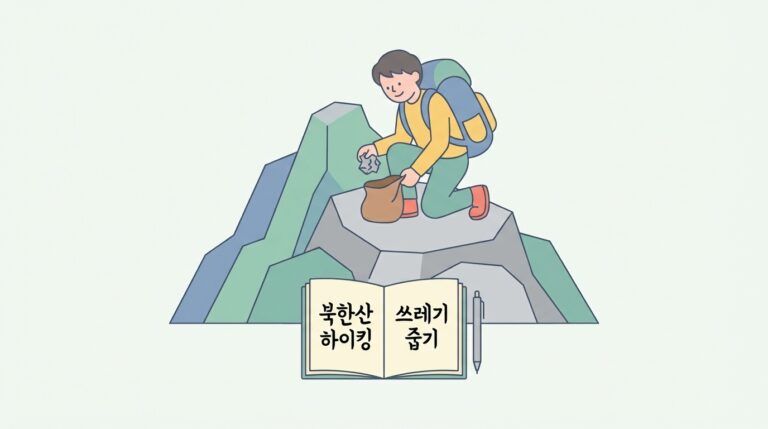
Phase 1: 공감 (Story-driven Opening)
안녕하세요! 매일한글 에디터입니다.
Picture this: You have just pushed through the steep, rocky trails of Bukhansan in northern Seoul. Your legs are trembling, but you finally reach the summit. The breeze cools your forehead, and the panoramic view of the Seoul skyline framed by ancient granite rocks takes your breath away. Like a true local hiker, you pull out a roll of gimbap wrapped in silver foil, peel back the wrapping, and savor every bite. But after finishing your snack, you look around to throw away the foil and your empty water bottle. You scan the resting area, walk around the peak platform, look behind the wooden signboards… and realize there is not a single trash can anywhere in sight.
Many intermediate Korean learners feel panic at this exact moment. Back home, national parks often provide bear-proof dumpsters or recycling stations at trail crossroads. In Korea, however, throwing trash away on a mountain trail is one of the quickest ways to earn stern scowls or sharp scolding from energetic Korean deungsan (hiking) aunties and uncles. Over the past decade tutoring hikers and expats in Korea, this “missing trash bin crisis” has been one of the top three cultural shocks my students face. Master today’s key phrases, and you won’t just avoid awkward stares; you’ll blend right into Korea’s passionate mountain community and hike like a respected insider.
Phase 2: 핵심 표현 3선 심층 분석
1. 쓰레기는 가방에 챙겨 가야 돼요. (Sseuregineun gabange chaenggyeo gaya dwaeyo.)
- Pronunciation: [Sseu-reh-gi-neun ga-bang-eh chaeng-gyeo ga-ya dwae-yo] (Think of sseu like the hissing start of “soot”, and chaeng like the chime of a bell)
- Meaning: “You must pack your trash back in your bag.”
- K-Culture Moment: In hiking variety shows like tvN’s Work Later, Hike Now, characters are seen double-checking their snack wrappers and stuffing them into side pouches before heading downhill.
- Editor’s Insight: The verb 챙기다 (chaenggida) is richer than simple “packing”—it carries a tone of mindful care and personal responsibility. The grammatical ending -아/어야 되다 (-a/eoya dwaeda) signals an essential social norm rather than an aggressive command.
- Situation Spectrum: Casual (⚠️ 쓰레기는 가방에 챙겨 가야 돼) / Semi-formal (✅ 쓰레기는 가방에 챙겨 가야 돼요) / Formal (✅ 쓰레기는 가방에 챙겨 가셔야 합니다)
- 🤔 Think About It: In your home country, is waste management on public trails considered an individual duty or a government service?
2. 혹시 비닐봉지 남는 거 있어요? (Hoksi binilbongji namneun geo isseoyo?)
- Pronunciation: [Hok-shi bee-neel-bong-jee nam-neun geo eet-sseo-yo?] (Hoksi sounds like “hawk-see”, and bongji like “bong-jee”)
- Meaning: “By any chance, do you have a spare plastic bag?”
- K-Culture Moment: A dramatic moment in K-dramas where two hikers break the ice on a trail: one offers a plastic bag so the other doesn’t ruin their sleek hiking gear with greasy food wrappers.
- Editor’s Insight: Starting with 혹시 (hoksi, by any chance) softens your request immediately. Using 남는 거 (namneun geo, extra/leftover one) signals that you don’t want to inconvenience them, asking only for surplus supplies.
- Situation Spectrum: Casual (✅ 혹시 비닐봉지 남아?) / Semi-formal (✅ 혹시 비닐봉지 남는 거 있어요?) / Formal (⚠️ 혹시 비닐봉투 여분이 있으십니까?)
- 🤔 Think About It: Why does softening a request with hypothetical words like “by any chance” matter so much in Korean interpersonal dynamics?
3. 흔적 남기지 말고 가요. (Heunjeok namgiji malgo gayo.)
- Pronunciation: [Heun-jeok nam-gee-jee mal-go ga-yo] (Heun sounds like “huh-n”, jeok rhymes with “duck”)
- Meaning: “Let’s leave without leaving any trace.” (Leave No Trace / LNT)
- K-Culture Moment: Used by younger Korean outdoor influencers and plogging (ssup-logging) clubs on Instagram when wrapping up clean-up hikes.
- Editor’s Insight: 흔적 (heunjeok) means “traces” or “tracks.” Pairing it with -지 말고 가요 (-ji malgo gayo, let’s not do X and go) creates a collaborative, inspiring mood instead of a dry rulebook instruction.
- Situation Spectrum: Casual (✅ 흔적 남기지 말고 가자) / Semi-formal (✅ 흔적 남기지 말고 가요) / Formal (✅ 흔적을 남기지 않고 정리하겠습니다)
- 🤔 Think About It: How does phrasing rules as collective teamwork change your motivation to protect shared public spaces?
Phase 3: 교과서 한국어 vs 진짜 한국어
Situation 1: Deciding what to do with food trash at the rest stop
- 📖 교과서 한국어: 쓰레기를 쓰레기통에 버려야 합니다. (Sseuregireul sseuregitonge beoryeoya hamnida. – “You must discard the trash in the trash bin.”)
- 🗣️ 진짜 한국어: 산에는 쓰레기통 없으니까 다 챙겨 가야 돼요. (Saneneun sseuregitong eopseunikka da chaenggyeo gaya dwaeyo. – “There are no bins on the mountain, so we gotta pack it all out.”)
- 💡 왜 다를까? Textbook examples assume public receptacles are readily available everywhere. Real native hikers acknowledge the reality of Korean trails: there are zero bins, so packing out everything is the universal default.
Situation 2: Asking a fellow hiker for a trash bag
- 📖 교과서 한국어: 저에게 쓰레기봉투를 빌려주시겠습니까? (Jeoege sseuregibongtureul billyeojusigesseumnikka? – “Would you lend me a garbage bag?”)
- 🗣️ 진짜 한국어: 혹시 남는 봉지 하나만 주실 수 있으세요? (Hoksi namneun bongji hanaman jusil su isseuseyo? – “Could you spare just one extra bag if you have one?”)
- 💡 왜 다를까? You cannot “borrow (빌리다)” a disposable bag since you cannot return it after use. Real Koreans ask if someone can “give (주다)” an extra disposable wrapper or bag nicely.
Phase 4: K-Culture 딥다이브 & 비언어적 매너
4-1. 눈치 (Nunchi) & Hiking Trail Gestures
In Korean mountain culture, proper trail manners are visual. When packing out trash, seasoned hikers tie a small, clean plastic bag onto the external gear loops of their backpacks. This is a subtle display of nunchi (social awareness): it signals to fellow hikers that you are carrying your own waste down and have no intention of dumping it in the woods.
* Eye Contact & Nodding: If someone spots trash on your picnic rock, give a slight head nod, pick it up immediately, and say: “제가 가져갈게요! (Jega gajyeogalkeoyo! – I will take it!)”
* Smell Management: Wrap food scraps (fruit peels, cup noodle broth leftovers) in a zip-top bag first before placing it inside a secondary bag to keep the shared trail air fresh.
4-2. Cultural Code: The Zero-Waste Hiking Ethos
Why are there no trash cans on Korean mountains? In the mid-1990s, the Korean National Park Service removed all trash cans from national mountain trails. The initiative, known as “쓰레기 되가져오기 운동” (Bring Your Trash Back Campaign), was launched because trail bins attracted wild animals, caused foul odors, and created hazardous labor for maintenance staff carrying heavy waste down steep peaks. Today, carrying your own trash down is considered a badge of mountain honor. Veteran hikers often carry empty plastic bags specifically to pick up stray wrappers left by inexperienced tourists!
Phase 5: 실전 롤플레이 시나리오
Setting: Bukhansan’s Baegundae peak. You have just finished eating mandu with your Korean hiking club friend, Min-ho (민호).
- Turn 1 (Min-ho):
🎭 Wiping sweat with a towel and pointing at the empty food container on the rock
민호: 와, 배부르다! 이제 슬슬 내려갈 준비할까요?
(Wa, baebureuda! Ije seulseul naeryeogal junbihalkkayo?)
“Wow, I’m full! Shall we slowly get ready to head down?” -
Turn 2 (You):
🎭 Looking around for a disposal spot while holding the greasy plastic container
당신: 네, 좋아요. 그런데 쓰레기통이 어디에 있어요?
(Ne, joayo. Geureonde sseuregitongi eodie isseoyo?)
“Yeah, sounds good. But where is the trash can?” -
Turn 3 (Min-ho):
🎭 Chuckling warmly while tapping his backpack
민호: 아, 산에는 쓰레기통이 아예 없어요. 다 가방에 챙겨 가야 돼요.
(A, saneneun sseuregitongi aye eopseoyo. Da gabange chaenggyeo gaya dwaeyo.)
“Ah, there are no trash cans on mountains at all. You have to pack it all back in your bag.” -
Turn 4 (You):
🎭 Checking your small backpack with a worried expression
당신: 어떡하죠? 가방에 넣으면 냄새가 날 것 같은데요.
(Eotteokhajyo? Gabange neoeumyeon naemsaega nal geot gateundeyo.)
“What should I do? If I put it in my bag, I think it will smell.” -
Turn 5 (Min-ho):
🎭 Unzipping the front pouch of his hiking bag and pulling out a roll of plastic bags
민호: 걱정 마세요. 제가 비닐봉지 챙겨왔어요. 여기 담으세요.
(Geokjeong maseyo. Jega binilbongji chaenggyeowasseoyo. Yeogi dameuseyo.)
“Don’t worry. I brought plastic bags. Put it in here.” -
Turn 6 (You):
🎭 Receiving the bag with both hands and bowing slightly
당신: 정말 감사합니다! 혹시 비닐봉지 여유 더 있어요?
(Jeongmal gamsahamnida! Hoksi binilbongji yeoyu deo isseoyo?)
“Thank you so much! Do you happen to have another spare bag?” -
Turn 7 (Min-ho):
🎭 Nodding approvingly with a proud smile
민호: 네, 많아요. 흔적 남기지 말고 깨끗하게 치우고 가요!
(Ne, manayo. Heunjeok namgiji malgo kkaekkeuthage chiugo gayo!)
“Yes, plenty. Let’s leave no trace and clean up nicely before leaving!” -
Turn 8 (You):
🎭 Tying the sealed bag to the exterior clip of your pack
당신: 네! 제 쓰레기는 제가 끝까지 책임질게요.
(Ne! Je sseuregineun jega kkeutkkaji chaegimjilgeyo.)
“Yes! I will take full responsibility for my trash until the very end.”
🔀 인터랙티브 분기점 (What would you do next?)
- Choice A: Leave the bag tucked neatly underneath a wooden park bench so it is out of sight.
Feedback: 🚫 Bad! Park rangers patrol trails regularly. Hiding trash under rest benches will cause animal scavenging and can lead to fines under the Natural Parks Act. - Choice B: Tie the securely sealed bag to the carabiner outside your pack and carry it down to the trailhead bins.
Feedback: ✅ Best! Perfect trail etiquette. It keeps your backpack interior fresh while proving you’re practicing Leave No Trace. - Choice C: Approach an elderly hiker sitting nearby and ask them to throw it away for you.
Feedback: ⚠️ Risk! Culturally offensive. Seniors revere clean mountain culture and consider dumping your waste on others disrespectful.
Phase 6: 10초 감정 섀도잉 드릴 (Shadowing Drill)
Practice these natural pacing pauses (/) while leaning into each emotion milestone:
[😅 약간 당황스럽지만 정중하게 - Slightly embarrassed but polite]
저기요… / 혹시 비닐봉지 / 남는 거 하나 있으세요?
(Jeogiyo… / hoksi binilbongji / namneun geo hana isseuseyo?)-
[🤝 책임감 있고 든든하게 - Responsible and determined]
제 쓰레기는 / 제가 직접 / 가방에 챙겨 갈게요.
(Je sseuregineun / jega jikjeop / gabange chaenggyeo galkeoyo.) -
[🏔️ 상쾌하고 당당하게 - Refreshing and cheerful]
산에서는 / 흔적 남기지 말고 / 깨끗하게 가요!
(Saneseoneun / heunjeok namgiji malgo / kkaekkeuthage gayo!)
Phase 7: K-Culture 미니 사전
- 쓰레기 되가져오기 (Sseuregi Doegajyeo-ogi) | Pack-out trash policy
The foundational rule of Korean hiking. National and provincial parks require visitors to carry all waste back down the mountain. - 종량제 봉투 (Jongnyangje Bongtu) | Volume-rate garbage bag
The official prepaid municipal waste bags used in Korea. Disposing of trash at the foot of the mountain requires sorting recyclables from regular waste. - 등산 동호회 (Deungsan Donghohoe) | Hiking club / Mountain society
Korea’s influential weekend hiking groups. They have strict social hierarchies, distinct colorful hiking gear, and fiercely protect trail hygiene. - 클린 산행 (Keullin Sanhaeng) | Eco-hiking / Clean hiking
A modern outdoor trend combining brisk mountain hiking with picking up litter along trails (similar to plogging).
Phase 8: 여행자를 위한 생존 키트
서바이벌 표현 TOP 3
- 이거 어디에 버려요? (Igeo eodie beoryeoyo?) – Where do I throw this away?
Pro Tip: Use this at park entrance trailheads or convenience stores, never on the summit. - 봉지 하나만 주실 수 있나요? (Bongji hanaman jusil su innayo?) – Could you give me just one bag?
Pro Tip: A lifesaver phrase when your snack wrapper tears and you need containment. - 산에서 쓰레기 버리면 벌금 나와요. (Saneseo sseuregi beorimyeon beolgeum nawayo.) – You will get fined if you throw away trash on the mountain.
Pro Tip: Good phrase to understand when reading warning signs or talking with hiking partners.
Editor’s Travel Note
- App Downloads: Before hitting the slopes, check trail paths and rest stations via 국립공원 스마트 탐방 앱 다운로드 페이지 or navigate public transport to trailheads using 네이버 지도 길찾기 서비스.
- Local Disposal Logistics: Once you descend to the trailhead village, you will often find sorting stations for cans and plastic bottles near the public restrooms. However, food waste and general trash should be carried back to your accommodation or disposed of using designated local jongnyangje bags.
Phase 9: 한 발 더 깊이 (Thought Provoking Insight)
In many individualistic cultures, public taxes are expected to cover public services such as park cleaning crews and mountain trash bins. In Korea, mountains represent sacred communal spaces where millions seek vitality and fresh air every weekend. Removing mountain trash cans was a deliberate philosophical shift: by shifting the burden of waste management from invisible cleaners onto every single citizen, the culture fosters collective ownership. When everyone carries down their own waste, nature remains pristine for the next hiker.
💬 Your Turn: Does your home country provide trash cans on nature trails, or are hikers expected to pack out their trash? Drop your thoughts in the comments below!
Phase 10: FAQ & 오해 방지
Q: Can I bury organic waste like banana peels or apple cores in the mountain soil?
A: No, absolutely not. Because millions hike Korean mountains every month, organic food scraps do not decompose quickly enough; they attract rodents, damage wild vegetation, and emit severe odors. In Korea, fruit rinds must be packed into sealed bags and brought back down.
Q: Are there really zero trash cans even at mountain top temples?
A: Yes, summit shrines and trail shelters do not take visitor waste. Some mountain temples have private disposal for resident monks, but visitors must carry their personal waste out.
Q: What should I do with leftover soup from instant cup noodles (ramyeon)?
A: Never pour soup broth onto mountain soil or into streams because the high sodium content harms flora and water quality. Seasoned Korean hikers bring an insulated thermos to pour leftover broth back in, or soak it up with paper towels inside a sealable bag.
🚨 흔한 실수 (Common Mistakes) TOP 3
- Mistake 1: Leaving a tied plastic bag beside a trailhead restroom hoping cleaners will take it.
Correct Action: Drop it in your hotel trash bin or use a designated volume-rate trash bin at the base. - Mistake 2: Tucking empty wet tissues into stone crevices.
Correct Action: Wet tissues contain microplastics; keep a dedicated mini ziploc pouch for used tissues. - Mistake 3: Using informal speech (banmal) like “봉지 줘 (Bongji jwo)” with older hikers.
Correct Action: Always use polite honorifics: 혹시 남는 봉지 하나 있으세요?
Phase 11: 액션 미션 & 참여 유도
- 🥉 Bronze Mission (Solo Practice): Stand in front of your mirror with your backpack. Practice saying: 쓰레기는 가방에 챙겨 갈게요! three times with a bright, confident tone.
- 🥈 Silver Mission (Social Share): Snap a photo of your reusable trail trash pouch on your next outdoor walk, post it on social media, and tag it
#클린산행 #LeaveNoTraceKorea. - 🥇 Gold Mission (Real-world Challenge): On your next hike in Korea, prepare an extra plastic bag. If a fellow hiker drops a candy wrapper by accident, politely pick it up and say: 제가 챙길게요!
- 🎮 K-Culture Mission: Watch an episode of outdoor-themed Korean shows (e.g., Europe Outside Your Tent or mountain scenes in Hospital Playlist) and spot how cast members store their picnic garbage.
Phase 12: 인터랙티브 퀴즈 챌린지
Test your knowledge with these three quick questions:
- [상황 판단] You just ate a tangerine at the peak of Inwangsan. What is the most respectful action?
- A. Bury the peel under a rock.
- B. Seal the peel in your bag and carry it down.
- C. Leave it near a tree for birds to eat.
- [빈칸 채우기] Fill in the missing word:
산에는 쓰레기통이 없으니까 쓰레기는 가방에 _________ 가야 돼요.
(Hint: It means ‘to mindfully pack and take’) -
[True / False] National parks in Korea removed summit trash bins starting in the mid-1990s to keep trails clean and prevent wildlife damage. (True / False)
👉 Click to view answers and explanations!
- Answer: B. Organic waste like citrus peels takes months to decay and harms natural ecosystems. Always seal and carry it down.
- Answer: 챙겨 (chaenggyeo). From the verb 챙기다 (to pack/look after).
- Answer: True. The “Bring Your Trash Back” campaign permanently eliminated trail bins to preserve Korea’s mountain environments.







