

안녕하세요! 매일한글 에디터입니다.
Imagine walking down a bustling street near a university in Seoul. You see vibrant shopfronts, the smell of freshly baked tteokbokki in the air, and neon signs everywhere. Then, you spot a shop window plastered with hundreds of tiny yellow and white paper slips listing numbers like 500/45 or 1000/60. This is a 부동산 (Bhudongsan – Real Estate Agency).
If you have ever watched the relatable K-Drama Because This Is My First Life or Fight for My Way, you know that finding a cozy, affordable studio apartment—known in Korea as a 원룸 (Won-rum / One-Room)—is the ultimate rite of passage. But standing outside that door, your palms get sweaty. How do you walk in? What if the real estate agent (중개사님) speaks rapid-fire Korean? Will you accidentally agree to rent an apartment without inspecting the bathroom?
Take a deep breath! As someone who has helped hundreds of international students and expats find their very first homes in Seoul, I promise you do not need fluent Korean to secure a safe, sunny, and affordable one-room. You only need a handful of natural, A2-level conversational tools. In this guide, we will break down the exact phrases, cultural etiquette, and real-life tactics so you can walk into any agency with confidence. Let’s find your dream home together!
Phase 2: Core Expressions Deep Dive
1. 원룸 보러 왔는데요. (Wonrum boreo wanneundeyo.)
- Pronunciation: Won-rum bo-reo wan-neun-de-yo. (Sounds like: “One-room” said quickly with a soft rolling ‘r’, followed by bo-ruh wahn-neun-day-yo).
- Meaning: Literally “I came to look at a one-room,” but practically “Hello, I am looking to tour some studio apartments.”
- K-Culture Moment: This is the iconic opening line delivered by every 20-something protagonist in slice-of-life K-dramas when they move out of their family home or dorm to start an independent life in Seoul.
- Editor’s Insight: Ending a sentence with ~는데요 (~neundeyo) creates a gentle, polite conversational bridge. It signals: “Here is my reason for visiting; please tell me what you have!” It sounds far warmer and less robotic than just saying “원룸 보여주세요” (Show me a one-room).
- Situation Spectrum: Casual: ⚠️ | Semi-formal: ✅ | Formal: ✅
- 🤔 Think About It: In English, we often say “I want to rent an apartment.” Why do you think Korean naturally frames it around seeing (보러 왔어요) rather than transacting?
2. 보증금이랑 월세가 어떻게 돼요? (Bojeunggeum-irang weolse-ga eotteoke dwaeyo?)
- Pronunciation: Boh-jeung-geum-ee-rahng wohl-seh-gah uh-ttuh-keh dweh-yo? (Think: Boh-jeung like “boat-journey” cut short, wohl-seh rhymes with “call-say”).
- Meaning: Literally “How do the deposit and monthly rent become?”, meaning “What are the deposit and monthly rent terms?”
- K-Culture Moment: When characters in YouTube room tour vlogs (룸투어) reveal their living costs, this sentence always appears in subtitle captions right before the numbers pop up on screen.
- Editor’s Insight: Korean rentals almost always run on a two-part pricing structure: 보증금 (Deposit) and 월세 (Monthly rent). For instance, “500/50” means a 5,000,000 KRW deposit with 500,000 KRW monthly rent. Using 어떻게 돼요? is the gold-standard polite way to ask for prices, ages, or conditions without sounding blunt.
- Situation Spectrum: Casual: 🚫 | Semi-formal: ✅ | Formal: ✅
- 🤔 Think About It: Does your home country require large lump-sum deposits that you get back when moving out? How does this financial trust system shape landlord-tenant relationships in Korea?
3. 방 지금 볼 수 있을까요? (Bang jigeum bol su isseulkkayo?)
- Pronunciation: Bahng jee-geum bohl soo ees-seul-kkah-yo? (Rhymes with “song”, jee-geum like “tea-gum”, bol su like “bowl soup”).
- Meaning: “Could I see the room right now?”
- K-Culture Moment: The moment an agent pulls out a massive ring of keys from their desk drawer and hops into their compact car with the client to tour three different studios in 30 minutes!
- Editor’s Insight: The ending ~ㄹ 수 있을까요? (~l su isseulkkayo?) means “Would it be possible to…?” It softens the request significantly compared to “방 보여주세요” (Show me the room). Agents love clients who are respectful and considerate of current tenants’ privacy.
- Situation Spectrum: Casual: 🚫 | Semi-formal: ✅ | Formal: ✅
- 🤔 Think About It: Asking permission softly shows high emotional intelligence (눈치, Nunchi) in Korean communication. How does softening requests build rapport in your culture?
Phase 3: Textbook Korean vs. Real Korean
Situation 1: Stating What You Want
- 📖 Textbook Korean: 저는 방을 빌리고 싶습니다. (Jeoneun bangeul billigo sipseumnida. – I desire to borrow a room.)
- 🗣️ Real Korean: 원룸 좀 보고 싶어서 왔어요. (Wonrum jom bogo sipeoseo wasseoyo. – I came because I’d like to look at some studios.)
- 💡 Why is it different? The verb 빌리다 (to borrow/rent) sounds unnatural for long-term leases in conversational Korean. Locals state their purpose naturally by saying they came to “look around” (보고 싶어서 왔어요).
Situation 2: Inspecting the Condition of the Studio
- 📖 Textbook Korean: 방을 검사해도 됩니까? (Bangeul geomsa-haedo doemnikka? – May I inspect the room?)
- 🗣️ Real Korean: 방 상태 좀 둘러봐도 될까요? (Bang sangtae jom dulleobwado doelkkayo? – May I look around the room’s condition?)
- 💡 Why is it different? 검사하다 (to inspect/examine) sounds like a formal police search or medical test! 둘러보다 (to look around) is relaxed, polite, and completely standard.
Phase 4: K-Culture Deep Dive & Non-Verbal Manners
4-1. 눈치 (Nunchi) & Body Language at the Property
When you step inside a potential one-room, the landlord or current tenant might still be there. Always slip off your shoes immediately at the entryway threshold (현관, hyeongwan). Keep your shoes neatly pointed toward the door.
Before running the faucets or flushing the toilet to check water pressure, make brief eye contact with the agent and give a slight, polite nod. This non-verbal cue signals: “I respect this space, but I am doing my due diligence.” Never criticize the room loudly while standing inside; instead, save your candid thoughts for when you and the agent return to the street.
4-2. Cultural Code: The One-Room Ecosystem
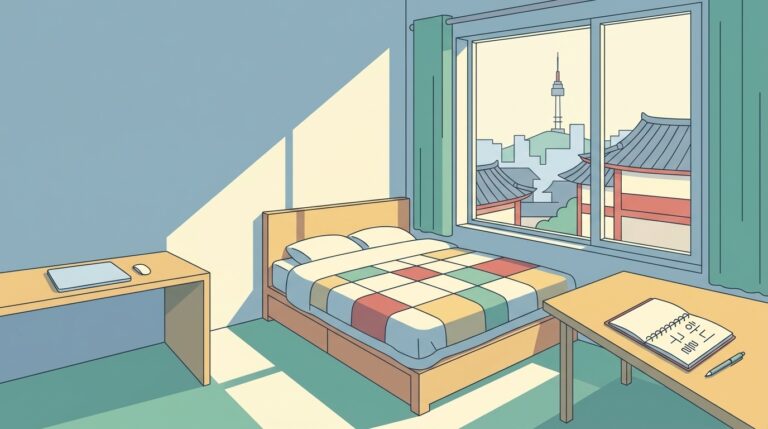
In Korea, one-room culture is deeply intertwined with young adult independence. Most studios come as 풀옵션 (Full Option), meaning an induction stove, washing machine, refrigerator, air conditioner, and sometimes a bed and wardrobe are already included. This allows young workers and students to move in with just a couple of suitcases—an aesthetic celebrated in countless modern lifestyle dramas!
Phase 5: Real-Life Roleplay Scenario
Setting: A cozy real estate agency near a subway station. Yellow listing papers cover the window. Agent Kim (김 중개사님), wearing a warm cardigan, looks up from her desk.
- Turn 1 (Agent): 어서 오세요! 어떤 방 찾으세요? (Eoseo oseyo! Eotteon bang chajeuseyo?)
🎭 Welcoming with a warm smile and pointing to an empty chair across the desk. - Turn 2 (You): 안녕하세요! 근처 원룸 보러 왔는데요. (Annyeonghaseyo! Geuncheo wonrum boreo wanneundeyo.)
🎭 Giving a slight 15-degree bow as you sit down. - Turn 3 (Agent): 혼자 살 방이죠? 생각하신 보증금이나 월세 있어요? (Honja sal bang-ijyo? Saenggakkasin bojeunggeumina weolse isseoyo?)
🎭 Opening a large binder filled with handwritten property notes. - Turn 4 (You): 네, 보증금 500에 월세 50만 원 정도 생각하고 있어요. (Ne, bojeunggeum obaek-e weolse osipman-won jeongdo saenggakhago isseoyo.)
🎭 Glancing down at your phone notes to confirm numbers. - Turn 5 (Agent): 마침 역 5분 거리에 깨끗한 풀옵션 원룸 하나 나왔는데, 지금 보실래요? (Machim yeok obun georie kkaekkeut-han pul-opsyeon wonrum hana nawanneunde, jigeum bosillaeyo?)
🎭 Pulling a set of silver keys from a wall hook. - Turn 6 (You): 네, 지금 볼 수 있으면 보여주세요! (Ne, jigeum bol su isseumyeon boyeojuseyo!)
🎭 Standing up promptly with an appreciative smile. - Turn 7 (Agent): 채광도 좋고 관리비도 싸요. 바로 앞이니까 같이 걸어갑시다! (Chaegwangdo joko gwallibido ssayo. Baro ap-inikka gachi georeogapsida!)
🎭 Grabbing her coat and holding open the front door for you. - Turn 8 (You): 감사합니다. 따라갈게요! (Gamsahamnida. Ttaragalgeyo!)
🎭 Nodding gratefully as you follow her outside.
🔀 Interactive Decision Point
You arrive at the studio, look around, and find it decent. What do you ask next?
* Option A: “무조건 제일 싼 방으로 다른 것도 다 보여주세요.” (Show me unconditionally all the cheapest rooms too.)
* Feedback (Risk): Sounds demanding and dismissive of the agent’s curated recommendation.
* Option B: “혹시 관리비에 인터넷이랑 수도세가 포함되어 있나요?” (Is internet and water included in the maintenance fee?)
* Feedback (Best!): Sharp, practical question that shows you understand Korean rental structures.
* Option C: “오늘 바로 계약 안 하면 이 방 바로 뺏기나요?” (Will someone steal this room if I don’t sign today?)
* Feedback (Bad): Expresses unnecessary panic and weakens your negotiation posture.
Phase 6: 10-Second Emotion Shadowing Drill
Practice these natural rhythm pauses (/) and emotional intentions out loud:
[😊 Bright & Polite]안녕하세요! / 저 원룸 좀 / 보러 왔는데요. (Annyeonghaseyo! / Jeo wonrum jom / boreo wanneundeyo.)[🤔 Clear & Focused]보증금 500에 / 월세 50만 원 / 생각하고 있어요. (Bojeunggeum obaek-e / weolse osipman-won / saenggakhago isseoyo.)[✨ Hopeful & Respectful]혹시 방 지금 / 바로 볼 수 있을까요? (Hoksi bang jigeum / baro bol su isseulkkayo?)
Phase 7: K-Culture Mini Dictionary
- 원룸 (Won-rum): Studio apartment where the bedroom, living space, and kitchen area share one open room.
- 보증금 (Bo-jeung-geum): Key money deposit held by the landlord and returned at contract completion.
- 월세 (Wol-se): Monthly rent payment made on a set date each month.
- 관리비 (Gwal-li-bi): Monthly maintenance fee covering communal lighting, stair cleaning, building upkeep, and sometimes water/Wi-Fi.
Phase 8: Survival Kit for Apartment Hunters
TOP 3 Survival Phrases
- 수압 확인해 봐도 돼요? (Suap hwaginhae bwado dwaeyo?) – Can I check the water pressure? (Pro Tip: Turn on the sink faucet and flush the toilet simultaneously!)
- 채광이 잘 들어요? (Chaegwangi jal deureoyo?) – Does it get good natural sunlight? (Pro Tip: South-facing studios are called 남향, namhyang).
- 관리비에 뭐 뭐 포함돼요? (Gwallibie mwo mwo pohamdwaeyo?) – What specific utilities are included in the maintenance fee?
Editor’s Travel & Housing Note
Before stepping into a local brick-and-mortar office, browse listings in advance to gauge neighborhood prices. You can start by checking listings on the 네이버 부동산 (Naver Real Estate) 웹사이트 확인하기 or download apps on your smartphone via 직방 (Zigbang) 부동산 앱 다운로드. Be aware of 허위매물 (bait-and-switch fake listings online); visiting a certified local realtor (공인중개사) in person is still the safest method in Korea!
Phase 9: One Step Deeper
In Korean culture, housing is deeply communal and protective. The substantial key deposit (보증금) functions as social insurance that maintains a mutual bond of responsibility between renter and owner. When an agent shows you a room, they are not merely selling square footage; they are vetting whether you will be a considerate neighbor who sorts their recycling (분리수거) and respects noise levels. Showing polite manners during your initial visit signals that you will be a wonderful tenant.
💬 Your Turn: What is the number one priority you look for when hunting for an apartment? Is it sunlight, low deposit, or proximity to a subway station? Let me know in the comments below!
Phase 10: FAQ & Avoiding Misunderstandings
Q: Can foreigners sign a lease contract for a one-room in Korea?
A: Yes! Foreigners with an Alien Registration Card (ARC, 외국인등록증) or a valid passport can legally lease studios. Many realtors near universities have ample experience handling international paperwork.
Q: Can I negotiate the deposit or monthly rent?
A: Yes, to a reasonable extent. If you have extra cash, you can often propose raising the deposit to lower monthly rent (e.g., adding 5,000,000 KRW to the deposit might reduce monthly rent by 20,000 to 30,000 KRW).
Q: What does ‘Full Option’ (풀옵션) actually include in Korea?
A: Standard full-option units include a refrigerator, washing machine, air conditioner, and electric stovetop or gas range. A bed, desk, and microwave may or may not be provided, so always ask during the tour.
🚨 Common Mistakes Board
- ❌ Mistake 1: Walking into the agency without knowing your exact maximum budget in Korean numbers.
👉 Correct Action: Write down your deposit and monthly rent caps (e.g., 보증금 1,000만 원 / 월세 60만 원) in your phone memo before entering. - ❌ Mistake 2: Forgetting to ask about the maintenance fee (관리비).
👉 Correct Action: Always ask if electricity, gas, water, and internet are separate expenses. - ❌ Mistake 3: Wearing shoes into the room during the tour.
👉 Correct Action: Always slip your shoes off at the entrance step (현관), even if the room is currently vacant.
Phase 11: Action Mission & Engagement
- 🥉 Bronze Mission: Stand in front of a mirror and practice saying: “원룸 보러 왔는데요!” three times with a bright, friendly smile.
- 🥈 Silver Mission: Open a map app, search for 부동산 around your favorite Seoul subway station, and write down two price tags you see.
- 🥇 Gold Mission: Walk into a real estate office or send an inquiry to practice asking: “보증금 500에 월세 50 원룸 있어요?”
- 🎮 K-Culture Mission: Search for “서울 원룸 룸투어” (Seoul One-room Tour) on YouTube and spot how many times the creator mentions 보증금 or 관리비!
Phase 12: Interactive Quiz Challenge
Test what you learned today before you go house hunting!
1. Situation Judgment: You walk into a real estate office. Which phrase is the most natural way to introduce your visit?
– (A) 방을 즉시 파세요! (Sell a room immediately!)
– (B) 원룸 보러 왔는데요. (I came to look at some studio apartments.)
– (C) 저랑 계약합시다. (Let’s make a contract with me.)
2. Fill in the Blank:
“보증금이랑 ______가 어떻게 돼요?” (What are the deposit and monthly rent?)
– (A) 월세 (weolse)
– (B) 식비 (sikbi)
– (C) 버스비 (beoseubi)
3. True or False: In Korea, “풀옵션 (Full Option)” always legally guarantees that free Wi-Fi, electricity, and water bills are completely free of charge.
👉 Click here to reveal answers & explanations!
- Answer: (B) 원룸 보러 왔는데요. is the polite, conversational standard when first entering an agency.
- Answer: (A) 월세 (Monthly rent). 식비 means food expenses, and 버스비 means bus fare!
- Answer: False! “Full Option” refers to physical appliances (fridge, washer, AC), not utility bills. Utilities are managed through the separate 관리비 (maintenance fee) or billed directly.







