

Beat the Heat Like a Local: Your Ultimate Guide to a Korean Gyegok (Valley) Getaway
Phase 1: Empathy (Welcome to the Real Korean Summer!)
안녕하세요! (Annyeonghaseyo!) It is your Daily Hangul editor and trusted Korean culture navigator here! Close your eyes and picture this: It is late July in Seoul. The thermometer reads 35°C (95°F), but with the sweltering humidity, it feels more like a sauna you never agreed to enter. The asphalt softens beneath your sneakers, and even an iced Americano melts in four minutes flat. This is what locals call 찜통더위 (jjimtong-deowi)—literally “steamer heat,” as if the entire peninsula were placed inside a giant dim sum bamboo steamer.
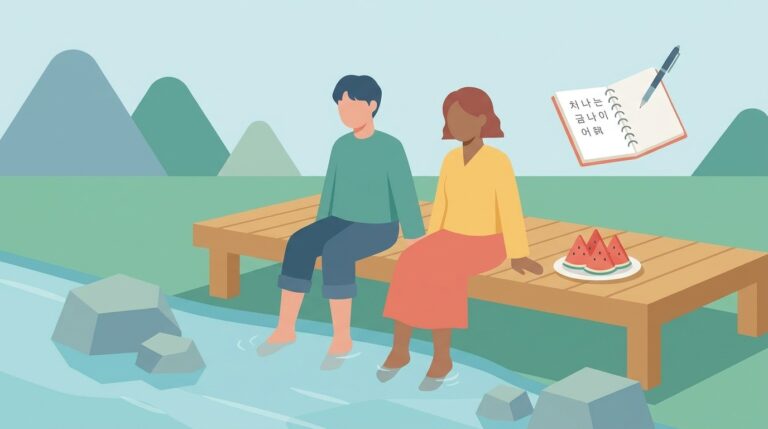
Now, open your eyes. Imagine trading the concrete heat island for the crystal-clear mountain streams of Gapyeong or Jirisan. You are sitting on a shaded wooden platform elevated right above a rushing stream, ice-cold emerald water splashing around your ankles, while a massive bubbling pot of herbal chicken soup simmers beside you. Sounds like paradise, right?
Yet, many international travelers and intermediate learners tell me: “Editor, when we got to the valley, we froze up! The restaurant owners spoke rapid local dialect, the menu had no pictures, and we had no idea how to rent the wooden platform or ask about water safety without sounding like a robotic textbook.”
Do not worry—I have got your back. Navigating a Korean valley escape (계곡 물놀이 – gyegok mulnori) is a quintessential rite of passage that bridges natural beauty, communal dining, and seasonal culture. By the end of this guide, designed with direct feedback from hundreds of intermediate learners, you will command the exact vocabulary, manners, and cultural instincts needed to chill by the stream with confidence!
Phase 2: Core Expressions Deep Dive (B1 Level)
Let’s master three indispensable phrases that will immediately elevate your conversational fluency from “tourist asking directions” to “savvy friend planning a weekend escape.”
1. 발 담그고 백숙 먹자! (Bal damgeugo baeksuk meokja!)
- Pronunciation: [Bal dam-geu-go baek-suk meok-ja] (Phonetic tip: “Bal” sounds like “ball”, “dam-geu-go” rhymes with “calm, canoe, go” without the ‘n’)
- Meaning:
- Literal: Let’s submerge our feet and eat whole herbal chicken soup!
- Nuance: “Let’s cool off in the stream while indulging in great food together!”
- K-Culture Moment: You will hear this in almost every Korean summer variety show (like 2 Days & 1 Night or I Live Alone) when cast members escape the city to recharge.
- Editor’s Insight: The verb 담그다 (damgeuda) means to soak, steep, or dip into liquid (used also for making kimchi: 김치를 담그다). In Korean summer culture, dipping just your feet (발을 담그다) represents immediate, unpretentious bliss when you do not want to change into full swimwear.
- Situation Spectrum:
- Casual (Friends): ✅ 발 담그고 백숙 먹자! (Bal damgeugo baeksuk meokja!)
- Semi-formal (Colleagues/Elder acquaintances): ⚠️ 발 담그고 백숙 먹으러 가요. (Bal damgeugo baeksuk meogeureo gayo.)
- Formal: 🚫 Too colloquial for rigid corporate settings.
- 🤔 Think About It: In many Western cultures, dining takes place strictly inside or at a patio table separate from water. Why do you think Korean leisure culture embraces eating hearty hot food literally inside or atop nature’s water sources?
2. 여기 물 엄청 시원해요! (Yeogi mul eomcheong siwonhaeyo!)
- Pronunciation: [Yeo-gi mul eom-cheong si-won-hae-yo] (Phonetic tip: “Si-won” sounds similar to “sea-one”)
- Meaning:
- Literal: The water here is extremely refreshing/cool!
- Nuance: “Hop in! The temperature is crisp, rejuvenating, and takes the edge off the heat!”
- K-Culture Moment: Seen in K-Dramas whenever a character joyfully splashes their partner or encourages hesitant friends to wade into the river.
- Editor’s Insight: Remember that 시원하다 (siwonhada) is a famous chameleon word in Korean. It describes ice-cold water, a crisp breeze, a spicy piping-hot soup that clears your throat, or even a deep muscle massage. At a valley stream, it specifically validates that refreshing, goosebump-inducing mountain chill.
- Situation Spectrum:
- Casual: ✅ 여기 물 진짜 시원해! (Yeogi mul jinjja siwonhae!)
- Semi-formal: ✅ 여기 물 엄청 시원해요! (Yeogi mul eomcheong siwonhaeyo!)
- Formal: ⚠️ 이곳의 수온이 쾌적합니다 (Igosi suoni kwaejeokhmnida – strictly for weather broadcast reporting).
- 🤔 Think About It: Does your native language have a single word that describes both cold mountain water and burning-hot soup as relieving sensations?
3. 거기는 수심이 깊으니까 조심하세요. (Geogineun susimi gipeunikka josimhaseyo.)
- Pronunciation: [Geo-gi-neun su-si-mi gi-peu-ni-kka jo-sim-ha-se-yo]
- Meaning:
- Literal: Over there, the water depth is deep, so please be careful.
- Nuance: “Watch your step over there; the current drops off suddenly!”
- K-Culture Moment: Often called out by cautious older characters, valley lifeguards, or restaurant owners watching energetic youngsters get too close to the dark pool underneath a mini-waterfall.
- Editor’s Insight: Valleys in Korea have uneven granite bedrock. While one step is ankle-deep, the next step can plunge past two meters. Using Sino-Korean 수심 (水深 – susim, water depth) sounds polite, informative, and safety-conscious, paired with the causative connector ~(으)니까 (~(eu)nikka, because/since).
- Situation Spectrum:
- Casual: ✅ 거기 물 깊으니까 조심해! (Geogi mul gipeunikka josimhe!)
- Semi-formal: ✅ 거기는 수심이 깊으니까 조심하세요. (Geogineun susimi gipeunikka josimhaseyo.)
- Formal: ✅ 수심이 깊으므로 입수를 삼가시기 바랍니다. (Susimi gipeumeuro ipsureul samgasigi baramnida – official warning signs).
- 🤔 Think About It: Notice how Korean safety warnings softly soften into polite caretaking (조심하세요 – please take care) rather than strict commands (금지 – forbidden).
Phase 3: Textbook Korean vs Real Native Korean
Textbooks teach you to pass proficiency exams; real life requires you to blend into the summer energy. Notice how native speakers streamline their words:
Situation 1: Describing the sizzling weather & craving the valley
- 📖 교과서 한국어 (Textbook):
- 날씨가 매우 덥습니다. 우리 계곡에 갑시다. (Nalssiga maeu deopseumnida. Uri gyegoge gapsida.)
- 🗣️ 진짜 한국어 (Real-life Native):
- 오늘 날씨 완전 푹푹 찐다. 계곡 각인데? (Oneul nalssi wanjeon pukpuk jjinda. Gyegok gaginende?)
- 💡 왜 다를까? (Why the difference?):
- 푹푹 찌다 (pukpuk jjida) is an onomatopoeic/mimetic expression describing the oppressive, humid steaming sensation of Korean midsummer. ~각이다 (~gak-ida) is a popular contemporary slang used by intermediate-to-younger speakers meaning “It feels like the perfect moment/angle for [Noun].”
Situation 2: Warning a friend that the water is too deep
- 📖 교과서 한국어 (Textbook):
- 수심이 깊어서 위험합니다. 들어가지 마십시오. (Susimi gipeoseo wiheomhamnida. Deureogaji masipsio.)
- 🗣️ 진짜 한국어 (Real-life Native):
- 거기 발 안 닿아! 더 들어가지 마! (Geogi bal an daa! Deo deureogaji ma!)
- 💡 왜 다를까? (Why the difference?):
- Natives rarely state formal abstract measurements in urgent physical situations. Instead, they refer directly to physical body contact: “발이 안 닿다” (bal-i an data) means “my feet can’t touch the riverbed/bottom.” It communicates immediate danger instantly.
Phase 4: K-Culture Deep Dive & Non-Verbal Manners
4-1. Nunchi (눈치) & Stream Etiquette
- The Footwear Rule: While splashing in the water requires durable water shoes (아쿠아슈즈), never step onto a wooden resting platform (평상 – pyeongsang) with wet, dirty shoes. Slip them off at the platform edge. Stepping on a pyeongsang with outdoor sandals is equivalent to stomping into a Korean living room with muddy combat boots!
- Water Splashing Nunchi: Valley pools are shared spaces. Korean families often bring toddlers and elderly grandparents. Splashing vigorously (물장구 치기) is welcomed in open areas, but be mindful (눈치 챙기기) if you are near platforms where people are dining.
- Sharing the Watermelon (수박 나눔): If your group packed a huge chilled watermelon and sliced up more than you can eat, it is customary courtesy to hand a plate with a couple of sweet slices to the family sitting on the neighboring pyeongsang. Accompany this with a bright: “조금 드셔보세요~” (Jogeum deosyeoboseyo~ / “Please try a little bit”). Nine times out of ten, you will receive grilled sweet potatoes, cider drinks, or savory snacks back in return!
4-2. Cultural Code: The Legend of Valley Baeksuk (계곡 백숙)
Why do Koreans eat steaming hot whole chicken soup with ginseng and jujubes on the hottest day of summer? This is grounded in the traditional philosophy of 이열치열 (以熱治熱 – I-yeol-chi-yeol), which means “conquering heat with heat.” Ancient medicine posited that in the summer, blood flows to the skin’s surface to release sweat, leaving internal organs cold. Eating hot, nutritious soup restores internal warmth and stamina (기력 회복).
Additionally, valley restaurants (산장 – sanjang) historically maintained the exclusive rights to riverbank spots. While recent environmental crackdowns removed illegal streamside structures, authorized valley chalets still feature the beloved ritual: waiting an hour for the rich, herbal broth to boil while lounging in the cool shadow of the mountain.
Phase 5: Real-Life Roleplay Scenario
Setting: You and your Korean buddy Minho (민호) have just arrived at a scenic valley eatery in Gapyeong. The air is filled with the aroma of garlic, wild leeks, and mountain pine.
Characters:
* You: Eager to experience your first valley dining and stream swim.
* 사장님 (Sajangnim / Restaurant Owner): A warm, hearty woman with a colorful sun visor and rubber boots.
[Scene Start]

1. 사장님: 어서 오세요! 몇 분이세요? 오늘 물놀이하기 딱 좋은 날이네!
   (Eoseo oseyo! Myeot bun-iseyo? Oneul mulnorihagi ttak joeun naline!)
   "Welcome! How many are in your party? Today is just the perfect day for water play!"
   🎭 [사장님 wipes down a wooden platform while gesturing warmly with a towel]

2. You: 안녕하세요! 두 명이에요. 혹시 물 바로 옆 평상에 앉아도 돼요?
   (Annyeonghaseyo! Du myeong-ieyo. Hoksi mul baro yeop pyeongsang-e anjayeodo dwaeyo?)
   "Hello! Two people. By any chance, may we sit on the platform right next to the water?"
   🎭 [You point towards the shaded platform overlooking the crystal stream]

3. 사장님: 그럼요, 저기 그늘진 데 앉아요. 우리는 능이백숙이 제일 잘나가요!
   (Geureomyo, jeogi geuneuljin de anjayo. Urineun neung-ibaeksugi jeil jallagayo!)
   "Of course, take that shaded spot over there. Our Neungi mushroom chicken soup is our bestseller!"
   🎭 [She hands over a laminated menu while wiping hands on her apron]

4. You: 좋아요! 능이백숙 하나 주시고요, 나오는 데 얼마나 걸려요?
   (Joayo! Neung-ibaeksuk hana jusigoyo, naoneun de eolmana geollyeoyo?)
   "Sounds great! Please give us one Neungi Baeksuk. How long will it take to come out?"
   🎭 [You check your wristwatch gently with an inquisitive, polite smile]

5. 사장님: 푹 고아야 해서 한 40분 걸려요. 음식 나오기 전에 발 먼저 담그고 놀다 와요!
   (Puk goaya haeseo han sasip-bun geollyeoyo. Eumsik naogi jeone bal meonjeo damgeugo nolda wayo!)
   "We have to simmer it deeply, so it takes about 40 minutes. Go dip your feet and play in the water first before the food arrives!"
   🎭 [She pats your shoulder encouragingly and winks]

6. You: 네, 알겠습니다! 참, 아래쪽 수심은 깊은 편인가요?
   (Ne, algessumnida! Cham, araejjok susimeun gipeun pyeon-ingayo?)
   "Understood! By the way, is the water deep down below?"
   🎭 [You gaze cautiously at the darker blue water basin down below]

7. 사장님: 바위 쪽은 어른 키 넘으니까 안쪽 얕은 데서만 놀아요. 튜브 빌려줄까?
   (Bawi jjogeun eoreun ki neomeunikka anjjok yateun deseoman norayo. Tyubeu billyeojulkka?)
   "Over near the boulders, it's deeper than an adult's height, so stay in the shallow inner part. Want me to lend you a swim tube?"
   🎭 [She points to a stack of yellow inflated tubes under the awning]

8. You: 와, 튜브 빌려주시면 정말 감사하죠! 얼른 다녀올게요.
   (Wa, tyubeu billyeojusimyeon jeongmal gamsahajyo! Eolleun danyeoolgeyo.)
   "Wow, if you could lend us a tube, that would be wonderful! We’ll be right back."
   🎭 [You bow cheerfully and kick off your shoes to get into your aqua gear]

[Scene End]
🔀 Interactive Decision Point!
You finish eating and want to leave the valley stream, but notice empty beverage cans and leftover watermelon rinds on your wooden platform. What do you do?
- Choice A: Leave them on the platform. Valley restaurants charge premium prices, so cleanup service is automatically included.
- Choice B: Ask the owner: “사장님, 쓰레기 분리수거 어디에 하면 될까요?” (Sajangnim, sseuregi bunrisugeo eodie hamyeon doelkkayo? – “Boss, where should we sort and dispose of the trash?”)
- Choice C: Throw the organic rinds into the stream for the fish, and shove the aluminum cans into your bag.
▶ Feedback on Choice A [Bad]: Leaving clutter scattered will earn heavy scowls. Valley platforms maintain communal hygiene, and customers are expected to tidy their immediate space.
▶ Feedback on Choice B [Best!]: Perfect manners! Valley ecosystems are vulnerable. Handing your segregated trash or asking where the recycling bin is earns the owner's immediate praise: "어머, 예의 바르시네!" (My, how well-mannered!).
▶ Feedback on Choice C [Risk]: Throwing food waste into protected valleys is strictly illegal in South Korea and incurs heavy environmental fines. Never dump food in mountain water!
Phase 6: 10-Second Emotion Shadowing Drill
Practice these natural rhythm pauses (marked with /) and mimic the emotional tags out loud!
- [😊 Shouting excitedly / high energy]
와! / 물 진짜 차갑다! / 빨리 들어와 봐!
*(Wa! / Mul jinjja chagapda! / Ppalli deureowa bwa!)
“Whoa! / The water is seriously freezing! / Hurry up and come in!” -
[🥶 Chilled and shivering / playful shudder]
으으, / 5분만 담갔는데도 / 온몸이 시원해졌어.
*(Eueu, / obunman damgatneundedo / onmomi siwonhaejyeosseo.)
“Brrr, / even though I only dipped for 5 minutes, / my whole body cooled right down.” -
[😋 Anticipating delicious food / hearty tone]
물놀이하고 먹는 백숙이 / 진짜 세상에서 제일 맛있어!
*(Mulnorihago meongneun baeksugi / jinjja sesang-eseo jeil masisseo!)
“Eating herbal chicken soup right after water games / is honestly the best taste in the whole world!”
Phase 7: K-Culture Mini Dictionary
- 계곡 (Gyegok / Mountain Valley Stream)
- Definition: A freshwater stream running between mountain slopes with flat rocks and deep pools.
- Usage: Unlike beaches (해수욕장) which offer direct sun exposure, a gyegok offers natural shade, chilly freshwater without sticky sea salt, and tree canopies.
- 평상 (Pyeongsang / Elevated Wooden Platform)
- Definition: A large rectangular low wooden deck built for communal sitting, lounging, and dining outdoors.
- Usage: It acts as your campsite base. You eat here, play cards, and take naps (낮잠) between river swims.
- 백숙 (Baeksuk / Whole Boiled Chicken Soup)
- Definition: Whole chicken or duck boiled for hours with sticky rice, garlic, ginseng, and medicinal herbs without spicy seasoning.
- Usage: The undisputed king of valley food. Served family-style in large wide cauldrons over portable butane stoves.
- 물놀이 (Mulnori / Water Recreation & Play)
- Definition: A compound word combining 물 (mul – water) and 놀이 (nori – play/games).
- Usage: Covers everything from dipping your toes to floating on inflatable tubes and splashing friends.
Phase 8: Traveler’s Survival Kit
🆘 Valley Survival Phrases TOP 3
- 혹시 튜브에 바람 넣는 기계 있어요?
(Hoksi tyubeu-e baram neonneun gigye isseoyo?)
Pro Tip: Valley spots often have an electric air compressor tucked near the kitchen. Avoid exhausting your lungs—just ask to use their pump! - 수건 하나만 더 빌릴 수 있을까요?
(Sugeon hanaman deo billil su isseulkkayo?)
Pro Tip: Towels get damp rapidly in humid mountain shade. Most mountain lodges keep spare hand towels behind the counter for guests. - 여기 카카오 택시 잘 잡히나요?
(Yeogi Kakao Taeksi jal japhinayo?)
Pro Tip: Deep valleys have spotty cellular connections and fewer empty cabs. Ask this early so you can schedule a ride ahead of time.
🎒 Editor’s Travel Note
- Essential Mobility: Valley valleys in Gapyeong or Yangpyeong are tricky to navigate by foot. Prioritize booking through the 카카오 T 앱으로 택시 호출하기 service, or look up exact rural bus timetables directly via the 네이버 지도 앱 다운로드 platform.
- Footwear Alert: Granite valley rocks are coated with invisible river moss (이끼). Traditional flip-flops will slide right off or snap in currents. Bring snug aqua shoes or strapped sport sandals!
Phase 9: “One Step Deeper” (Cultural Reflection)
In many individualistic cultures, holiday leisure is viewed as personal solitude—curling up under an umbrella with noise-canceling headphones. In contrast, the Korean valley phenomenon is profoundly communal.
Families, university friends, and colleagues crowd side-by-side onto wooden platforms, passing around shared pots of soup, clinking soju glasses, and laughing as strangers slide off slippery boulders into the water. In the valley, personal boundaries dissolve into collective respite. It reflects Korea’s ancient agrarian spirit of 품앗이 (Pum-asi) and 정 (Jeong): enduring the exhausting summer trials together, nourishing the body together, and celebrating the seasonal transition as one collective community.
💬 Your Turn: What does a traditional “escape-the-heat” trip look like in your hometown? Do you head to the ocean, lakes, or stay indoors with AC? Let me know in the comments below!
Phase 10: FAQ & Common Mistakes
Q: Do I need to make a reservation for a valley restaurant platform in advance?
A: During peak vacation season (극성수기 – geuk-seong-su-gi, late July to mid-August), yes! High-profile spots near Gapyeong and Bukhansan require calling 1–2 weeks ahead or arriving before 10:30 AM to secure a water-adjacent platform.
Q: Is swimming permitted in every Korean mountain valley?
A: No. Many mountain streams are protected as national park potable water reserves (상수원 보호구역). If you see signs saying “물놀이 금지” (Swimming Prohibited) or “입수 통제” (Entry Restricted), you may face fines up to 500,000 KRW. Stick to authorized commercial and recreational valley zones.
Q: How much does a valley Baeksuk meal typically cost?
A: It usually ranges between 60,000 KRW and 90,000 KRW for a large pot that easily feeds 3 to 4 adults, typically inclusive of platform seating for several hours.
🚨 Common Mistakes Alert (TOP 3)
- Mistake: Wearing cotton socks or bare feet onto mossy boulders.
- Correct Action: Wear strapped rubber-tread aqua shoes. Valley rocks are deceptively slippery.
- Mistake: Assuming the water is clean enough to drink.
- Correct Action: Valley water looks crystal clear, but wild wildlife lives upstream. Never drink unfiltered stream water directly; always drink bottled mineral water (생수).
- Mistake: Forgetting a lightweight windbreaker (바람막이).
- Correct Action: The temperature in mountain valleys drops rapidly once the sun dips behind the ridges. Even in peak August, you will feel chilly after emerging from glacier-cold water!
Phase 11: Action Missions & Community Challenges
- 🥉 Bronze Mission (Solo Practice): Read the Phase 6 shadowing drill aloud 3 times, matching the vocal inflection of the emotion prompts.
- 🥈 Silver Mission (Social Connection): Snap your next cold beverage or summer outing and post an Instagram story with the caption: “오늘 날씨 완전 계곡 각! 🌊”
- 🥇 Gold Mission (Real Life Action): The next time you visit a Korean restaurant or speak with a Korean tutor, use the phrase: “이번 여름에 계곡에 가본 적 있으세요?” (Have you ever been to a valley stream this summer?).
- 🎮 K-Culture Mission: Watch an episode of 2 Days & 1 Night (1박 2일) Summer Special and spot at least one scene where they play games on a pyeongsang platform!
Phase 12: Interactive Quiz Challenge
Test your knowledge before packing your towel!
1. Situation Judgment: You are dipping your legs in the stream and feel your friend step into a sudden 2.5-meter drop-off. What is the most immediate, natural phrase to yell?
* (A) 수심을 측정하십시오!
* (B) 거기 발 안 닿아, 조심해!
* (C) 물이 대단히 시원합니다!
2. Fill-in-the-Blank: Complete the classic summer phrase:
* “날씨가 너무 더워서 계곡에 발 ( ) 백숙 먹으러 왔어요!”
* (A) 씻고 (washing)
* (B) 담그고 (soaking/dipping)
* (C) 버리고 (throwing away)
3. True or False Cultural Manners:
* “It is polite and normal to walk directly onto a restaurant’s wooden platform (평상) with wet aqua shoes since everyone is swimming anyway.”
👉 Click here to reveal the answers and explanations!
- Answer: (B) 거기 발 안 닿아, 조심해!
- Explanation: In urgent situations, native speakers rely on the intuitive “feet not touching the bottom” rather than clinical vocabulary.
- Answer: (B) 담그고
- Explanation: 발을 담그다 is the natural collocation for dipping one’s feet into water for cooling off.
- Answer: FALSE!
- Explanation: Platforms are treated as indoor seating spaces. Always slip off wet sandals or aqua shoes before stepping onto the wooden deck to keep the lounging area clean and dry for everyone!
- Explanation: Platforms are treated as indoor seating spaces. Always slip off wet sandals or aqua shoes before stepping onto the wooden deck to keep the lounging area clean and dry for everyone!







