

Phase 1: Empathy & Immersion
안녕하세요! 매일한글 에디터입니다. (Hello! This is your Daily Hangul editor.)
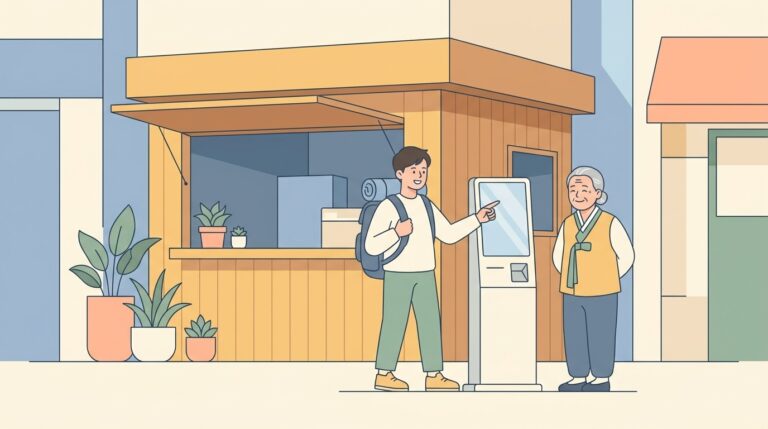
Picture this: You are standing in a bustling takeout coffee shop in downtown Jongno, Seoul. The lunch rush is at its peak. Office workers are tapping away on their smartphones while waiting for their iced Americanos. Right at the entrance stands a towering touchscreen kiosk, beeping aggressively with a 30-second countdown timer. Standing in front of it is an elderly grandfather (halabeoji). His hand hovers nervously over the screen, squinting at confusing loanwords like “디카페인 옵션” (decaf option), “샷 추가” (extra espresso shot), and “페이 결제” (digital wallet payment). Behind him, a slight sigh escapes from a hurried commuter. You want to step in and help, but suddenly your mind goes blank. Will your textbook Korean sound rude? Will offering help hurt his pride?
This exact moment represents one of modern South Korea’s most poignant social realities: the digital divide (디지털 격차). In the world’s most hyper-connected society, where unmanned kiosks, QR codes, and robotic servers have replaced human cashiers almost overnight, millions of older Koreans find themselves feeling stranded in their own neighborhoods. Over 70% of foreign learners tell us they hesitated to intervene not because they lacked kindness, but because they feared using the wrong honorific nuance. In this guide, tailored specifically to B2-level learners, we will break down the exact emotional vocabulary, polite social cues, and nunchi (눈치) required to step in gracefully, bridge the generational gap, and turn an awkward digital encounter into a warm human connection.
Phase 2: Core Expressions Deep Dive
1. 제가 대신 눌러드릴게요 (Jega daesin nulleodeurilgeyo)
- Pronunciation: Jeh-gah deh-shin nool-luh-deu-ril-geh-yo (Think of “nool” sounding like the word “nook” but ending with an ‘l’).
- Meaning: Literal: “I will press it instead of you.” / Real Nuance: “Allow me to tap that on the screen for you!” (Warm, proactive, and respectful).
- K-Culture Moment: You will often hear this in heartwarming family-centric K-dramas (like Our Blues or Navillera) when a considerate younger protagonist gently steps in before an elderly person feels embarrassed in front of automated machines.
- Editor’s Insight: Using 대신 (on someone’s behalf) paired with the humble auxiliary verb ~드리다 strikes the golden ratio of Korean politeness. It frames your action as a personal favor that eases their physical burden, rather than an implication that they are incapable of using the kiosk.
- Situation Spectrum:
- Casual (Friends): 🚫 (Too formal and distant)
- Semi-formal (Polite everyday): ✅ (Perfect for elders in public places)
- Formal (Public service announcement): ⚠️ (Use ‘도와드리겠습니다’ instead)
- 🤔 Think About It: In English, saying “Let me do that for you” can sometimes sound slightly patronizing if said briskly. Why does the Korean humble suffix ~드리다 completely neutralize that condescending edge?
2. 천천히 하셔도 괜찮아요 (Cheoncheonhi hasyeodo gwaenchannayo)
- Pronunciation: Chuhn-chuhn-hee hah-shyuh-doh gwen-chahn-ah-yo (“Cheon” rhymes with “sun”).
- Meaning: Literal: “Even if you do it slowly, it is okay.” / Real Nuance: “Please don’t feel rushed at all; take all the time you need.”
- K-Culture Moment: Seen frequently in variety shows like You Quiz on the Block, where empathetic hosts put nervous civilian guests at ease during fast-paced segments.
- Editor’s Insight: In South Korea’s fast-paced Ppalli-ppalli (빨리빨리 – hurry, hurry) society, elderly citizens often feel severe psychological pressure when holding up a queue. By vocalizing this phrase, you are actively giving them social permission to breathe and take their time, dissipating the anxiety caused by impatient bystanders.
- Situation Spectrum:
- Casual (Peers): ⚠️ (Change to ‘천천히 해’)
- Semi-formal (Daily life / Kiosks): ✅ (Warm, deeply comforting)
- Formal (Official contexts): ⚠️ (Prefer ‘편안히 진행하셔도 됩니다’)
- 🤔 Think About It: Does your native culture emphasize collective speed in public customer service, or is personal patience more commonly vocalized?
3. 어려우시면 편하게 말씀하세요 (Eoryeousimyeon pyeonhage malsseumhaseyo)
- Pronunciation: Uh-ryuh-oo-she-myun pyun-hah-geh mal-sseum-hah-seh-yo (Note the double-s in sseum, producing a crisp, tense ‘s’ sound like the hiss of steam).
- Meaning: Literal: “If it is difficult, comfortably speak.” / Real Nuance: “If anything gets tricky, please just ask me without hesitation.”
- K-Culture Moment: Common in modern neighborhood clinic scenes or community centers in slice-of-life K-dramas, showing compassionate nurses assisting grandmothers with digital registration tablets.
- Editor’s Insight: Notice the honorific shift: 말씀 is the elevated honorific noun for speech, paired with the polite imperative ~하세요. It creates a zero-pressure invitation for them to request help without losing face (체면 – che-myeon).
- Situation Spectrum:
- Casual (Close friends): 🚫 (Unnaturally polite)
- Semi-formal (Respectful stranger): ✅ (The gold standard for social assistance)
- Formal (Workplace/Client): ✅
- 🤔 Think About It: How does offering unconditional assistance preserve an elder’s dignity in communal societies compared to Western individualistic norms?
Phase 3: Textbook Korean vs. Real Korean
Situation 1: Offering assistance to a struggling elder
- 📖 Textbook Korean: 제가 기계 사용법을 가르쳐 드리겠습니다. (Jega gigye sayongbeobeul gareuchyeo deurigesseumnida. – I will teach you how to use the machine.)
- 🗣️ Real Korean: 제가 같이 봐드릴게요! (Jega gachi bwadeurilgeyo! – Let me take a look at it together with you!)
- 💡 Why is it different?: The textbook phrase uses 가르치다 (to teach), which inadvertently places you in an authoritative teacher-student dynamic. Real Koreans prefer 같이 보다 (to look together), which conveys solidarity, making the senior feel accompanied rather than patronized.
Situation 2: Reassuring someone flustered by the queue behind them
- 📖 Textbook Korean: 조급해하지 마십시오. (Jogeup-haehaji masipsio. – Do not be impatient.)
- 🗣️ Real Korean: 뒤에 신경 쓰지 마시고 편히 보세요. (Dwie singyeong sseuji masigo pyeonhi boseyo. – Don’t mind the people behind you; take a comfortable look.)
- 💡 Why is it different?: “조급해하지 마십시오” sounds like an automated instruction manual or military command. The natural phrasing directly targets their actual trigger—the gaze of the crowd behind them (뒤에 신경 쓰지 마시고)—providing immediate psychological relief.
Phase 4: K-Culture Deep Dive & Non-Verbal Manners
4-1. 눈치 (Nunchi) & Mindful Body Language
When assisting an elder at a digital touchscreen in Korea, non-verbal etiquette is just as vital as your spoken grammar:
1. The Respectful Angle: Never loom directly over their shoulder. Stand roughly 45 degrees to the side, slightly crouched so your eye level is equal to or slightly lower than theirs. Towering over someone is perceived as intimidating.
2. The Open Hand Gesture: When indicating menu items on the display, avoid pointing with an aggressive single index finger right in front of their eyes. Instead, use an open palm with your fingers gathered gently, guiding their gaze softly to the screen.
3. Touch Boundaries: Never grab their hands or snatch control of the screen without explicit consent. Point first, explain clearly, and ask permission before tapping the card terminal on their behalf.
4-2. Cultural Code: The Paradox of “빨리빨리” (Ppalli-ppalli)
South Korea modernized faster than almost any nation in the 20th century. This gave birth to the legendary Ppalli-ppalli (fast, fast) culture, which propelled innovations like lightning-fast 5G, automated ordering terminals, and 24-hour convenience apps. However, this velocity created a stark sociological fault line. For younger digital natives (MZ generation), kiosks represent convenience and autonomy; for seniors who grew up prioritizing human warmth and oral bargaining, kiosks feel like an impenetrable barrier. Stepping in to help an elder bridge this digital divide is one of the highest modern expressions of 정 (Jeong)—the uniquely Korean bond of communal affection and mutual responsibility.
Phase 5: Interactive Roleplay Scenario
Scenario Setting & Characters
- Location: A vibrant Mega Coffee branch near Jongno 3-ga station, Seoul. The screen glows brightly, cycling through confusing English menu tabs.
- NPC: Halmeoni Park (Age 74). She is clutching an old floral coin purse and staring anxiously at the screen’s countdown bar.
[Halmeoni Park]: (안경을 고쳐 쓰며 한숨을 쉰다) 아이고, 글씨가 너무 작아서 뭐가 뭔지 통 모르겠네... 카드 넣으라는 건 어디여?
(Aigo, geulssiga neomu jagaseo mwoga mwonji tong moreugenne... Kadeu neoheuraneun geon eodiyeo?)
[Sighs while adjusting her glasses] Oh dear, the letters are so tiny I have no clue what is what... Where does it say to insert the card?

[Learner (You)]: (한 걸음 다가가며 따뜻한 미소로) 어르신, 제가 같이 봐드릴까요?
(Eoreusin, jega gachi bwadeurilkkayo?)
[Stepping forward with a warm smile] Grandparent, shall I take a look at it together with you?

[Halmeoni Park]: (미안해하며 뒤를 돌아본다) 아이고, 젊은이 바쁠 텐데... 내가 줄을 막고 있어서 어쩌나.
(Aigo, jeolmeuni bappeul tende... Naega jureul makgo isseoseo eojjeona.)
[Looking back apologetically] Oh my, young person must be busy... What do I do, holding up the queue like this?

[Learner (You)]: (뒤쪽 사람들을 살짝 바라본 뒤 안심시키며) 전혀 안 바빠요. 뒤에 신경 쓰지 마시고 편히 말씀해 주세요.
(Jeonhyeo an bappayo. Dwie singyeong sseuji masigo pyeonhi malsseumhae juseyo.)
[Looking slightly behind to reassure her] I'm not busy at all. Please don't mind behind us and tell me comfortably.

[Halmeoni Park]: (화면을 가리킨다) 따뜻한 유자차 한 잔 마시고 싶은데, 화면에 차 종류가 안 보여...
(Tteutteutan yujacha han jan masigo sipeunde, hwamyeone cha jongnyuga an boyeo...)
[Pointing at the screen] I want a cup of hot citron tea, but I don't see teas on the screen...

[Learner (You)]: (화면 상단의 메뉴 탭을 부드럽게 가리키며) 아! 여기 위쪽에 '티/차' 메뉴 누르시면 나와요. 제가 대신 눌러드릴게요.
(Ah! Yeogi wijjoge 'ti/cha' menyu nureusimyeon nawayo. Jega daesin nulleodeurilgeyo.)
[Gently indicating the upper tab] Ah! If you tap the 'Tea' menu at the top here, it appears. Let me tap it for you.

[Halmeoni Park]: (화사하게 웃으며) 아이고, 참 고마워요. 이제 이 카드를 꽂으면 되는 건가?
(Aigo, cham gomawoyo. Ije i kadeureul kkojeumyeon doeneun geonga?)
[Smiling brightly] Oh my, thank you so much. Do I just insert this card now?

[Learner (You)]: (카드리더기 위치를 두 손으로 안내하며) 네, 여기 아래 반짝이는 곳에 카드를 쏙 꽂으시면 끝나요!
(Ne, yeogi arae banjjagineun gose kadeureul ssok kkojeusimyeon kkeutnayo!)
[Guiding toward the card slot with two hands] Yes, if you slide the card right into this blinking slot below, you're all done!
🔀 Interactive Choice Point
Halmeoni Park’s card gets rejected on the first attempt with a sudden buzzer sound. How do you respond?
- Option A: “어르신, 카드가 안 된대요. 다른 카드 없으세요? 비켜주셔야 할 것 같아요.”
- Option B: “당황하지 마세요! IC칩 방향이 반대였네요. 제가 방향 돌려서 다시 꽂아드릴게요.”
- Option C: “직원 불러올 테니까 거기 가만히 계세요.”
Choice Feedback:
- Option A [Bad]: Blunt and hurtful. Asking an elder to step aside in front of a crowd causes major loss of face (che-myeon).
- Option B [Best]: Empathetic, calm, and practical. Identifying the physical mistake (IC chip orientation) relieves her fear of financial malfunction while resolving the technical hitch respectfully.
- Option C [Risk]: Well-intentioned, but shouting “stay still” and running away can make the senior feel helpless and visibly abandoned at the front of a busy line.
Phase 6: 10-Second Emotion Shadowing Drill
Read these aloud while mimicking the precise pitch contours and emotional marks:
- [😊 따뜻하고 안심시키는 어조로 – Warm & Reassuring]
천천히 하셔도 / 괜찮아요. / 뒤에 / 신경 쓰지 마세요.
(Cheoncheonhi hasyeodo / gwaenchannayo. / Dwie / singyeong sseuji maseyo.) -
[🤗 다정하고 차분하게 – Gentle & Calm]
어려우시면 / 언제든 말씀하세요. / 제가 / 같이 봐드릴게요!
(Eoryeousimyeon / eonjedeun malsseumhaseyo. / Jega / gachi bwadeurilgeyo!) -
[✨ 싹싹하고 명쾌하게 – Courteous & Bright]
원하시는 메뉴 / 말씀만 해주세요. / 제가 대신 / 싹 눌러드릴게요!
(Wonhasineun menyu / malsseumman haejuseyo. / Jega daesin / ssak nulleodeurilgeyo!)
Phase 7: K-Culture Mini Dictionary
- 키오스크 (Kioskeu) — Touchscreen Kiosk
Refers to automated ordering stations dominating Korean fast food, cafes, and train stations. Often criticized for high screens and low contrast. - 디지털 소외계층 (Dijeiteol Soegyecheung) — The Digitally Excluded Class
Sociological term regularly highlighted in Korean news editorials describing elderly citizens and rural residents struggling with smart devices. - 버벅거리다 (Beobeokgeorida) — To Fumble / To Stumble / To Glitch
Colloquial verb describing a person hesitating nervously with digital menus or a machine loading slowly. Example: “기계 앞에서 자꾸 버벅거리게 돼.” (I keep fumbling in front of the machine). - 차근차근 (Chageunchageun) — Step-by-Step / Methodically
A comforting onomatopoeic adverb meaning to do things orderly without rushing. Example: “차근차근 하나씩 눌러보세요.” (Please tap them one by one, step-by-step).
Phase 8: Traveler’s Survival Kit
Survival Top 3
- 도와드릴까요? (Dowadeurilkkayo?) — “Shall I help you?” (Simple, polite, universally effective).
- 영수증 필요하세요? (Yeongsujeung piryohaseyo?) — “Do you need the receipt?” (Critical at kiosks because order numbers are printed on receipts!).
- 포장해 드릴까요? (Pojanghae deurilkkayo?) — “Would you like me to select takeout?” (Kiosks in Korea always force a “매장(For Here) vs. 포장(To Go)” choice).
Editor’s Travel Note
- Before navigating public transit or train ticket kiosks in Korea, check out this comprehensive [네이버 지도 및 코레일톡 활용 가이드 (Naver Map & Korail Talk Usage Guide)] to understand digital reservation workflows beforehand.
- Many modern Korean franchise cafes (like Compose Coffee, Paik’s Coffee, and Mega Coffee) place the barcode scanner at the extreme bottom left and the credit card slot on the bottom right. When guiding someone, remember that older cards with worn IC chips must be inserted chip-forward facing upward.
Phase 9: A Step Deeper (Reflective Insight)
In Korea, technology is celebrated for its frictionless speed, but speed without warmth inevitably breeds solitude. The Korean language inherently carries checks and balances against this through honorific architecture: the gap between people is recognized, yet bridged by deliberate verbal humility. When you use your Korean skills to guide an elder through an overwhelming digital terminal, you are participating in a living defense of communal dignity (공동체 의식). True fluency is not merely passing a TOPIK exam; it is knowing when to slow down and hold the digital door open for someone else.
💬 Your Turn: Have you ever experienced digital anxiety when traveling abroad, or stepped in to help someone navigate a foreign technology system? Drop your thoughts and experiences in the comments below!
Phase 10: FAQ & Avoiding Misunderstandings
Q: Can I address an elderly stranger as ‘할머니’ (Halmeoni) or ‘할아버지’ (Halabeoji)?
A: While common in TV shows, calling an active senior 할머니 or 할아버지 in real modern urban life can sometimes unintentionally offend them if they feel young at heart! The safest, most respectful term of address in Korean society is 어르신 (Eoreusin – Honored Senior) or simply using polite verbal endings without a direct noun address.
Q: Is it rude to take the card from their hand to pay for them?
A: Yes, seizing someone’s payment card without an explicit verbal cue like “제가 꽂아드릴까요?” (Shall I insert it for you?) can trigger defensiveness or alarm. Always guide with words and pointing gestures first; only touch their card if they directly hand it out toward you.
Q: What if an elder snaps back that they can do it themselves?
A: Don’t take it personally! Due to pride (자존심), some seniors may feel embarrassed when singled out. Simply bow slightly, say “네, 천천히 하세요!” (Yes, please take your time!), and step back naturally to remove any pressure.
🚨 Top 3 Common Learner Mistakes
| Common Mistake | Why It’s Risky | Correct Action |
|---|---|---|
| Saying “도와줄게요” (Dowajulgeyo) | Using casual-polite ending with strangers sounds like speaking down to children | Use 도와드릴게요 (-deurilgeyo) |
| Tapping the screen instantly over their shoulder | Startles the person and induces panic | Ask “제가 대신 눌러드릴까요?” first |
| Speaking extremely loud in broken Korean | Draws public attention and causes loss of face | Speak at a normal, warm volume with distinct pauses |
Phase 11: Action Missions
- 🥉 Bronze Level (Solo Prep): Stand in front of your bathroom mirror and practice saying “어르신, 제가 대신 눌러드릴게요!” with a gentle 15-degree torso bow and open-hand gesture 5 times.
- 🥈 Silver Level (Observation & Tag): Watch an episode of a neighborhood variety show (like 식객 허영만의 백반기행 or 유 퀴즈 온 더 블럭) and note how hosts adjust their body posture when talking to market grandmothers.
- 🥇 Gold Level (Real-World Application): Next time you visit Korea or a local Koreatown supermarket, notice someone hesitating near automated registers. Smile, stand at a respectful 45-degree angle, and offer: “제가 같이 봐드릴까요?”
🎮 K-Culture Discovery Mission: Search YouTube or TikTok for the search term #키오스크어르신 (Kiosk Seniors) to watch real Korean street experiments and news reports on this movement.
Phase 12: Interactive Quiz Challenge
Q1. (Scenario Judgement) An elderly gentleman is visibly sweating in front of an automated ticket kiosk at Seoul Station with 3 people queued behind him. Which phrase is culturally MOST appropriate to defuse his anxiety?
* A) 비키세요, 기차 놓쳐요! (Bikiseyo, gicha notchyeoyo!)
* B) 어르신, 뒤에 신경 쓰지 마시고 편히 보세요. (Eoreusin, dwie singyeong sseuji masigo pyeonhi boseyo.)
* C) 제가 기계 조작을 가르쳐 드리겠습니다. (Jega gigye jojageul gareuchyeo deurigesseumnida.)
Q2. (Fill-in-the-Blank) Complete the polite offer to assist using the humble form of ‘give/do’:
* “제가 메뉴를 대신 골라______. (I will select the menu on your behalf.)”
Q3. (True or False) It is considered good etiquette to point directly at screen buttons with your index finger right in front of an elder’s nose to guide them quickly.
👉 Click to view answers and explanations!
- Q1 Answer: B. It addresses his root emotional fear (the people waiting behind) using respectful honorifics (어르신, 편히 보세요). Option A is extremely rude, and Option C sounds like an unwanted technical lecture.
- Q2 Answer: 드릴게요 (deurilgeyo). ‘골라드릴게요’ combines 고르다 (to choose) with ~드리다 (humble form of 주다), signaling respectful service.
- Q3 Answer: False. Pointing sharply near an elder’s face is seen as rude. Use an open palm held at an angle to direct their vision gently.







