

Phase 1: 공감 (The Heartbeat of Korean Nightlife)
안녕하세요! 매일한글 에디터입니다.
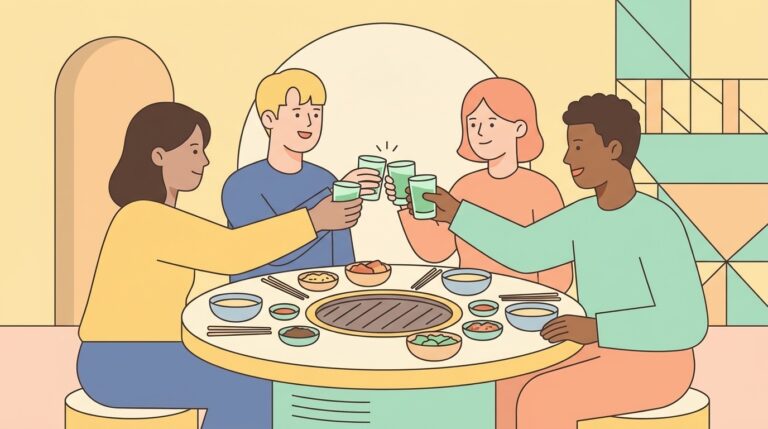
Picture this: You are sitting at a bustling pojangmacha (포장마차, street food tent) in Euljiro, surrounded by the sizzling sound of pork belly, the soft chime of green bottles clinking, and the warm laughter of local friends. Suddenly, the table turns to you. Your Korean coworker smirks, hands you a freshly poured glass of soju, and announces: “자, 오늘은 특별한 날이니까 한마디 해 줘! (Ja, oneureun teukbyeolhan narinikka hanmadi hae jwo! — Hey, it’s a special day, say a word!)”
Panic sets in. Your mind scrambles through textbook vocabulary. Do you say “건배 (Geonbae)” like an action-movie villain? Do you stand up stiffly like you are presenting a quarterly business report? In Korean drinking culture (sul-jari, 술자리), giving a toast (geonbaesa, 건배사) is not just about making a loud sound before drinking. It is a shared emotional rhythm, an art of nunchi (눈치, situational awareness), and the quickest shortcut to transforming polite acquaintances into lifelong hyeong (형) and unnie (언니).
Over the past decade of guiding hundreds of intermediate learners through Korean cultural waters, I have seen so many students freeze when handed the conversational mic at dinner. But here is the secret: you do not need an eloquent, poetic speech. A short, punchy phrase delivered with the right energy and body language will make the entire table erupt in cheers. Today, let’s unlock the insider secrets to delivering a toast that will make you the undisputed star of any Korean gathering!
Phase 2: 핵심 표현 3선 심층 분석 (Top 3 Signature Toasts)
1. 위하여! (Wihayeo!)
- Pronunciation: [Wi-ha-yeo] (Sounds like “We-high-yuh”, spoken with rising chest resonance)
- Meaning: Literal: “For the sake of!” | Real Nuance: “To us! / Here’s to our success and happiness!”
- K-Culture Moment: You have seen this in corporate K-dramas like Misaeng. The team leader stands up at a company dinner (hoesik), raises a glass high, shouts a wish, and the entire team roars “위하여!” in unison.
- Editor’s Insight: This is the undisputed timeless classic. You can attach a noun in front of it: “우리의 우정을 위하여! (U-ri-ui ujeong-eul wihayeo! — To our friendship!)” or “팀워크를 위하여! (Tim-wokeu-reul wihayeo! — To teamwork!)”. When you chant it, elongate the final syllable: “위하~여!”.
- Situation Spectrum: Casual ✅ | Semi-formal ✅ | Formal ✅
- 🤔 Think About It: Notice how English toasts often focus on a specific person (“To John!”), while Korean toasts almost always elevate the shared group value (“To our future!”). What does this reveal about Korean community mindset?
2. 짠! (Jjan!)
- Pronunciation: [Jjan] (Tense double-J sound, like a sharp “Jzahn!” mimicking glass clinking)
- Meaning: Literal: Sound of clinking glasses | Real Nuance: “Cheers! / Clink!”
- K-Culture Moment: In almost every romantic comedy, from Crash Landing on You to Business Proposal, two characters make unexpected eye contact at a pocha, gently bump glasses, and whisper a playful “짠~”.
- Editor’s Insight: 짠 is effortlessly friendly and casual. You do not use this with the CEO of your company unless they ask for a relaxed vibe. With friends, language exchange partners, or coworkers your age, shouting “자, 짠 하자! (Ja, jjan haja! — Let’s clink!)” instantly melts social awkwardness.
- Situation Spectrum: Casual ✅ | Semi-formal ⚠️ | Formal 🚫
- 🤔 Think About It: Why do you think Koreans invented an onomatopoeic word specifically for drinking together rather than using a formal wish?
3. 청바지! (Cheongbaji!)
- Pronunciation: [Cheong-ba-ji] (Like “Chung-bah-jee”, sounds identical to “blue jeans”)
- Meaning: Literal: Blue jeans | Real Nuance: Acronym for 청춘은 바로 지금부터 (Cheongchuneun baro jigeumbuteo — Youth begins right now!)
- K-Culture Moment: Seen frequently in variety shows like Running Man or Workman. It represents the witty, modern culture of acronym toasts (sam-haeng-si style).
- Editor’s Insight: When you pull this out as an international speaker, Koreans will be stunned by your deep cultural knowledge. You yell “청바지!” and explain the acronym, or you lead a call-and-response: you say “청춘은 바로!” and everyone screams “지금부터!”.
- Situation Spectrum: Casual ✅ | Semi-formal ✅ | Formal ⚠️
- 🤔 Think About It: How does humor through wordplay bridge generational gaps at a Korean dinner table?
Phase 3: 교과서 한국어 vs 진짜 한국어 (Textbook vs. Real Native Korean)
Situation 1: Suggesting a toast to the group
- 📖 교과서 한국어: “다 함께 건배합시다.” (Da hamkke geonbaehapsida. — “Let us toast all together.”)
- 🗣️ 진짜 한국어: “자, 다 같이 가볍게 짠 한번 할까요?” (Ja, da gachi gabyeopge jjan hanbeon halkkayo? — “Alright, shall we all do a quick clink together?”)
- 💡 왜 다를까? Textbook Korean teaches stiff, declarative grammar ending in -ㅂ시다. In real Korean life, drinks are about collective warmth, so natives soften suggestions into gentle questions using -ㄹ까요? paired with the casual rhythmic filler 자 (ja, well/alright).
Situation 2: Encouraging everyone to finish their drinks
- 📖 교과서 한국어: “잔을 모두 비워 주세요.” (Janeul modu biwo juseyo. — “Please empty all your glasses.”)
- 🗣️ 진짜 한국어: “이번 잔은 다 같이 원샷!” (Ibeon janeun da gachi wonsyat! — “For this round, let’s all bottom-up!”)
- 💡 왜 다를까? While nobody should ever be forced to overdrink, the energetic Konglish phrase 원샷 (one-shot) is the undisputed champion of bar talk when the mood hits its peak. Saying 잔을 비우다 sounds like an instruction manual.
Phase 4: K-Culture 딥다이브 & 비언어적 매너 (Deep Dive: Manners & Nuance)
4-1. 눈치 (Nunchi) & Non-Verbal Gestures
Korean drinking etiquette is an elegant choreography of respect and connection:
1. The Two-Hand Rule (Du Son, 두 손): When clinking glasses or receiving a pour, always hold your glass with both hands if someone older or higher in status is serving. Even resting your left hand lightly on your right forearm or wrist demonstrates high cultural fluency.
2. The Glass Elevation Game: When touching glasses with a senior or boss, intentionally lower the rim of your glass slightly below theirs. Touching glasses higher than your elder is considered bold or thoughtless.
3. The Courtesy Turn: When taking a sip in front of elders, subtly tilt your head and upper body slightly away from them, shielding your drink with your opposite hand. It is an ancient sign of modesty.
4-2. Cultural Code: The Magic of Work Later, Drink Now (술꾼도시여자들)
In the hit K-Drama Work Later, Drink Now, drinking is not depicted as mere partying. It is presented as emotional therapy. At a Korean sul-jari, making a toast is your permission slip to speak genuinely (jinsim, 진심). Once glasses clink and the table chants together, rigid social hierarchies soften, allowing junior and senior colleagues to form an unspoken camaraderie that rarely happens inside the daytime office.
Phase 5: 실전 롤플레이 시나리오 (Interactive Role-Play)
Setting: A retro-styled barbecue restaurant in Mapo-gu. Thick aromas of sizzling Galbi fill the air. Fresh green bottles of soju and amber bottles of beer sit on the stainless-steel table.
Characters:
* Min-jun (민준): Your warm, energetic Korean team manager.
* You (Alex): Intermediate-level exchange professional.
- Turn 1 (Min-jun):
자, 오늘 알렉스 씨 환영회니까 모두 잔 채우세요!
(Ja, oneul Alex-ssi hwanyeonghoenikka modu jan chae-useyo!)
“Alright, tonight is Alex’s welcome dinner, so everyone fill your glasses!”
🎭 [Grinning brightly, waving a soju bottle to rally the table] -
Turn 2 (You):
감사합니다, 팀장님! 제가 한 잔 따라 드릴게요.
(Gamsahamnida, timjangnim! Jega han jan ttara deurilgeyo.)
“Thank you, Team Leader! Let me pour you a glass.”
🎭 [Politely supporting right forearm with left hand while pouring] -
Turn 3 (Min-jun):
오, 센스 있네! 자, 알렉스 씨가 건배사 한번 멋지게 날려줘!
(Oh, senseu inne! Ja, Alex-ssiga geonbaesa hanbeon meotjige nallyeojwo!)
“Oh, you’ve got great etiquette! Come on, hit us with an awesome toast!”
🎭 [Hands the conversational spotlight to you with an encouraging wink] -
Turn 4 (You):
제가요? 떨리지만 열심히 해보겠습니다!
(Je-gayo? Tteollijiman yeolsimhi haebogesseumnida!)
“Me? I’m nervous, but I’ll do my best!”
🎭 [Taking a breath, raising your glass to chest height] -
Turn 5 (You):
한국에 와서 여러분을 만나서 정말 행복합니다!
(Hanguge waseo yeoreobuneul mannaseo jeongmal haengbokhamnida!)
“Coming to Korea and meeting everyone here makes me truly happy!”
🎭 [Making warm, smiling eye contact around the table] -
Turn 6 (Min-jun):
좋다! 뒤에 뭐라고 외칠까요?
(Jota! Dwie mworago oechilkkayo?)
“Awesome! What should we yell after that?”
🎭 [Leaning forward in anticipation] -
Turn 7 (You):
제가 ‘우리의 만남을’ 하면, 다 같이 ‘위하여’ 해주세요! 우리의 만남을!
(Jega ‘uriui mannameul’ hamyeon, da gachi ‘wihayeo’ haejuseyo! Uriui mannameul!)
“When I say ‘To our meeting,’ please all shout ‘Wihayeo’! To our meeting!”
🎭 [Speaking clearly with confidence and a broad smile] -
Turn 8 (Min-jun & Team):
위하여~! 환영해요, 알렉스!
(Wihayeo~! Hwanyeonghaeyo, Alex!)
“Wihayeo~! Welcome, Alex!”
🎭 [Roaring applause followed by rhythmic clinking of glasses]
🔀 Your Interactive Branching Point
Min-jun says your toast was great and immediately pours you a fresh shot of soju. What do you do?
- Option A: Hold your glass with both hands slightly below Min-jun’s, clink with a smile, turn your head slightly sideways to take a sip, and say “감사합니다!”.
- Outcome (BEST): Absolute perfection! The entire table nods in approval. You have demonstrated native-level cultural instinct and respect.
- Option B: Keep both eyes locked onto Min-jun’s eyes, clink your glass high above his, and gulp it down while staring forward.
- Outcome (BAD): Awkward silence. Looking straight while drinking in front of a senior feels confrontational, and clinking higher comes off as arrogant.
- Option C: Say “No thanks, I’ll pass on this round” and push the glass away abruptly.
- Outcome (RISK): High social friction. Even if you don’t drink alcohol, you should accept the pour with both hands and leave it on the table, or politely request water or cider (사이다) beforehand.
Phase 6: 10초 감정 섀도잉 드릴 (10-Second Emotional Shadowing)
Practice these lines out loud with the exact vocal inflection marked below:
[😊 신나고 당당하게 / Confident and Upbeat]
“자, / 오늘 다들 고생 많으셨습니다! / 짠 한번 할까요? / 짠!”
(Ja, / oneul dadeul gosaeng maneusyeosseumnida! / Jjan hanbeon halkkayo? / Jjan!)
Pause naturally after ‘자’ and hit the final ‘짠!’ with a snappy burst of energy.-
[🔥 열정적이고 패기 있게 / Passionate and Spirited]
“우리의 / 멋진 미래를 / 위하여~!”
(Uriui / meotjin miraereul / wihayeo~!)
Stretch out the final ‘여~!’ like you are leading an anthem stadium chant. -
[🥺 다정하고 귀엽게 / Warm and Affectionate with Friends]
“우리 우정 / 변치 말자! / 가볍게 짠~”
(Uri ujeong / byeonchi malja! / Gabyeopge jjan~)
Soften your voice at the end to create cozy intimacy.
Phase 7: K-Culture 미니 사전 (Mini Dictionary)
-
2차 (I-cha)
- English: Round Two (After-party venue).
- Real Usage: Korean nights out rarely end at one restaurant. Moving from barbecue (1차) to a craft pub (2차) and then karaoke (3차) is customary. To suggest moving: “우리 2차 갈까요? (Uri i-cha galkkayo?)”.
- 안주 (Anju)
- English: Food paired specifically with alcohol.
- Real Usage: In Korea, you rarely drink alcohol alone without food. Fried chicken, stew, or dried squid are essential companions that balance the drink.
- 회식 (Hoesik)
- English: Company gathering / team dinner.
- Real Usage: An official-yet-informal gathering designed for team bonding outside office hours.
- 주량 (Juryang)
- English: Alcohol tolerance / capacity.
- Real Usage: Commonly measured in soju bottles. When people ask, “주량이 어떻게 되세요? (Juryang-i eotteoke doeseyo? — What’s your tolerance?)”, answering “소주 반 병 정도요 (About half a bottle of soju)” is a safe standard.
Phase 8: 여행자를 위한 생존 키트 (Traveler’s Survival Kit)
Top 3 Survival Phrases
- 1. 물 좀 더 주실 수 있나요? (Mul jom deo jusil su innayo?)
- Romanization: [Mul jom deo ju-sil su in-na-yo?]
- Pro Tip: Hydration is essential at a lively bar. Use this when the water carafe empties.
- 2. 저 술 잘 못 마셔요. 음료수로 대신해도 될까요? (Jeo sul jal mot masyeoyo. Eumnyosuro daesinhaedo doelkkayo?)
- Romanization: [Jeo sul jal mot ma-syeo-yo. Eum-nyo-su-ro dae-sin-hae-do doel-kka-yo?]
- Pro Tip: If you don’t drink alcohol, politely state this early. Modern Koreans will happily cheer with soda or water without pressure.
- 3. 여기 계산해 주세요! (Yeogi gyesanhae juseyo!)
- Romanization: [Yeo-gi gye-san-hae ju-se-yo!]
- Pro Tip: Call out clearly to the server when you are ready to settle the bill at the front register.
Editor’s Travel Note
- Getting Home Safe: Late-night taxis in Seoul can be competitive on Friday evenings. Make sure to download and set up the 카카오 T (Kakao T) 앱 다운로드 before heading out. It works smoothly with foreign international credit cards.
- Payment Culture: Splitting the bill item-by-item at the register is unpopular at crowded bars. Usually, one person pays in full, and friends transfer money via banking apps, or one person pays for 1차 and another covers 2차.
Phase 9: “한 발 더 깊이” (Cultural Reflection)
In Western individualist traditions, raising a glass is often a personal wish for someone’s health or happiness. In Korean culture, however, making a toast is an act of communal synchronization. When ten people simultaneously chant “위하여!” and bump their glasses together, they are shedding individual professional barriers to reaffirm their shared identity as a single tribe (woori, 우리). Drinking in Korea is rarely about intoxication alone; it is an intimate social ritual designed to weave people into a protective community tapestry.
💬 Your Turn: What is the traditional toast in your culture, and how does its meaning compare to the Korean concept of “위하여 (Wihayeo)”? Share your story in the comments below!
Phase 10: FAQ & 오해 방지 (FAQ & Common Mistakes)
Q: What should I do if my glass is empty? Should I pour a drink for myself?
A: In traditional Korean etiquette, you never pour your own drink (jajak, 자작). Instead, observe your companions’ glasses. When you notice someone’s glass is low or empty, offer to pour for them (“한 잔 따라 드릴게요”). Naturally, they will notice your empty glass and return the favor!
Q: Can I decline alcohol without offending my hosts?
A: Yes, absolutely! Modern Korean social culture is respectful of personal choices. Simply explain with a smile early in the evening: “제가 건강/종교 문제로 술을 못 마십니다 (I cannot drink due to health/religious reasons).” You can still participate in the clinking rituals by holding a glass filled with tea, water, or soda.
Q: Do I have to drink the whole shot in one go (원샷)?
A: Not at all! Unless it is an explicit 원샷 chant during a celebratory game, sipping (kkeun-eo masigi, 끊어 마시기) is completely acceptable. Just ensure you take at least a small sip immediately after clinking before setting your glass down.
🚨 Common Mistakes Alert Board
| Foreign Learner Mistake | Cultural Risk | Correct Action |
|---|---|---|
| Clinking glass higher than an elder’s | Perceived as self-absorbed or disrespectful | Deliberately lower your glass rim beneath theirs |
| Pouring with one limp hand | Looks overly aloof or careless | Use two hands, or steady your right arm with your left hand |
| Drinking face-to-face with seniors | Considered confrontational | Turn your upper torso 45 degrees away while drinking |
Phase 11: 액션 미션 & 참여 유도 (Action Missions)
- 🥉 Bronze Mission (Self Practice): Stand in front of your mirror, hold a glass with two hands, and deliver the line “우리의 만남을 위하여!” three times with an open, confident voice.
- 🥈 Silver Mission (Social Sharing): Post a short story or tweet about your favorite Korean street food paired with the hashtag
#DailyHangulToast. - 🥇 Gold Mission (Real Life Application): At your next dinner with Korean friends, language exchange partners, or Korean restaurant visit, volunteer to lead the toast using “가볍게 짠 한번 할까요?”.
- 🎮 K-Culture Media Hunt: Watch one episode of a slice-of-life K-drama (like Hospital Playlist or Itaewon Class) and spot whether characters turn their heads when drinking in front of older colleagues!
Phase 12: 인터랙티브 퀴즈 챌린지 (Interactive Quiz)
Test your cultural fluency below!
Q1. When clinking glasses with someone older or senior in status, where should your glass rim be?
* A) As high as possible to show enthusiasm
* B) Slightly lower than the other person’s glass rim
* C) Exactly touching at the same height
👉 Click to see the answer and explanation
Correct Answer: B
Explanation: Lowering the rim of your glass slightly below your senior’s is a subtle, elegant display of humility and respect (ye-ui, 예의).
Q2. Fill in the blank:
“우리의 우정을 ________!” (To our friendship!)
👉 Click to see the answer and explanation
Correct Answer: 위하여 (Wihayeo)
Explanation: “우리의 우정을 위하여!” is the classic phrase used to dedicate a toast to friendship.
Q3. True or False:
It is polite and normal to pour your own alcohol into your own glass during a traditional Korean dinner gathering.
* (True / False)
👉 Click to see the answer and explanation
Correct Answer: False
Explanation: Pouring for oneself (jajak, 자작) can signal that others are neglecting you. Look after your neighbors’ glasses, and they will gladly pour for you!







