

Phase 1: Empathy & Storytelling
안녕하세요! (Hello!) This is your Daily Hangul editor.
Picture this: You step through the automated sliding glass doors of a bright, spotless bank in Hongdae or Gangnam. Chimes ding pleasantly, tellers in neat business suits bow gently to customers, and the cool scent of crisp air conditioning and freshly printed paper fills the lobby. You walked in with high spirits, eager to exchange money or finally open your Korean bank account. But just two steps inside, you freeze.
Right in front of you stands a massive digital kiosk glowing with neon Korean buttons: ‘입금/출금’ (Deposit/Withdrawal), ‘예금/신탁’ (Savings), ‘외환’ (Foreign Exchange), and ‘대출’ (Loans). Behind you, an office worker in an impeccably pressed suit taps their watch impatiently. Your palms begin to sweat. Which button do you press? Where does the ticket even come out? Do you talk to the security guard standing in the corner, or will you embarrass yourself?
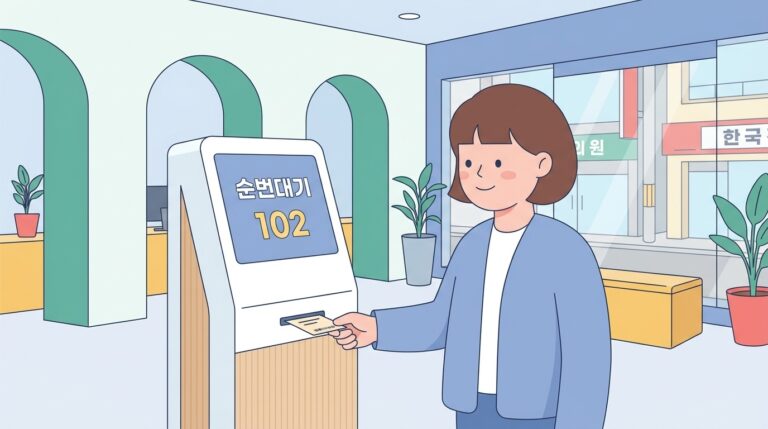
Take a deep breath—every single foreigner living in South Korea has frozen in front of that exact touch screen! Grabbing your waiting ticket—번호표 뽑기 (beonhopyo ppopgi)—is the very first gate you must pass to navigate Korean public life. Today, backed by real classroom hurdles from our students, I’m holding your hand through every button, phrase, and cultural nuance. By the end of this guide, you will stride up to that kiosk, tap the right option, and wait like a seasoned Seoulite.
Phase 2: Core Expressions Deep Dive
Here are the top three magic phrases you need to breeze through taking a ticket at any Korean bank.
1. 번호표 어디서 뽑아요? (Beonhopyo eodiseo ppobayo?)
- Pronunciation: Beon-ho-pyo eo-di-seo ppo-ba-yo? (Think: Bun-ho-pyo uh-dee-suh po-bah-yo?)
- Meaning: Literal: “Where do I pull a number ticket?” vs. Real Nuance: “Excuse me, where can I get a queue ticket?”
- K-Culture Moment: In workplace K-dramas like Misaeng, busy rookies sprint into government offices or bank branches, bowing politely to the lobby officer while asking this exact question before the lunch rush kicks in.
- Editor’s Insight: Notice the verb 뽑다 (ppopda), which means “to pluck” or “to pull out.” Because old mechanical dispensers required you to physically pull out a paper slip, Koreans still say ticket “pulling” even on touch screens!
- Situation Spectrum: Casual: ⚠️ (번호표 어디서 뽑아?) | Semi-formal: ✅ (번호표 어디서 뽑아요?) | Formal: ✅ (번호표는 어디서 뽑습니까?)
- 🤔 Think About It: Does your native language say “take a ticket,” “pick a number,” or something else? Why do you think Korean uses the kinetic action of “pulling”?
2. 통장 만들러 왔어요. (Tongjang mandeulleo wa-sseoyo.)
- Pronunciation: Tong-jang man-deul-leo wa-sseo-yo. (Think: Tong-jahng mahn-deul-luh wah-ssuh-yo)
- Meaning: Literal: “I came to make a bankbook.” vs. Real Nuance: “I’m here to open a bank account.”
- K-Culture Moment: You will hear this spoken by international students or characters in youth dramas like Weightlifting Fairy Kim Bok-joo when stepping up to a bank counter for their very first independent bank account.
- Editor’s Insight: While formal signs write ‘계좌 개설’ (gyejwa gaeseol – account creation), ordinary Koreans almost exclusively say ‘통장 만들다’ (tongjang mandeulda – to make a bankbook) in everyday speech. Using this phrase makes you sound immediately natural.
- Situation Spectrum: Casual: 🚫 | Semi-formal: ✅ (통장 만들러 왔어요.) | Formal: ✅ (통장 개설하러 왔습니다.)
- 🤔 Think About It: Koreans still refer to bank accounts as “bankbooks” (통장) because paper bankbooks were stamped and updated at ATMs for decades. What nostalgic terms exist in your home country’s banking system?
3. 제 차례예요? (Je charyeyeyo?)
- Pronunciation: Je cha-rye-ye-yo? (Think: Jeh chah-ryeh-yeh-yo?)
- Meaning: Literal: “Is it my turn?” vs. Real Nuance: “Is it my turn now? / Am I up next?”
- K-Culture Moment: In comedy sitcoms, a distracted protagonist glued to their smartphone looks up abruptly when the electronic chime rings and nervously asks their neighbor or teller if their number was called.
- Editor’s Insight: In Korean banks, an automated voice announces your ticket number with a ding: “Ttaeng-ddong! 104-beon gogaek-nim, 3-beon chang-gu-ro osipsiyo” (Customer 104, please proceed to Counter 3). If you miss the call, this phrase safely clarifies your turn without confusion.
- Situation Spectrum: Casual: ⚠️ (내 차례야?) | Semi-formal: ✅ (제 차례예요?) | Formal: ✅ (제 차례입니까?)
- 🤔 Think About It: Queuing etiquette in Korea is strictly automated and respected. How do you feel about electronic boards versus people calling out family names in waiting rooms?
Phase 3: Textbook Korean vs. Real Korean
Let’s compare stiff book phrases with what native speakers actually say at A2 level.
Situation 1: Asking the security officer at the kiosk for assistance
- 📖 Textbook Korean: “실례합니다만, 번호표를 어떻게 발급받아야 합니까?” (Sil-lye-ham-ni-da-man, beon-ho-pyo-reul eo-tteo-ke bal-geup-ba-da-ya ham-ni-kka? – Excuse me, how must I be issued a number ticket?)
- 🗣️ Real Korean: “저기요, 이거 어떻게 눌러요?” (Jeo-gi-yo, i-geo eo-tteo-ke nul-leo-yo? – Excuse me, how do I press this?)
- 💡 Why the difference?: Sino-Korean administrative vocabulary like “발급받다 (to be issued)” sounds like a written legal statute. In person, pointing at the screen and asking “어떻게 눌러요? (how do I press?)” is warm, clear, and perfectly polite.
Situation 2: Explaining foreign exchange needs
- 📖 Textbook Korean: “외국 통화를 대한민국 원화로 환전하기를 희망합니다.” (Oe-guk tong-hwa-reul dae-han-min-guk won-hwa-ro hwan-jeon-ha-gi-reul hui-mang-ham-ni-da. – I desire to exchange foreign currency into Republic of Korea Won.)
- 🗣️ Real Korean: “달러 환전하러 왔어요.” (Dal-leo hwan-jeon-ha-reo wa-sseo-yo. – I came to exchange dollars.)
- 💡 Why the difference?: Koreans value conciseness at service counters. State the currency name + hwanjeon-hareo wasseoyo (“came to exchange”), and the teller will instantly hand you the proper forms.
Phase 4: K-Culture Deep Dive & Non-Verbal Manners
4-1. 눈치 (Nunchi) & Body Language at the Kiosk
When you enter a Korean bank, the uniformed staff member standing beside the ticket machine is the 청원경찰 (cheongwon-gyeongchal – security/service officer). In Korea, this person is not an intimidating guard—they are your greatest ally!
- The Eye Contact & Bow: As soon as you step up, give a small 15-degree head bow. If you stare helplessly at the kiosk for more than 3 seconds, an attentive officer will approach and ask: “Eotteon illo osyeosseoyo?” (What brings you in today?).
- Two-Hand Rule (두 손 예절): When the officer hands you your ticket slip, or when you hand your passport/ARC card to the teller, always receive and offer items with both hands, or support your right wrist lightly with your left hand. Never take a ticket with one hand casually swinging at your side!
4-2. Culture Code Analysis: The “Bbali-Bbali” (빨리빨리) Queue Science
Korea’s famous “hurry-hurry” (ppalli-ppalli) culture turns banking into a fine-tuned engineering marvel. Ticketing machines divide customers into specific lanes:
1. 일반예금 (General Banking): Deposits, withdrawals, bankbook updates.
2. 개인뱅킹 / 상담 (Personal Banking / Consultation): Opening accounts, debit cards, internet banking.
3. 외환 (Foreign Exchange): Remittances, foreign currency exchange.
If you press the wrong category, you might wait 20 minutes at Counter 1 only to find out you need Counter 5! Understanding which ticket to pull respects everyone’s fast-paced day.
Phase 5: Real-Life Roleplay Scenario
Setting: A bustling Hana Bank branch in Sinchon at 10:30 AM. Sunlight pours across sleek marble counters. Officer Park, a friendly security guide with a gold name tag, stands next to the automated touch screen.
Characters:
* You: A learner visiting to open an account.
* Officer Park: Attentive bank concierge.
- Officer Park: 어서 오세요! 어떤 일로 오셨어요?
(Eoseo oseyo! Eotteon illo osyeosseoyo?)
“Welcome! What can we help you with today?”
🎭 Bows respectfully with hands clasped in front. -
You: 안녕하세요. 통장 만들러 왔어요.
(Annyeonghaseyo. Tongjang mandeulleo wa-sseoyo.)
“Hello. I came to open a bank account.”
🎭 Returns a polite head nod and smiles. -
Officer Park: 아, 통장 개설이요? 신분증이나 외국인등록증 있으세요?
(A, tongjang gaeseoriyo? Sinbunjeung-ina oeguk-in-deung-rok-jeung isseuseyo?)
“Ah, opening an account? Do you have your ID or Alien Registration Card with you?”
🎭 Gestures with an open palm toward your documents. -
You: 네, 외국인등록증 여기 있어요.
(Ne, oeguk-in-deung-rok-jeung yeogi isseoyo.)
“Yes, my Alien Registration Card is right here.”
🎭 Lightly touches bag pocket to confirm. -
Officer Park: 좋습니다. 화면에서 ‘개인뱅킹’ 누르시면 번호표 나와요.
(Jot-seumnida. Hwamyeon-eseo ‘Gaein-baeng-king’ nureusimyeon beonhopyo nawayo.)
“Great. If you press ‘Personal Banking’ on the screen, your ticket will dispense.”
🎭 Points gently to the second blue touch button. -
You: 아, 이거 누르면 돼요? 감사합니다!
(A, igeo nureumyeon dwaeyo? Gamsahamnida!)
“Ah, I just press this one? Thank you!”
🎭 Taps the screen and waits for the chime. -
Officer Park: 네, 번호표 챙겨서 저쪽 2번 창구 앞에서 기다려 주세요.
(Ne, beonhopyo chaeng-gyeoseo jeojjok i-beon chang-gu ap-eseo gidaryeo juseyo.)
“Yes, take your ticket and please wait in front of Counter 2 over there.”
🎭 Hands you the printed ticket with both hands. -
You: 네! 저기 앉아서 기다릴게요.
(Ne! Jeogi anjaseo gidarilgeyo.)
“Got it! I will sit over there and wait.”
🎭 Accepts ticket with both hands and walks to the chairs.
🔀 Interactive Branching Moment!
While you are standing at the kiosk, Officer Park turns to you with a question:
“오늘 체크카드도 같이 신청하실 거예요?” (Are you going to apply for a debit card today as well?)
How do you respond?
* Option A: “네, 카드도 같이 만들고 싶어요.” (Yes, I want to make a card together.)
* 👉 Feedback [Best!]: Excellent! Tellers can prepare both account opening forms and debit card agreements simultaneously, saving you 20 extra minutes of paperwork.
* Option B: “아니요, 그냥 구경하러 왔어요.” (No, I just came to look around.)
* 👉 Feedback [Bad!]: Banks are strictly for official financial tasks. Telling staff you came to “browse” will baffle them and confuse the queue system.
* Option C: “몰라요. 그냥 해 주세요.” (I don’t know. Just do it.)
* 👉 Feedback [Risk!]: “몰라요” sounds abrupt and irritable in Korean. If you are unsure, say: “상담받고 결정할게요” (I will decide after consulting).
Phase 6: 10-Second Emotion Shadowing Drill
Practice reading these out loud! Follow the rhythm pauses marked by / and channel the emotional cues:
[😊 Friendly & Polite]
저기요, / 번호표 / 어디서 뽑아요?
(Jeo-gi-yo, / beon-ho-pyo / eo-di-seo ppo-ba-yo?)-
[🎯 Clear & Confident]
통장 / 만들러 / 왔어요.
(Tong-jang / man-deul-leo / wa-sseo-yo.) -
[🧐 Curious & Careful]
이 버튼 / 누르면 / 돼요?
(I beo-teun / nu-reu-myeon / dwae-yo?) -
[🙏 Grateful & Courteous]
감사합니다, / 저기서 / 기다릴게요.
(Gam-sa-ham-ni-da, / jeo-gi-seo / gi-da-ril-ge-yo.)
Phase 7: K-Culture Mini Dictionary
- 번호표 (Beonhopyo) | Queue / Waiting Ticket
The small paper slip printed by the kiosk containing your calling number (호출번호) and the count of people ahead of you. - 창구 (Changgu) | Bank Teller Counter
The individual service desks labeled with bright numerical boards (e.g., 1번 창구, 2번 창구). - 대기인수 (Daegi-insu) | Number of Waiting Customers
Found at the bottom of your ticket. If it says “대기인수: 4명”, exactly four people are ahead of you in that lane. - 외국인등록증 (Oeguk-in-deung-rok-jeung) | Alien Registration Card (ARC)
The essential official identification card required for all major banking transactions in Korea.
Phase 8: Traveler’s Survival Kit
Survival Expressions Top 3
- “영어로 된 서류 있어요?” (Yeong-eo-ro doen seoryu isseoyo? – Do you have forms in English?)
Pro Tip: Major banks (Hana, Shinhan, KB) keep English application forms behind the counter! - “얼마나 기다려야 해요?” (Eolmana gidaryeoya haeyo? – How long will the wait be?)
Pro Tip: Handy if you visit during lunchtime and see 15 people waiting. - “외환 창구가 어디예요?” (Oe-hwan chang-gu-ga eodi-yeyo? – Where is the foreign exchange counter?)
Pro Tip: Remittance and currency exchanges are often segregated into special windows.
Editor’s Travel Note
- Smart Navigation: Always locate bank branches with specialized foreign exchange desks using the Naver Map app download.
- Bank Operating Hours: Korean bank branches typically close at 4:00 PM (some at 3:30 PM). Do not arrive at 3:55 PM, as kiosk machines may be turned off early.
- Avoid the Lunch Rush: 11:45 AM to 1:15 PM is packed with local workers taking their lunch break to run errands. Aim for 9:30 AM or 2:00 PM!
Phase 9: “One Step Deeper” (Reflective Humanities Essay)
In South Korea, the humble 번호표 (queue ticket) represents something much larger than automated efficiency: it is a tangible symbol of modern Korean democracy and social fairness. In a country that underwent rapid post-war urbanization, strict automated ticketing removed the anxieties of queue-jumping, favoritism, and hierarchy. In front of that little kiosk, an executive CEO and a university freshman receive the exact same treatment: whoever pulls the ticket first gets served first. Sitting quietly beneath the flashing LED display while listening for the signature chime is a silent communal contract of mutual patience and civic courtesy.
💬 Your Turn: How does waiting for service work in your home country? Do people line up physically, chat with strangers, or rely entirely on apps? Tell me your story in the comments below!
Phase 10: FAQ & Common Mistakes
Q: What should I do if my ticket number is called on the board, but I don’t speak enough Korean to answer the teller?
A: Walk straight to the illuminated counter, present your ticket with both hands, bow, and say: “Hangugeo jogeum bakke motaeyo. Yeong-eo ganeung-hasin bun gyesyeoyo?” (I only speak a little Korean. Is someone who speaks English available?). Tellers will immediately bring out bilingual forms or call an English-speaking colleague.
Q: Which kiosk button should I press if I only want to exchange US dollars or Euros into Korean Won?
A: Look for the word 외환 (Oehwan – Foreign Exchange) or 환전 (Hwanjeon – Currency Exchange). If you don’t see a dedicated foreign exchange button, select 일반예금 (General Deposits).
Q: Can I take a ticket before the bank officially opens in the morning?
A: Most Korean bank lobbies open their outer ATM vestibule at 9:00 AM sharp. You cannot take a ticket before 9:00 AM, so visitors simply form a polite, orderly physical line outside the glass doors before opening time.
🚨 Common Mistakes Board
- Mistake 1: Throwing away the printed ticket slip.
Correct Action: Keep the paper ticket in your fingers! Tellers scan the barcode on your ticket to officially register that you arrived at the window. - Mistake 2: Standing right behind the customer currently at the counter.
Correct Action: Never crowd the teller counter. Stay seated in the lobby chairs until your specific 3-digit number chimes. - Mistake 3: Hitting the red emergency button on the kiosk.
Correct Action: Red buttons near kiosks are often marked ‘호출’ (Emergency Call). To restart your kiosk screen, tap ‘처음으로’ (Back to Start), not the emergency button!
Phase 11: Action Mission & Engagement
- 🥉 Bronze Mission (Solo Practice): Stand in front of your mirror, raise two hands as if pressing a screen, and say clearly: “통장 만들러 왔어요!” three times.
- 🥈 Silver Mission (Community Share): Leave a comment under this post sharing which Korean bank logo you find the most recognizable (the green Hana leaf, the blue Shinhan bird, or the yellow KB star).
- 🥇 Gold Mission (Real-world Challenge): Next time you walk past a Korean bank in your city or during your travels, peek at the lobby kiosk and see if you can spot the word 번호표!
- 🎮 K-Culture Mission: Watch any episode of a contemporary K-drama set in an office or bank. Keep your ears peeled for the chime sound (ttaeng-ddong!) and shout: “제 차례예요?”!
Phase 12: Interactive Quiz Challenge
Test your real-world banking chops with these three quick questions!
1. Situational Challenge: You enter a bank lobby and see an automated ticketing machine. You want to ask the friendly officer how to get a ticket. What is the most natural sentence?
* A) 번호표 빨리 줘. (Beonhopyo ppalli jwo.)
* B) 저기요, 번호표 어디서 뽑아요? (Jeogiyo, beonhopyo eodiseo ppobayo?)
* C) 당신은 누구입니까? (Dangsineun nugu-imnikka?)
2. Fill-in-the-Blank: Complete the sentence meaning “I came to exchange currency”:
* “달러 ________ 왔어요.” (Hint: The Korean word for currency exchange is 환전).
3. True or False: In a Korean bank, it is polite to stand right next to the person at Counter 1 while waiting for your ticket number to appear.
* ( True / False )
👉 Click here to reveal the answers and explanations!
-
Answer: B (저기요, 번호표 어디서 뽑아요?)
Explanation: Option A is informal and impolite (banmal), while Option C is unnaturally aggressive (“Who are you?”). B is polite, natural, and friendly! -
Answer: 환전하러 (Hwanjeon-hareo)
Explanation: Full sentence: Dal-leo hwan-jeon-ha-reo wa-sseo-yo (I came to exchange dollars). The grammar pattern ‘-(으)러 오다’ expresses coming with a specific purpose. -
Answer: False
Explanation: Strict financial privacy is valued in Korea. Always sit in the waiting lobby until your number and counter flash on the overhead digital board!







