

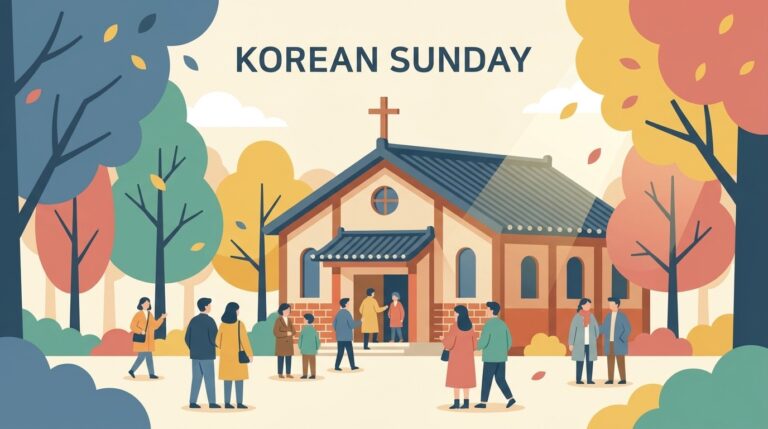
Phase 1: 공감 (Story Opening)
안녕하세요! 매일한글 에디터입니다.
Imagine waking up on a crisp Sunday morning in Seoul. The golden autumn sunlight reflects off the glass windows of bustling apartments, and the distinct sound of melodic church bells gently echoes through your neighborhood. While strolling toward your local cafe, you run into your Korean classmate Minji, carrying a neat bible pouch and dressed in clean, smart-casual attire. She flashes a warm smile and asks, “일요일에 뭐 해요? (Ilyoile mwo haeyo? / What are you doing on Sunday?)”
You want to share your own weekly routine or politely express that you regularly attend service too, but suddenly your mind goes blank. How do Koreans talk about religious routines without sounding like a rigid historical drama or an awkward tourist phrasebook? In Korea, church is far more than just a place of quiet contemplation; it is a lively social anchor, a communal lunch destination, and a vibrant community of lifelong friendships.
Over the past decade of guiding global learners, I have watched so many intermediate students freeze up when simple weekend routines touch upon religious faith. With this guide, tailored specifically to CEFR B1 learners, you will discover the exact everyday expressions, etiquette tips, and warmth needed to talk about Sunday services naturally like a local!
Phase 2: 핵심 표현 3선 심층 분석
1. 일요일마다 교회에 가요 (Ilyoilmada gyohoe-e gayo)
- Pronunciation: Il-yo-il-ma-da gyo-hwe-e ga-yo (Pronounce ma-da like “mother” without the “th”, and gyo-hwe like “kyo-way”)
- Meaning: Literal: “Every Sunday to church I go” | Real Nuance: “I go to church every Sunday as a regular part of my weekly lifestyle.”
- K-Culture Moment: In many heartwarming slice-of-life K-dramas, family members gather on Sunday mornings wearing their best outfits, heading out the door while calling out this phrase to neighbors.
- Editor’s Insight: The particle -마다 (-mada) means “every” or “each.” In B1 grammar, pairing a day of the week with -마다 shows regular commitment and habitual rhythm without having to say the rigid word “매주 (mae-ju / weekly).”
- Situation Spectrum: Casual: ✅ | Semi-formal: ✅ | Formal: ✅
- 🤔 Think About It: In English, you drop the article (“go to church”). In Korean, adding the direction particle -에 and frequency marker -마다 paints a clear image of an anchored life path. How does your language express spiritual or personal routines?
2. 오늘 예배 몇 시에 시작해요? (Oneul yebae myeot si-e sijakaeyo?)
- Pronunciation: Oh-neul ye-bae myut shi-eh shi-jak-hae-yo? (Rhyme ye-bae with “day-bay”)
- Meaning: Literal: “Today worship what hour at start?” | Real Nuance: “What time does the service start today?”
- K-Culture Moment: Running up the steps of a bustling Seoul church campus at 10:45 AM, quickly texting a fellow youth group member to sync up before seats fill up.
- Editor’s Insight: Make sure to distinguish 예배 (yebae / Protestant service) from 미사 (misa / Catholic mass)! Using the right term immediately signals cultural awareness and respect.
- Situation Spectrum: Casual: ✅ | Semi-formal: ✅ | Formal: ✅
- 🤔 Think About It: Notice how Korean speakers rarely say “the church starts,” but specifically mention the action 예배 (worship). How specific is your home culture when discussing scheduled rituals?
3. 예배 끝나고 같이 점심 먹어요! (Yebae kkeutnago gachi jeomsim meogeoyo!)
- Pronunciation: Ye-bae kkeut-na-go gah-chi jum-shim mug-eo-yo!
- Meaning: Literal: “Worship finishes-and together lunch let’s eat!” | Real Nuance: “Let’s grab lunch together right after the service finishes!”
- K-Culture Moment: After the final hymn ends, churchgoers flood toward the fellowship cafeteria for steaming bowls of banquet noodles or wander off to nearby bibimbap restaurants together.
- Editor’s Insight: Fellowship in Korea revolves deeply around sharing a table. Saying this shows you aren’t just there to observe; you want to connect and build genuine community.
- Situation Spectrum: Casual: ✅ | Semi-formal: ✅ | Formal: ⚠️
- 🤔 Think About It: Why do you think sharing food is considered the universal completion of religious bonding in Korean culture?
Phase 3: 교과서 한국어 vs 진짜 한국어
Situation 1: Explaining that you attend church regularly
- 📖 교과서 한국어: 저는 매주 일요일 교회에 참석합니다. (Jeoneun maeju ilyoil gyohoee chamseokhamnida. / “I participate in church every Sunday.”)
- 🗣️ 진짜 한국어: 저 일요일마다 교회 다녀요. (Jeo ilyoilmada gyohoe danyeoyo. / “I go to church every Sunday.”)
- 💡 왜 다를까?: The verb 다니다 (danida) implies going and coming repeatedly, making it the most natural word for attending schools, jobs, or religious centers, while 참석하다 (chamseokhada) sounds like a formal business conference.
Situation 2: Inviting someone to the youth fellowship
- 📖 교과서 한국어: 청년부 모임에 합류하시겠습니까? (Cheongnyeonbu moime hamnyuhasigesseumnikka? / “Will you join the youth department assembly?”)
- 🗣️ 진짜 한국어: 끝나고 청년부 모임 같이 갈래요? (Kkeutnago cheongnyeonbu moim gachi gallaeyo? / “Wanna head over to the youth gathering together afterwards?”)
- 💡 왜 다를까?: Native speakers use the soft proposal ending -ㄹ/을래요? (-l/eullaeyo?) to invite peers warmly without exerting uncomfortable pressure.
Phase 4: K-Culture 딥다이브 & 비언어적 매너
4-1. 눈치 (Nunchi) & Gestures
- Two-Hand Offering (두 손으로 내기): When placing money into the offering basket (헌금함) or handing a bulletin to an elder, always use both hands or support your right elbow with your left hand. It conveys immense respect.
- Sanctuary Decorum: When stepping into the main chapel (본당), slightly bow your head toward the pulpit area as a quiet gesture of reverence, and ensure your phone is switched to silent mode before sitting.
4-2. 문화 코드 분석 (Culture Code)
- 교회 밥 (Church Lunch Culture): Almost every Korean church prides itself on hearty, freshly made Sunday communal lunches. From comforting 잔치국수 (warm banquet noodles) to spicy geotjeori kimchi, lingering over lunch is where real community happens.
- 청년부 (The Youth Ministry Phenomenon): In Korean churches, the youth group (spanning ages 20 through 35) functions as a giant community hub. Young adults study, hike, organize retreats, and build deep personal friendships here.
Phase 5: 실전 롤플레이 시나리오
Setting: The bright, welcoming foyer of an upbeat church in Mapo-gu, Seoul. You run into Minji, a smiling youth group volunteer holding bulletins.
- 민지: 안녕하세요! 오늘 처음 오셨어요? (Annyeonghaseyo! Oneul cheoeum osyeosseoyo? / [Smiling brightly while handing over a bulletin] “Hello! Is it your first time here today?”)
- 당신: 네, 맞아요. 일요일마다 교회 다녀서 오늘 여기 와 봤어요. (Ne, majayo. Ilyoilmada gyohoe danyeoseo oneul yeogi wa bwasseoyo. / [Nodding politely with two hands clasped] “Yes, that’s right. I go to church every Sunday, so I thought I’d check this place out today.”)
- 민지: 정말 잘 오셨어요! 오늘 예배 11시에 시작해요. (Jeongmal jal osyeosseoyo! Oneul yebae yeol-han-si-e sijakaeyo. / [Guiding you toward the sanctuary doors] “Welcome! Today’s service starts at 11 o’clock.”)
- 당신: 안내해 주셔서 감사합니다. 어디에 앉으면 될까요? (Annaehae jusyeoseo gamsahamnida. Eodie anjeumyeon doelkkayo? / [Looking around the hall courteously] “Thank you for guiding me. Where should I sit?”)
- 민지: 편하신 자리에 앉으시면 돼요! 청년부 친구들이 앞쪽에 모여 있어요. (Pyeonhasin jarie anjeusimyeon dwaeyo! Cheongnyeonbu chingudeuri apjjoge moyeo isseoyo. / [Pointing gently toward the front rows] “You can sit wherever you feel comfortable! The youth group members are gathered near the front.”)
- 당신: 아, 청년부요? 저도 청년부 자리에 앉아도 괜찮을까요? (A, cheongnyeonbuyo? Jeodo cheongnyeonbu jarie anjado gwaenchaneulkkayo? / [Asking with gentle curiosity] “Oh, the youth group? Would it be okay for me to sit with the youth group as well?”)
- 민지: 당연하죠! 예배 끝나고 같이 점심도 먹어요. (Dang-yeonhajyo! Yebae kkeutnago gachi jeomsimdo meogeoyo. / [Beaming enthusiastically] “Of course! Let’s eat lunch together after the service ends, too.”)
- 당신: 네, 좋아요! 끝나고 꼭 같이 가요. (Ne, joh-ayo! Kkeutnago kkok gachi gayo. / [Giving a joyful bow] “Sounds wonderful! Let’s definitely go together afterwards.”)
🔀 인터랙티브 분기점 (Choose Your Response):
Imagine Minji welcomes you right as you walk in. What will you say?
- Choice A: “안녕하세요! 오늘 처음 왔는데, 어디로 가면 돼요? (Annyeonghaseyo! Oneul cheoeum wanneunde, eodiro gamyeon dwaeyo?)”
- Feedback (Best): Polite, natural, and shows clear intent. You’ll get an immediate, warm guide!
- Choice B: “여기 밥 진짜 맛있어요? (Yeogi bap jinjja masisseoyo?)”
- Feedback (Risk): Hilarious, and while church food is legendary, asking about food before stepping into the service can make you sound like you only came for the buffet!
- Choice C: “아무 데나 앉아도 됨? (Amu dena anjado doem?)”
- Feedback (Bad): Super casual slang (반말/음체). Speaking this way to someone you just met at church comes off as very rude.
Phase 6: 10초 감정 섀도잉 드릴
Practice these lines with rhythm, feeling each pause (/) and capturing the emotional milestone!
[😊 차분하고 편안하게]저 일요일마다 / 교회 다녀요. (Jeo ilyoilmada / gyohoe danyeoyo.)[🤔 궁금하고 조심스럽게]오늘 예배 / 몇 시에 시작해요? (Oneul yebae / myeot si-e sijakaeyo?)[🎉 신나고 기대에 차서]예배 끝나고 / 우리 같이 맛있는 거 먹어요! (Yebae kkeutnago / uri gachi masinneun geo meogeoyo!)
Phase 7: K-Culture 미니 사전 (핵심 키워드 4선)
- 청년부 (Cheongnyeonbu) | Youth/Young Adult Fellowship
- The lifeblood of Korean modern church culture. Caters to college students and young professionals up to their 30s for group studies and outdoor bonding trips.
- 헌금 (Heongeum) | Tithe / Offering
- Financial offering placed in special paper envelopes during the service. Always passed forward with two hands.
- 나눔 (Nanum) | Sharing / Small Group Reflection
- Literally means “sharing.” After listening to the sermon, members sit in a circle to discuss personal struggles and support one another emotionally.
- 주보 (Jubo) | Weekly Church Bulletin
- The printed weekly program handed out at the door detailing the hymns, announcements, upcoming events, and weekly lunch menu!
Phase 8: 여행자를 위한 생존 키트
서바이벌 표현 TOP 3
- 영어 예배 있어요? (Yeong-eo yebae isseoyo?)
- Meaning: Do you have an English-language service?
- Pro Tip: Many large churches in Seoul (like Onnuri, Yoido, or Somang) offer specialized multilingual services with earphones for live translation.
- 주보 하나 받을 수 있을까요? (Jubo hana badeul su isseulkkayo?)
- Meaning: Could I get one weekly bulletin, please?
- Pro Tip: Helps you follow along even if the pastor speaks quickly.
- 화장실이 어디예요? (Hwajangshiri eodiyeyo?)
- Meaning: Where is the restroom?
- Pro Tip: Church buildings in Korea can be labyrinthine complexes; asking early saves you from wandering during prayer time.
Editor’s Travel Note
- Finding local churches with English translation is easy when you search directly using the 네이버 지도 앱 다운로드 platform with terms like
영어 예배 교회 (English service church). Prepare a little cash in advance if you wish to participate in the offering, as digital card terminals in sanctuaries are still quite rare!
Phase 9: “한 발 더 깊이” (생각 질문)
In many Western cultures, religious faith is experienced as a deeply individualized and quiet sanctuary for personal reflection. In Korea, however, church life is profoundly tied to the concept of 우리 (Uri – We/Our) and collective warmth (정 – Jeong). When someone joins a Korean church, the congregation doesn’t just greet them; they adopt them into a family structure where folks eat together, solve real-life problems, and celebrate milestones collectively.
💬 Your Turn: What role does community play in your own hometown’s weekend rituals? Does gathering with others involve shared meals like Korean church fellowship? Leave your thoughts in the comments below!
Phase 10: FAQ & 오해 방지
Q: Do I have to dress up in a formal suit or dress to attend church in Korea?
A: Not at all! While grandmothers and deacons may wear formal attire or Hanbok on special holidays, young adults and attendees dress in neat, respectful smart-casual clothes like clean sweaters, shirts, or slacks.
Q: What is the polite way to politely decline an invitation to church?
A: Simply say, “초대해 주셔서 감사하지만, 일요일에는 다른 일정이 있어요 (Thank you for inviting me, but I have other plans on Sundays).” Koreans appreciate polite boundaries paired with appreciation.
Q: Is it rude to leave before the communal lunch?
A: Not at all! If you have to step out, just politely tell your neighbor or leader, “오늘 약속이 있어서 먼저 가 볼게요 (I have an appointment today, so I’ll be heading out first).”
🚨 흔한 실수 (Common Mistakes) 경고판
- ❌ Mistake 1: Calling Catholic Mass
예배 (Yebae)or Protestant Service미사 (Misa).- Correct Action: Always use 예배 for Protestant churches and 미사 for Catholic cathedrals.
- ❌ Mistake 2: Tossing offering money single-handedly into the basket.
- Correct Action: Place offering envelopes into the basket using both hands.
- ❌ Mistake 3: Using stiff textbook vocabulary like “참석합니다 (chamseokhamnida)” with peers.
- Correct Action: Use natural conversational Korean: “저 일요일마다 교회 다녀요 (Jeo ilyoilmada gyohoe danyeoyo).”
Phase 11: 액션 미션 & 참여 유도
- 🥉 Bronze Mission: Say “저 일요일마다 교회 가요” aloud three times in front of your mirror with natural rhythm and a smile.
- 🥈 Silver Mission: Write a mock text message to an imaginary Korean buddy proposing Sunday lunch after service in our comments section below.
- 🥇 Gold Mission: Next Sunday, walk into a local Korean church fellowship or an international service in Korea and ask the greeter for a bulletin using the phrase: “주보 하나 받을 수 있을까요?”
- 🎮 K-Culture Mission: Watch an episode of a neighborhood K-drama (like Reply 1988 or Hospital Playlist) and spot when friends or family members mention their Sunday morning routines!
Phase 12: 인터랙티브 퀴즈 챌린지
Q1. Fill in the blank:
“저는 [ ] 교회에 다녀요. (I go to church every Sunday.)”
👉 정답 확인하기 (Click to reveal answer)
정답: 일요일마다 (ilyoilmada)
Explanation: 일요일 (Sunday) + -마다 (every) indicates a recurring weekend routine!
Q2. Situation Match:
You want to invite your Korean friend to grab lunch right when service finishes. Which sentence sounds most natural?
A) 예배를 끝내고 식사를 섭취합시다.
B) 예배 끝나고 같이 점심 먹어요!
C) 점심 먹으러 빨리 나갑시다.
👉 정답 확인하기 (Click to reveal answer)
정답: B
Explanation: “예배 끝나고 같이 점심 먹어요!” is the warm, natural, and culturally polite way to invite a friend for fellowship mealtime.
Q3. True or False:
In Korea, it is polite to drop offering envelopes into the collection basket using just one hand if the line is moving fast.
👉 정답 확인하기 (Click to reveal answer)
정답: False
Explanation: In Korean etiquette, religious offerings, gifts, and drinks are always offered using both hands to show respect!







