

Phase 1: Empathy (Story-Driven Opening)
안녕하세요! 매일한글 에디터입니다. (Annyeonghaseyo! This is your Daily Hangul editor.)
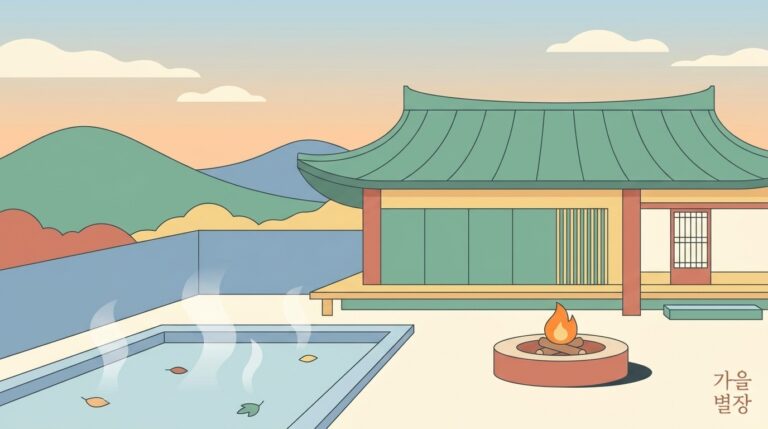
Picture this: You are planning an unforgettable autumn weekend escape with your friends or partner. You open social media and feast your eyes on those ultra-aesthetic Korean private pool villas (풀빌라) in Gapyeong or Jeju—the exact ones you’ve binge-watched in dating shows like Single’s Inferno or high-end K-dramas. Steaming water cascading into an infinity pool, an ambient fire pit ready for bulmeong (불멍, trance-like campfire gazing), and a pristine barbecue patio. You finally select your dream villa, but the moment you open the booking page or start messaging the host on Naver TalkTalk, a wave of confusion hits you.
What does “기준 인원 2인 / 최대 4인” really mean for your party of three? Why does the listing say pool access is included, yet down in the fine print there is a mysterious 50,000 KRW surcharge for “미온수” (lukewarm/heated water)? If you just say “Can we use the barbecue?” in basic textbook Korean, you might end up cold and hungry because you didn’t reserve the charcoal prep window in advance.
Navigating Korea’s luxury glamping and private pension culture requires more than beginner survival phrases; it demands C1-level pragmatic competence. You need to balance refined politeness (존댓말) with razor-sharp precision to clarify surcharges, verify amenities, and negotiate custom check-in conditions seamlessly. This masterclass is built on direct feedback from advanced international travelers who wanted five-star relaxation without the awkward check-in misunderstandings. Let’s elevate your Korean so you can book, customize, and indulge in luxury stays like a seasoned Seoul insider.
Phase 2: Core Expressions In-Depth
Here are three essential, highly nuanced C1-level expressions that will protect your travel budget and establish instant respect with luxury hosts.
1. 온수 풀 이용 시 미온수 추가 비용이 포함되어 있나요? (Onsu pul iyong si mionsu chuga biyongi pohamdoeeo innayo?)
- Pronunciation: On-soo pool ee-yong see mee-on-soo choo-gah bee-yong-ee poh-hahm-dwae-eo een-nah-yo? (Think of “on” like “switch on”, and “pool” like a swimming pool, gliding smoothly into “mee-on-soo”).
- Meaning:
- Literal: When using the warm water pool, is the lukewarm water additional fee included?
- Nuanced context: “Does the booking rate cover the heated pool service, or is there an extra surcharge for heating the water?”
- K-Culture Moment: In Korea, most private pool villas maintain ambient water temperatures by default. During spring, autumn, and winter, swimming requires an artificial heating cycle (미온수), which consumes immense energy and almost always incurs a separate fee (typically 30,000 to 70,000 KRW). Seasoned travelers ask this upfront before confirming payment.
- Editor’s Insight: Notice the phrase 추가 비용이 포함되어 있나요?. At the C1 level, asking directly “얼마예요?” (How much is it?) feels too blunt for luxury hospitality. Frame it around package inclusion to sound sophisticated and well-informed.
- Situation Spectrum:
- Casual: 🚫 (Too formal for friends)
- Semi-formal (Host texting/DM): ✅
- Formal (Inquiry board/Phone): ✅
- 🤔 Think About It: In Western vacation rentals, pool heating is often either fully included or strictly toggleable via an app. Why do Korean pensions separate the base room rate from heating and charcoal fees? Does itemized billing foster transparency, or does it feel like hidden costs to international guests?
2. 바비큐 숯·그릴 세트는 몇 시까지 준비해 주실 수 있나요? (Babikyu sut-geuril seteuneun myeot sikkaji junbihae jusil su innayo?)
- Pronunciation: Bah-bee-kyoo soot-geu-reel seh-teu-neun myut see-kkah-jee joon-bee-hae joo-seel soo een-nah-yo? (The word sut sounds like “soot” with a crisp, stopped ‘t’ sound at the end).
- Meaning:
- Literal: Until what time can you prepare the barbecue charcoal and grill set?
- Nuanced context: “What is the latest cut-off time for you to set up and light the outdoor charcoal grill for our dinner?”
- K-Culture Moment: Glamping and pension stays revolve around the sacred evening ritual of grilling thick pork belly (samgyeopsal) and beef chuck flap tail (salchisal). Pension hosts light the hot coals manually. They do not operate 24/7; hosts typically wrap up grill ignition service by 7:30 PM or 8:00 PM.
- Editor’s Insight: Using the full compound noun 바비큐 숯·그릴 세트 shows you understand the operational logistics of Korean camping. Pairing it with ~몇 시까지 준비해 주실 수 있나요? strikes the perfect balance of an assertive timeline check wrapped in polite request grammar.
- Situation Spectrum:
- Casual: ⚠️ (Only if speaking casually with a very familiar host)
- Semi-formal: ✅
- Formal: ✅
- 🤔 Think About It: In many cultures, guests light their own grills at leisure. In Korea, the host provides hot ignited charcoal directly to your patio table. How does this high-touch hospitality reflect the Korean service expectation of convenience (편의성)?
3. 기준 인원 외 추가 인원에 대한 침구류 제공 여부 확인 부탁드립니다. (Gijun inwon oe chuga inwon-e daehan chimguryu jegong yeobu hwagin butakdeurimnida.)
- Pronunciation: Ghee-joon een-won weh choo-gah een-won-eh dae-hahn cheem-goo-ryoo jeh-gong yeo-boo hwah-geen boo-tahk-deu-reem-nee-dah. (Pronounce chimguryu smoothly as “cheem-goo-ryoo”, rolling the ‘r’).
- Meaning:
- Literal: Please confirm the status of bedding provision regarding additional guests beyond the standard occupancy.
- Nuanced context: “Could you please verify whether extra bedding sets will be provided for the extra guests exceeding the base capacity?”
- K-Culture Moment: Korean pensions distinguish between 기준 인원 (base occupancy covered by the price tag) and 최대 인원 (maximum permitted heads). Even if a villa allows 4 people, a booking for 3 might incur an extra-person charge per night. If you don’t explicitly verify 침구류 (bedding sets), you might receive only one master bed and no floor futons (yo-set) for the third person.
- Editor’s Insight: This sentence features impeccable C1 formal phrasing: ~에 대한 (regarding), 제공 여부 (whether provided or not), and 확인 부탁드립니다 (we kindly request verification). It leaves zero room for ambiguity in luxury hospitality.
- Situation Spectrum:
- Casual: 🚫
- Semi-formal: ⚠️
- Formal / Written Booking App Form: ✅
- 🤔 Think About It: Traditional Korean homes utilized floor-sleeping futon systems (ondol bedding) rather than Western-style bed frames. How does this cultural legacy influence why bedding sets are calculated and charged as individual items in luxury accommodations today?
Phase 3: Textbook Korean vs. Real Korean
Notice how rigid textbook sentences turn into sleek, professional Korean used by actual travelers.
Situation 1: Requesting an Early Check-In or Self-Check-In due to Late Arrival
- 📖 Textbook Korean:
제가 늦게 도착할 것 같습니다. 문을 열어 주십시오.
(Jega neutge dochakhal geot gatseumnida. Muneul yeoreo jusipsio.)
“I seem likely to arrive late. Please open the door for me.” - 🗣️ 진짜 한국어 (Real Korean):
일정상 입실이 다소 늦어질 것 같은데, 혹시 비대면 체크인으로 진행해도 괜찮을까요?
(Iljeongsang ipsiri daso neojeojil geot gateunde, hoksi bidaemyeon chekeu-ineuro jinhaenghaedo gwaenchaneulkkayo?)
“Due to my schedule, check-in might be somewhat delayed; would it be alright if we proceed with contactless self-check-in?” - 💡 Why it differs: The textbook version sounds demanding and unnatural. C1 speakers frame constraints with softenings like 일정상 (due to scheduling) and 다소 (somewhat), followed by 비대면 (untact/contactless), which is the standard term hosts appreciate.
Situation 2: Asking for a Quiet, Scenic Villa Assignment
- 📖 Textbook Korean:
경치가 좋은 방으로 배정해 주십시오. 시끄러운 방은 싫습니다.
(Gyeongchiga joeun bangeuro baejeonghae jusipsio. Sikkeureoun bangeun silseumnida.)
“Assign me a room with a good view. I dislike noisy rooms.” - 🗣️ 진짜 한국어 (Real Korean):
가능하다면 마운틴 뷰가 트여 있고 비교적 프라이빗한 독채 동으로 배정 부탁드려도 될까요?
(Ganeunghadamyeon mauntin byuga teuyeo itgo bigyojeok peuraibithan dokchae dongeuro baejeong butakdeuryeodo doelkkayo?)
“If possible, could we kindly request a detached private unit that opens up to an unobstructed mountain view?” - 💡 Why it differs: High-end pensions feature different standalone cabins (독채). Real travelers use industry-specific vocabulary like 뷰가 트이다 (unobstructed open view) and 프라이빗한 독채 동 (private standalone unit) instead of simplistic words like 좋은 방.
Phase 4: K-Culture Deep Dive & Non-Verbal Manners
4-1. Nunchi (눈치) & Digital Messaging Manners
In modern Korea, the majority of pension host interactions do not occur over high-stress phone calls. They happen via Naver TalkTalk (네이버 톡톡) or KakaoTalk. Here is where your digital nunchi comes into play:
* The Softener Emoticon: Ending messages with cold periods can make you sound dissatisfied. Korean hosts frequently use polite markers like ^^ or mild exclamation marks (감사합니다!). While you don’t need to spam cartoon stickers, maintaining a gentle, upbeat punctuation style establishes warm rapport.
* Clear Arrival Timestamps: Pensions in regions like Yangpyeong, Gapyeong, and Gangneung are often family-run or managed by boutique hoteliers living nearby. Messaging your estimated time of arrival (ETA) 30 minutes in advance demonstrates top-tier manners, allowing the host to warm up the pool or pre-heat the living space.
4-2. Cultural Code Analysis: The Modern “Staycation” & “Bulmeong”
Luxury glamping in Korea is an art form rooted in contrast. South Korea is one of the most hyper-connected, fast-paced societies in the world. As a counterbalance, the trend of 호캉스 (Hocance – Hotel Vacance) evolved into 펜캉스 (Pencance – Pension Vacance) and 글램핑 (Glamping).
The core highlight of this cultural movement is 불멍 (Bulmeong)—a blend of bul (fire) and meongttaerida (zoning out). Urban professionals pay premium rates not simply to sleep in nature, but to disconnect, stare silently into artisanal fire pits with crackling oak firewood (참나무 장작), roast marshmallows, and sip boutique makgeolli. When you book a villa, knowing how to request a 불멍 세트 signals that you aren’t just a tourist staying in a room—you understand the soul of Korean leisure.
Phase 5: Real-World Roleplay Scenario
Setting: A tranquil Friday afternoon. Elena, an experienced international traveler, messages Mr. Park, the owner of a luxury cliffside pool villa in Jeju Island, via the booking messenger to finalize custom arrangements.
Characters:
- Elena: An articulate traveler seeking a seamless, restorative weekend.
- Mr. Park (Host): Attentive, hospitable owner of “Aewol Ocean Villa”.
[1] Elena 🎭 (Typing with polite anticipation on her phone)
안녕하세요, 사장님! 이번 주 토요일 애월 독채 풀빌라 예약한 엘레나입니다.
(Annyeonghaseyo, sajangnim! Ibeon ju toyoil Aewol dokchae pulbilla yeyakhan Ellena-imnida.)
"Hello, Host! This is Elena, who booked the Aewol standalone pool villa for this Saturday."

[2] Mr. Park 🎭 (Replying warmly with prompt hospitality)
네, 엘레나 고객님 반갑습니다! 편안한 휴식 준비해 두겠습니다. 확인 필요하신 사항 있으실까요?
(Ne, Ellena gogaengnim bangapseumnida! Pyeon-an-han hyusik junbihae dugesseumnida. Hwagin piryohasin sahang itseusilkkayo?)
"Yes, welcome Ms. Elena! We will prepare a relaxing stay for you. Are there any details you would like to confirm?"

[3] Elena 🎭 (Inquiring precisely without ambiguity)
네, 저희가 수영장을 적극 활용할 예정인데요, 혹시 온수 이용 시 미온수 비용이 1박 요금에 포함된 구조인가요?
(Ne, jeohuiga suyeongjangeul jeokgeuk hwalyonghal yejeong-inde-yo, hoksi onsu iyong si mionsu biyongi ilbak yogeume pohamdoen gujoin-gayo?)
"Yes, we plan to make full use of the pool. Could you let us know if the heated water fee is included in the nightly rate?"

[4] Mr. Park 🎭 (Explaining the facility options in detail)
아, 수영장 기본 수온은 상온이고요. 32도 미온수 유지는 1박당 5만 원 현장 결제 발생합니다! 체크인 전 미리 데워드릴까요?
(A, suyeongjang gibon su-oneun sang-on-igoyo. Samsibi-do mionsu yujineun ilbakdang oman-won hyeonjang gyeolje balsaenghamnida! Chekeu-in jeon miri dewo-deurilkkayo?)
"Ah, the pool's default temperature is ambient. Maintaining heated water at 32°C requires an on-site payment of 50,000 KRW per night! Shall we preheat it for you before check-in?"

[5] Elena 🎭 (Confirming the option and coordinating evening dining)
네, 미온수 신청 부탁드립니다! 그리고 저녁 7시쯤 바비큐 숯·그릴 세트 준비도 가능한지 여쭙고 싶습니다.
(Ne, mionsu sincheong butakdeurimnida! Geurigo jeonyeok ilgopsijjeum babikyu sut-geuril seteu junbido ganeunghanji yeojjutgo sipseumnida.)
"Yes, please add the heated pool service! Also, I'd like to ask if it's possible to prepare the barbecue charcoal/grill set around 7 PM."

[6] Mr. Park 🎭 (Checking the prep schedule cheerfully)
그럼요, 7시에 맞춰 테라스에 숯불 점화해 두겠습니다. 장작 불멍 세트도 필요하시면 말씀해 주세요.
(Geureomyo, ilgopsie matchwo teraseue sutbul jeomhwahae dugesseumnida. Jangjak bulmeong setedo piryohasimyeon malsseumhae juseyo.)
"Certainly, we'll light the charcoal on your terrace right at 7:00 PM. If you also need the firewood bulmeong set, just let me know."

[7] Elena 🎭 (Accepting the recommendation politely)
불멍 세트까지 함께 부탁드릴게요! 현장에서 계좌이체나 카드 결제로 진행하면 될까요?
(Bulmeong seteukkaji hamkke butakdeurilgeyo! Hyeonjang-eseo gyejwa-iche-na kadeu gyeoljero jinhaenghamyeon doelkkayo?)
"We'll definitely take the bulmeong set as well! May we settle the payment on-site via bank transfer or credit card?"

[8] Mr. Park 🎭 (Reassuring with a friendly closing)
현장 카드 결제 모두 가능하니 편하게 오세요. 따뜻하게 준비하고 기다리겠습니다!
(Hyeonjang kadeu gyeolje modu ganeunghani pyeonhage oseyo. Ttatteuthage junbihago gidarigesseumnida!)
"Both credit card and on-site payments are accepted, so feel free to come relaxed. We'll have everything warm and ready!"
🔀 Interactive Decision Point
Suppose you arrive at the villa, and despite confirming ahead, the pool water is lukewarm-cold because the host experienced an equipment glitch. How do you respond?
- Option A: “물이 차가운데요? 사장님 지금 장난하세요? 바로 환불해 주세요!” (Muri chagawundeoyo? Sajangnim jigeum jangnanhaseyo? Baro hwanbulhae juseyo!)
- Option B: “사장님, 바쁘시겠지만 미온수 온도가 아직 올라오지 않은 것 같습니다. 보일러 점검 한 번만 부탁드려도 될까요?” (Sajangnim, bappeusigettjiman mionsu ondoga ajik olla-oji aneun geot gatseumnida. Boilleo jeomgeom han beonman butakdeuryeodo doelkkayo?)
- Option C: “그냥 수영 안 할게요. 돈 돌려주든가 마시든가 알아서 하세요.” (Geunyang suyeong an halgeyo. Don dollyeojudeunga masideunga araseo haseyo.)
Detailed Branching Feedback:
- Option A (Bad): Accusing the host of playing games (장난하세요?) destroys goodwill instantly in Korean culture. Even if you are entitled to redress, hyper-aggressive language closes the door to collaborative solutions and creates defensive friction.
- Option B (Best): Exceptional C1 diplomacy! Acknowledging they are busy (바쁘시겠지만), using indirect observation (온도가 올라오지 않은 것 같습니다), and politely requesting an inspection (점검 한 번만 부탁드려도 될까요?) gets the host sprinting to fix your pool immediately with sincere apologies and complimentary extras.
- Option C (Risk): Passive-aggressive dismissiveness (알아서 하세요) leaves the situation unresolved and ruins your vacation mood while risking your refund eligibility.
Phase 6: 10-Second Emotional Shadowing Drill
Train your intonation and breath pauses (/) to deliver these requests with the poise of an eloquent Korean native speaker.
- [😊 Clear & Courteous Inquiry]
온수 풀 이용 시 / 미온수 추가 비용이 / 예약 금액에 포함되어 있나요?
(Onsu pul iyong si / mionsu chuga biyongi / yeyak geumaeke pohamdoeeo innayo?) -
[✨ Polite Operational Request]
바비큐 숯·그릴 세트는 / 저녁 7시쯤으로 / 준비 부탁드려도 될까요?
(Babikyu sut-geuril seteu-neun / jeonyeok ilgopsijjeumeuro / junbi butakdeuryeodo doelkkayo?) -
[🛋️ Thoughtful Clarification]
기준 인원 외에 / 추가 인원에 대한 침구류는 / 어떻게 준비되는지 여쭙고 싶습니다.
(Gijun inwon oe-e / chuga inwon-e daehan chimguryu-neun / eotteoke junbidoeneunji yeojjutgo sipseumnida.)
Phase 7: K-Culture Mini Dictionary
-
풀빌라 (Pulbilla) | Private Pool Villa
In Korea, this refers to standalone or upscale architectural properties featuring a dedicated private swimming pool within your personal suite or enclosed patio, offering absolute privacy from other guests. -
미온수 (Mionsu) | Heated / Lukewarm Water (Approx. 30–34°C)
Essential vocabulary for autumn-to-spring glamping. It signifies the steady thermal circulation needed to keep an outdoor or enclosed pool swim-ready during crisp weather. -
불멍 (Bulmeong) | Fire-Gazing Trance / Campfire Therapy
A modern Korean cultural concept representing therapeutic mindfulness achieved by staring aimlessly into flames. When pensions list a “불멍 세트”, it includes a fire brazier, seasoned firewood, igniter fluid, and sometimes magic color flame powder or s’mores. -
독채 (Dokchae) | Entire Detached Unit / Standalone Villa
Contrasting with multi-room pension complexes with shared hallways, a 독채 guarantees an independent, single-standing building exclusively reserved for your party.
Phase 8: Survival Kit for Travelers
Top 3 Survival Expressions
- 분리수거는 어디에 해 두면 될까요? (Bunniseugeoneun eodie hae dumyeon doelkkayo?)
Pro Tip: Korean pensions strictly expect guests to sort recyclables, food waste (음식물 쓰레기), and general trash upon checkout. Asking this upfront signals that you are an exemplary, cultured guest. - 혹시 근처에 배달 가능한 식당이나 편의점이 있나요? (Hoksi geuncheoe baedal ganeunghan sikdang-ina pyeon-uijeomi innayo?)
Pro Tip: Mountain villas often sit outside standard food delivery zones. Asking the host reveals hidden local spots that do personal delivery runs to the pension. - 체크아웃 연장이 가능한지, 시간당 추가 요금이 어떻게 되는지 알고 싶습니다. (Chekeu-aut yeonjang-i ganeunghanji, sigandang chuga yogeumi eotteoke doeneunji algo sipseumnida.)
Pro Tip: If you want a slow Sunday morning, request a late checkout using this sophisticated structure. Most villas charge between 10,000 to 20,000 KRW per additional hour.
Editor’s Travel Note: Essential Apps & Practical Advice
- App Guide: Do not rely strictly on global booking engines; the premier, most scenic villas list exclusively on domestic platforms. Download the Naver Map app on iOS/Android to search for 펜션 (pension) or 풀빌라 directly in scenic areas like Gapyeong or Taean, and use the Naver Booking (네이버 예약) integration.
- Payment & Deposits: Many boutique pensions request an on-site security deposit (보증금) or separate payment for heated water via domestic wire transfer (무통장 입금) or mobile transfer. Always confirm in chat if credit cards (현장 카드 결제) are accepted upon arrival to avoid carrying excessive cash.
Phase 9: “One Step Deeper” (Cultural Reflection)
In modern Korean leisure spaces, hospitality is anchored in an unspoken contract of mutual care. While international resort brands operate on complete separation of service staff and passive guests, the Korean pension and glamping model preserves a remnant of jeong (정, emotional connection) rooted in village bed-and-breakfast traditions (민박). The host goes out of their way to ignite your coals and adjust your hot water, while the guest demonstrates respect by preserving property decorum, observing quiet hours (매너 타임, Manner Time usually starting at 10 PM), and sorting recyclables.
Understanding this balance shifts your travel experience from mere commercial transaction to meaningful cultural communion.
💬 Your Turn: Have you ever experienced vacation rental culture in another country where guests and hosts share mutual responsibilities like this? How do you feel about the tradition of “불멍” (campfire therapy)? Share your thoughts in the comments below!
Phase 10: FAQ & Common Mistakes
Q: Can I just turn on the pool heating myself without paying the fee?
A: Never attempt this. The heating systems for pool villas are industrial boilers managed from central mechanical rooms or smart panels locked by the host. Bypassing this or filling the pool with bathroom hot water can damage equipment, trigger breaker trips, and incur substantial damage penalty fees.
Q: What exactly is “Manner Time” (매너 타임) at Korean glamping sites?
A: 매너 타임 is a sacred rule in Korean camping and glamping sites, almost universally enforced starting at 10:00 PM or 11:00 PM. During this time, guests must silence outdoor speakers, lower their speaking volume to a whisper, and keep bright terrace floodlights turned off. Sound travels intensely through valleys and canvas walls, and hosts will issue strict warnings if noise continues.
Q: Do we need to bring our own charcoal and grill grid?
A: If you pay for the host’s 바비큐 세트, everything is provided: high-grade charcoal (참숯), a clean disposable grill net (석쇠), work gloves, tongs, and ignition scissors. You only need to supply your food, marinades, aluminum foil, and beverages.
🚨 Common Mistakes Alert (흔한 실수 TOP 3)
- Mistake: Showing up with extra friends without notifying the host, assuming “there’s plenty of space on the floor.”
- Correct Action: Pension insurance licenses in Korea have legal capacity limits. Always inform the host in advance and settle the extra headcount surcharge (추가 인원 요금).
- Mistake: Grilling meat inside the luxury bedroom or closed living room.
- Correct Action: Strictly use the designated outdoor deck or enclosed barbecue zone (개별 바비큐장). Pork fat fumes stick permanently to wallpaper and fabric headboards, leading to steep deep-cleaning fines.
- Mistake: Throwing all garbage into a single plastic bag at checkout.
- Correct Action: Separate food waste (음식물) into the dedicated mini-bin, plastics/cans/glass into the recycling crates, and general trash into the designated volume-rate bag (종량제 봉투).
Phase 11: Action Mission & Engagement
- 🥉 Bronze Mission (Solo Practice): Read Phase 6 Shadowing Drill aloud three times. Focus on keeping your tone soft, rhythmic, and natural without pausing mid-word.
- 🥈 Silver Mission (Social Share): Share this guide with your travel squad or post your favorite Korean glamping phrase on Instagram Stories tagging
@DailyHangul. - 🥇 Gold Mission (Real Application): Next time you send an inquiry to a Korean host on Naver TalkTalk, Instagram, or Airbnb, draft your message using: “혹시 미온수 추가 비용 및 바비큐 세트 준비 가능한 시간 확인 부탁드려도 될까요?”
- 🎮 K-Culture Mission: Watch an episode of a Korean reality travel show (like Camping Vignette or I Live Alone camping specials) and spot how many times the cast mentions 불멍 (fire-gaze) or 숯불 (charcoal fire)!
Phase 12: Interactive Quiz Challenge
Test your situational mastery and cultural intuition with these three challenges.
1. Contextual Judgment (C1)
You are booking a winter glamping villa. You want to make sure the floor is well-heated and that there is a fire pit ready when you arrive around 6 PM. Which message is the most sophisticated and culturally appropriate?
* A) 불 피워 놓고 바닥 뜨겁게 해 놓으세요. 6시에 갑니다.
* B) 사장님 안녕하세요! 6시쯤 입실 예정인데, 혹시 난방 미리 가동과 6시 불멍 세트 세팅이 가능할지 조심스럽게 여쭤봅니다.
* C) 왜 방이 안 따뜻해요? 불멍 공짜로 해 주시면 감사하겠습니다.
2. Fill-in-the-Blank
Fill in the missing industry term:
“기준 인원 외에 1인이 추가될 경우, (____________) 제공 여부와 추가 요금이 어떻게 되는지 확인 부탁드립니다.”
(Hint: The Korean word for sheets, blankets, and pillows as a set)
3. True / False Cultural Check
T/F: In Korea, paying the standard high-end pool villa nightly room rate automatically guarantees that the pool will be heated to warm bath temperatures year-round without prior reservation or extra fees.
👉 Click to reveal answers & explanations
-
Answer: B
Explanation: Option B uses refined, respectful phrasing (조심스럽게 여쭤봅니다 – “I inquire cautiously/politely”) while clearly providing the ETA. Option A is an aggressive command; Option C makes inappropriate demands. -
Answer: 침구류 (Chimguryu)
Explanation: 침구류 specifically designates bedding sets (quilts, mats, pillows). Specifying this avoids ending up with an extra guest sleeping on the cold floor without linen. -
Answer: FALSE
Explanation: Almost all private pool villas maintain ambient (cold) water by default and require advance notice plus a dedicated heating fee (미온수 추가 비용, 30,000–70,000 KRW) because heating massive pools requires significant boiler energy.







