

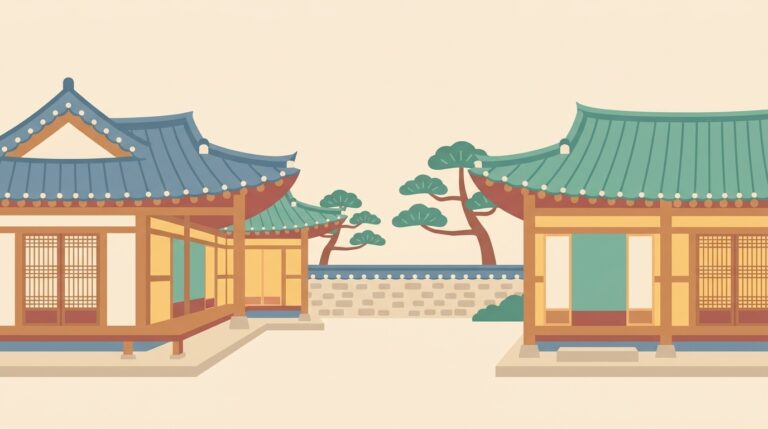
The Architectural Mindset: Mastering the Spatial Codes of Anchae and Sarangchae
Phase 1: 공감 (Story Immersion)
안녕하세요! 매일한글 에디터입니다.
Imagine this: You have finally arrived in South Korea for that dream cultural immersion tour. You are visiting a breathtaking, two-hundred-year-old jongga (head family estate) nestled in the misty foothills of Andong or a quiet alleyway in Bukchon Hanok Village. The wooden eaves sweep gracefully toward the sky; the scent of sun-baked pine and beeswax polish lingers in the air. As an enthusiastic K-culture lover and advanced learner, you have watched dozens of historical dramas (sageuk) like Mr. Sunshine or The Red Sleeve, and you want to appreciate the space like a true insider.
You slide off your shoes onto the stone stepping terrace (jimbang) and hear laughter echoing from a sunlit courtyard further inside. Eager to explore, you start walking down a secluded corridor toward an enclosed interior garden, thinking, “It’s just another wing of the house, right?”
Suddenly, the resident elder gently stops in their tracks, their eyes widening slightly. A soft, apologetic pause hangs in the air before they guide you back toward the open, airy pavilion where the tea table is prepared. You didn’t break anything, yet an invisible boundary was crossed. You just felt the subtle, electrifying current of Korean socio-spatial hierarchy—specifically, the unspoken demarcation between 안채 (Anchae – the inner sanctuary) and 사랑채 (Sarangchae – the social receiving wing).
At the C1 level, fluency is no longer about just conjugating honorifics correctly; it is about cultivating gonggam (empathy) for the profound cultural philosophy baked into the very architecture of Korea. Understanding why entering someone’s anchae uninvited triggers social alarm—and knowing the exact high-register phrases to navigate traditional and contemporary spaces—will transform you from a tourist into a revered cultural conversationalist. This guide compiles years of real-life feedback from advanced learners who transitioned from feeling culturally clumsy to reading spatial boundaries with effortless nunchi.
Phase 2: 핵심 표현 3선 심층 분석
1. 안채에 들다 (Anchae-e deulda)
- Pronunciation: [An-chae-e deul-da] (Imagine saying ‘un-check’ without the ‘k’, followed by ‘eh’ and a smooth ‘dool-dah’.)
- Meaning: Literal: To enter the inner quarters. / Nuanced: To step into the strictly private, matriarchal domain of the household; crossing from public hospitality into intimate family sanctuary.
- K-Culture Moment: In period dramas, when a trusted female elder or an exceptionally esteemed daughter-in-law is finally invited across the inner courtyard, the matriarch murmurs: “안채로 드시지요” (Please step into the inner quarters), signifying total familial acceptance.
- Editor’s Insight: Anchae was historically governed by the Anju-in (the lady of the house). It housed the master bedroom, the ancestral treasury, and the central pantry. Modern Korean apartments still mirror this dynamic: passing through the living room (geosil) directly into the master bedroom (anbang) without explicit permission is considered a major boundary violation.
- Situation Spectrum: Casual 🚫 | Semi-formal ⚠️ | Formal/Traditional ✅
- 🤔 Think About It: Does your native culture divide domestic architecture by gender or external/internal hospitality, or is social access based entirely on personal relationship rather than physical zones?
2. 사랑채로 모시다 (Sarangchae-ro mosida)
- Pronunciation: [Sa-rang-chae-ro mo-si-da] (Rhymes with ‘sah-rahng’ + ‘chay’ + ‘ro’, followed by the honorific verb ‘mo-she-dah’.)
- Meaning: Literal: To escort someone to the men’s reception wing. / Nuanced: To receive a guest with the highest level of formal etiquette, intellectual hospitality, and diplomatic respect without exposing private domestic affairs.
- K-Culture Moment: Seen frequently in historical dramas when scholars, political allies, or esteemed travelers arrive at a nobleman’s estate. The master of the house tells his servant: “귀한 손님이 오셨으니 사랑채로 모셔라” (A precious guest has arrived; escort him to the Sarangchae).
- Editor’s Insight: Sarang (舍廊) does not mean romantic love (sarang); it refers to an elevated pavilion designed for study, calligraphy, tea ceremony, and high-level discourse. Offering someone hospitality in the sarangchae indicates: “I respect your dignity as a public guest.”
- Situation Spectrum: Casual 🚫 | Semi-formal ⚠️ | Formal/Ceremonial ✅
- 🤔 Think About It: How do formal meeting rooms in Western residences (such as a Victorian drawing room or a modern private study) compare to a space intentionally separated from the family’s cooking and sleeping quarters?
3. 문턱을 넘다 / 안팎을 가르다 (Munteok-eul neomda / Anpak-eul gareuda)
- Pronunciation: [Moon-teok-eul neom-da / Ahn-pahk-eul gah-reu-da] (Think of ‘moon’ + ‘tuck’, then ‘un-pock’ meaning inside-outside.)
- Meaning: Literal: To cross the wooden door threshold / To divide the inside from the outside. / Nuanced: To cross a decisive psychological or sociological boundary; distinguishing public persona (oe) from private vulnerability (nae).
- K-Culture Moment: Often used metaphorically in contemporary legal or political K-Dramas when discussing someone intruding upon deeply private matters: “그 선은 집안의 안팎을 가르는 문턱과 같습니다” (That line is like the threshold dividing the inside from the outside).
- Editor’s Insight: In Hanok design, you never step on the wooden door sill (munteok); you step over it. Stepping on it is believed to bring bad luck and damages the wooden frame. Metaphorically, recognizing where the public space ends and the private sanctuary begins is the definition of advanced cultural fluency.
- Situation Spectrum: Casual ⚠️ | Semi-formal ✅ | Formal ✅
- 🤔 Think About It: Why does Korean culture place such immense philosophical weight on transitions—shoes on/off, outer gate/inner gate, public/private?
Phase 3: 교과서 한국어 vs 진짜 한국어
Situation 1: Visiting a Traditional Hanok Heritage Site or Jongga Guest House
- 📖 교과서 한국어 (Textbook):
“안채는 여자의 공간이고 사랑채는 남자의 공간입니다. 들어가지 마세요.”
(Anchae is the woman’s space and Sarangchae is the man’s space. Do not enter.) - 🗣️ 진짜 한국어 (Real-life C1 Korean):
“그쪽은 안채 영역이라 바깥손님 출입이 조심스러운 곳이에요. 담소는 사랑채 대청에서 나누시지요.”
(Geu-jjok-eun an-chae yeong-yeok-i-ra ba-kkat-son-nim chul-ib-i jo-sim-seu-leun got-i-e-yo. Dam-so-neun sa-rang-chae dae-cheong-e-seo na-nu-si-ji-yo. / “That side is the inner quarters where outside guests exercise discretion. Let us enjoy our conversation on the main hall of the reception pavilion.”) - 💡 왜 다를까? (Why the difference?):
Textbooks reduce Confucian spatial philosophy to simplistic gender segregation. Educated native speakers frame it through hospitality etiquette (ye-eui) and discretion (josim), directing guests toward the grand veranda (daecheong) with dignity rather than issuing flat prohibitions.
Situation 2: Asking Permission to Tour a Restored Historical Estate
- 📖 교과서 한국어 (Textbook):
“안에 들어가도 됩니까? 방을 구경하고 싶습니다.”
(Can I go inside? I want to look at the room.) - 🗣️ 진짜 한국어 (Real-life C1 Korean):
“혹시 실례가 안 된다면 사랑마루 너머 안채 안뜰 쪽도 잠시 둘러보아도 괜찮을까요?”
(Hok-si sil-lye-ga an doen-da-myeon sa-rang-ma-ru neo-meo an-chae an-tteul jjok-do jam-si dul-leo-bo-a-do gwaen-chan-eul-kka-yo? / “If it wouldn’t be an imposition, would it be permissible to gently view the inner courtyard beyond the reception veranda?”) - 💡 왜 다를까? (Why the difference?):
C1 speakers employ multi-layered cushions (sil-lye-ga an doen-da-myeon, jam-si dul-leo-bo-a-do). Using spatial landmarks like sarang-maru shows you recognize the architectural boundary before asking to cross it.
Phase 4: K-Culture 딥다이브 & 비언어적 매너
4-1. 눈치(Nunchi) & Spatial Body Language
When navigating a Hanok, physical movement communicates your education and respect before you speak a single word.
* The Threshold Step: Never plant your heel or sole directly onto the munteok (문턱, wooden threshold). Lift your foot cleanly over it. Stepping on the threshold symbolizes treading on the head of the house’s master.
* Shoe Alignment (Sinbal Dolryeonoki): When stepping up onto the raised wooden floor (maru), slip off your shoes and pivot them so the toes point outward toward the yard. This signals both preparedness and elegance, showing you won’t clumsily turn your back on the room when departing.
* The Courtyard Gaze: While the sarangchae faces outward to welcome the world and frame majestic views of mountains, the anchae is introverted, facing inward toward a tranquil courtyard (madang). Lower your speaking volume by at least half when approaching the inner courtyard walls.
4-2. Cultural Code Analysis: The Joseon Heritage in Modern Living
The distinction between Anchae and Sarangchae stems from the Joseon Dynasty’s Naeoe-beop (내외법, the rule of mutual propriety between inner and outer domains). While Western architecture frequently centralizes hallways connecting interconnected bedrooms, Hanok utilizes empty courtyards (madang) to buffer social zones.
Look at modern Korean society: Notice how contemporary Koreans rarely invite casual acquaintances or coworkers directly to their apartments. Instead, they socialize in cafés, restaurants, and lounges—modern functional equivalents of the sarangchae. When a Korean friend eventually invites you into their private home, you are crossing an invisible psychological munteok into their personal anchae.
Phase 5: 실전 롤플레이 시나리오
Setting: You are visiting the preserved 18th-century private estate of Master Park (박 명인), a celebrated tea master and heritage custodian in the historical town of Gyeongju. The afternoon sun illuminates the wooden lattice screens.
Characters:
* Master Park: A refined, soft-spoken cultural custodian dressed in crisp linen Hanbok.
* You: An advanced foreign researcher interested in traditional lifestyle aesthetics.
[Turn 1]
* Master Park: 🎭 Gently gestures toward the open wooden platform of the guest pavilion while setting down a celadon teapot.
“먼 길 오시느라 고단하셨지요? 우선 사랑채 대청마루에 여장을 푸시고 차 한잔 드시지요.”
(Meon gil o-si-neu-ra go-dan-ha-syeot-ji-yo? U-seon sa-rang-chae dae-cheong-ma-ru-e yeo-jang-eul pu-si-go cha han-jan deu-si-ji-yo.)
“You must be weary from the long journey. Please set your belongings down here on the Sarangchae wooden hall and partake in a cup of tea.”
[Turn 2]
* You: 🎭 Carefully stepping over the threshold without touching it, bowing slightly.
“배려해 주셔서 감사합니다, 명인님. 고택의 기품이 사랑채 현판에서부터 고스란히 묻어납니다.”
(Bae-ryeo-hae ju-syeo-seo gam-sa-hap-ni-da, myeong-in-nim. Go-taek-ui gi-pum-i sa-rang-chae hyeon-pan-e-seo-bu-teo go-seu-ran-i mud-eo-nap-ni-da.)
“Thank you for your warm consideration, Master. The nobility of this historic estate is vividly captured right from the calligraphy plaque of the Sarangchae.”
[Turn 3]
* Master Park: 🎭 Smiles with genuine appreciation at your architectural vocabulary.
“한옥의 결을 제대로 보실 줄 아는군요. 이 사랑채는 대대로 학문과 교유를 나누던 바깥주인의 공간이었습니다.”
(Han-ok-ui gyeol-eul je-dae-ro bo-sil jul a-neun-gun-yo. I sa-rang-chae-neun dae-dae-ro hak-mun-gwa gyo-yu-leul na-nu-deon ba-kkat-ju-in-ui gong-gan-i-eot-seup-ni-da.)
“You truly understand the grain and texture of Hanok. This Sarangchae has been the master’s space for scholarship and fellowship for generations.”
[Turn 4]
* You: 🎭 Looking toward the narrow stone path leading through a modest middle gate.
“저기 중문 너머로 이어지는 곳이 가솔들의 일상이 머물던 안채 구역인가 봅니다.”
(Jeo-gi jung-mun neo-meo-ro i-eo-ji-neun got-i ga-sol-deul-ui il-sang-i meo-mul-deon an-chae gu-yeok-in-ga bom-ni-da.)
“I presume beyond that middle gate lies the Anchae area, where the daily household life of the family unfolded.”
[Turn 5]
* Master Park: 🎭 Nods slowly, pouring golden tea into a miniature porcelain cup.
“그렇지요. 안채는 안주인이 살림을 총괄하며 가문의 기틀을 다지던 내밀한 중심부입니다.”
(Geu-reot-ji-yo. An-chae-neun an-ju-in-i sal-lim-eul chong-gwal-ha-myeo ga-mun-ui gi-teul-eul da-ji-deon nae-mil-han jung-sim-bu-im-ni-da.)
“Indeed. The Anchae is the intimate sanctuary where the lady of the house oversaw the estate and grounded the family’s legacy.”
[Turn 6]
* You: 🎭 Holding the teacup with both hands, showing proper deference before asking.
“혹시 실례가 되지 않는다면, 차를 마신 후 안채의 구조적 배치를 멀리서나마 살펴볼 수 있을까요?”
(Hok-si sil-lye-ga doe-ji an-neun-da-myeon, cha-leul ma-sin hu an-chae-ui gu-jo-jeok bae-chi-leul meol-li-seo-na-ma sal-pyeo-bol su iss-eul-kka-yo?)
“If it wouldn’t be an imposition, after our tea, might I observe the structural layout of the Anchae, even if only from a discreet distance?”
[Turn 7]
* Master Park: 🎭 Impressed by your restrained etiquette and polite distance.
“예의를 아시는 귀한 손님이시니, 마당 정리 후 안채 대청 건너편까지 직접 안내해 드리겠습니다.”
(Ye-eui-leul a-si-neun gwi-han son-nim-i-si-ni, ma-dang jeong-ri hu an-chae dae-cheong geon-neo-pyeon-kka-ji jik-jeop an-nae-hae deu-ri-get-seup-ni-da.)
“Since you are a distinguished guest who honors proper decorum, I shall guide you personally across from the Anchae veranda once the yard is tidied.”
[Turn 8]
* You: 🎭 Bowing head slightly in gratitude.
“안채의 내밀한 공간을 허락해 주셔서 진심으로 영광입니다, 명인님.”
(An-chae-ui nae-mil-han gong-gan-eul heo-rak-hae ju-syeo-seo jin-sim-eu-ro yeong-gwang-im-ni-da, myeong-in-nim.)
“I am deeply honored that you have granted permission to view the intimate space of the Anchae, Master.”
🔀 인터랙티브 분기점 (Choose Your Move!)
During Turn 6, what if you had acted differently instead of asking politely?
- Choice A: Stand up during tea, walk directly through the middle gate unannounced, taking photos on your smartphone while saying: “안채도 구경 좀 할게요!” (I’m gonna look around the Anchae too!)
- Outcome (Bad): Master Park will immediately stiffen. In traditional Korean etiquette, bypassing the host directly into the domestic sanctuary violates the baseline principle of naeoe. You will be seen as culturally insensitive, and the tea session will end abruptly.
- Choice B: Ask respectfully: “혹시 실례가 되지 않는다면, 차를 마신 후 안채의 구조적 배치를 멀리서나마 살펴볼 수 있을까요?”
- Outcome (Best): By acknowledging the space’s sanctity (sil-lye-ga doe-ji an-neun-da-myeon) and using qualifying spatial phrases (meol-li-seo-na-ma), you display elite C1 cultural diplomacy. Master Park gladly escorts you personally.
- Choice C: Stay completely silent about your curiosity, never asking, but lingering awkwardly at the threshold staring toward the gate.
- Outcome (Risk): Master Park may feel you are uncomfortable or unsatisfied with the reception at the Sarangchae. Passive hesitation without clear, refined communication creates unnecessary social tension. Always express respect through verbal elegance.
Phase 6: 10초 감정 섀도잉 드릴
Practice these lines aloud! Follow the pause markers (/) and embody the bracketed emotions.
[🧐 격식 있고 공손하게 / Respectful & Deferential]
“혹시 실례가 안 된다면, / 사랑마루 너머 안채 안뜰 쪽도 / 잠시 둘러보아도 괜찮을까요?”
(Hok-si sil-lye-ga an doen-da-myeon, / sa-rang-ma-ru neo-meo an-chae an-tteul jjok-do / jam-si dul-leo-bo-a-do gwaen-chan-eul-kka-yo?)-
[🌿 차분하고 깊은 감탄을 담아 / Poetic Admiration]
“바깥의 소음은 온데간데없고, / 안채 안뜰에 드니 / 비로소 고택의 온기가 / 가슴에 닿는 듯합니다.”
(Ba-kkat-ui so-eum-eun on-de-gan-de-eopt-go, / an-chae an-tteul-e deu-ni / bi-ro-so go-taek-ui on-gi-ga / ga-seum-e da-neun deut-hap-ni-da.) -
[🤝 정중하게 예를 갖추며 / Formal Host Etiquette]
“사랑채에서 담소를 마쳤으니, / 안주인께 여쭙고 / 안채 다실로 정중히 모시겠습니다.”
(Sa-rang-chae-e-seo dam-so-leul ma-chyeot-seu-ni, / an-ju-in-kke yeo-jjup-go / an-chae da-sil-ro jeong-jung-hi mo-si-get-seup-ni-da.)
Phase 7: K-Culture 미니 사전
-
안주인 (Anju-in)
- Translation: The Mistress of the House / Matriarch.
- Usage: Beyond historical contexts, this term is still used with deep respect in traditional circles to refer to the female head who governs household logistics, ancestral rites (jesa), and family assets.
- 바깥양반 (Bakkat-yangban)
- Translation: The Master of the House / Outside Gentleman.
- Usage: Derived from the master residing in the sarangchae (the exterior quarters). Older Korean generations still casually refer to their husbands as uri bakkat-yangban (우리 바깥양반) when conversing with acquaintances.
- 문턱 (Munteok)
- Translation: Door threshold / Sill.
- Usage: Widely used in business and psychology. For example: “진입 문턱이 높다” (The barrier to entry is high) or “심리적 문턱을 낮추다” (To lower psychological barriers).
- 대청마루 (Daecheongmaru)
- Translation: The central open wooden hall.
- Usage: The architectural spine of the Hanok connecting rooms. In modern cultural journalism, it is frequently referenced as a metaphor for open communication, cross-functional collaboration, and communal gathering.
Phase 8: 여행자를 위한 생존 키트
Survival Expressions TOP 3
- “사랑채에서 잠시 대기해도 될까요?”
(Sa-rang-chae-e-seo jam-si dae-gi-hae-do doel-kka-yo? / “May I wait briefly in the Sarangchae?”)- Pro Tip: Perfect when arriving early at a Hanok stay or tea salon. Shows you know the proper waiting area.
- “안채 쪽은 사진 촬영을 삼가는 게 맞지요?”
(An-chae jjok-eun sa-jin chwal-yeong-eul sam-ga-neun ge mat-ji-yo? / “It is proper to refrain from taking photographs toward the Anchae, correct?”)- Pro Tip: Demonstrates extraordinary cultural sensitivity. Many traditional head houses still use the anchae as residential quarters.
- “신발은 툇마루 아래에 벗어두면 됩니까?”
(Sin-bal-eun toen-ma-ru a-rae-e beot-eo-du-myeon doem-ni-kka? / “Should I leave my shoes below the narrow wooden veranda?”)- Pro Tip: Prevents confusion at modern heritage guesthouses where guests accidentally step onto the polished wood with their footwear.
Editor’s Travel Note
- Navigation Guide: When walking through complex villages like Bukchon, Jeonju, or Andong Hahoe, standard international mapping apps often fail to show micro-alleys. Make sure to download the Naver Map app for heritage walking trails to find historic house numbers accurately.
- Train Bookings: If traveling out to historical estates in Gyeongju or Gangneung, arrange high-speed rail via the official KORAIL booking portal well in advance, especially during the autumn foliage season.
- Etiquette Rule of Thumb: If a sliding paper screen (changhoji mun) is completely shut, announce your presence with a gentle clearing of the throat (gichim) or say “계십니까?” (Is anyone present?) from a meter away rather than tapping abruptly on the delicate paper.
Phase 9: “한 발 더 깊이” (Cultural Essay)
Traditional Korean architecture does not impose itself onto nature; it breathes alongside it through a philosophy of structural negative space (yeobaek-ui mi). The boundary separating Anchae and Sarangchae was never merely a physical wall of separation, but rather an intricate ethical agreement that shielded the home’s emotional center from public scrutiny while affording honored guests unimpeded dignity. In our hyper-connected modern world where private life is constantly broadcast on social feeds, the Hanok’s deliberate demarcation of an (inner intimacy) and bakk (outer hospitality) offers a refreshing lesson in healthy boundaries.
💬 Your Turn: Have you ever experienced an invisible spatial boundary in Korea or in your own country where entering felt like stepping into someone’s sacred personal space? Share your experience in the comments below!
Phase 10: FAQ & 오해 방지
Q: Is the Anchae completely off-limits to visitors in modern Hanok guesthouses?
A: Not necessarily. In commercial Hanok stays (Hanok-stay), rooms in both the anchae and sarangchae wings are rented out to guests. However, if you are visiting a functioning jongga (ancestral clan estate) where real family members still live, the anchae remains their private sanctuary. Always look for signage or ask the host before exploring inner pathways.
Q: Why do people say stepping on the ‘munteok’ brings misfortune?
A: Historically, the wooden threshold holds the entire frame of the traditional door aligned. Stepping on it repeatedly warps the wood, preventing the sliding paper doors from sealing out winter drafts. Folk beliefs personified this practical architectural vulnerability as disturbing the household guardian deity (Seongju-sin).
Q: Did men never enter the Anchae in traditional times?
A: No, the master of the house entered the anchae to dine, rest, and spend time with his wife and family. However, male guests or distant male acquaintances were strictly prohibited from crossing into the anchae. Hospitality took place exclusively in the sarangchae or the open garden pavilion.
🚨 흔한 실수 (Common Mistakes) TOP 3
- Mistake: Walking straight through the courtyard gate with outdoor shoes still on.
- Correct Action: Keep shoes on in the open gravel courtyards (madang), but always remove them onto the designated stone step (didimdol) before stepping onto any raised wooden floor (maru).
- Mistake: Assuming Sarangchae is related to romantic love (sarang).
- Correct Action: Remember that Sarang (舍廊) uses Chinese characters meaning a detached lodge or salon. Using romantic puns when talking to elders about the sarangchae will cause confusion.
- Mistake: Pushing open paper doors (changhoji) by pressing your fingers directly against the paper grid.
- Correct Action: Only touch the wooden handles or frames. The mulberry paper (hanji) is fragile and costly to re-paste.
Phase 11: 액션 미션 & 참여 유도
- 🥉 Bronze Mission (Solo Shadowing): Stand up, lift your foot cleanly over an imaginary door sill, and record yourself saying: “사랑채 대청마루에서 차 한잔 나누시지요.” Listen back to match the calm, resonant cadence.
- 🥈 Silver Mission (Interactive Social Share): Take a screenshot of your favorite historical drama Hanok scene and identify whether the characters are in the anchae or sarangchae. Share it on Instagram or X with the tag
#DailyHangulHanokChallenge. - 🥇 Gold Mission (Real-Life Mastery): The next time you visit a traditional tea house or cultural site in Korea, address the staff using formal spatial terms: “사랑마루 쪽에 자리가 있을까요?” (Is there a seat available near the Sarang veranda?).
🎮 K-Culture Mission: Watch an episode of the drama Mr. Sunshine or The King’s Affection. Spot the scene where an outsider comes to deliver an official message versus where intimate family discussions happen. Can you identify the architectural differences?
Phase 12: 인터랙티브 퀴즈 챌린지
Q1. [상황 판단] You are invited to an ancestral clan estate in Jeonju. The host steps into the kitchen to prepare refreshments. While waiting in the courtyard, you see an exquisite flower garden inside the inner gate. What is the most appropriate action?
* A) Walk inside and snap a close-up photo of the inner bedroom windows.
* B) Remain in the reception area or open sarangchae veranda, appreciating the view from outside the gate until invited.
* C) Shout toward the kitchen asking if you can go lie down on the anchae floor.
Q2. [빈칸 채우기] 전통 한옥에서 바깥손님을 맞이하고 학문과 예술을 논하던 공간을 ( )(이)라고 부르며, 집안의 안주인이 거처하며 살림을 돌보던 내밀한 공간을 ( )(이)라고 부릅니다.
Q3. [True / False] In traditional Korean etiquette, it is considered polite to step firmly on the center of the wooden munteok (threshold) to test the house’s structural sturdiness. (T / F)
👉 정답 및 상세 해설 확인하기 (Click to reveal answers)
- Q1 정답: B
- 해설: The inner courtyard and anchae represent the family’s private sanctum. Walking in uninvited breaches the host-guest boundary. A civilized guest remains in the sarangchae zone unless specifically escorted inward.
- Q2 정답: 사랑채 (Sarangchae) / 안채 (Anchae)
- 해설: Sarangchae handled public diplomacy and scholarly exchange, while Anchae was the domestic heartbeat governed by the matriarch.
- Q3 정답: False
- 해설: Stepping on the threshold is a major breach of traditional decorum and warps the door frame over time. You must always step cleanly over it!
- 해설: Stepping on the threshold is a major breach of traditional decorum and warps the door frame over time. You must always step cleanly over it!







