

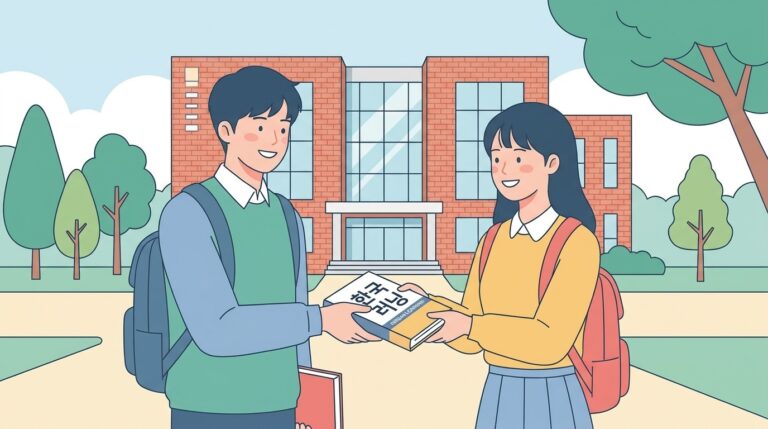
Campus Life Survival Guide: How to Buy Used Textbooks in Korea
Phase 1: Empathy (Real Campus Struggles)
안녕하세요! 매일한글 에디터입니다.
If you have ever experienced the sheer adrenaline rush of Korean university course registration—universally known as sugang sincheong (수강 신청)—you know that clicking a mouse 0.01 seconds too late can banish you to an 8:00 AM class across campus. But just when you breathe a sigh of relief after securing your syllabus, reality hits: the textbook list. Buying brand-new textbooks at the campus bookstore can easily drain your monthly budget in minutes.
Every semester, international students tell us the same story: “I downloaded campus apps like Everytime and Karrot, found a senior selling the exact book I need for a third of the price, but I was terrified to message them! What if my Korean sounds rude? What if I mess up the meeting spot?”
Don’t worry! Navigating the second-hand textbook market is a rite of passage for every college student in Korea. Mastering this skill not only saves your wallet but also opens the door to authentic campus interactions. Today’s guide brings you battle-tested phrases, subtle cultural etiquette, and practical tips tested by real international students in Seoul. Let’s make you sound like a savvy campus insider!
Phase 2: Core Expressions Deep Dive
1. 혹시 책 아직 판매 중인가요? (Hoksi chaek ajik panmae jung-ingayo?)
- Pronunciation: Hoke-shee chek ah-jeek pahn-meh joong-in-gah-yo? (Think of “Hoksi” like a gentle, hesitant “by any chance,” softening the blow before asking).
- Meaning: Literal: “By any chance, is the book still in the middle of selling?” | Actual Nuance: “Hi! Is this textbook still available?”
- K-Culture Moment: You will hear this exact opener in campus dramas like Cheese in the Trap or Weightlifting Fairy Kim Bok-joo whenever someone sends a direct message to buy second-hand class gear.
- Editor’s Insight: Never start with just “책 사요” (I’m buying the book). In Korea, the magic word 혹시 (hoksi – by any chance) acts as an emotional cushion. It shows consideration, acknowledging that the seller might have already reserved it for someone else.
- Situation Spectrum: Casual ⚠️ | Semi-formal ✅ | Formal ✅
- 🤔 Think About It: Why does Korean culture value softening words like 혹시 so much before making a direct inquiry? How does your native language cushion polite online requests?
2. 필기나 밑줄 많이 그어져 있나요? (Pilgina mitjul mani geueojyeo innayo?)
- Pronunciation: Peel-ghee-nah meet-jool mah-nee geu-uh-jyu inn-ah-yo? (“Mitjul” rhymes smoothly with “meet-jewel”).
- Meaning: Literal: “Are notes or underlines drawn a lot?” | Actual Nuance: “Does the book have heavy annotations or highlighting?”
- K-Culture Moment: Seen frequently in college vlogs on YouTube when students inspect study materials before exams to make sure the previous owner’s handwriting isn’t too messy to read.
- Editor’s Insight: In Korean universities, used textbooks fall into three categories: sae-chaek geup (새책급 – like new), pilgi so-ryang (필기 소량 – minor notes), and pilgi da-ryang (필기 다량 – heavily marked). Asking this prevents awkward surprises when you meet up.
- Situation Spectrum: Casual ⚠️ | Semi-formal ✅ | Formal ✅
- 🤔 Think About It: In some cultures, an annotated book is prized because past test answers are inside; in others, clean pages are king. Which do you prefer when studying?
3. 학생회관 앞에서 직거래 가능할까요? (Haksaenghoegwan ap-eseo jikgeorae ganeunghalkkayo?)
- Pronunciation: Hahk-seng-hweh-gwahn ahp-eh-suh jeek-guh-reh gah-neung-hahl-kkah-yo? (“Jikgeorae” sounds like jeek-guh-reh—short, crisp, and decisive).
- Meaning: Literal: “In front of the Student Union building, is direct transaction possible?” | Actual Nuance: “Could we meet up in person in front of the Student Union?”
- K-Culture Moment: Typical campus rendezvous scene: standing nervously near the campus post office or university bank branch clutching a phone waiting for the buyer.
- Editor’s Insight: 직거래 (Jik-geo-rae) refers to face-to-face meetups, contrasting with taekbae (택배 – parcel delivery). On university campuses, meetups almost always happen at landmark spots like the Student Union (Hakgwan), Central Library (Jung-do), or near the campus subway exit.
- Situation Spectrum: Casual ⚠️ | Semi-formal ✅ | Formal ✅
- 🤔 Think About It: Why do Korean campus trades almost always occur in broad daylight at central landmarks rather than dorm entrances?
Phase 3: Textbook Korean vs. Real-World Korean
Situation 1: Asking for a Slight Discount
- 📖 교과서 한국어 (Textbook):
너무 비싸요. 깎아 주세요. (Neomu bissayo. Kkakka juseyo. / “It’s too expensive. Give me a discount.”) - 🗣️ 진짜 한국어 (Real-World):
혹시 쿨거하면 네고 살짝 가능할까요? (Hoksi kul-geo-hamyeon nego saljjak ganeunghalkkayo? / “If I purchase right away without hassle, would a tiny discount be possible?”) - 💡 왜 다를까? (Why the difference?):
Demanding “깎아 주세요” sounds aggressive and child-like to modern ears. Combining 쿨거 (cool transaction) with 네고 (negotiation) signals that you will be quick and respectful, making the seller far more willing to knock off 1,000 or 2,000 KRW.
Situation 2: Concluding the In-Person Meetup
- 📖 교과서 한국어 (Textbook):
책을 주셔서 대단히 감사합니다. 안녕히 가십시오. (Chaegeul jusyeoseo daedanhi gamsahamnida. Annyeonghi gasipsio. / “Thank you very much for giving me the book. Please go in peace.”) - 🗣️ 진짜 한국어 (Real-World):
깨끗하게 잘 쓸게요! 이번 학기 수업 잘 들으세요! (Kkaekkeuthage jal sseulgeyo! Ibeon hakgi sueop jal deureuseyo! / “I’ll take good care of it! Have a great semester in your classes!”) - 💡 왜 다를까? (Why the difference?):
Extreme formality creates emotional distance between fellow students. Wishing someone a successful semester (sueop jal deureuseyo) builds genuine campus warmth and marks you as someone with great social sense.
Phase 4: K-Culture Deep Dive & Non-Verbal Manners
4-1. 눈치 (Nunchi) & Gestures: The Two-Handed Handover
When meeting a student seller on campus:
* The Visual Signal: Hold your phone in one hand or hold the drink you might have bought them visible. When spotting someone checking their phone while holding a thick textbook, make polite eye contact and give a slight, respectful 15-degree head nod.
* The Handover: Even if the seller is younger than you, always receive the textbook using both hands (or one hand supporting your forearm).
* The Instant Inspection: Do not flip through every single page for five minutes while they stand awkwardly in the cold. Do a brief, gentle 5-second check, smile, and say: “상태 정말 좋네요!” (Sangtae jeongmal jonneyo! – The condition is really great!).
4-2. Cultural Code: The ‘Everytime’ (에브리타임) & ‘Cool-Deal’ Syndrome
In Korean university culture, almost all textbook transactions happen inside university-verified forums like Everytime (에브리타임, affectionately called 에타 / E-ta). Because buyers and sellers belong to the same school community, trust is exceptionally high. Asking endless questions or disappearing mid-chat (jam-soo / 잠수) can ruin your internal campus rating. Showing up 3 minutes early and completing payment promptly earns you the coveted label of a 쿨거래자 (cool/smooth trader).
Phase 5: Real-World Roleplay Scenario
Setting: A sunny afternoon on the stone benches outside the Central Library (중앙도서관).
Characters:
* Min-woo (민우): A friendly 3rd-year Business major in a varsity jacket (gwajam).
* Alex (알렉스): An exchange student buying the Principles of Economics textbook.
Turn 1
알렉스: 저기... 혹시 에브리타임 당근왕 님이신가요?
(Jeogi... hoksi Ebeuritaim Dang-geun-wang nim-i-sin-ga-yo?)
[Excuse me... by any chance, are you 'CarrotKing' from Everytime?]
🎭 Stage Direction: Approaches hesitantly while checking the profile photo on the phone screen.

Turn 2
민우: 아, 네! 경제학 원론 구매하시는 분 맞으시죠?
(A, ne! Gyeongjehak wonron gumaehasineun bun majeosijyo?)
[Ah, yes! You are the one buying Principles of Economics, right?]
🎭 Stage Direction: Smiles warmly, pulling the thick textbook from his tote bag.

Turn 3
알렉스: 네, 맞아요! 시간 맞춰 나와 주셔서 감사합니다.
(Ne, majayo! Sigan matchwo nawa jusyeoseo gamsahamnida.)
[Yes, that's right! Thank you for coming out right on time.]
🎭 Stage Direction: Bows head slightly with hands clasped in front.

Turn 4
민우: 아니에요, 마침 도서관에 있었어요. 책 상태 한번 훑어보세요.
(Anieyo, machim doseogwane isseosseoyo. Chaek sangtae hanbeon hulteoboseyo.)
[Not at all, I happened to be in the library anyway. Please feel free to glance over the book condition.]
🎭 Stage Direction: Hands the book over with both hands.

Turn 5
알렉스: 와, 밑줄도 거의 없고 거의 새 책이네요!
(Wa, mitjuldo geoui eopgo geoui sae chaeg-ineyo!)
[Wow, there are barely any underlines and it looks almost like new!]
🎭 Stage Direction: Flips through the first chapter briefly with an impressed expression.

Turn 6
민우: 교수님이 PPT 위주로 수업하셔서 깨끗해요. 중간고사 팁 적힌 요약본도 끼워 드렸어요.
(Gyosunimi PPT wijuro sueophasyeoseo kkaekkeuthaeyo. Jung-gangosa tip jeokhin yoyakbondo kkiwo deuryeosseoyo.)
[The professor lectured mostly with slides, so it stayed clean. I even tucked in a midterm tip sheet for you.]
🎭 Stage Direction: Points proudly to a folded A4 sheet inside the cover.

Turn 7
알렉스: 정말요? 대박... 2만 원 지금 계좌로 바로 보내드릴게요!
(Jeongmalyo? Daebak... I-man won jigeum gyejwaro baro bonaedeurilgeyo!)
[Really? Amazing... I'll transfer the 20,000 KRW to your account right now!]
🎭 Stage Direction: Pulls out banking app on phone with a bright smile.

Turn 8
민우: 입금 확인했습니다! 이번 학기 학점 A+ 받으세요!
(Ipgeum hwaginhaessseumnida! Ibeon hakgi hakjeom A-peulleoseu badeuseyo!)
[Transfer confirmed! Get an A+ this semester!]
🎭 Stage Direction: Gives a warm two-handed wave as they part.
🔀 Interactive Choice Point: You forgot to bring cash!
What should you say to the seller?
- Option A: “돈 없는데 계좌이체 해도 돼요?” (Don eomneunde gyejwa-iche haedo dwaeyo?)
- Feedback [Bad]: Saying “I don’t have money” sounds slightly blunt and unorganized, even if you mean cash.
- Option B: “혹시 카카오페이나 계좌이체로 보내드려도 괜찮을까요?” (Hoksi Kakaope-ina gyejwa-ichero bonaedeuryeodo gwaenchanheulkkayo?)
- Feedback [Best]: Polite, natural, and offers convenient modern options that 99% of Korean students prefer anyway!
- Option C: “다음에 만나서 현금으로 드릴게요.” (Daeume mannaseo hyeongeumeuro deurilgeyo?)
- Feedback [Risk]: High risk of scaring the seller off. Postponing payment after meeting in person violates campus trading manners.
Phase 6: 10-Second Emotional Shadowing Drill
Practice reading these out loud at normal conversational speed! Pay attention to the breath pauses marked by /.
[😊 Bright & Polite]
“안녕하세요! / 에브리타임 보고 연락드렸는데요, / 책 아직 있나요?”
(Annyeonghaseyo! / Ebeuritaim bogo yeonrak-deuryeonneundeyo, / chaek ajik innayo?)-
[🤔 Careful & Inquiring]
“혹시 필기나 찢어진 곳은 / 전혀 없을까요?”
(Hoksi pilgina jjijeojin goseun / jeonhyeo eopseulkkayo?) -
[🥺 Warm & Friendly]
“제가 외국인 학생인데, / 학생회관 앞 시계탑에서 / 뵐 수 있을까요?”
(Jega oegukin haksaeng-inde, / haksaenghoegwan ap sigyetap-eseo / boel su isseulkkayo?)
Phase 7: K-Culture Mini Dictionary
- 직거래 (Jik-geo-rae) | Direct face-to-face transaction | Refers to meeting someone in physical space to inspect and hand over goods directly, avoiding shipping fees and scams.
- 쿨거 (Kul-geo) | Cool deal / Quick transaction | Short for ‘쿨거래’. Buying an item immediately without demanding deep discounts, asking excessive questions, or delaying payment.
- 필기감 (Pil-gi-gam) | Handwriting trace / Volume of notes | Specifically describes how heavily a used book has been written in. Example: “필기감 거의 없어요” (Barely any writing inside).
- 에브리타임 (Everytime / 에타) | Everytime Campus App | The undisputed #1 college mobile app in Korea used for timetables, professor evaluations, and internal second-hand marketplaces.
Phase 8: Campus Survival Kit
Top 3 Survival Expressions
- “포스트잇 붙여둔 부분만 확인해도 될까요?” (Poseuteu-it buchyeodun bubunman hwaginhaedo doelkkayo?)
- Pro Tip: Use this if the seller marked specific damaged sections. It shows you respect their time while checking important pages.
- “계좌번호랑 예금주명 알려주세요!” (Gyejwabeonhorang yogeumjumyeong allyeojuseyo!)
- Pro Tip: When paying by phone, Koreans always confirm both the account number and the account holder’s name (yegeumjumyeong) to prevent transfer errors.
- “좋은 거래 감사합니다. 수업 잘 들으세요!” (Joeun georae gamsahamnida. Sueop jal deureuseyo!)
- Pro Tip: The ultimate polite wrap-up phrase that leaves a lasting positive impression.
Editor’s Campus Travel Note
- Essential Navigation: Korean campuses are notoriously hilly and complex. Before agreeing on a meeting spot, check campus building codes using the 네이버 지도 앱 다운로드 to avoid getting lost in an unfamiliar engineering hall.
- Digital Cash: If you don’t have a Korean bank account yet, withdraw clean 10,000 KRW bills from a campus ATM beforehand. Handing over wrinkled pocket change is considered bad form!
Phase 9: Deep Dive Essay & Discussion
In many Western universities, campus bookstores dominate the trade, or students rent digital e-books anonymously. In Korea, the used textbook trade remains deeply communal and interpersonal. Even with apps mediating the trade, meeting on the steps of the library preserves an unspoken lineage: seniors pass down highlighted secrets, midterm hints, and professor quirks to juniors they have never met before.
This high-trust interaction reflects Korea’s unique jeong (정) and the shared camaraderie of surviving rigorous academic semesters together.
💬 Your Turn: Have you ever bought or sold something second-hand directly to another person? How does second-hand culture on your home university campus compare to Korea’s in-person meetings? Share your story in the comments below!
Phase 10: FAQ & Common Mistakes
Q: Can exchange students use the Everytime (에브리타임) used marketplace?
A: Yes, but you must verify your student status using your university email address (.ac.kr) or a physical student ID card. If you don’t have verification yet, check local campus foreigner groups or look up nearby secondhand bookstores like Aladdin (알라딘 중고서점).
Q: Is it rude to negotiate (네고) the price of a textbook?
A: It depends on the listing. If the post says “네고 불가” (No negotiation), asking for a discount will be seen as disrespectful. If it doesn’t say that, asking politely once for a small adjustment (e.g., rounding 22,000 KRW down to 20,000 KRW) using the word 혹시 is acceptable.
Q: What if the seller doesn’t show up at the agreed campus spot?
A: Message them on the chat app politely: “혹시 어디쯤 오셨을까요? 저 학생회관 앞입니다!” (Whereabouts might you be? I am in front of the Student Union!). Give them a 5-10 minute grace period, as college class release times often run a few minutes late.
🚨 Common Mistakes Warning Board
- Mistake: Using casual language (banmal) because the seller looks your age.
- Correct Action: Always use polite speech (jondaetmal, -요/-습니다) during transactions, even if the student is clearly younger than you.
- Mistake: Changing the meeting time 10 minutes prior.
- Correct Action: Korean students schedule trades tightly between 15-minute class breaks. Give at least 1-2 hours’ notice if you need to reschedule.
- Mistake: Demanding shipping (taekbae) for a 5,000 KRW book.
- Correct Action: Campus trades are meant for convenient walking meetups. Only ask for delivery if the seller explicitly offered it.
Phase 11: Action Mission & Engagement
- 🥉 Bronze Level: Stand in front of your mirror and practice saying: “혹시 책 아직 판매 중인가요?” three times with a bright, friendly smile.
- 🥈 Silver Level: Find an item in your room you no longer use, take a photo, and write a mock Korean listing title including condition words like 새것 같음 (like new) or 직거래 희망 (in-person trade preferred).
- 🥇 Gold Level: Open your campus community board or exchange student forum and successfully send a polite inquiry about a textbook or class material in natural Korean!
🎮 K-Culture Mission: Watch any college campus K-drama (like Weightlifting Fairy Kim Bok-joo or My ID is Gangnam Beauty). Spot how students greet each other when meeting outside campus buildings. Notice their hand posture and bowing angle!
Phase 12: Interactive Quiz Challenge
1. Situation Quiz:
You messaged a student on a campus board about a Korean grammar textbook, but you want to know if they wrote answers inside. What is the most natural question?
* (A) 책에 낙서 왜 했어요? (Why did you scribble in the book?)
* (B) 필기나 답 적힌 부분 많을까요? (Are there many notes or answers written inside?)
* (C) 깨끗한 책만 사니까 확인하세요. (I only buy clean books, so check it.)
🔍 Click to reveal Answer & Explanation
Correct Answer: (B)
Explanation: Option (B) uses the soft, polite ending -많을까요? to inquire comfortably without putting the seller on the defensive. (A) and (C) sound accusatory and demanding.
2. Fill-in-the-Blank:
When you want to meet directly on campus rather than shipping, you ask for a face-to-face transaction:
“학생회관 앞에서 [ ] 가능할까요?”
🔍 Click to reveal Answer & Explanation
Correct Answer: 직거래 (Jik-geo-rae)
Explanation: Jikgeorae means direct, in-person trade—the golden standard for university students trading materials between classes.
3. True or False:
If an online post has the tag “네고 불가”, it means the seller is willing to give you a discount if you bring cash on the spot.
🔍 Click to reveal Answer & Explanation
Correct Answer: False
Explanation: 네고 불가 (Nego Bul-ga) means “No negotiation / Firm price.” Trying to haggle after meeting them will be considered very impolite!







