

Conquering the Korean Board Game Cafe: From Ordering Tteokbokki to Slaying the Final Turn
Phase 1: 공감 (Story-Immersive Opening)
안녕하세요! 매일한글 에디터입니다. (Hello! This is your Daily Hangul editor.)
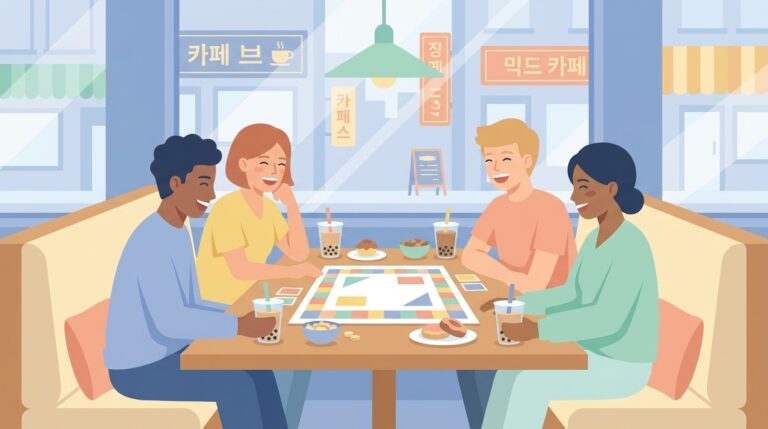
Picture this: You find yourself in the bustling neon-lit alleys of Hongdae on a Friday evening with your Korean friends. Someone shouts, “보드게임 카페 갈래?” (Shall we hit a board game cafe?), and within five minutes, you’re stepping into an upscale, retro-futuristic labyrinth that looks like a private club. Instead of dusty shelves in an old basement, you’re ushered into a cozy private booth with plush cushions, a tablet menu on the wall, and the irresistible aroma of Cajun french fries and tteokbokki wafting through the air.
Then, the moment of hesitation strikes. The tablet pops up with dozens of rules, your friend rapidly shuffles a deck of Splendor cards, and someone asks what you want to play. You freeze. In textbook Korean, you might know how to say “취미가 무엇입니까?” (What is your hobby?), but you have no clue how to call the staff to explain a complex strategy, check whose turn it is without sounding like an instructional manual, or yell friendly banter when someone ruins your winning streak.
Relax, you are definitely not alone! Navigating modern Korean leisure spaces is one of the biggest hurdles intermediate learners face because the language spoken across cafe tables is lightning-fast, colloquial, and laced with social cues. In this guide—built directly from feedback gathered across hundreds of our intermediate tutoring sessions—we’ll transform your game night hesitation into fluent, fun-loving confidence. By the time you finish this guide, you’ll know how to command the table, banter like a variety show regular, and use natural Korean that makes everyone forget you aren’t a local.
Phase 2: 핵심 표현 3선 심층 분석 (Deep Dive into 3 Key Expressions)
1. 이 게임 룰 설명 영상 어디서 봐요? (I geim rul seolmyeong yeongsang eodiseo bwayo?)
- Pronunciation: [I geim rul seol-myeong yeong-sang eo-di-seo bwa-yo?] (Think: ee game rule soul-myung young-sang uh-dee-seo bwah-yo)
- Meaning: Literal: “Where do I watch this game’s rule explanation video?” | Practical Nuance: Modern Korean board game cafes (like Red Button) use customized tablets in every booth. Asking this gets you straight to the interactive tutorial without embarrassing anyone.
- K-Culture Moment: In YouTube variety shows like Going Seventeen, members often crowd around an iPad waiting for the staff or video to explain chaotic custom rules before diving in.
- Editor’s Insight: Notice the word “룰” (rul). While Korean has the pure Korean word “규칙” (gyuchik), native speakers almost exclusively use the English loanword “룰” (rul) in board game and PC contexts. Using gyuchik here immediately sounds like an academic exam!
- Situation Spectrum:
- Casual (with friends): 이 게임 룰 영상 어디 있어? (✅)
- Semi-formal (to cafe staff/polite): 이 게임 룰 설명 영상 어디서 봐요? (✅)
- Formal (business presentation style): 규칙 설명 영상을 어디서 시청합니까? (🚫 – unnaturally robotic)
- 🤔 Think About It: In English, we often ask “Do you know how to play this?” directly to a friend. In Korea, suggesting checking the tablet first prevents your friend from feeling put on the spot if they don’t actually remember the rules. How does your culture handle not wanting to embarrass someone in a social setting?
2. 이번 턴에 누구 차례예요? (Ibeon teone nugu charyeyeyo?)
- Pronunciation: [I-beon teon-e nu-gu cha-rye-ye-yo?] (Think: ee-bun turn-eh noo-goo cha-ryae-ye-yo)
- Meaning: Literal: “In this turn, whose order is it?” | Practical Nuance: “Whose turn is it right now?”
- K-Culture Moment: You’ll hear this constantly on shows like Running Man right before someone gets caught cheating or when everyone gets distracted eating their snacks.
- Editor’s Insight: “차례” (charye) means order or turn, but young Koreans combine it with the English loanword “턴” (teon) to designate game rounds. If you want to say “It’s my turn,” simply say “제 차례예요!” (Je charyeyeyo!) or casually “내 차례야!” (Nae charyeya!).
- Situation Spectrum:
- Casual: 지금 누구 차례야? (✅)
- Semi-formal: 이번 턴에 누구 차례예요? (✅)
- Formal: 다음 순서가 누구인지 확인 부탁드립니다. (🚫 – sounds like an airport announcement)
- 🤔 Think About It: Notice how Korean speakers effortlessly mix English loanwords with Sino-Korean grammar particles to create gaming jargon. Does your native language create mixed slang for casual hobbies?
3. 한 판만 더 하고 판 뒤집어 봐요! (Han panman deo hago pan dwijibeo bwayo!)
- Pronunciation: [Han pan-man deo ha-go pan dwi-ji-beo bwa-yo!] (Think: Hahn pahn-mahn duh hah-go pahn dwee-jee-buh bwah-yo)
- Meaning: Literal: “Let’s do just one more round and turn the table/board over!” | Practical Nuance: “One more game! We can totally make a comeback!”
- K-Culture Moment: Classic esports and game show exclamation. When an underdog team is losing in a tournament, the caster yells “판을 뒤집을 기회입니다!” (This is their chance to flip the script!).
- Editor’s Insight: The idiom “판을 뒤집다” (paneul dwijipda) literally means to flip the game board upside down (think rage-quitting Monopoly), but in everyday gaming and business, it metaphorically means “turning the tables” or “making a dramatic reversal.”
- Situation Spectrum:
- Casual: 한 판만 더 해, 판 뒤집자! (✅)
- Semi-formal: 한 판만 더 하고 판 뒤집어 봐요! (✅)
- Formal: 다시 한번 진행하여 상황을 반전시켜 봅시다. (⚠️ – overly rigid for social games)
- 🤔 Think About It: The Korean counter word “판” (pan) refers to a field, a flat surface, or an entire round of a match. Why do you think Korean uses physical spatial words to describe time and game rounds?
Phase 3: 교과서 한국어 vs 진짜 한국어 (Textbook vs. Real Korean)
Situation 1: Asking the Staff for a Game Recommendation
- 📖 교과서 한국어: 저에게 재미있는 보드게임을 추천해 주시겠습니까? (Jeo-ege jae-mi-it-neun bo-deu-ge-im-eul chu-cheon-hae ju-si-get-seum-ni-kka? / “Would you please recommend an interesting board game to me?”)
- 🗣️ 진짜 한국어: 넷이서 가볍게 할 만한 게임 있을까요? 머리 쓰는 거 말고요! (Ne-i-seo ga-byeop-ge hal man-han ge-im iss-eul-kka-yo? Meo-ri sseu-neun geo mal-go-yo! / “Is there a game that’s easy/fun for four people? Something without heavy brainwork!”)
- 💡 왜 다를까?: Native speakers rarely ask for a generic “interesting game.” Instead, they specify the head-count (넷이서), the vibe (가볍게), and eliminate certain game genres using vivid expressions like 머리 쓰는 거 (head-scratchers/heavy strategy).
Situation 2: Realizing Someone Has Missed the Rule or It’s Time to Move on
- 📖 교과서 한국어: 당신의 행동을 마치고 다음 차례로 넘어가십시오. (Dang-sin-ui haeng-dong-eul ma-chi-go da-eum cha-rye-ro neo-meo-ga-sip-si-o. / “Finish your action and proceed to the next turn.”)
- 🗣️ 진짜 한국어: 다 했으면 턴 넘겨줘! 시간 끌지 말고~ (Da haess-eu-myeon teon neom-gyeo-jwo! Si-gan kkeul-ji mal-go~ / “Pass the turn if you’re done! Stop stalling, haha!”)
- 💡 왜 다를까?: Game cafes are high-energy social arenas. Playful teasing like “시간 끌지 마” (Stop stalling / dragging time) keeps the tempo fun and matches the snappy pacing expected in Korean social gatherings.
Phase 4: K-Culture 딥다이브 & 비언어적 매너 (Cultural Nuances & Etiquette)
4-1. 눈치 (Nunchi) & Non-Verbal Manners in Korean Board Game Cafes
- The Bell & The Tablet: Most premium Korean board game cafes (such as Red Button, Devil’s Dice) feature private cubicles. Do not stick your head out into the hallway and yell “저기요!” (Jeogiyo!). Look for the digital bell on the table or the call-button on your room’s iPad.
- Game Hygiene: Korean board games are meticulously maintained. Cards often have individual protective plastic sleeves (프로텍터). Eating greasy snacks like Cajun fries with your fingers and immediately touching the cards will trigger silent side-eyes (눈치). Cafes always provide small plastic finger tongs (핑거팁스) or wet wipes. Use them!
- The Squeaky Hammer (뿅망치): When playing penalty games, you’ll often see yellow plastic squeaky hammers. The unspoken etiquette: hit the table or your opponent’s shoulder with a theatrical swing, but control your physical power. It’s about the comical sound effect, not inflicting real damage!
4-2. Cultural Code: The Board Game Cafe as a “Third Space” & Mukbang Zone
In Korea, board game cafes aren’t just for hard-core hobbyists—they are prime date spots and after-dinner hangouts for university students and coworkers. In fact, many people go as much for the food as for the games! The menus rival trendy snack bars: croffles (croissant waffles), Ddeokbokki, sweet potato fries, and iced milk teas are standard. Sharing snacks while playing creates a communal 정 (Jeong) atmosphere that breaks down formal hierarchies.
Phase 5: 실전 롤플레이 시나리오 (Interactive Role-Play Scenario)
Setting: Friday, 8:00 PM at Red Button Board Game Cafe in Sinchon. You and your Korean acquaintance Min-su (민수) are sitting in a cozy curtain-partitioned booth.
- 민수: 오늘 불금인데 사람 진짜 많다! 자, 태블릿으로 음료 먼저 시키자. 너 뭐 마실래?
(Oneul bul-geum-in-de sa-ram jin-jja man-ta! Ja, tae-beul-lit-eu-ro eum-ryo meon-jeo si-ki-ja. Neo mwo ma-sil-rae?)
“It’s Friday night, so it’s super crowded! Alright, let’s order drinks on the tablet first. What do you want to drink?”
🎭 민수가 태블릿을 당신 쪽으로 슥 밀어준다. (Min-su slides the tablet toward you.) -
You: 난 아이스 아메리카노! 그리고 여기 로제 떡볶이도 하나 시키면 안 돼?
(Nan a-i-seu a-me-ri-ka-no! Geu-ri-go yeo-gi ro-je tteok-bok-ki-do ha-na si-ki-myeon an dwae?)
“Iced Americano for me! And can we also order a Rosé Tteokbokki here?”
🎭 눈을 반짝이며 메뉴판의 간식 탭을 가리킨다. (Eyes sparkling, pointing at the snack tab.) -
민수: 오, 먹을 줄 아네! 주문 완료했고. 그럼 게임 골라보자. 머리 쓰는 전략 게임 갈까, 아니면 순발력 게임 갈까?
(O, meog-eul jul a-ne! Ju-mun wan-ryo-haess-go. Geu-reom ge-im gol-ra-bo-ja. Meo-ri sseu-neun jeon-ryak ge-im gal-kka, a-ni-myeon sun-bal-ryeok ge-im gal-kka?)
“Oh, you know how it’s done! Order placed. Now let’s pick a game. Should we go for a brainy strategy game, or a reflex game?”
🎭 팔을 걷어붙이며 기대감 넘치는 표정을 짓는다. (Rolling up his sleeves with an eager face.) -
You: 오늘은 가볍게 순발력 게임으로 가자! 할리갈리나 다빈치 코드 어때?
(Oneul-eun ga-byeop-ge sun-bal-ryeok ge-im-eu-ro ga-ja! Hal-ri-gal-ri-na Da-bin-chi Ko-deu eo-ttae?)
“Let’s keep it light with a reflex game today! How about Halli Galli or Da Vinci Code?”
🎭 테이블 위에 있는 종을 살짝 쳐보며 웃는다. (Tapping the bell on the table gently with a smile.) -
민수: 할리갈리 좋지! 진 사람이 게임비 몰아주기 내기 콜?
(Hal-ri-gal-ri jo-chi! Jin sa-ram-i ge-im-bi mol-a-ju-gi nae-gi kol?)
“Halli Galli sounds great! Loser pays the entire cafe bill, deal?”
🎭 *장난기 가득한 눈빛으로 손바닥을 내민다. (Extending his palm playfully.) -
You: 당연히 콜이지! 나 순발력 장난 아니야, 후회하지 마.
(Dang-yeon-hi kol-i-ji! Na sun-bal-ryeok jang-nan a-ni-ya, hu-hoe-ha-ji ma.)
“Totally deal! My reflexes are no joke, don’t regret it later.”
🎭 *자신만만하게 손바닥을 마주친다. (High-fiving confidently.) -
민수: 와, 이 카드 나왔다! 종 쳐! 종!
(Wa, i ka-deu na-wat-da! Jong chyeo! Jong!)
“Whoa, the card came out! Ring the bell! The bell!”
🎭 *흥분해서 테이블을 손으로 내리칠 뻔한다. (Almost smacking the table in excitement.) -
You: 내가 먼저 쳤지! 봤어? 이 턴은 내 거야!
(Nae-ga meon-jeo chyeot-ji! Bwat-eo? I teon-eun nae geo-ya!)
“I struck first! Did you see that? This turn is mine!”
🎭 *재빠르게 카드를 끌어모으며 씩 웃는다. (Quickly scooping the cards up with a grin.)
🔀 인라인 분기점 (Interactive Branching Point)
Min-su has just lost three rounds in a row and looks devastated. He stares at his remaining five cards. How do you respond?
- Option A: “민수 씨, 낙담하지 마세요. 게임은 단지 오락일 뿐입니다.” (Min-su ssi, nak-dam-ha-ji ma-se-yo. Ge-im-eun dan-ji o-rak-il ppun-im-ni-da.)
- Option B: “아쉽다! 판 뒤집기 가야지? 이번 판에 이기면 봐줄게, 다시 해!” (A-swip-da! Pan dwi-jip-gi ga-ya-ji? I-beon pan-e i-gi-myeon bwa-jul-ge, da-si hae!)
- Option C: “내가 이겼으니까 게임비 다 내! 약속은 약속이지!” (Nae-ga i-gyeoss-eu-ni-kka ge-im-bi da nae! Yak-sok-eun yak-sok-i-ji!)
Feedback:
* Option A (Risk/Awkward): Far too stiff and formal! It sounds like a psychological counselor rather than a buddy on a Friday night out.
* Option B (Best Choice!): Outstanding! You empathize (아쉽다), suggest a dramatic turnaround (판 뒤집기), and playfully offer a rematch. This matches natural Korean game night banter perfectly.
* Option C (Bad/Harsh): A bit too ruthless. Even when bets are made playfully, native speakers usually banter back and forth before strictly demanding payment.
Phase 6: 10초 감정 섀도잉 드릴 (Shadowing Drill)
Practice matching the rhythm, breath pauses (/), and emotional intent of native speakers!
[🔥 자신감 넘치고 승부욕 자극하며 / Confident & Competitive]
“한 판만 더 해요, / 이번엔 진짜 / 판 뒤집을 수 있어요!”
(Han pan-man deo hae-yo, / i-beon-en jin-jja / pan dwi-ji-beul su iss-eo-yo!)
“Just one more round / this time / we can definitely turn the tables!”-
[🤔 고민스럽고 억울하다는 듯이 / Puzzled & Comically Whiny]
“잠깐만요, / 지금 누구 차례예요? / 저 방금 카드 안 냈는데요!”
(Jam-kkan-man-yo, / ji-geum nu-gu cha-rye-ye-yo? / Jeo bang-geum ka-deu an naet-neun-de-yo!)
“Hold on a second, / whose turn is it now? / I didn’t even play my card just now!” -
[😊 직원에게 공손하고 싹싹하게 / Polite & Bright to Cafe Staff]
“저희 넷이서 왔는데요, / 룰이 쉬운 파티 게임으로 / 추천 좀 해주실 수 있나요?”
(Jeo-hui net-i-seo wat-neun-de-yo, / rul-i swi-un pa-ti ge-im-eu-ro / chu-cheon jom hae-ju-sil su iss-na-yo?)
“There are four of us here, / could you recommend / a party game with easy rules?”
Phase 7: K-Culture 미니 사전 (Mini Dictionary)
- 보드게임 카페 (Bo-deu-ge-im Ka-pe) | Noun: Premium Korean Board Game Cafe
- Unlike simple tabletop clubs abroad, Korean board game cafes feature private partitioned rooms, high-tech tablet ordering, full restaurant-quality snack bars, and thousands of cataloged games.
- 뿅망치 (Ppyong-mang-chi) | Noun: Squeaky Toy Hammer
- The ubiquitous yellow plastic hammer used for harmless penalties. In modern variety shows and hangouts, hitting the loser with a squeaky hammer is the ultimate lighthearted punishment.
- 벌칙 (Beol-chik) | Noun: Penalty / Forfeit
- Crucial in Korean game culture. Games are rarely played just for the win; there is almost always a 벌칙 (paying for coffee, snapping a wrist, making a funny face, or doing a dance).
- 룰마스터 (Rul-ma-seu-teo) | Noun: Rule Master
- Slang for the designated friend in the group who reads through the game manual and painstakingly teaches everyone else how to play.
Phase 8: 여행자를 위한 생존 키트 (Traveler’s Survival Kit)
Top 3 Survival Phrases
- “음료 반납 어디에 해요?” (Eum-ryo ban-nap eo-di-e hae-yo?)
- Meaning: “Where do we return our empty drinks?”
- Pro Tip: Don’t leave your cups in the private room when leaving. There is almost always a return counter (반납대) right next to the cash register.
- “게임 반납하고 다른 걸로 바꿀게요.” (Ge-im ban-nap-ha-go da-reun geol-ro ba-kkul-ge-yo.)
- Meaning: “I’ll return this game and switch to another one.”
- Pro Tip: Most cafes enforce a “one game at a time” rule so pieces don’t get mixed up. Return your previous box before grabbing a new one.
- “이거 카드 프로텍터가 찢어졌어요.” (I-geo ka-deu peu-ro-tek-teo-ga jji-jeo-jyeoss-eo-yo.)
- Meaning: “The card sleeve protector on this is torn.”
- Pro Tip: Pointing this out politely to staff upon opening the box shows immense respect for their game quality and prevents you from being charged for damage.
Editor’s Travel Note
- Finding Cafes Nearby: When you’re in Seoul, open your phone and search on the Naver Map app download using the keyword
보드게임카페. Major chains like “레드버튼 (Red Button)” and “히어로보드게임카페 (Hero Board Game Cafe)” accept international credit cards and offer English UI tablets in areas like Hongdae, Gangnam, and Myeongdong. - Billing System: You usually pay an hourly rate per person (roughly 3,000 KRW/hour) plus a mandatory 1-drink order per person. You settle the hourly tab at the counter when you check out!
Phase 9: “한 발 더 깊이” (Cultural Essay & Reflection)
In Korean society, hierarchical communication (존댓말 vs. 반말) often dictates how freely people speak depending on age or seniority. However, the game table acts as an exceptional cultural oasis—a socially sanctioned “safety valve.” Inside the booth of a board game cafe, the strict rules of daily etiquette temporarily soften into playful competition. Friends can playfully challenge an older peer (선배), celebrate dramatically, or exact a squeaky hammer penalty without causing real social offense. It is one of the few urban spaces where Koreans of all ages can let their guard down completely.
💬 Your Turn: What is an activity or space in your own home country where normal formal social hierarchies break down so people can bond playfully? Share your thoughts below in the comments!
Phase 10: FAQ & 오해 방지 (FAQ Schema)
Q: Do I need to be fluent in Korean to visit a board game cafe in Korea?
A: Not at all! Modern chain cafes (like Red Button) have iPad menus with English language options for selecting food and drinks, and many global classics (like Catan, Rummikub, Splendor) have language-neutral components. Knowing basic phrases like “한 판 더 해요!” will simply make playing with Korean acquaintances ten times more fun!
Q: Can we bring our own outside snacks or drinks into the cafe?
A: No. Korean board game cafes operate under a cafe license where ordering at least one beverage per guest is mandatory. Outside food is strictly prohibited, but the in-house snack menu is affordable and genuinely delicious.
Q: What should we do if we lose a game piece or card?
A: Never hide it or shove the game back on the shelf! Simply bring the box to the counter and say politely: “죄송한데 부품 하나를 잃어버린 것 같아요” (Joesonghande bupum hanareul ireobeorin geot gatayo – “I’m sorry, but I think we lost one piece”). Staff are very accommodating and have spare parts drawers behind the counter.
🚨 Common Mistakes Alert (흔한 실수)
- Mistake: Using formal honorifics during high-speed party games like Halli Galli.
- Correction: Drop into short, snappy expressions like “내 거!” (Mine!) or “쳤다!” (Hit it!). High-intensity reflex games naturally invite informal excitement!
- Mistake: Touching cards with sauce-covered hands.
- Correction: Always use the provided wet tissue (물티슈) or finger tongs (핑거팁스).
- Mistake: Shouting across the cafe to order more food.
- Correction: Everything must be placed through the booth’s tablet or the call-bell system.
Phase 11: 액션 미션 & 참여 유도 (Action Missions)
- 🥉 Bronze Level (Solo Drill): Practice saying
"한 판만 더 하고 판 뒤집어 봐요!"out loud three times while looking in the mirror with maximum dramatic confidence. - 🥈 Silver Level (Social Media): Take a photo of your favorite board game, post it to your Instagram stories, and caption it in Korean:
"주말에 보드게임 한 판 어때요? 🎲"(How about a round of board games this weekend?). - 🥇 Gold Level (Real Life): Visit a board game cafe in Korea (or host a game night with Korean language exchange partners) and use at least two of today’s expressions during the session!
- 🎮 K-Culture Mission: Watch an episode of Going Seventeen (e.g., the “Don’t Lie” series) or Run BTS game episodes. Spot whenever the members shout “누구 차례야?” or “판 뒤집자!”.
Phase 12: 인터랙티브 퀴즈 챌린지 (Interactive Quiz Challenge)
Test your knowledge from today’s guide! Click the toggle to reveal the answers.
- [Situation Judgment] You are losing badly in a match against your friend and want to enthusiastically demand one last rematch to make a comeback. What should you say?
- (A) “이 게임 룰 영상 어디서 봐요?”
- (B) “한 판만 더 하고 판 뒤집어 봐요!”
- (C) “음료 반납 어디에 해요?”
- [Fill-in-the-Blank] Complete the sentence to ask whose turn it is:
- “이번 턴에 _______ 차례예요?”
- [True / False Cultural Check] At modern Korean board game cafes, you should shout loudly toward the hallway whenever you want to order more snacks. (T / F)
👉 Click to reveal answers & explanations!
- Answer: (B)
- Explanation: “판 뒤집어 봐요” directly means to turn the tables or make a dramatic comeback in a game.
- Answer: 누구 (nugu)
- Full Sentence: “이번 턴에 누구 차례예요?” (Whose turn is it in this turn?)
- Answer: False (F)
- Explanation: Modern Korean board game cafes prioritize booth privacy. You should place additional food orders directly through the room’s tablet or press the digital call bell!
- Explanation: Modern Korean board game cafes prioritize booth privacy. You should place additional food orders directly through the room’s tablet or press the digital call bell!







