

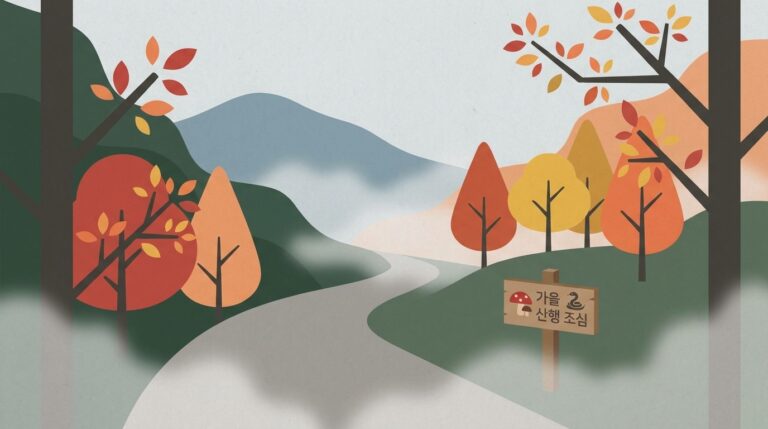
Surviving the Korean Wild: Distinguishing Toxic Mushrooms and Venomous Snakes Like a Local
Phase 1: 공감 (Empathy & Cultural Immersion)
안녕하세요! 매일한글 에디터입니다.
Picture this: You are hiking up the majestic trails of Bukhansan or Jirisan during peak autumn. The crisp mountain air is exhilarating, and the crimson maple foliage looks straight out of a K-drama romance. Suddenly, off the designated trail, you spot a group of friendly Korean hikers crouching by a damp tree trunk. One of them points eagerly at a cluster of pristine, milky-white mushrooms that look suspiciously like gourmet oyster mushrooms, while another hiker reaches towards a sunlit stone ledge where an unassuming brown serpent is resting. You freeze. In Korean hiking culture, foraging for wild mountain herbs (sannamul) is practically a national pastime for older generations, but every single year, the National Institute of Biological Resources issues dire warnings about fatal mushroom ingestions and viper bites.
When emergencies strike miles away from the nearest paved road, textbook phrases like “병원에 가야 합니다” (I need to go to the hospital) simply will not cut it. You need immediate, authoritative, and linguistically precise C1-level Korean to deter reckless actions, describe dangerous species accurately to dispatchers, and coordinate urgent first aid. This survival guide is built on real-world incident reports from Korea National Park rangers and field-tested hiking expressions so you can stay safe and sound in the breathtaking Korean wild.
Phase 2: 핵심 표현 3선 심층 분석 (Top 3 Survival Expressions)
1. 함부로 채취했다가는 큰일 납니다 (Hamburo chaechwihaetdaganen keunil namnida)
- Pronunciation: [Ham-bu-ro chae-chwi-haet-da-ga-neun keun-il nam-ni-da] (Think: “Hahm-boo-ro” like bamboo, “che-chwee”, “kuhn-eel”)
- Meaning: “If you forage carelessly/recklessly, you are inviting disaster.”
- K-Culture Moment: Frequently heard in outdoor survival broadcasts like Law of the Jungle or public safety campaigns by the Korea Forest Service (산림청) when warning tourists not to pick poisonous look-alikes like the Destroying Angel (독우산광대버섯).
- Editor’s Insight: The conditional grammar
~했다가는carries a strong warning that an ill-advised preliminary action will inevitably yield catastrophic consequences. In C1 Korean, using채취하다(to harvest/forage) instead of the elementary따다or뽑다conveys formal authority and environmental literacy. - Situation Spectrum: Casual 🚫 | Semi-formal ⚠️ | Formal ✅
- 🤔 Think About It: Notice how the Korean sentence leaves “who” suffers disaster implicit (
큰일 납니다), emphasizing the universal, objective consequence rather than attacking the listener directly. How does your native language structure stern public warnings?
2. 독이 바짝 올라 있으니 절대 건드리지 마세요 (Dogi bajjak olla isseuni jeoldae geondeuriji maseyo)
- Pronunciation: [Do-gi ba-jjak ol-la it-seu-ni jeol-dae geon-deu-ri-ji ma-se-yo] (Crisp double “jj” sound like “bba-jjak”, snapping like a dry twig)
- Meaning: “Its venom/aggression is at its absolute peak, so never touch it.”
- K-Culture Moment: Used by seasoned park rangers when spotting a Mamushi viper (살모사) basking before hibernation in September or October. Metaphorically, you will hear this in suspense K-dramas when a betrayed protagonist becomes ruthlessly vindictive.
- Editor’s Insight: The adverb
바짝vividly portrays tension, dryness, or extreme intensity. Combined with독이 오르다, it signifies either an animal whose venom concentration/defensiveness is heightened or someone overflowing with pure spite. It commands immediate physical distance. - Situation Spectrum: Casual ✅ | Semi-formal ✅ | Formal ✅
- 🤔 Think About It: Korean sensory adverbs like
바짝create physical sensations in the listener’s imagination. Does your mother tongue have sensory words specifically for heightened lethal danger?
3. 물린 부위를 심장보다 낮게 유지하고 즉시 고정하세요 (Mullin buwireul simjangboda natge yujihago jeuksi gojeonghaseyo)
- Pronunciation: [Mul-lin bu-wi-reul sim-jang-bo-da nat-ge yu-ji-ha-go jeuk-si go-jeong-ha-se-yo]
- Meaning: “Keep the bitten area lower than the heart and immobilize it immediately.”
- K-Culture Moment: The gold standard protocol recited by 119 Mountain Rescue units (119 산악구조대) in medical dramas such as Jirisan.
- Editor’s Insight: C1 medical and rescue terminology requires precise body landmarks. Notice the pair
유지하다(maintain/keep) and고정하다(immobilize/splint). Korean first-aid guidance explicitly warns against outdated myths like cutting the wound or applying a tight arterial tourniquet. - Situation Spectrum: Casual ⚠️ | Semi-formal ✅ | Formal ✅
- 🤔 Think About It: Contrast the calm, procedural clarity of modern emergency Sino-Korean vocabulary (심장, 유지, 고정) with the instinctive panic words used on the trails. How do you shift registers when adrenaline spikes?
Phase 3: 교과서 한국어 vs 진짜 한국어 (Textbook vs. Real-World Korean)
Situation 1: Warning someone about an edible-looking wild mushroom
- 📖 교과서 한국어 (Textbook): 이 버섯은 독성이 있을 수 있으니 드시지 마십시오. (I beoseoseun dokseongi isseul su isseuni deusiji masipsio. / This mushroom might be toxic, so please do not consume it.)
- 🗣️ 진짜 한국어 (Real-World C1): 야생 버섯 함부로 손댔다가는 진짜 골로 가요. 식용 버섯이랑 구별 아예 안 돼요! (Yasaeng beoseot hamburo sondaetdaganen jinjja gollo gayo. Sigyong beoseot-irang gubyeol aye an dwaeyo! / If you touch wild mushrooms recklessly, you’re literally flirting with death. They are indistinguishable from edible ones!)
- 💡 왜 다를까? (Why the difference?): While the textbook relies on detached safety notices, native Koreans use the punchy, high-stakes idiom
골로 가다(to go to the grave / to meet one’s end) to jolt someone out of complacency. In nature, overly gentle warnings cost lives.
Situation 2: Spotting a coiled viper beside a rock
- 📖 교과서 한국어 (Textbook): 바위 옆에 뱀이 있으니 조심하여 지나가십시오. (Bawi yeope baemi isseuni josimhayeo jinagasipsio. / There is a snake beside the rock, so pass with care.)
- 🗣️ 진짜 한국어 (Real-World C1): 저기 살모사 또아리 틀고 있으니까 발밑 잘 보시고 뒤로 슬금슬금 물러나세요! (Jeogi salmosa ttoari teulgo isseunikka balmit jal bosigo dwiro seulgeum-seulgeum mulleonaseyo! / There’s a viper coiled up right over there; watch your footing and slowly back away!)
- 💡 왜 다를까? (Why the difference?): Real trail warnings are descriptive and actionable. Instead of just
뱀(snake), native outdoors enthusiasts identify살모사(viper) and describe its defensive posture with the native term또아리를 틀다(to coil up), followed by precise mimetic movement advice (슬금슬금 물러나다).
Phase 4: K-Culture 딥다이브 & 비언어적 매너 (Deep Dive & Non-Verbal Nuance)
4-1. 눈치 (Nunchi) & Mountain Etiquette
On narrow rocky ridges (능선), your body language speaks before your Korean does. If you encounter a snake or hazardous flora:
* Freezing vs. Fleeing: Never wave hiking poles erratically above your head. Striking at a Korean pit viper (쇠살모사 or 까치살모사) will trigger an immediate lunging strike. Instead, plant both trekking poles firmly behind you to block fellow hikers on the single-file trail.
* The Trail Whisper Warning: Rather than shouting, which causes trailing hikers to rush forward out of curiosity, turn around, extend a flat palm at chest level (the Korean non-verbal sign for “halt”), and speak in a low, firm, urgent baritone: “잠시 멈추세요” (Jamsi meomchuseyo).
* Foraging Confrontations: Older hikers (등산 동호회) often feel proprietary pride in mountain knowledge. If you see an elder picking toxic fire-char mushrooms (화경버섯) thinking they are edible oyster mushrooms (느타리버섯), never mock them. Use polite deferential register (존댓말) combined with authoritative deference: “선생님, 요즘 뉴스에 이거 먹고 실려 간 사고가 많이 나오더라고요.” (Sir/Ma’am, there have been so many news reports lately of people being hospitalized after eating these).
4-2. Cultural Code: The Foraging Instinct and Autumn News Rituals
In Korean culinary history, wild herbs (나물) sustained populations through famine and spring shortages (보릿고개). Consequently, deep-seated enthusiasm for foraging wild forest products lingers. However, South Korea’s subtropical climate shift has caused non-native fungal and reptilian behaviors to shift. In September and October, terrestrial broadcasts (KBS, SBS) feature an annual seasonal segment: “독버섯·독사 주의보” (Poisonous Mushroom and Viper Alert). Understanding this cultural calendar elevates your Korean fluency from language student to genuine cultural insider.
Phase 5: 실전 롤플레이 시나리오 (Survival Roleplay)
Setting: A secluded trail in Jirisan National Park. You encounter Ranger Park (박 반장), a veteran national park ranger inspecting a rock wall where a group of hikers has paused.
- 박 반장: 저기 등산객분들, 거기서 뭐 하십니까? 지정된 탐방로를 벗어나시면 위험합니다!
(Jeogi deunsangaek-bundeul, geogiseo mwo hasimnikka? Jijeongdoen tambangro-reul beoseonasimyeon wiheomhamnida!)
“Hikers over there, what are you doing? Leaving the designated trail is dangerous!”
🎭 Furrowing his brow, blowing his emergency whistle gently. -
You: 반장님, 여기 이 버섯 좀 봐주세요. 일행분이 상황버섯인 줄 알고 채취하려고 하셔서요.
(Banjang-nim, yeogi i beoseot jom bwajuseyo. Ilhaeng-buni sanghwang-beoseot-in jul algo chaechwiharyeogo hasyeoseoyo.)
“Ranger Park, please take a look at this mushroom. My companion was about to harvest it, thinking it was a medicinal Sanghwang mushroom.”
🎭 Pointing with an open hand at the tree trunk without touching it. -
박 반장: 아이고, 큰일 날 뻔했습니다! 이건 맹독성 붉은사슴뿔버섯입니다. 만지기만 해도 피부 괴사가 일어납니다.
(Aigo, keunil nal ppeonhaetssumnida! Igeon maengdokseong bulgeunsaseumppul-beoseot-imnida. Manjigiman haedo pibu goesaga ireonamnida.)
“Good grief, that was almost a disaster! This is the deadly Poison Fire Coral. Even touching it can cause skin necrosis.”
🎭 Shaking his head while putting on thick puncture-proof tactical gloves. -
You: 정말 다행이네요. 게다가 저쪽 바위 틈에 뱀도 한 마리 숨어 있는 것 같은데요?
(Jeongmal dahaeng-ineyo. Gedaga jeojjok bawi teume baemdo han mari sumeo inneun geot gateundeyo?)
“What a relief. Furthermore, I believe there’s also a snake concealed in that rock crevice over there.”
🎭 Subtly guiding the ranger’s eyes toward the ledge. -
박 반장: 어디 봅시다… 혓바닥이 붉고 머리가 삼각형인 걸 보니 쇠살모사로군요. 또아리를 틀고 위협 자세를 취하고 있습니다.
(Eodi bopsida… Hyeotbadagi bulkgo meoriga samgak-hyeong-in geol boni soesalmosarogunyo. Ttoari-reul teulgo wiyeop jase-reul chwihago itsseumnida.)
“Let’s see… Judging by the reddish tongue and triangular head, that’s a Red-tongued Pit Viper. It has coiled up in a defensive threat posture.”
🎭 Stepping back two deliberate paces and raising a trekking pole defensively. -
You: 가을철이라 독이 바짝 올라 있겠군요. 다른 분들이 접근하지 못하도록 통제해야겠습니다.
(Gaeul-cheol-ira dogi bajjak olla itgetgunyo. Dareun bundeuri jeopgeunhaji mot-hadorok tongjehaeyagetseumnida.)
“Because it’s autumn, its venom must be intensely concentrated. We should cordon this off so others don’t approach.”
🎭 Standing alongside the ranger, directing other hikers backwards. -
박 반장: 네, 신속하게 판단을 아주 잘하셨습니다. 만에 하나 물린 분이 생기면 국가지점번호를 확인해서 119에 구조 요청을 해야 합니다.
(Ne, sinsokhage pandaneul aju jalhasyeotsseumnida. Mane hana mullin buni saenggimyeon gukgajijeombeonhoreul hwaginhaeseo il-il-gu-e gujo yocheongeul haeya hamnida.)
“Yes, you made a very swift and sensible judgment call. If anyone ever gets bitten, check the National Point Number and dial 119 for rescue.”
🎭 Taking out a radio to report the hazardous spot to headquarters. -
You: 알겠습니다. 절대로 상처를 째거나 입으로 독을 빨아내는 민간요법은 쓰지 않겠습니다.
(Algetseumnida. Jeoldae-ro sangcheoreul jjaegeona ibeuro dogeul pparanaeneun minganyobeobeun sseuji anketseumnida.)
“Understood. We will strictly avoid folklore remedies like slashing the wound or sucking out the venom.”
🎭 Nodding resolutely and retrieving the safety guidebook.
🔀 인터랙티브 분기점 (Interactive Branching Point)
During the encounter, an oblivious tourist walks directly toward the viper to photograph it with a smartphone. How do you intervene?
- Option A: “사진 찍으면 위험해요! 일로 와요!” (Sajin jjik-eumyeon wiheomhaeyo! Illo wayo! / Taking pictures is dangerous! Come here!)
- Feedback [Bad]: The sudden yell might startle both the tourist and the coiled viper, provoking a rapid strike. Furthermore, “일로 와요” sounds overly casual and indistinct during an acute wildlife hazard.
- Option B: “거기 멈추세요! 발밑에 독사 있으니 절대 움직이지 마시고 가만히 계세요!” (Geogi meomchuseyo! Balmite doksa isseuni jeoldae umjigiji masigo gamanhi gyeseyo! / Stop right there! There’s a venomous snake at your feet—do not move and freeze!)
- Feedback [Best]: Authoritative, concise, and immediately prevents foot movement that could step on the viper’s tail. Directs physical stillness first.
- Option C: “선생님, 뱀은 야생생물 보호법에 따라 포획하시면 과태료가 부과됩니다.” (Seonsaengnim, baemeun yasaengsaengmul bohhobeobe ttara poeghasimyeon gwataeryoga bugwadoemnida. / Sir, if you capture the snake, you will be fined under wildlife conservation laws.)
- Feedback [Risk]: Grammatically sophisticated C1 Korean, but entirely inappropriate for immediate lethal danger. Administrative trivia will not prevent a trip to the ICU.
Phase 6: 10초 감정 섀도잉 드릴 (10-Second Shadowing Drill)
Read these aloud while breathing through your diaphragm and mimicking the specified emotional intensity.
[🚨 다급하고 경계하며 / Urgent & Guarded]
“저기 바위 밑에 / 맹독사가 똬리를 틀고 있으니 / 한 발짝도 더 가지 마세요!”
(Jeogi bawi mite / maengdoksa-ga ttwari-reul teulgo isseuni / han baljjak-do deo gaji maseyo!)
Pause marker/= Take a quick micro-breath.-
[🛑 단호하고 전문적으로 / Firm & Professional]
“야생 버섯은 / 육안으로 독성을 가려낼 수 없으니 / 채취 시도를 즉각 중단하십시오.”
(Yasaeng beoseos-eun / yuganeuro dokseong-eul garyeonael su eopseuni / chaechwi sidoreul jeukgak jungdanhasipsio.) -
[🩺 침착하고 지시적으로 / Calm & Prescriptive]
“환자를 눕힌 뒤 / 물린 부위를 심장보다 낮게 두고 / 즉시 국가지점번호를 부르세요.”
(Hwanjareul nuphin dwi / mullin buwireul simjangboda natge dugi / jeuksi gukgajijeombeonhoreul bureuseyo.)
Phase 7: K-Culture 미니 사전 (Survival Mini-Dictionary)
-
살모사 (Salmosa) | Pit Viper (Agkistrodon species)
- Usage: Korea hosts three notorious pit vipers: 살모사, 쇠살모사, and 까치살모사. The folk etymology literally translates to “snake that kills its mother” due to its ovoviviparous birth, emphasizing its lethal, treacherous cultural reputation.
- 붉은사슴뿔버섯 (Bulgeunsaseumppul-beoseot) | Poison Fire Coral (Podostroma cornu-damae)
- Usage: One of the world’s deadliest fungi, commonly found in Korean forests. Often confused with edible young Cordyceps (동충하초) or Ganoderma antler forms. Just grams cause multi-organ failure and dermatological burns.
- 국가지점번호 (Gukgajijeombeonho) | National Point Number
- Usage: Alphanumeric coordinates displayed on bright yellow rectangular signs attached to mountain lampposts and trail markers. When calling 119 in backcountry with zero cell GPS accuracy, reading this code allows the rescue helicopter to locate you within meters.
- 입산 통제 (Ipsan tongje) | Mountain Access Restriction
- Usage: Administrative closure of mountain routes due to forest fire prevention, wild weather, or ecological recovery. Entering an
입산 통제 구역carries a 500,000 KRW fine and puts you far outside regular emergency patrol routes.
- Usage: Administrative closure of mountain routes due to forest fire prevention, wild weather, or ecological recovery. Entering an
Phase 8: 여행자를 위한 생존 키트 (Traveler’s Survival Kit)
Top 3 Survival Phrases
- “119죠? 뱀에 물린 교상 환자가 발생했습니다.” (Il-il-gu-jyo? Baeme mullin gyosang hwanjaga balsaenghaetseumnida.)
- Pro Tip: Use the formal medical term
교상(bite injury/wound) instead of just “물렸어요” to alert the 119 operator that antivenom (항독소) must be mobilized immediately.
- Pro Tip: Use the formal medical term
- “현재 위치 국가지점번호는 ‘다사 1234 5678’입니다.” (Hyeonjae wichi gukgajijeombeonhoneun ‘dasa il-i-sam-sa o-yuk-chil-pal’imnida.)
- Pro Tip: Read the Hangul syllables clearly followed by individual digits for foolproof radio transmission.
- “환자가 의식을 잃지 않게 계속 말 걸어주세요.” (Hwanjaga uisigeul ilchi anke gyesok mal georeojuseyo.)
- Pro Tip: Essential cooperative command when administering aid with other Korean hikers while awaiting air rescue.
Editor’s Travel Note: Tech & Backcountry Navigation
Do not rely on standard international map applications while trekking through South Korea’s rugged topography. Make sure you set up navigation before losing cell service:
* Check trail conditions using the Korea National Park Service Smart Exploration App to verify open routes and wildlife advisories.
* Download offline topographic maps via Naver Map Application, which accurately registers marked trails and mountain shelters.
* If you must hike alone, always notify your accommodation host and submit your trekking itinerary at the trail head’s 탐방지원센터 (Visitor Center).
Phase 9: “한 발 더 깊이” (Cultural Reflection Essay)
In many Western cultures, wilderness survival is viewed through an individualistic lens of self-reliance—man versus nature. In South Korea, however, mountain spaces are deeply communal social ecosystems. Hikers greet total strangers with hearty shouts of “안산하세요!” (Wishing you a safe hike), share fruit and dried pollack at resting pavilions, and actively monitor each other’s pace. This communal vigilance (공동체 의식) is why hikers will vocally challenge you if you wander toward a hazard. Intervening to protect someone from a toxic mushroom or an aggressive viper isn’t considered meddling; it is an active expression of Jeong (정) and shared responsibility on the mountain paths.
💬 Your Turn: How does your home culture handle wilderness warnings? Would a complete stranger intervene if you were about to touch a hazardous plant on a trail? Share your experiences in the comments below!
Phase 10: FAQ & 오해 방지 (FAQ Schema)
Q: What should I do if a Korean hiker offers me a piece of wild mushroom they just picked on the trail?
A: Politely and firmly decline using the deferential excuse: “제가 알레르기가 심해서 야생 버섯은 일절 먹지 못합니다. 마음만 감사히 받겠습니다.” (I have severe allergies and cannot ingest wild mushrooms under any circumstances. I warmly appreciate your kind thought). This protects both your liver and their feelings (기분).
Q: Can I suck out the snake venom or tie a tight string around the limb?
A: Absolute myth! The National Emergency Medical Center explicitly advises against incising tissue or using makeshift tourniquets (지혈대), which causes concentrated tissue necrosis. Keep the victim calm, maintain the wound below the heart, and wait for 119.
Q: How do I distinguish an edible Korean mushroom from a deadly toxic one?
A: You don’t. The Korea Forest Service repeatedly emphasizes that popular folk criteria—such as “colorful mushrooms are toxic, white ones are safe” or “mushrooms eaten by insects are non-toxic”—are fatally wrong. Korea’s deadliest mushroom (독우산광대버섯) is pure, snow-white, and smells delicious.
🚨 흔한 실수 (Common Mistakes) Warning Board
- Mistake: Slashing the snakebite puncture marks with a pocketknife.
- Correct Action: Leave the skin intact. Wipe the surface gently with a damp cloth if available, and splint the extremity.
- Mistake: Shouting “살려주세요!” (Save me!) without contextual location data.
- Correct Action: Look for the nearest yellow post displaying the 8-character
국가지점번호and relay it to 119.
- Correct Action: Look for the nearest yellow post displaying the 8-character
- Mistake: Packing the severed head of the viper to bring to the hospital.
- Correct Action: Take a high-resolution photo from a safe distance (at least 2 meters). Even a severed snake head can inject venom for hours via autonomic reflexes.
Phase 11: 액션 미션 & 참여 유도 (Action Missions)
- 🥉 Bronze Mission (Solo Practice): Stand in front of your mirror and practice giving the urgent 3-part trail warning in under 5 seconds: “잠시 멈추세요! 발밑에 독사가 있으니 뒤로 물러서세요!”
- 🥈 Silver Mission (Community Interaction): Post an image of your hiking gear or a past mountain trip on your social channels and caption it in Korean using the conditional grammar:
~했다가는 큰일 납니다. - 🥇 Gold Mission (Real-World Application): On your next hike in Korea, find an official yellow
국가지점번호sign on the trail, take a photo, and practice reading the coordinate aloud without hesitation. - 🎮 K-Culture Mission: Watch Episode 1 or 2 of the outdoor mystery drama Jirisan (지리산). Listen closely for how Jun Ji-hyun and Ju Ji-hoon communicate rescue coordinates and trail hazard alerts over their radios!
Phase 12: 인터랙티브 퀴즈 챌린지 (Interactive Quiz)
1. Situational Judgment
While resting on a bench near Seoraksan, your friend spots a cluster of bright orange mushrooms growing on a dead beech tree and says: “색깔이 예쁜 걸 보니 독버섯이 아니야. 먹어보자!” What is your most accurate C1 response?
* ① “맞아요, 색이 화려하지 않으니 안심하고 드세요.”
* ② “색깔로 독성을 판별하는 건 민간요법에 불과하니 절대 손대지 마세요.”
* ③ “119에 전화해서 먹어도 되는지 물어봅시다.”
2. Fill in the Blank
산에서 뱀을 만났을 때는 흥분해서 소리를 지르지 말고, 뱀이 ( )을/를 틀고 있는지 확인한 후 천천히 물러서야 합니다.
* (A) 나래
* (B) 또아리
* (C) 둥지
3. Cultural True or False
In South Korea, it is legally permitted to harvest rare wild mushrooms and medicinal herbs inside National Parks as long as they are for personal consumption, not commercial sale. (T/F)
👉 Click for Answers & Detailed Explanations
- Answer: ②
- Explanation: Basing fungal toxicity on color is a lethal myth. Option ② uses sophisticated Korean (민간요법에 불과하다 = is nothing more than folk remedy; 판별하다 = to distinguish/judge).
- Answer: (B) 또아리 (또아리를 틀다)
- Explanation: The idiom for a snake coiling into a strike position is
또아리를 틀다(or똬리를 틀다).
- Explanation: The idiom for a snake coiling into a strike position is
- Answer: False (F)
- Explanation: Under the Natural Parks Act (자연공원법), unauthorized harvesting of any flora, fauna, or mineral resources in designated national parks is strictly illegal and subject to heavy criminal fines regardless of personal intent.
- Explanation: Under the Natural Parks Act (자연공원법), unauthorized harvesting of any flora, fauna, or mineral resources in designated national parks is strictly illegal and subject to heavy criminal fines regardless of personal intent.







