

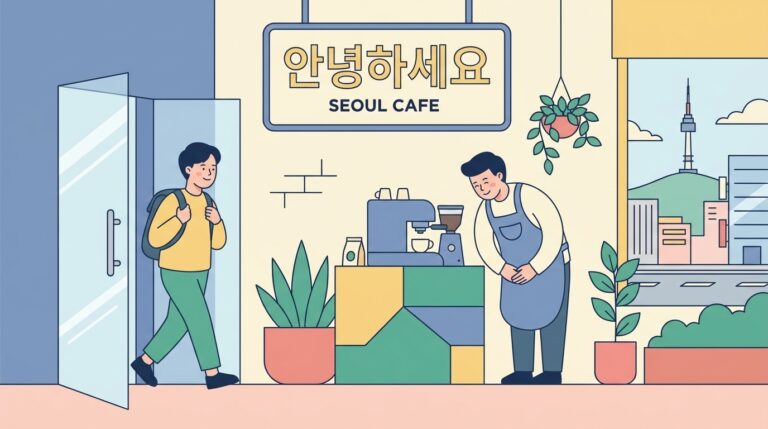
Master Customer Greetings at Your Korean Part-Time Job: From Cafe to Convenience Store
Phase 1: Empathy (Story-Driven Opening)
안녕하세요! 매일한글 에디터입니다. (Hello! I’m your Daily Hangul editor.)
Imagine this: It is your very first afternoon working an alba (part-time job) at a sunlit cafe tucked into the trendy alleys of Yeonnam-dong. The soothing scent of roasted coffee beans fills the air. Suddenly, the chime above the entrance rings—ding-dong! The glass door swings open, and a customer walks in, looking straight at you. Your heart skips a beat. Your mind races: Do I say ‘Annyeonghaseyo’? Do I bow at a 90-degree angle? What if they ask for a table of four and I freeze?
If you have ever felt that sudden rush of panic when facing native speakers across a counter, take a deep breath. You are definitely not alone. Over the past decade guiding international students and expats who step behind the counter in Seoul, I have watched countless beginners stumble through this exact moment. Welcoming guests in Korea is not about reciting stiff grammar from an old textbook; it is a warm, rhythmic dance of hospitality that can instantly make you sound like a seasoned local pro. In this guide, we will unpack the exact words, body language, and cultural instinct (nunchi) you need so you can greet every single guest with calm, magnetic confidence.
Phase 2: Top 3 Core Expressions (Deep Dive)
1. 어서 오세요 (Eoseo oseyo)
- Pronunciation: [Eoseo oseyo] (Sounds like: “Uh-saw oh-say-yo” — say “uh-saw” smoothly, then bounce gently into “oh-say-yo”)
- Meaning: Literal: “Quickly come in” | Real Nuance: “Welcome! Please come right in and make yourself comfortable.”
- K-Culture Moment: Think of convenience store scenes in dramas like Backstreet Rookie or neighborhood pub scenes in Itaewon Class, where the front door chime triggers an automatic, energetic chorus of this phrase from the entire staff.
- Editor’s Insight: In English, we often greet retail guests with “Hi, how are you?” Korean service culture does not usually ask how the customer is doing personally. Instead, “어서 오세요” focuses on the physical invitation to enter a hospitable space. Pitch it on a lively, upbeat note to instantly radiate friendly warmth.
- Situation Spectrum: Casual (🚫) | Semi-formal (✅) | Formal (✅)
- 🤔 Think About It: Notice how “어서” literally hints at moving quickly or warmly without hesitation. Why do you think Korean hospitality highlights welcoming someone into a physical space rather than asking about their personal mood?
2. 몇 분이세요? (Myeot bun-iseyo?)
- Pronunciation: [Myeot bun-iseyo?] (Sounds like: “Myut boon-ee-say-yo” — crisp “myut”, followed by soft “boon”, then a rising question intonation)
- Meaning: Literal: “How many esteemed persons are you?” | Real Nuance: “Party of how many? / How many in your group?”
- K-Culture Moment: Every classic K-Drama dining scene starts right here: two friends enter a bustling K-BBQ restaurant, and the server holding a stack of metal menus asks this in half a second flat.
- Editor’s Insight: Notice the word 분 (bun) instead of the everyday counter 명 (myeong). In Korean honorific grammar, guests are referred to as bun to grant them honor and respect. Asking “몇 명이에요?” to a customer sounds blunt and childish behind the counter; “몇 분이세요?” instantly marks you as polite and professional.
- Situation Spectrum: Casual (🚫) | Semi-formal (✅) | Formal (✅)
- 🤔 Think About It: In your native language, do you use different counting words when speaking respectfully to guests versus counting everyday objects or friends?
3. 이쪽으로 앉으세요 (Ijjogeuro anjeuseyo)
- Pronunciation: [Ijjogeuro anjeuseyo] (Sounds like: “Ee-johk-eu-ro an-jeu-say-yo” — glide across “ij-jok” and gently land on “an-jeu-say-yo”)
- Meaning: Literal: “Sit toward this direction.” | Real Nuance: “Please follow me right this way to your seat.”
- K-Culture Moment: You will hear this in serene traditional tea houses in Insadong or modern cafes when staff guide guests away from crowded doorways toward a cozy window table.
- Editor’s Insight: Pair this phrase with an open right hand (palm turned slightly upward at a 45-degree angle). Never point with a single index finger! In Korean service etiquette, pointing your finger at a customer or seat is seen as aggressive.
- Situation Spectrum: Casual (🚫) | Semi-formal (✅) | Formal (✅)
- 🤔 Think About It: How does guiding someone with subtle spatial directions (“toward this side”) create a smoother, more courteous atmosphere than commanding “sit here”?
Phase 3: Textbook Korean vs. Real Korean
Situation 1: The Door Opens and Customers Walk In
- 📖 Textbook Korean: 환영합니다! (Hwanyeonghamnida! – “Welcome!”)
- 🗣️ Real Korean: 어서 오세요~! (Eoseo oseyo~! – “Welcome, come right in!”)
- 💡 Why it differs: Hwanyeonghamnida sounds like a grand digital billboard at Incheon International Airport or an opening speech at a diplomatic summit. In daily cafe, retail, or restaurant settings, 어서 오세요 is the real, natural phrase locals use.
Situation 2: Asking if the Order is for Here or To-Go (Cafe Setting)
- 📖 Textbook Korean: 여기서 드실 것입니까, 아니면 가져가실 것입니까? (Yeogiseo deusil geosimnikka, animyeon gajyeogasil geosimnikka? – “Will you consume it here or will you take it away?”)
- 🗣️ Real Korean: 드시고 가세요? (Deusigo gaseyo? – “Are you dining in?”)
- 💡 Why it differs: Textbook sentences love long compound clauses. In Korea’s fast-paced service culture, cashiers shorten the question politely: “드시고 가세요?” (Having it here?) or “포장이세요?” (Takeaway?). It keeps the line moving smoothly without losing politeness.
Phase 4: K-Culture Deep Dive & Non-Verbal Manners
4-1. 눈치 (Nunchi) & Essential Gestures
Customer service in Korea relies heavily on non-verbal cues. When welcoming someone, remember three gold rules:
1. The 15-Degree Nod Bow: You do not need a dramatic 90-degree bow when someone opens the door. A crisp, clean 15-to-30 degree bow paired with eye contact and a gentle smile displays great nunchi (tactful awareness).
2. The Open-Palm Guide: When directing guests to a table or counter, keep your fingers together and gesture with your palm facing slightly upward. Pointing with an index finger is a major service faux pas.
3. The Two-Hand Handover: When handing menus, buzzers, or receipts, hold the item with both hands—or support your right wrist lightly with your left hand. This subtle gesture signals undivided attention and respect.
4-2. Cultural Code: The Rhythm of “Bbali-Bbali” and Warmth
In Korean workplaces, speed and courtesy coexist in what locals call bbali-bbali (fast-paced) efficiency. When a customer enters, greeting them within two seconds shows that you are alert and attentive. Leaving a guest standing by the door in silence while you finish wiping down an espresso machine makes them feel neglected. Even a quick, cheerful “어서 오세요!” while your hands are busy establishes immediate rapport.
Phase 5: Real-Life Roleplay Scenario
Setting: Saturday 2:00 PM at “Cafe Dalcom” in Yeonnam-dong. The shop is buzzing with indie lofi beats. A customer, Min-ji, pushes the glass door open while checking her smartphone.
Characters:
* Min: You (The alert, friendly part-time barista)
* Min-ji: A 20-something local customer looking for a quiet table
- Min: 🎭 Steps slightly forward, bowing 15 degrees with a bright smile
어서 오세요! (Eoseo oseyo!)
“Welcome! Please come in!” - Min-ji: 🎭 Looks up, smiles back, and steps inside
안녕하세요! 혹시 자리 있나요? (Annyeonghaseyo! Hoksi jari innayo?)
“Hello! By any chance, do you have seats?” - Min: 🎭 Nods attentively, making soft eye contact
네, 있어요! 몇 분이세요? (Ne, isseoyo! Myeot bun-iseyo?)
“Yes, we do! How many people in your group?” - Min-ji: 🎭 Holds up two fingers
두 명이에요. (Du myeong-ieyo.)
“Two people.” - Min: 🎭 Extends open right palm toward a cozy corner booth
이쪽으로 앉으세요. (Ijjogeuro anjeuseyo.)
“Please take a seat over this way.” - Min-ji: 🎭 Heads to the corner table and sets her bag down
감사합니다! 메뉴판 보고 주문할게요. (Gamsahamnida! Menyupan bogo jumunhalgeyo.)
“Thank you! I will look at the menu and order.” - Min: 🎭 Maintains a polite posture behind the counter
네, 천천히 보세요! (Ne, cheoncheonhi boseyo!)
“Sure, take your time!” - Min-ji: 🎭 Nods happily
네! (Ne!)
“Okay!”
🔀 Interactive Decision Point
Suppose Min-ji suddenly asks: “창가 자리로 앉아도 돼요? (Chang-ga jariro anjado dwaeyo? – Can we sit at the window table?)” but that window table has not been cleared yet. What should you say?
- Choice A: “안 돼요, 더러워요.” (An dwaeyo, deoreowoyo.)
- Choice B: “네! 바로 치워 드릴게요. 이쪽에서 잠시만 기다려 주세요!” (Ne! Baro chiwo deurilgeyo. Ijjogeseo jamsiman gidaryeo juseyo!)
- Choice C: “그냥 저기 앉으세요.” (Geunyang jeogi anjeuseyo.)
💡 Choice Feedback:
* Choice A (Bad): Telling a customer "No, it's dirty" sounds harsh and unprofessional.
* Choice B (Best! ⭐): Politeness at its peak! You happily accommodate their preference ("Yes! I'll clean it right away") and guide them gently to wait for a moment.
* Choice C (Risk): Saying "Just sit over there" sounds dismissive and blunt, which will instantly cool down customer satisfaction.
Phase 6: 10-Second Emotion Shadowing Drill
Practice these lines out loud! Pay attention to the slash (/) pauses and emotional intentions:
[😊 Bright & Energetic]
어서 오세요! / 편한 자리에 앉으세요!
(Eoseo oseyo! / Pyeonhan jarie anjeuseyo!)
“Welcome! / Please sit in any comfortable seat!”-
[✨ Polite & Inquiring]
안녕하세요! / 혹시 / 몇 분이세요?
(Annyeonghaseyo! / Hoksi / myeot bun-iseyo?)
“Hello! / By any chance, / how many are in your party?” -
[🙏 Reassuring & Friendly]
네, / 이쪽 자리로 / 안내해 드릴게요!
(Ne, / ijjok jariro / annaehae deurilgeyo!)
“Yes, / over to this table, / I will guide you!”
Phase 7: K-Culture Mini Dictionary (4 Key Terms)
- 알바 (Alba) | Short for 아르바이트 (Arbeit)
- Meaning: Part-time job / Part-time worker.
- Usage: Everyone in Korea uses this daily. You can say: “저 오늘 카페 알바 가요” (I’m heading to my cafe part-time shift today).
- 손님 (Sonnim) | Customer / Guest
- Meaning: Honored guest.
- Usage: Colleagues will alert you quietly behind the bar: “손님 오셨어!” (A customer has arrived!). Never call a customer “당신” (you); always refer to them as 손님.
- 사장님 (Sajangnim) | Boss / Shop Owner
- Meaning: Store manager or business owner.
- Usage: Used to address your employer respectfully, or even when customers call out to the restaurant owner for extra banchan (side dishes).
- 포장 (Pojang) | Takeout / Packaging
- Meaning: To-go packaging.
- Usage: When customers order drinks to take out, they often say: “포장해 주세요” (Please pack it to go).
Phase 8: Survival Kit for Travelers & Job Seekers
Survival Expressions TOP 3
- 어서 오세요! (Eoseo oseyo!)
- Pro Tip: Say this with a melodic rise on “오-” to create instant welcoming charm.
- 몇 분이세요? (Myeot bun-iseyo?)
- Pro Tip: Keep your hands softly folded in front of your waist when asking this question.
- 드시고 가세요? (Deusigo gaseyo?)
- Pro Tip: Essential question at cafe counters before ringing up the order on the POS register.
Editor’s Travel & Alba Note
If you plan to work an alba or explore neighborhood cafes in Seoul, ditch international map apps and use the Naver Map app download to search for trending cafes and check real customer reviews. Also, familiarize yourself with modern self-service kiosks: even when kiosks handle orders, saying a warm “어서 오세요!” as guests step through the door remains an indispensable cultural etiquette that Korean bosses adore!
Phase 9: “One Step Deeper” (Reflective Question)
In Korean society, language is an interactive map of human relationships. When you speak honorific Korean (jondaetmal) to a guest—swapping everyday counters like myeong for bun, and offering a subtle bow—you are not lowering your personal dignity. Rather, you are participating in a cherished cultural circle of mutual respect. In a country where community (uri) and heartfelt connection (jeong) run deep, the welcoming words you speak build an instant bridge of trust between strangers.
💬 Your Turn: In your home country, what is the very first sentence customer service staff say to someone walking through the door? How does it reflect your culture’s view of customer hospitality compared to Korea’s “어서 오세요”? Share your thoughts below!
Phase 10: FAQ & Avoiding Misunderstandings
Q: Can I just say “안녕!” (Annyeong!) to young customers who look like students?
A: Definitely not! In Korean service culture, even if the customer is younger than you, staff must always speak in polite honorifics (jondaetmal). Treating every customer with respectful language protects you from misunderstandings and maintains the store’s reputation.
Q: What if I don’t catch how many people they said?
A: Stay calm and politely ask: “죄송하지만 다시 한번 말씀해 주시겠어요?” (Joesonghajiman dasi hanbeon malsseumhae jusigesseoyo? – I’m sorry, but could you please say that one more time?). Customers appreciate honesty and effort much more than guessing and leading them to the wrong table.
Q: Should I bow deeply every single time someone walks in?
A: A 15-to-30 degree head-and-torso bow is the sweet spot. A deep 90-degree bow is reserved for formal apologies or high-end hotel VIP greetings and will feel overly dramatic in a cozy cafe or convenience store.
🚨 Common Mistakes Alert
- ❌ Mistake 1: Pointing with your index finger when saying “이쪽으로 앉으세요”.
- Correct Action: Guide with your full hand, palm facing gently upward.
- ❌ Mistake 2: Asking “몇 명이야?” (Casual speech to guests).
- Correct Action: Always use the respectful counter and ending: “몇 분이세요?”.
- ❌ Mistake 3: Staying silent because you feel shy about your Korean accent.
- Correct Action: A cheerful accent is 100 times better than silence! Even an imperfect “어서 오세요!” with a bright smile will win everyone’s heart.
Phase 11: Action Mission & Engagement
- 🥉 Bronze Mission (Solo Practice): Stand in front of your mirror. Practice bowing 15 degrees while saying “어서 오세요! 몇 분이세요?” five times smoothly without pausing.
- 🥈 Silver Mission (Social / Audio): Record your voice saying “이쪽으로 앉으세요, 천천히 보세요!” and listen back. Check if your tone sounds warm, melodic, and friendly.
- 🥇 Gold Mission (Real Life): The next time you visit a Korean mart, cafe, or restaurant, listen carefully for the greeting. Greet the clerk back with a pleasant nod and “안녕하세요!” before ordering!
- 🎮 K-Culture Mission: Watch episode 1 of any slice-of-life K-Drama (like Hospital Playlist or Our Blues). Spot the exact moment someone enters a restaurant and count how many times staff call out “어서 오세요!”
Phase 12: Interactive Quiz Challenge
Test your part-time customer greeting mastery! Try solving these three quick questions:
1. [Scenario Judgment] A customer enters your convenience store while you are restocking drinks in the back aisle. What is the best immediate response?
* A) Wait until they come to the cash register to say anything.
* B) Call out brightly: “어서 오세요!”
* C) Shout: “환영합니다!”
2. [Fill-in-the-Blank] Complete the polite question used to ask how many guests are dining:
* “실례지만, 손님 ____ 분이세요?”
3. [True or False] When pointing guests toward a table, it is polite Korean etiquette to point directly with your index finger.
* (True / False)
👉 Click here to reveal the answers and explanations!
Answers & Explanations:
1. Answer: B (어서 오세요!)
* Explanation: Even if your hands are busy restocking, calling out a quick, warm “어서 오세요!” lets the customer know you acknowledge their presence.
2. Answer: 몇 (Myeot)
* Explanation: The full phrase is “몇 분이세요?” (How many esteemed guests are in your group?).
3. Answer: False
* Explanation: Never point with your index finger! Always guide guests using an open hand with your palm facing slightly upward.







