

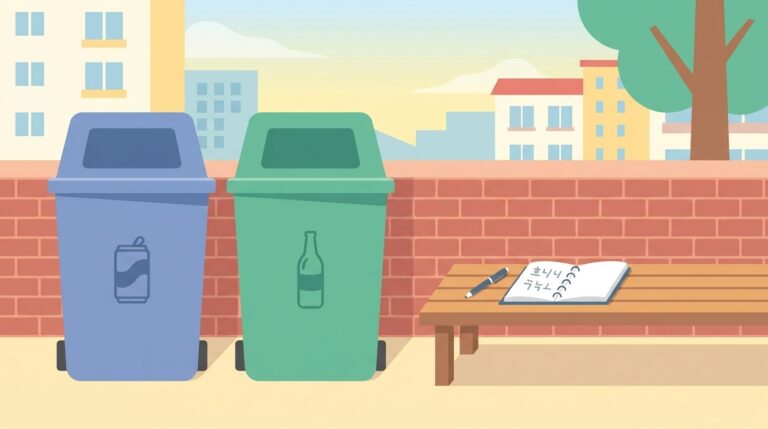
Master Korean Recycling: How to Sort Cans and Bottles Without Stress
Phase 1: 공감 (Story Immersion Opening)
안녕하세요! 매일한글 에디터입니다. Have you ever stood in front of an apartment recycling zone in Korea on a Sunday evening, holding an empty Chilsung Cider can and a green soju bottle, feeling completely paralyzed? You look around and see color-coded bins, giant mesh bags, and an alert apartment security guard (경비 아저씨) watching from afar. You wonder: Do I keep the metal bottle cap on? Can I leave a drop of soda inside? Where does this plastic label go?
You are not alone! In fact, sorting waste—known as 분리수거 (bunrisugeo)—is one of the top culture shocks foreign residents and travelers face in South Korea. Korea has one of the strictest, most sophisticated recycling systems in the world. Getting it wrong can lead to stern neighborhood warnings or even hefty fines. But don’t worry! This guide is crafted directly from real learner experiences and local know-how. By the end of this lesson, you’ll know the exact A2-level Korean phrases and insider habits to sort cans and glass bottles smoothly and confidently just like a Seoul local.
Phase 2: Core Expressions Deep Dive
1. 캔하고 병은 어디에 버려요? (Can-hago byeong-eun eodie beoryeoyo?)
- Pronunciation: Can-ha-go byung-eun aw-di-eh buh-ryuh-yo? (Rhymes with “can”, “go”, and the “eo” sounds like the ‘u’ in ‘cup’)
- Meaning: Literal: “Where do I throw away cans and bottles?” | Actual Nuance: “Where should I put the recyclable cans and glass bottles?”
- K-Culture Moment: In roommate K-Dramas like Age of Youth (청춘시대), new housemates use this exact phrase on move-in day while cleaning the kitchen after an epic housewarming party.
- Editor’s Insight: In Korean, the verb 버리다 (beorida) means “to throw away” or “to discard.” When paired with 분리수거 items, it naturally implies “recycle.” Adding ~하고 (hago) links “can” and “bottle” naturally in spoken Korean.
- Situation Spectrum: Casual (⚠️ 캔하고 병 어디 버려?) | Semi-formal (✅ 캔하고 병은 어디에 버려요?) | Formal (✅ 캔과 병은 어디에 배출합니까?)
- 🤔 Think About It: In English, we often say “Where does this go?” In Korean, specifying the object category (캔, 병) upfront helps the listener direct you to the exact bin instantly.
2. 비우고 헹궈서 버려야 해요. (Biugo henggwoseo beoryeoya haeyo.)
- Pronunciation: Bee-oo-go heng-gwaw-seo buh-ryuh-yah hae-yo. (Sounds like “bee” + “woo”, and “heng” like “hang” with a short ‘e’)
- Meaning: Literal: “You must empty it, rinse it, and throw it away.” | Actual Nuance: “Make sure it’s completely empty and washed clean before tossing it in.”
- K-Culture Moment: On reality shows like I Live Alone (나 혼자 산다), neat celebrity idols rinse their empty canned tuna or drink bottles thoroughly under the tap while explaining their Sunday cleaning rituals.
- Editor’s Insight: This sentence features the essential “-고” (and then) and “-아서/어서” (sequence/cause) grammar. The 4-step golden rule of Korean recycling is: 비운다 (empty), 헹군다 (rinse), 분리한다 (separate), 섞지 않는다 (don’t mix).
- Situation Spectrum: Casual (✅ 비우고 헹궈서 버려.) | Semi-formal (✅ 비우고 헹궈서 버려야 해요.) | Formal (✅ 내용물을 비우고 세척 후 배출해야 합니다.)
- 🤔 Think About It: Why does Korean culture stress rinsing food containers so intensely? Korea’s dense urban living means dirty containers attract pests quickly in shared residential recycling stations.
3. 라벨은 떼서 비닐에 넣어요. (Rabereun tteseo binire neoeoyo.)
- Pronunciation: Rah-bel-eun tteh-saw bee-neel-eh naw-aw-yo. (Pronounce ‘tte’ with a crisp, tense ‘t’ sound like in Spanish ‘tapa’)
- Meaning: Literal: “Peel the label and put it into the plastic wrapper bin.” | Actual Nuance: “You have to remove the label sticker/film and sort it into plastic film.”
- K-Culture Moment: Seen across Korean variety programs where guests peel perforation strips off beverage bottles with immense satisfaction.
- Editor’s Insight: Most drink bottles in Korea now feature perforated tear lines (절취선). Even if the bottle is glass or plastic, that outer film label is classified as 비닐 (vinyl/plastic film).
- Situation Spectrum: Casual (✅ 라벨은 떼서 비닐에 넣어.) | Semi-formal (✅ 라벨은 떼서 비닐에 넣어요.) | Formal (✅ 라벨을 제거한 후 비닐류로 분리하십시오.)
- 🤔 Think About It: Notice how Korean classifies soft plastic wraps and film packaging as “비닐” (vinyl), whereas English speakers call almost all of it “plastic.” Differentiating “플라스틱” (rigid plastic) and “비닐” (soft wrap) is critical in Korea!
Phase 3: 교과서 한국어 vs 진짜 한국어 (Textbook vs. Real-Life)
Situation 1: Asking neighbor or security officer where to place recyclable bottles
- 📖 교과서 한국어: 재활용 쓰레기는 어디에 분리수거합니까? (Jaehwalyong sseuregineun eodie bunrisugeohamnikka? – Where do you separate and collect recyclable garbage?)
- 🗣️ 진짜 한국어: 이거 병이랑 캔 어디에 둬요? (Igeo byeong-irang kaen eodie dwoyo? – Where do I put these bottles and cans?)
- 💡 왜 다를까?: Real Koreans avoid long Sino-Korean words like “재활용 쓰레기 분리수거” in daily casual speech. Instead, they point to the items and use conversational markers like ~이랑 (and) and the easy verb 두다 (to place/put).
Situation 2: Returning empty soju or beer bottles to a convenience store for cash deposit
- 📖 교과서 한국어: 공병 보증금을 환불받고 싶습니다. (Gongbyeong bojeunggeumeul hwanbulbatgo sipseumnida? – I would like to receive a refund for the empty bottle deposit.)
- 🗣️ 진짜 한국어: 빈 병 보증금 받을 수 있어요? (Bin byeong bojeunggeum badeul su isseoyo? – Can I get the empty bottle deposit back?)
- 💡 왜 다를까?: Instead of the overly formal legal term “환불받다” (to receive a refund), native speakers prefer “받을 수 있어요?” (Can I receive?). It sounds friendlier and natural for an A2 learner at a neighborhood mart.
Phase 4: K-Culture 딥다이브 & 비언어적 매너 (Deep Dive & Manners)
4-1. 눈치 (Nunchi) & Body Language at the Recycling Station
- The Two-Handed Placement: Glass bottles can shatter easily. Always place glass bottles gently into the basket with both hands or a supportive underhand grip rather than dropping them from above. This signals mindfulness to neighbors.
- Flattening Cans: Step on beverage cans with the sole of your shoe to crush them flat before tossing them into the mesh bag. It shows community manners (배려) by saving precious collection space.
- Acknowledge the Security Guard: When you enter the apartment recycling area, offer a polite 15-degree bow with a friendly greeting: “안녕하세요!” (Annyeonghaseyo!). Having good rapport with the building manager makes sorting guidance a pleasant conversation rather than a reprimand.
4-2. Culture Code: The Empty Bottle Deposit System (공병보증금제도)
Did you know that standard green soju bottles and brown beer bottles in Korea carry a cash refund value? Look at the label: if it says 100원 (soju) or 130원 (beer), you can bring clean, unbroken bottles back to almost any convenience store or supermarket to claim cash on the spot! This eco-friendly cycle is a staple of everyday Korean frugality and environmental consciousness.
Phase 5: 실전 롤플레이 시나리오 (Real-Life Roleplay)
- Setting: An apartment recycling area behind Building 104 on a chilly Sunday evening.
- Characters:
- You (민우/Minwoo): A beginner Korean learner holding a bag of empty beer cans and soju bottles.
- Mr. Park (박 경비아저씨): A meticulous yet warm-hearted security guard holding a clipboard.
- You: 저기요, 아저씨! 캔하고 병은 어디에 버려요? (🎭 Holding up a reusable tote bag full of drinks)
(Jeogiyo, ajeossi! Kaen-hago byeong-eun eodie beoryeoyo? / Excuse me, mister! Where do I throw away cans and bottles?) - Mr. Park: 아, 캔은 저기 파란색 그물망에 넣고, 병은 노란 상자에 넣어요. (🎭 Pointing with his flashlight towards the bins)
(A, kaeneun jeogi paransaek geumulmang-e neoko, byeong-eun noran sangja-e neoeoyo. / Ah, put cans in that blue mesh net over there, and bottles in the yellow crate.) - You: 아, 네! 캔은 찌그러뜨려서 넣어야 해요? (🎭 Pantomiming stepping down with a foot)
(A, ne! Kaeneun jjigeureotteuryeoseo neoeoya haeyo? / Ah, yes! Do I need to crush the cans before putting them in?) - Mr. Park: 그렇지! 밟아서 납작하게 만들면 아주 좋아요. (🎭 Nodding approvingly with a proud smile)
(Geureochi! Balbaseo napjakhage mandeulmyeon aju joayo. / Exactly! It’s great if you step on them and make them flat.) - You: 맥주병 뚜껑은 어떻게 해요? 같이 버려요? (🎭 Showing a glass beer bottle with a metal crown cap)
(Maekjubyeong ttukkeong-eun eotteoke haeyo? Gachi beoryeoyo? / What do I do with the beer bottle cap? Do I throw it away together?) - Mr. Park: 뚜껑은 쇠니까 캔 쪽에 넣고, 병 속은 물로 한번 헹궜어요? (🎭 Peering closely into the bottle neck)
(Ttukkeong-eun soenikka kaen jjok-e neoko, byeong sog-eun mullo hanbeon henggwosseoyo? / The cap is metal so put it with the cans. Did you rinse inside the bottle with water?) - You: 네! 집에서 깨끗하게 헹궈 왔어요. (🎭 Smiling proudly and showing the clean, dry bottle)
(Ne! Jib-eseo kkaekkeuthage henggwo wasseoyo. / Yes! I rinsed it cleanly at home before coming.) - Mr. Park: 아이고, 분리수거 정말 잘하네! 한국 사람 다 됐어요. (🎭 Chuckling warmly and giving a big thumbs up)
(Aigo, bunrisugeo jeongmal jalhane! Hanguk saram da dwaesseoyo. / Oh my, you recycle so well! You’ve basically become Korean.)
🔀 Interactive Choice Point
You realize one glass bottle still has sweet coffee residue at the very bottom, but you don’t want to carry it back upstairs. What do you say?
- Choice A: “아저씨, 조금 남았는데 그냥 여기 버릴게요!” (Mister, a little is left inside, but I’ll just toss it here!)
- ❌ Bad: This disrespects the system. Dirty liquids contaminate paper/mesh bins and attract fruit flies. Mr. Park will feel frustrated.
- Choice B: “어? 안에 조금 남았네요. 경비실 수돗가에서 헹궈도 돼요?” (Oh? There is a little left inside. May I rinse it at the guard station faucet?)
- 🌟 Best: Courteous, responsible, and proactive! Mr. Park will gladly let you use the outdoor tap and admire your manners.
- Choice C: “이거 그냥 일반쓰레기 종량제 봉투에 몰래 넣을까…” (Should I secretly stuff this into the general trash bag…?)
- ⚠️ Risk: Glass in general trash bags can rip the bag and injure sanitation workers, plus surveillance cameras (CCTV) can flag your unit for fines.
Phase 6: 10초 감정 섀도잉 드릴 (10-Second Emotion Shadowing Drill)
Practice these lines out loud with feeling! Watch the pauses (/) and adopt the emotion tags.
[🤔 조심스럽고 공손하게 - Polite & Inquiring]
저기요, / 캔하고 병은 / 어디에 버려요?
(Jeogiyo, / kaen-hago byeong-eun / eodie beoryeoyo?)-
[💡 깨달음을 얻고 명랑하게 - Energetic Realization]
아하! / 라벨은 떼고 / 캔은 찌그러뜨려요!
(Aha! / rabereun ttego / kaeneun jjigeureotteuryeoyo!) -
[😊 뿌듯하고 자신감 넘치게 - Proud & Confident]
안에 다 비우고 / 깨끗하게 헹궈 왔어요!
(Ane da biugo / kkaekkeuthage henggwo wasseoyo!)
Phase 7: K-Culture 미니 사전 (Key Vocabulary)
- 분리배출 (Bunri-baechul) | Separate disposal / Sorting recyclables
The formal term seen on government posters and recycling bins nationwide. While everyday Koreans say “분리수거” (sorting collection), official signs always write “올바른 분리배출” (proper separate disposal). - 공병 (Gong-byeong) | Empty beverage bottle
Specifically refers to returnable glass bottles (soju, beer, soft drinks) eligible for deposit refunds at supermarkets. - 캔류 (Kaen-ryu) | Can category / Metal cans
The label header on sorting bins. It encompasses aluminum soda cans, steel canned foods, and empty aerosol canisters (which must be punctured). - 종량제 봉투 (Jongnyangje bongtu) | Volume-rate government garbage bag
The official prepaid trash bag required for non-recyclable general waste. If an item cannot be recycled, it must go in here!
Phase 8: 여행자를 위한 생존 키트 (Traveler’s Survival Kit)
Top 3 Survival Expressions
- 이거 캔에 버려요, 일반 쓰레기예요? (Igeo kaene beoryeoyo, ilban sseuregi-yeyo? – Do I throw this in cans, or is it general trash?)
Pro Tip: Use this at an Airbnb or guesthouse when you aren’t sure if a coated food tin counts as scrap metal. - 라벨 떼는 곳 있어요? (Rabel tteneun got isseoyo? – Is there a spot to peel the label?)
Pro Tip: Most Korean water and tea bottles now have easy-peel pull-tabs labeled “에코 절취선” (Eco Tear Line). - 빈 병 보증금 여기서 바꿔요? (Bin byeong bojeunggeum yeogiseo bakkwoyo? – Do I exchange empty bottle deposits here?)
Pro Tip: Ask this at the counter of your local neighborhood mart or convenience store.
Editor’s Travel Note
- Navigation Guide: Finding public trash bins on the street in Korea can feel impossible! Download the Naver Map app for mobile to easily locate nearby subway stations or public parks, which almost always have multi-compartment recycling receptacles.
- Local Subway Tip: In Seoul subways, recycling bins are placed right next to ticket gates. They are strictly divided into “음료 용기 (캔/페트)” (Drink Containers: Cans/PET) and “일반 쓰레기” (General Waste).
Phase 9: “한 발 더 깊이” (Food for Thought)
In many Western cultures, waste disposal is viewed as an individual’s private right—you pay taxes or utility fees, and a company hauls everything away unseen. In Korea, however, recycling reflects the deep-rooted cultural concept of 우리 (Uri – We/Our) and shared collective responsibility. Because Korean neighborhoods are closely knit apartment and villa communities, sorting your glass bottles and cans cleanly is considered an act of basic civic courtesy toward your neighbors and local sanitation workers.
💬 Your Turn: How does recycling work in your home country? Do you have to rinse containers and peel labels like in Korea, or is single-stream recycling more common? Share your experience in the comments below!
Phase 10: FAQ & 오해 방지 (FAQ Schema)
Q: Do I need to remove the metal caps from glass bottles before recycling?
A: Yes, metal caps belong in the metal/can bin (캔류), while the bottle itself goes into the glass bin (병류). If the bottle has a plastic twist-cap, remove it and place it into the plastic bin.
Q: Can I throw broken glass into the regular glass recycling bin?
A: Absolutely not! Broken glass or ceramic dishes cannot be recycled with standard glass bottles. They must be wrapped safely in newspaper and placed inside a special designated heavy-duty sack (특수규격마대) or general trash bag depending on local district rules.
Q: What should I do with butane gas canisters (부탄가스) used for Korean BBQ tables?
A: You must safely puncture a small hole in the bottom of the empty gas canister outdoors in a well-ventilated area to release residual gas before tossing it into the metal can section.
🚨 Common Mistakes (흔한 실수 TOP 3)
| Mistake | What Happens | Correct Action |
|---|---|---|
| 1. Leaving cigarette butts in empty beer cans | Contaminates aluminum processing and ruins the batch | Never use drink cans as ashtrays; cans must be 100% empty and rinsed. |
| 2. Tossing mirror glass or mugs into the glass bin | Glass melting points differ; heat-resistant glass ruins recycled bottles | Only glass drink & food jars go into 병류. Dishes go to general waste. |
| 3. Leaving plastic wrappers on glass drink bottles | Sorting machine cannot separate adhered plastic film | Always peel off the thin vinyl wrap (라벨) and place it in the plastic film bin (비닐류). |
Phase 11: 액션 미션 & 참여 유도 (Action Missions)
- 🥉 Bronze Mission (Solo Practice): Take one empty beverage can and one glass bottle at home. Wash them out, peel any exterior plastic label, crush the can flat with your foot, and say out loud: “비우고 헹궈서 버려요!”
- 🥈 Silver Mission (Social Share): Snap a photo of a Korean recycling station or a beverage bottle with its tear-line label peeled off. Post it on your Instagram Stories with the caption: “Learning Korean 분리수거 with Daily Hangul! 캔/병 분리 완료!”
- 🥇 Gold Mission (Real-Life Challenge): Return an empty soju or beer bottle to a local convenience store and politely say: “빈 병 보증금 받을 수 있어요?” to get your 100 or 130 won deposit back in cash!
- 🎮 K-Culture Mission: Watch an episode of a Korean variety show (like Three Meals a Day or Jinny’s Kitchen). Spot how the cast cleans, dries, and stacks empty canned ingredients and soju bottles at the sink!
Phase 12: 인터랙티브 퀴즈 챌린지 (Quiz Challenge)
Quiz 1. Situational Judgment
You just finished drinking an iced coffee in a metal can. It still has half the ice cubes and some sweet syrup inside. What is the correct way to recycle it?
* A) Throw it directly into the blue can net so the ice melts outside.
* B) Melt or dump the remaining ice/liquid in the sink, rinse with clean water, crush it, and put it in the can bin.
* C) Toss it into the general trash bag (종량제 봉투) to avoid touching the wet can.
👉 Click to view Answer & Explanation
Answer: B
In Korea, unrinsed cans attract pests and contaminate recycling batches. Always empty liquids, give it a quick rinse, flatten it, and place it in the designated 캔류 receptacle!
Quiz 2. Fill in the Blank
Complete the sentence in natural Korean:
“병의 비닐 라벨은 ______ 비닐류에 넣으세요.”
* A) 덮어서 (cover and)
* B) 떼서 (peel off and)
* C) 마셔서 (drink and)
👉 Click to view Answer & Explanation
Answer: B (떼서)
떼다 (to peel/detach) combines with ~어서 to form 떼서 (peel and then). Full sentence: “병의 비닐 라벨은 떼서 비닐류에 넣으세요.” (Peel off the bottle’s vinyl label and put it in vinyl film).
Quiz 3. True or False (K-Culture)
Question: In Korea, you can return empty soju bottles with the deposit sign (100원) to local convenience stores to receive cash back.
* A) True
* B) False
👉 Click to view Answer & Explanation
Answer: A (True)
South Korea’s Empty Bottle Deposit Return System (공병보증금제도) refunds 100 won for standard soju bottles and 130 won for beer bottles when returned clean to retail stores!







