

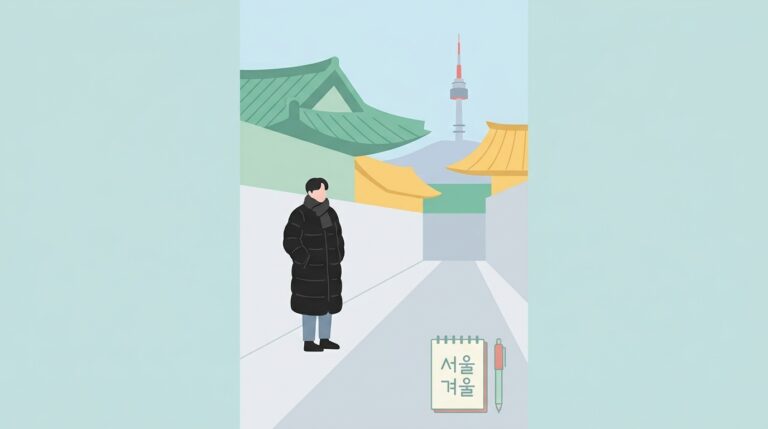
When the Perceived Temperature Drops Below Freezing: Your Ultimate Survival Guide to Korean Winter
Phase 1: Empathy (Story-Immersive Opening)
안녕하세요! 매일한글 에디터입니다. (Hello! This is your Daily Hangul editor.)
You step out of Hongik University Station Exit 9 in mid-December. The weather app on your smartphone confidently claims it is a mild 1°C (34°F). You think to yourself, “Hey, that’s not too bad! I can leave my heavy coat unzipped.”
Then, a sharp gust of Siberian wind cuts straight through the glass towers, whipping past the street performers and hitting your face like an icy slap. Your ears start burning, your eyes water involuntarily, and your teeth chatter uncontrollably. You look around, and every single local walking past you is cocooned in an ankle-length black puffer coat—the legendary Korean long padding—with scarves wound up to their noses and both hands clamped tightly onto steaming paper cups or pocket hand warmers. You realize instantly: the app may say 1°C, but out here on the pavement, it feels like -10°C.
In Korea, winter is defined not by the number on the mercury, but by 체감 온도 (chegam ondo)—the “felt” or perceived wind-chill temperature. If you only rely on standard textbook expressions like “날씨가 춥습니다” (The weather is cold), you will miss the vivid, dramatic, and intensely communal way Koreans process the cold. Over the past decade tutoring hundreds of expats, exchange students, and K-drama fans, I’ve seen countless learners freeze up—both literally and socially—because they lacked the exact conversational tools to talk about this bitter cold. Mastering these expressions doesn’t just save you from shivering in silence; it unlocks warm, caring conversations with friends, coworkers, and cafe owners. Let’s make sure you survive and thrive when Korean winter shows its teeth!
Phase 2: Core Expressions Deep Dive
1. 체감 온도가 영하로 떨어졌어요 (한글)
- Pronunciation: [Chegam ondoga yeongharo tteoreojyeosseoyo] (Think: Cheh-gahm ohn-doh-gah yung-hah-roh ddaw-raw-jyu-ssaw-yoh)
- Meaning: “The perceived temperature (wind chill) dropped below freezing/zero.”
- K-Culture Moment: In morning news broadcasts or JTBC weather segments, meteorologists stand shivering along the Han River in thick down coats, warning commuters that while the thermometer reads 2°C, “체감 온도는 영하 5도까지 떨어졌습니다” (The wind chill has plummeted to -5°C).
- Editor’s Insight: 체감 (體感) literally means “bodily sensation.” Adding 영하 (零下) indicates temperatures below 0°C. Koreans care far more about 체감 온도 than actual temperature because Seoul’s humidity and seasonal wind tunnels make cold feel sharp and piercing.
- Situation Spectrum: Casual: ✅ | Semi-formal: ✅ | Formal: ✅ (A universal, incredibly useful phrase for any setting!)
- 🤔 Think About It: In your country, do people talk more about actual ambient temperature or wind chill? Why do you think Korean news and daily banter prioritize how the body experiences the weather?
2. 칼바람이 불어서 뼈가 시려요 (한글)
- Pronunciation: [Kalbarami bureoseo ppyeoga siryeoyo] (Think: Kahl-bah-rahm-ee boo-raw-saw ppyaw-gah she-ryaw-yoh)
- Meaning: “A razor-sharp wind is blowing, so my bones ache from the cold.”
- K-Culture Moment: Think of a scene in a cozy slice-of-life drama like Reply 1988 or Our Blues, where someone rushes into a neighborhood pojangmacha (tented street stall), rubs their freezing hands together, and sighs this exact phrase to the stall owner before ordering hot fish cake soup.
- Editor’s Insight: 칼바람 combines 칼 (knife/blade) and 바람 (wind)—literally “knife wind.” Meanwhile, 시리다 describes a deep, aching cold that seems to bypass the skin and freeze your joints or bones. It’s the ultimate winter complaint phrase!
- Situation Spectrum: Casual: ✅ | Semi-formal: ✅ | Formal: ⚠️ (Slightly too visceral for an executive presentation, but perfect for small talk with coworkers during lunch breaks.)
- 🤔 Think About It: Notice how Korean uses physical, sensory metaphors (“knife wind”, “bone-chilling”) rather than abstract adjectives like “unpleasant.” How does this reflect the direct, emotionally expressive nature of spoken Korean?
3. 따뜻하게 챙겨 입고 나와요 (한글)
- Pronunciation: [Tteatteuthage chaenggyeo ipgo nawayo] (Think: Ddah-ddeut-hah-geh cheng-gyaw eep-goh nah-wah-yoh)
- Meaning: “Make sure to dress warmly before you head out.”
- K-Culture Moment: Frequently sent over KakaoTalk between best friends or romantic couples in K-dramas before meeting up in winter, often accompanied by a cute shivering bear sticker.
- Editor’s Insight: Notice the verb 챙기다 (to take care of / to pack / to put together thoughtfully). Rather than simply saying “입어요” (wear it), saying 챙겨 입어요 conveys proactive care and affection. It’s one of the purest linguistic acts of Jeong (정, emotional bonding).
- Situation Spectrum: Casual: ✅ | Semi-formal: ✅ | Formal: ⚠️ (To elders or bosses, use the honorific: 따뜻하게 챙겨 입으세요).
- 🤔 Think About It: In Western cultures, telling someone what to wear can sometimes feel intrusive. Why is it seen as pure kindness and affection in Korea?
Phase 3: Textbook Korean vs. Real Korean
Situation 1: Describing Bitter Cold to a Friend
- 📖 교과서 한국어: 오늘 날씨가 매우 춥습니다. (Oneul nalssiga maeu chupsumnida.) – “The weather is very cold today.”
- 🗣️ 진짜 한국어: 오늘 날씨 완전 미쳤어, 영하로 뚝 떨어졌어! (Oneul nalssi wanjeon michyeosseo, yeongharo ttuk tteoreojyeosseo!) – “The weather today is totally insane, it plummeted below zero!”
- 💡 왜 다를까?: In real life, Korean speakers use expressive dynamic adverbs like 뚝 (describing a sudden, steep drop) and slang intensifiers like 완전 (totally/completely) to capture the shock of freezing weather.
Situation 2: Advising Someone on What Outerwear to Wear
- 📖 교과서 한국어: 두꺼운 외투를 입으십시오. (Dukkeoun oetureul ip-eusipsio.) – “Please wear a thick overcoat.”
- 🗣️ 진짜 한국어: 오늘 나가려면 롱패딩 무조건 필수야. (Oneul nagaryeomyeon rongpaeding mujogeon pilsuya.) – “If you’re going out today, a long padding coat is an absolute must.”
- 💡 왜 다를까?: Nobody says “thick overcoat” (두꺼운 외투) in casual conversation. Koreans specify the exact cultural survival garment: the iconic 롱패딩 (long padding), paired with buzzwords like 무조건 필수 (an absolute must).
Phase 4: K-Culture Deep Dive & Non-Verbal Manners
4-1. 눈치 (Nunchi) & Cold-Weather Body Language
- The Sleeve Turtle (소매 손 넣기): Pull your long sleeves down over your palms until only your fingertips peek out. When receiving a hot beverage or receipt from a cashier, do not keep both hands stubbornly buried in your pockets—that feels dismissive. Pull at least one hand out (or support your wrist with your other hand) to show polite respect.
- Foot Stomping Protocol (발 동동 구르기): While waiting at outdoor pedestrian traffic lights, it is completely normal and expected to bounce gently on your heels and stomp your feet while tucking your chin into your scarf. It’s a shared social cue signaling: “Yes, we are all braving this Siberian freezer together!”
4-2. Cultural Codes: The “Eol-Juk-Ah” Phenomenon vs. Long Padding
Korean winter culture features a hilarious paradox: the contrast between 롱패딩 (Long Padding) and 얼죽아 (Eol-juk-ah).
- The Armor (롱패딩): Often jokingly dubbed the “black cocoon uniform,” the full-body down coat is not a fashion statement—it is survival infrastructure. From high school students to corporate executives, the moment the perceived temperature drops below zero, Seoul turns into a sea of long coats.
- The Defiance (얼죽아): Short for “얼어 죽어도 아이스 아메리카노” (Even if I freeze to death, I’ll drink Iced Americano!). Despite winds cold enough to freeze eyelashes, you will see Koreans standing outside in the bitter chill clutching an iced cup with a straw. It represents the Korean spirit of enduring adversity and the desperate need for cold caffeine after a heavy lunch!
Phase 5: Real-Life Roleplay Scenario
Setting: Outside Exit 9 of Hongik University Station (Hongdae). The wind is howling between the high-rises. You are meeting your Korean friend, Minwoo (민우), who is running 3 minutes late.
- 민우 (Minwoo): 🎭 (Dashes out of the exit door panting, ears bright red, pulling his scarf higher)
어머, 미안해! 많이 기다렸지? 오늘 날씨 진짜 살벌하다!
(Eomeo, mianhae! Mani gidaryeotji? Oneul nalssi jinjja salbeolhada!)
“Oh gosh, I’m so sorry! Did you wait long? The weather today is truly brutal!” -
You: 🎭 (Stamping your feet and blowing warm breath onto your hands)
괜찮아, 방금 나왔어. 근데 체감 온도가 영하로 뚝 떨어진 것 같아.
(Gwaenchana, banggeum nawasseo. Geunde chegam ondoga yeongharo ttuk tteoreojin geot gata.)
“No worries, I just stepped out. But it feels like the wind chill totally plunged below zero.” -
민우 (Minwoo): 🎭 (Nods intensely, shuddering)
맞아. 일기예보 보니까 칼바람 때문에 체감 영하 8도래.
(Maja. Ilgi-yebo bonikka kalbaram ttaemune chegam yeongha pal-dorae.)
“Exactly. I checked the forecast and it said with the razor wind, wind chill is -8°C.” -
You: 🎭 (Looking at his outfit with amusement)
너 롱패딩 안 입고 코트 입었네? 안 추워?
(Neo rongpaeding an ipgo koteu ibeonne? An chuwo?)
“You’re wearing a wool coat instead of a long padding coat? Aren’t you freezing?” -
민우 (Minwoo): 🎭 (Laughs awkwardly, rubbing his arms)
오늘 멋 좀 부리려다가 뼈가 시려 죽는 줄 알았어. 완전 실수했지.
(Oneul meot jom buriryeodaga ppyeoga siryeo jungneun jul arasseo. Wanjeon silsuhaetji.)
“I tried to look stylish today, but my bones are freezing to death. Total mistake.” -
You: 🎭 (Takes out a spare warm heat pack from your pocket and hands it over)
자, 이거 써! 주머니에 핫팩 하나 더 챙겨 왔어.
(Ja, igeo sseo! Jumeonie hatpaek hana deo chaenggyeo wasseo.)
“Here, take this! I packed an extra hot pack in my pocket.” -
민우 (Minwoo): 🎭 (Eyes widening with sheer gratitude, clutching the hot pack against his palms)
대박… 천사다, 천사! 따뜻한 국물 먹으러 바로 갈까?
(Daebak… Cheonsada, cheonsa! Tteatteut-han gungmul meogeureo baro galkka?)
“Unbelievable… You’re an angel! Shall we head straight for some hot soup?” -
You: 🎭 (Smiles and gestures toward a warm stew restaurant down the alley)
좋아, 얼른 들어가자. 밖은 너무 춥다!
(Joa, eolleun deureogaja. Bakkeun neomu chupda!)
“Sounds great, let’s get inside quickly. It’s way too cold out!”
🔀 Interactive Decision Point!
Minwoo asks: “우리 국밥 먹고 카페 가서 아이스 아메리카노 마실래?” (Shall we eat hot soup and then go to a cafe for Iced Americano?) How do you respond?
- Option A: “이 날씨에 얼죽아는 무리야. 따뜻한 유자차 마시자!” (Iced Americano in this weather is impossible. Let’s drink hot citron tea!)
- 👉 Feedback (Best! 🏆): Shows great cultural understanding of the “Eol-juk-ah” concept while playfully choosing a cozy winter alternative (유자차). Natural and humorous!
- Option B: “아니요, 저는 차가운 커피를 좋아하지 않습니다.” (No, I do not like cold coffee.)
- 👉 Feedback (Risk / Awkward ⚠️): Grammatically accurate, but way too stiff and formal (-습니다) for an informal chat with a friend. Kills the playful vibe.
- Option C: “네가 사주면 영하 20도여도 아이스 마실 수 있어!” (If you’re paying, I can drink iced even in -20°C!)
- 👉 Feedback (Hilarious & Super Native! 🌟): Top-tier witty bantering between close Korean friends.
Phase 6: 10-Second Emotion Shadowing Drill
Practice reading these out loud! Pay special attention to the pause slashes (/) and adopt the indicated emotional state to build native-like muscle memory.
[🥶 이가 덜덜 떨리며 / Shivering with teeth chattering]
바람이 너무 세서 / 체감 온도가 / 영하로 뚝 떨어졌어!
(Barami neomu seseo / chegam ondoga / yeongharo ttuk tteoreojyeosseo!)
“The wind is so strong / the wind chill / has plunged below zero!”-
[🧣 다정하고 걱정스럽게 / Caring and affectionate]
오늘 칼바람 부니까 / 롱패딩 / 꼭 챙겨 입고 나와요.
(Oneul kalbaram bunikka / rongpaeding / kkok chaenggyeo ipgo nawayo.)
“Since a razor wind is blowing today / your long padding / definitely bundle up before stepping out.” -
[🍲 얼어붙은 몸을 녹이며 / Sighing in warm relief inside a cozy diner]
와, 밖에서는 뼈가 시리더니 / 국물 한 입 먹으니까 / 살 것 같다.
(Wa, bakkeseoneun ppyeoga sirideoni / gungmul han ip meogeunikka / sal geot gata.)
“Wow, outside my bones were aching cold / but having a sip of hot soup / I feel like I can live again.”
Phase 7: K-Culture Mini Dictionary
- 체감 온도 (Chegam ondo) | Perceived temperature / Wind chill
- Real-world usage: Always checked before leaving home between November and March. In Korean weather apps, it appears right beneath the standard temperature in bold red or blue numbers.
- 칼바람 (Kalbaram) | Razor-sharp wind / Knife-wind
- Real-world usage: Describes the icy gusts channeled between high-rise buildings and subway station entrances that feel physically sharp against exposed skin.
- 롱패딩 (Long-paeding) | Long down puffer jacket
- Real-world usage: The undisputed national uniform of Korean winter. Wearing one down to your calves isn’t a fashion faux pas; it is a sign of common sense.
- 핫팩 (Hat-paek) | Disposable chemical hand warmer
- Real-world usage: Sold in towers near convenience store cash registers. Handing an activated hot pack to someone waiting outside is an instant, universally beloved gesture of warmth and care.
Phase 8: Traveler’s Survival Kit
Top 3 Survival Expressions
- 핫팩 어디에 있어요? (Hatpaek eodie isseoyo?)
- “Where are the hand warmers?”
- Pro Tip: Ask this at any convenience store (CU, GS25, 7-Eleven). They are often kept in a heated metal warmer box by the register, already toasty and ready to hold!
- 따뜻한 물로 부탁드려요. (Tteatteut-han mullo butakdeuryeoyo.)
- “Could I please have warm water?”
- Pro Tip: Korean restaurants almost exclusively serve ice-cold water (찬물) in carafes year-round. Don’t freeze your stomach—use this phrase to request hot water politely.
- 여기 온돌 난방 어떻게 켜요? (Yeogi ondol nanbang eotteoke kyeoyo?)
- “How do I turn on the Ondol floor heating here?”
- Pro Tip: If your Airbnb or traditional Hanok guesthouse feels chilly, ask the host this. Korean floor heating (온돌) takes about 30 minutes to warm up, creating heaven on your socks.
Editor’s Travel Note
- App Recommendation: Download the official 기상청 날씨누리 앱 다운로드 (Korea Meteorological Administration app) or check 네이버 지도 앱 다운로드 which features real-time wind chill and arrival times for heated buses.
- Transit Survival Tip: Did you know Seoul’s public transportation is heated? Subway car seats have built-in seat heaters under the stainless steel or fabric benches! Furthermore, many bus stops in Seoul have heated glass waiting benches and transparent wind-blocker booths (온기텐트, Warmth Tents). Step inside if your bus is more than 3 minutes away!
Phase 9: “One Step Deeper” (Reflective Question)
In Korean society, weather is rarely an impersonal topic reserved for polite distance. When a Korean asks you, “따뜻하게 입었어?” (Did you dress warmly?) or tells you, “감기 조심해” (Be careful not to catch a cold), they are not evaluating your wardrobe or giving health advice. They are extending 정 (Jeong)—the communal warmth that connects people in Korea. In a collectivist culture with intense seasonal shifts, surviving harsh winters has historically been a community project. Caring about someone else’s temperature is one of the most fundamental ways Koreans say: “You matter to me, and I want you to be safe.”
💬 Your Turn: How does your native language express care through small daily check-ins? Do you have seasonal phrases that show affection? Share your thoughts in the comments below!
Phase 10: FAQ & Misconception Prevention
Q: What is the difference between “춥다 (chupda)” and “시리다 (sirida)”?
A: 춥다 is general ambient coldness affecting the air or overall environment (날씨가 춥다 = The weather is cold). In contrast, 시리다 describes an acute, penetrating coldness felt in specific body parts—usually hands, feet, ears, or bones (손이 시려워요 = My hands are freezing/aching; 뼈가 시려요 = My bones ache from the cold). You cannot say “날씨가 시려워요”!
Q: How do I read negative Celsius temperatures in Korean?
A: Use the prefix 영하 (yeongha) followed by Sino-Korean numbers. For example, -3°C is 영하 3도 (yeongha sam-do), and -10°C is 영하 10도 (yeongha sip-do). If the temperature is above zero, you can optionally say 영상 (yeongsang), such as 영상 5도 (+5°C), though people often just say 5도.
Q: Can I use “얼어 죽겠다 (eoreo jukgetda)” in polite conversation?
A: 얼어 죽겠다 literally means “I’m going to freeze to death.” While extremely common among friends, students, and peers, the suffix -죽겠다 (to die of something) is very casual and hyperbolic. Avoid using it with your boss, professors, or elderly strangers. Instead, say “날씨가 너무 쌀쌀하네요” (The weather is very chilly) or “바람이 많이 붑니다” (The wind is blowing a lot).
🚨 Common Mistakes (흔한 실수) Warning Board
- ❌ “체감 온도가 추워요.” (Saying the temperature itself is “cold” like an adjective)
- ✅ Correct Action: Say “체감 온도가 낮아요” (The perceived temperature is low) or “체감 온도가 영하로 떨어졌어요” (The perceived temperature dropped below zero).
- ❌ “날씨가 시려워요.” (Applying bone-chill to the general weather)
- ✅ Correct Action: Keep 시리다 for body parts: “발이 시려워요” (My feet are freezing) or “손이 시려요” (My hands are freezing).
- ❌ Keeping your hands completely buried in your coat pockets while speaking to an elder.
- ✅ Correct Action: Pull your hands out of your pockets when greeting or conversing with seniors, hotel staff, or store clerks, even if it is cold outside.
Phase 11: Action Missions & Engagement
Ready to put your cold-weather Korean into practice? Complete these three missions:
- 🥉 Bronze Mission (Self-Practice): Look at your weather app right now. Convert the current temperature into Korean! Speak aloud: “현재 온도는 [X]도이고, 체감 온도는 [Y]도예요.”
- 🥈 Silver Mission (Social Media / Friends): Send a message to a Korean study buddy, tutor, or friend on KakaoTalk/Instagram: “오늘 칼바람 부니까 따뜻하게 챙겨 입고 나와요!”
- 🥇 Gold Mission (Real-Life Survival): Walk into a convenience store or cafe on a cold day, order your drink, and add: “오늘 체감 온도가 영하로 떨어져서 너무 춥네요!” Watch the cashier instantly nod with empathetic agreement.
🎮 K-Culture Mission: Watch any winter episode of a Korean variety show (like 2 Days & 1 Night or Running Man). Count how many times the cast members shout “뼈가 시려!” or complain about “칼바람” during outdoor punishment games!
Phase 12: Interactive Quiz Challenge
Test your real-world readiness with these three quick questions!
- Situational Judgment: You are meeting your Korean language teacher outside in a freezing wind. Which sentence is the most polite and natural way to express care?
- A) 롱패딩 안 입었어? 얼어 죽겠네.
- B) 선생님, 칼바람이 부는데 따뜻하게 챙겨 입으셨어요?
- C) 날씨가 시려우니까 집으로 가십시오.
- Fill-in-the-Blank: Complete the sentence with the correct natural dynamic expression.
- “바람이 너무 많이 불어서 체감 온도가 영하 5도로 ____ 떨어졌어요.”
- [뚝 / 쾅 / 삐걱]
- True / False Cultural Check:
- Koreans only drink hot drinks when the temperature drops below freezing. (True / False)
👉 Click to reveal answers & explanations!
- Answer: B
- Explanation: Option B uses respectful honorifics (선생님, -셨어요?) while showing warm concern. Option A is too casual and impolite for a teacher (얼어 죽겠네), and Option C incorrectly uses 시렵다 with 날씨 and sounds commanding.
- Answer: 뚝
- Explanation: 뚝 is the quintessential Korean onomatopoeic/mimetic adverb representing a sudden, sharp, vertical drop (뚝 떨어지다). 쾅 means “bang/slam,” and 삐걱 means “creak.”
- Answer: False
- Explanation: Welcome to the land of 얼죽아 (Eol-juk-ah)! Even at -10°C with howling winds, millions of Koreans proudly carry their Iced Americanos!
- Explanation: Welcome to the land of 얼죽아 (Eol-juk-ah)! Even at -10°C with howling winds, millions of Koreans proudly carry their Iced Americanos!
Stay warm, bundle up in your 롱패딩, and we’ll see you in the next Daily Hangul guide! 다음에 또 만나요!







