

Phase 1: 공감 (Story-driven Opening)
안녕하세요! 매일한글 에디터입니다. (Hello! This is your Daily Hangul editor.)
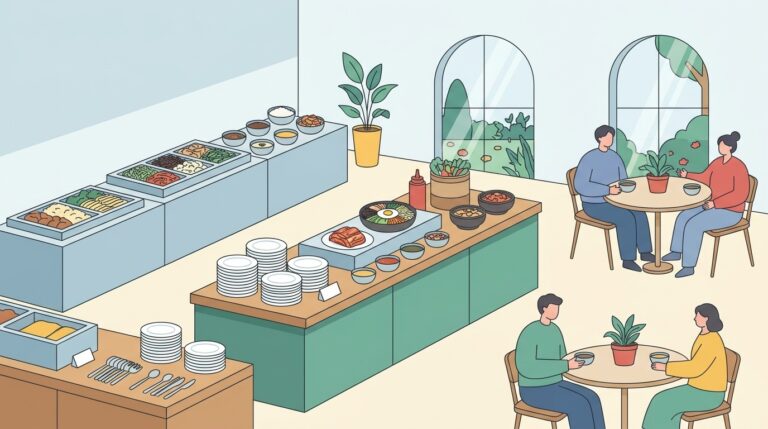
Picture this: You step into a lavish Korean buffet in Yeouido, surrounded by glistening platters of freshly sliced hoe (sashimi), marinated galbi (short ribs), steaming seafood pots, and intricate dessert towers. The price tag? Easily 80,000 KRW (around $60 USD). You grab a plate with excitement, but ten minutes later, you find yourself staring at half a bowl of carbonara pasta, three fried dumplings, and a giant roll of kimbap. Your stomach is already tight, your energy is dipping, and your Korean dining partner raises an eyebrow with a playful smirk: “벌써 배부르면 어떡해? 뽕을 뽑아야지!” (How can you already be full? You’ve got to get your money’s worth!)
Every foreign foodie visiting Korea encounters this exact buffet crisis at least once. Buffets in Korea aren’t merely places to graze casually; they are strategic battlegrounds where diners navigate the delicate balance of maximizing gaseongbi (cost-effectiveness), pacing their food sequence, and observing nuanced dining etiquette. This guide is crafted directly from real B2 learners’ dining mishaps and local foodies’ secret playbooks. By mastering these idiomatic expressions and cultural maneuvers, you won’t just avoid rookie mistakes—you’ll dine with the effortless swagger of a true Seoul insider.
Phase 2: 핵심 표현 3선 심층 분석 (Top 3 Core Expressions)
1. 뽕을 뽑다 (Ppong-eul ppopda)
- Pronunciation: [Ppong-eul ppop-da] (Think of the explosive ‘pp’ sound like popping champagne: ‘ppong’, followed by pulling out: ‘ppop-da’)
- Meaning: Literal: “To pluck mulberry shoots / extract the core essence” ➔ Pragmatic Nuance: “To get every single cent’s worth out of an investment or experience.”
- K-Culture Moment: You’ll frequently hear this line in reality shows like Running Man or food mukbang vlogs whenever cast members enter an all-you-can-eat Korean BBQ or hotel buffet. The camera zooms in on their determined faces as they proclaim, “오늘 뽕 뽑고 간다!” (We are squeezing every drop out of this place today!).
- Editor’s Insight: While originally derived from textile or game slangs, ppong-eul ppopda is the holy grail of modern consumer slang. At B2, using this phrase signals that you comprehend the competitive, high-value consumer mindset of contemporary Koreans.
- Situation Spectrum: Casual ✅ | Semi-formal ⚠️ | Formal 🚫
- 🤔 Think About It: Does your native language have an expression that equates enjoying food with recovering a financial investment? Why do you think Korean dining culture ties emotional satisfaction so closely to efficiency?
2. 페이스 조절해야 돼 (Pe-i-seu jo-jeol-hae-ya dwae)
- Pronunciation: [Pe-i-seu jo-jeol-hae-ya dwae] (English loanword ‘pace’ paired with the Sino-Korean verb 조절하다, sounding like ‘choh-jeol’)
- Meaning: Literal: “Must regulate one’s pace.” ➔ Pragmatic Nuance: “Pace yourself so you don’t burn out or fill up too early.”
- K-Culture Moment: In K-Dramas, whenever an ambitious rookie joins an expensive corporate team dinner (hoesik), a veteran colleague will tap their shoulder, wave away the side noodles, and whisper this line right before the premium Hanwoo beef arrives.
- Editor’s Insight: Korean dining is communal, but eating at a buffet is a tactical marathon. If you attack high-carb items immediately, locals will genuinely worry that your “pacing” is off. Saying this shows great dining foresight.
- Situation Spectrum: Casual ✅ | Semi-formal ✅ | Formal ⚠️
- 🤔 Think About It: In your culture, is eating slowly viewed as a health practice, or can it also be a deliberate tactical strategy like it is here?
3. 본전은 건져야지 (Bonjeon-eun geonjyeoyaji)
- Pronunciation: [Bon-jeon-eun geon-jyeo-ya-ji] (Bon-jeon rhymes with ‘con-done’; geon-jyeo sounds like ‘gun-jaw’)
- Meaning: Literal: “We must fish back the principal capital.” ➔ Pragmatic Nuance: “We have to at least break even!”
- K-Culture Moment: Heard among close colleagues, family gatherings, or student groups splitting a hefty bill. When someone hesitates to go for round three, another will nudge them: “본전은 건져야지!” while pointing directly toward the snow crab legs.
- Editor’s Insight: Bonjeon (본전) means the principal money invested. Geonjida (건지다) means to rescue or salvage something from water. Combining them produces a vivid image of salvaging your hard-earned cash from the buffet spread.
- Situation Spectrum: Casual ✅ | Semi-formal ✅ | Formal 🚫
- 🤔 Think About It: How does viewing a meal through the lens of “breaking even” alter the dining experience? Does it build camaraderie or create unnecessary pressure?
Phase 3: 교과서 한국어 vs 진짜 한국어 (Textbook vs. Real-Life Korean)
Situation 1: Expressing that you are preparing to eat an enormous quantity
- 📖 교과서 한국어: 오늘 음식을 아주 많이 먹을 것입니다. (Oneul eumsig-eul aju mani meogeul geosimnida. / I will eat very much food today.)
- 🗣️ 진짜 한국어: 오늘 바지 벨트 풀고 제대로 털어보자! (Oneul baji belteu pulgo jedaero teoreoboja! / Let’s unbuckle our belts and completely clean this place out today!)
- 💡 왜 다를까? (Why the difference?): Standard textbooks teach rigid, literal declarations of quantity. Real native speech relies on dynamic physical metaphors like loosening your belt (벨트 풀다) and playfully using the verb 털다 (literally ‘to dust off’ or colloquially ‘to loot/raid’).
Situation 2: Selecting high-value dishes over filling staples
- 📖 교과서 한국어: 저는 비싼 요리 위주로 접시에 담겠습니다. (Jeoneun bissan yori wiju-ro jeopsie damgetseumnida. / I will put mainly expensive dishes on my plate.)
- 🗣️ 진짜 한국어: 탄수화물로 배 채우지 말고, 해산물이랑 소고기로 달리자. (Tansuhwamul-lo bae chae-uji malgo, haesanmurirang sogogiro dallija. / Don’t fill your stomach with carbs; let’s sprint with seafood and beef.)
- 💡 왜 다를까? (Why the difference?): Koreans rarely speak explicitly about “expensive dishes” in direct words; instead, they specify nutrient categories (탄수화물 vs 단백질/해산물) and use energetic momentum verbs like 달리다 (to run/sprint).
Phase 4: K-Culture 딥다이브 & 비언어적 매너 (Deep-Dive & Dining Etiquette)
4-1. 눈치 (Nunchi) & Plate Clearing Etiquette
At a Korean buffet, Nunchi (social intuition) revolves around your table space and synchronized rhythm. Unlike in some Western venues where servers take plates directly from your immediate elbows, in Korea, servers quietly navigate around you. To assist them and keep the table tidy, gather your emptied plates and stack them neatly toward the outer aisle edge of the table. A slight 15-degree nod toward the server when they whisper “접시 치워드리겠습니다” (I will clear your plates) demonstrates polished manners. Furthermore, never leave a dining partner eating alone at the table while you take twenty minutes browsing dishes; coordinate your trips to maintain flowing conversation.
4-2. The Unwritten Culinary Roadmap: Cold to Hot, Light to Rich
Korean food culture is deeply rooted in digestive harmony. Going straight for heavy, sweet barbecue sauces or spicy braised meats paralyzes your taste buds. A seasoned Korean buffet strategist always follows this precise route:
1. Warm Soup/Porridge: A small bowl of Jeonbok-juk (abalone porridge) or pumpkin soup to warm up the stomach lining.
2. Cold & Fresh: Sashimi (hoe), raw beef (yukhoe), and fresh salads.
3. Warm Proteins: Grilled meats (galbi, steak), steamed seafood, and hot stir-fries.
4. Carb Accent: A bite of seasonal noodles (like cold naengmyeon) to cleanse the palate.
5. Dessert & Tea: Seasonal fruits and maesil-cha (plum tea, prized as a digestive aid).
Phase 5: 실전 롤플레이 시나리오 (Interactive Roleplay Scenario)
Setting: A premium hotel seafood & grill buffet in Gangnam, Seoul. The ambient lighting is warm, jazz plays softly, and the scent of grilled lobster fills the air.
Characters:
* 민지 (Min-ji): Your Korean foodie friend who takes buffet strategy as seriously as an Olympic sport.
* Alex (You): An intermediate Korean learner determined to show off their cultural instincts.
— Dialogue —
민지: 와, 여기 주말 디너라 그런지 라인업 장난 아니다! 알렉스, 첫 접시 뭐 담아왔어?
(Wa, yeogi jumal dineora geureonji raineop jangnan anida! Alex, cheot jeopsi mwo damawasseo?)
“Wow, maybe because it’s weekend dinner, this lineup is insane! Alex, what did you grab for your first plate?”
🎭 눈을 반짝이며 당신의 접시를 힐끔 내려다본다.
Alex: 나 배고파서 볶음밥이랑 크림 파스타 잔뜩 퍼 왔지!
(Na baegopaseo bokkeumbabirang keurim paseuta jantteuk peo watji!)
“I was starving, so I scooped up a heap of fried rice and cream pasta!”
🎭 자랑스럽게 가득 찬 탄수화물 접시를 내밀며.
민지: 헐, 안 돼! 시작부터 탄수화물 폭탄이면 어떡해? 오늘 뽕 뽑기로 했잖아.
(Heol, an dwae! Sijakbuteo tansuhwamul poktan-imyeon eotteokhae? Oneul ppong ppopgiro haetjana.)
“Gasp, no! How can you drop a carb bomb right from the start? We promised to get our money’s worth today!”
🎭 진심으로 안타까운 표정으로 가슴을 치며.
Alex: 아, 맞다! 페이스 조절을 깜빡했네. 본전은 건져야 하는데…
(A, matda! Pe-i-seu jo-jeor-eul kkamppakhaenne. Bonjeon-eun geonjyeoya haneunde…)
“Ah, right! I totally forgot to pace myself. We’re supposed to at least break even…”
🎭 머리를 긁적이며 멋쩍게 웃는다.
민지: 지금이라도 늦지 않았어. 저 접시는 천천히 두고, 일단 회 코너랑 육회부터 가자!
(Jigeum-irado neutji anasseo. Jeo jeopsineun cheoncheonhi dugo, ildan hoe koneorang yukhoe-buteo gaja!)
“It’s not too late. Leave that plate aside for now, and let’s hit the sashimi and raw beef corner first!”
🎭 집게를 집어 들며 비장하게 자리에서 일어선다.
Alex: 좋아, 위장 워밍업 끝났으니까 단백질 위주로 달린다!
(Joa, wijang warming-eop kkeutnasseunikka danbaekjil wiju-ro dallinda!)
“Awesome, stomach warm-up is done, so I’m sprinting with protein!”
🎭 빈 접시를 새롭게 집어 들며 결의에 찬 눈빛으로 답한다.
민지: 오, 역시 감 잡았네! 다 먹고 마지막에 매실차로 소화시키는 거 잊지 마.
(O, yeoksi gam jaban-ne! Da meokgo majimage maesil-charo sohwasikineun geo itji ma.)
“Oh, you’ve definitely caught the drift! Don’t forget to digest with plum tea at the end.”
🎭 엄지손가락을 척 치켜세우며.
Alex: 당연하지! 디저트 배는 따로 있으니까 걱정 마.
(Dangyeonhaji! Dijeoteu baeneun ttaro isseunikka geokjeong ma.)
“Of course! My dessert stomach is completely separate, so don’t worry.”
🎭 윙크를 하며 민지의 뒤를 바짝 따라간다.
🔀 Interactive Choice Point
You are on your third plate. You feel about 75% full, but the dessert section features a chocolate fondue fountain, while the grill station just put out fresh lamb chops. What do you do?
- Choice A: “배 터질 것 같은데 양갈비 딱 한 대만 더 먹고 끝내자!” (I’m bursting, but let’s eat just one more lamb chop and wrap up!)
- Choice B: “이제 배부르니까 국수 한 그릇 말아서 밥 먹듯이 든든하게 끝낼게.” (I’m full now, so I’ll whip up a bowl of noodles to finish hefty like a meal.)
- Choice C: “사장님, 남은 고기 포장해 주실 수 있나요?” (Boss, can you pack up this leftover meat to go?)
Feedback:
* Choice A (Best): Superb! Targeting a single high-value protein before stepping back respects your pacing and maximizes value without overloading on cheap fillers.
* Choice B (Risk): Filling your already packed stomach with noodle broth will lead to immediate food coma and undo your strategic pacing.
* Choice C (Bad): Major social blunder! Asking to box up buffet food (포장) is strictly prohibited in Korea and will cause extreme embarrassment for your party.
Phase 6: 10초 감정 섀도잉 드릴 (10-Second Emotional Shadowing Drill)
Practice reading these out loud, observing the pause marks (/) and internalizing the exact emotional state.
[🔥 비장하고 당차게 - Resolute and Determined]
“오늘 우리 / 절대 무리하지 말고 / 차근차근 뽕 뽑고 가자!”
(Oneul uri / jeoldae murihaji malgo / chageunchageun ppong ppopgo gaja!)
“Today / let’s definitely not overdo it / and systematically get our money’s worth!”-
[🤤 기대감에 가득 차서 - Thrilled and Anticipatory]
“회 코너 먼저 털고 나서 / 바로 양갈비로 / 갈아타야 돼!”
(Hoe koneo meonjeo teoreo naseo / baro yanggalbi-ro / garatayeo dwae!)
“Hit the sashimi corner first / and immediately / switch over to lamb chops!” -
[😮💨 배불러서 헐떡이며 - Panting with Satiation]
“진짜 배 터질 것 같은데… / 그래도 디저트 배는 / 따로 있지!”
(Jinjja bae teojil geot gateunde… / geuraedo dijeoteu baeneun / ttaro itji!)
“I really feel like my belly might burst… / but still, my dessert stomach / is completely separate!”
Phase 7: K-Culture 미니 사전 (Mini Dictionary)
- 뽕을 뽑다 (Ppong-eul ppopda) | To extract absolute maximum value
- Used whenever someone fully utilizes an entry fee, seasonal subscription, or buffet meal.
- 본전 (Bonjeon) | Principal cost / Breakeven threshold
- Common in phrases like 본전 생각나다 (to be reminded of how much you paid, urging you to consume more).
- 탄수화물 컷 (Tansuhwamul keot) | Cutting down carbohydrates
- A widespread tactic among young diners to skip bread, rice, and noodles to savor high-end proteins at buffets.
- 디저트 배 (Dijeoteu bae) | Separate stomach for dessert
- The universally acknowledged Korean phenomenon that sweet foods somehow activate an untapped digestive chamber.
Phase 8: 여행자를 위한 생존 키트 (Traveler’s Survival Kit)
Top 3 Survival Phrases for Buffets
- “빈 접시 치워주셔도 돼요.” (Bin jeopsi chiwojusyeodo dwaeyo.)
- “You may take away these empty plates.”
- Pro Tip: Say this with a warm smile when the server hovers near your finished stacks.
- “이용 시간제한이 어떻게 되나요?” (Iyong siganjehani eotteoke doenayo?)
- “What is the usage time limit?”
- Pro Tip: Popular Korean buffets typically enforce a strict 90-minute to 120-minute limit (이용 시간제한).
- “생수랑 탄산음료는 무료인가요?” (Saengsurang tansaneumryoneun muryoingayo?)
- “Are bottled water and soda complimentary?”
- Pro Tip: In some hotel buffets, soft drinks or alcoholic drinks are charged separately.
Editor’s Travel Note
- Descriptive Navigation Guide: When hunting for top-rated buffets, download the 캐치테이블 앱 (CatchTable App) for instant hotel and gourmet restaurant reservations, and check 네이버 지도 앱 (Naver Map App) for verified visitor reviews (내돈내산 리뷰—reviews paid with one’s own money).
- The “Environmental Fee” Rule (환경부담금): Many Korean all-you-can-eat buffets display signs threatening a 3,000–5,000 KRW 환경부담금 (environmental waste fee) if you leave excessive leftover food on your plates. While not always strictly charged, taking small, frequent portions avoids both waste and awkward confrontations.
Phase 9: “한 발 더 깊이” (Cultural Reflection)
In many Western cultures, a buffet is seen as an exercise in leisurely personal autonomy—you eat what you want, when you want. In contemporary South Korea, however, a buffet is transformed into a collaborative communal performance. Rooted in the rapid post-war modernization and hyper-competitive urban society, the concepts of gaseongbi (cost-effectiveness) and bonjeon (recouping capital) have become playful social rituals rather than mere stinginess. Sharing tactical advice with tablemates, celebrating someone’s clever plate composition, and cheering on the “final dessert sprint” reflect an endearing cultural impulse: turning every shared financial transaction into a spirited team sport.
💬 Your Turn: Have you ever felt pressure to “break even” at an all-you-can-eat restaurant? Which dish would you target first to make your Korean friend proud? Share your thoughts below in Korean or English!
Phase 10: FAQ & 오해 방지 (FAQ & Common Mistakes)
Q: Is it considered rude to leave food on your plate at a Korean buffet?
A: Leaving a few bones or vegetable garnishes is normal, but leaving whole untouched sushi rolls or half-eaten steaks is frowned upon. Korean restaurants are legally accountable for high food-waste management costs, which is why the 환경부담금 (environmental fee) policy exists. Practice taking smaller portions across multiple trips.
Q: Can I ask the staff to pack leftover buffet food into a doggy bag?
A: Absolutely not. Health inspection laws and buffet business models in Korea strictly forbid taking any buffet food outside the premises. Asking for takeout (포장해 주세요) at an all-you-can-eat venue will be flatly refused.
Q: Can I use the phrase “뽕을 뽑다” with my boss or elder in-laws?
A: Exercise caution. 뽕을 뽑다 is vivid colloquial slang. With direct superiors or elders, soften your speech by saying: “오늘 정말 알차게 잘 먹었습니다” (We ate very thoroughly and fruitfully today).
🚨 흔한 실수 (Common Mistakes) Top 3
- Piling everything onto Plate #1: You look rushed and risk cold food getting soggy. Correct Action: Treat each plate as a single course—two to three items maximum per round.
- Ignoring the tongs designated for each dish: Using the tongs from the spicy pork to grab your mild salad spreads allergens and ruins delicate flavors. Correct Action: Keep each dish’s serving utensil dedicated to its pan.
- Leaving chopsticks stuck vertically into a rice bowl: This mimics ancestral memorial offerings (Jesa). Correct Action: Always rest chopsticks horizontally on the chopstick stand or the side of your plate.
Phase 11: 액션 미션 & 참여 유도 (Action Missions)
- 🥉 Bronze Mission (Solo Practice): Stand in front of your mirror and practice saying: “오늘 페이스 조절해서 뽕 뽑고 간다!” with an energetic, playful expression three times.
- 🥈 Silver Mission (Social Connection): Next time you eat out with friends or family, take a picture of your plate and post it with the caption: “오늘의 페이스 조절 성공! (Pacing success today!)”.
- 🥇 Gold Mission (Real-world Challenge): Enter a buffet or unlimited K-BBQ (무한리필) in Korea, stack your finished plates neatly to the edge, and thank the server using: “빈 접시 치워주셔도 돼요!”
- 🎮 K-Culture Mission: Watch any episode of the Korean variety show I Live Alone (나 혼자 산다) or a mukbang video by YouTuber Heebab (히밥) and see how many times they mention the words 본전 (bonjeon) or 페이스 (pace)!
Phase 12: 인터랙티브 퀴즈 챌린지 (Interactive Quiz)
Test your grasp of today’s tactical Korean buffet knowledge!
Q1. Situation Judgment:
You are at an upscale buffet. Your friend notices you carrying a mountain of French fries and pizza slices on your very first round. Which phrase is your friend most likely to exclaim playfully?
* A) “정말 격식 있는 식사 예절이네요!”
* B) “첫 접시부터 탄수화물 폭탄이면 뽕은 언제 뽑아?”
* C) “환경부담금을 미리 내셨군요.”
Q2. Fill in the Blank:
“오늘 비싼 뷔페에 왔으니까 최소한 ______은/는 건져야지!”
(We came to an expensive buffet today, so we should at least recover our principal cost!)
Q3. True or False:
If you can’t finish the expensive braised short ribs on your table, it is acceptable in Korean buffet culture to ask the server for a doggy bag container (포장 용기). (True / False)
👉 Click here for Answers & Explanations
- Q1 Answer: B. Your friend will lament your lack of strategy! Loading up on carbs right away defeats the unspoken quest to 뽕을 뽑다 (get your money’s worth).
- Q2 Answer: 본전 (Bonjeon). 본전을 건지다 is the classic idiom for recovering your initial expenditure.
- Q3 Answer: False. Asking to take out leftover buffet food is strictly banned due to safety, hygiene regulations, and restaurant policies. Take only what you can eat!







