

Phase 1: Empathy & Storytelling Opening
안녕하세요! 매일한글 에디터입니다. (Hello! I’m your Daily Hangul editor.)
Picture this: You are seated in a sleek, glass-enclosed conference room high above Teheran-ro in Gangnam—a scene straight out of K-dramas like Agency (대행사) or Start-Up. The hum of the projector fills the room as the quarterly marketing deck flickers onto the screen. Suddenly, your executive director turns to you, fixes her gaze, and asks: “우리 브랜드의 위협 요인을 어떻게 기회로 전환할 것인가요?” (How will you convert our brand’s threat factors into opportunities?)
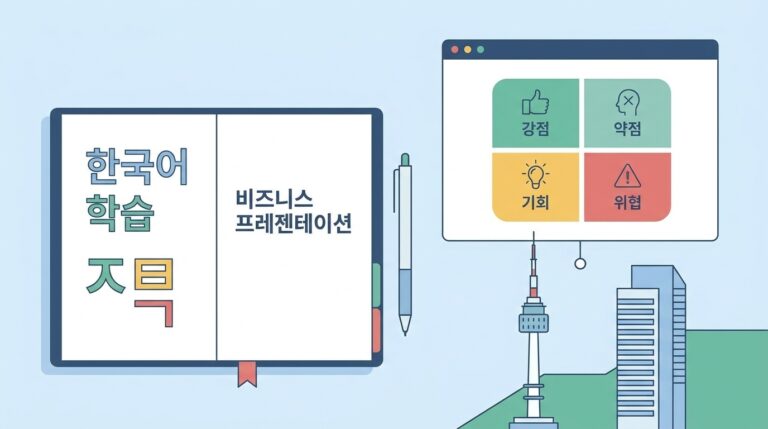
Your heart skips a beat. You know SWOT analysis inside and out. You understand Strengths, Weaknesses, Opportunities, and Threats. But in high-level Korean corporate environments, simply translating textbook words like “강점” and “위협” isn’t enough. If you speak too bluntly about weaknesses, you sound uncooperative; if you praise strengths too aggressively, you risk appearing naive and overconfident. Navigating Korean business meetings requires a refined vocabulary of diplomatic framing, strategic foresight, and cultural tact.
Over the past decade, I’ve coached dozens of global directors, product managers, and marketing leads navigating the fast-paced Korean startup and corporate landscape. Today, we will bridge the gap between academic theory and real-world boardroom fluency. By mastering these C1-level strategic formulations, you will not only articulate complex SWOT matrices with effortless sophistication, but you will also command the room and earn the trust of Korean executives.
Phase 2: Core Expressions Deep Dive
1. 약점을 보완하여 기회를 선점하다
- Pronunciation: [Yak-jeom-eul bo-wan-ha-yeo gi-hwe-reul seon-jeom-ha-da] (Pronunciation clue: Say ‘yahk-jum’ like a quick hop, ‘bo-wahn’ like smooth water, and ‘sun-jum’ with crisp emphasis)
- Meaning: Literal: “Complement weaknesses and preoccupy opportunities.” | Nuanced: To mitigate operational vulnerabilities strategically in order to capture first-mover market advantage.
- K-Culture Moment: In the hit drama Agency, advertising executive Go A-in redirects a disastrous corporate audit by pairing hidden vulnerabilities with untapped digital demographics, using this precise phrase to silence skeptics.
- Editor’s Insight: At the C1 level, avoid basic verbs like “고치다” (to fix) or “잡다” (to catch). “보완하다” signifies thoughtful enhancement rather than admitting failure, while “선점하다” conveys aggressive, tactical market dominance.
- Situation Spectrum: Casual 🚫 | Semi-formal ⚠️ | Formal ✅
- 🤔 Think About It: Notice how Korean strategic thought pairs deficit remediation (“보완”) directly with forward expansion (“선점”). How does this holistic balance reflect collective resilience compared to Western “fail-fast” paradigms?
2. 위협 요인을 돌파구로 전환하다
- Pronunciation: [Wi-hyeop yo-in-eul dol-pa-gu-ro jeon-hwan-ha-da] (Pronunciation clue: ‘We-hyeop’ like a swift whip, ‘dohl-pah-goo’ echoing through an obstacle)
- Meaning: Literal: “Convert threat factors into a breakthrough.” | Nuanced: To pivot macro industry threats into a game-changing business breakthrough.
- K-Culture Moment: Think of Itaewon Class, where Park Sae-ro-yi turns relentless corporate sabotage into viral marketing moments for his pub, DanBam.
- Editor’s Insight: “돌파구” (breakthrough) carries deep emotional resonance in Korean business. It invokes the cultural spirit of overcoming adversity through sheer grit and strategic ingenuity. Framing a risk as a “돌파구” positions you as an active problem-solver.
- Situation Spectrum: Casual ⚠️ | Semi-formal ✅ | Formal ✅
- 🤔 Think About It: Why is converting threats (“전환”) favored over merely enduring or shielding against them in hyper-competitive Korean industries?
3. 차별화된 강점으로 니치 마켓을 공략하다
- Pronunciation: [Cha-byeol-hwa-doen gang-jeom-eu-ro ni-chi ma-ket-eul gong-nyeok-ha-da] (Pronunciation clue: ‘Cha-byul-hwah’ rolled smoothly into ‘gong-nyuk’)
- Meaning: Literal: “Attack niche markets with differentiated strengths.” | Nuanced: To target underserved market segments by deploying proprietary competitive advantages.
- K-Culture Moment: In Search: WWW, the portal strategy team analyzes rival search engines and decides to dominate specialized search verticals rather than competing head-on with market giants.
- Editor’s Insight: “공략하다” originates from military strategy (to capture a fortress). In modern Korean corporate speak, it denotes focused, resource-optimized campaigns rather than reckless expansion.
- Situation Spectrum: Casual ⚠️ | Semi-formal ✅ | Formal ✅
- 🤔 Think About It: Korean commerce moves at lightning speed (“빨리빨리”). How does identifying a “니치 마켓” (niche market) reflect modern shifts away from legacy conglomerate monopolies?
Phase 3: Textbook Korean vs. Real Korean
Situation 1: Describing Corporate Strengths
- 📖 교과서 한국어: 우리 회사는 장점이 많고 단점이 적습니다. (Uri hoesaneun jangjeomi manko danjeomi jeokseumnida. / Our company has many pros and few cons.)
- 🗣️ 진짜 한국어: 자사의 독보적인 기술력을 발판 삼아 시장 지배력을 확대할 계획입니다. (Jasa-ui dokbojeogin gisullyeog-eul balpan sama sijang jibaeryeog-eul hwakdaehal gyehoeg-imnida. / We plan to leverage our proprietary technology as a springboard to expand market dominance.)
- 💡 왜 다를까?: In professional presentations, “우리 회사” is replaced by the refined humble term “자사” (our company) or “당사”. Phrases like “장점/단점” sound elementary; C1 communicators use “독보적인 기술력” (unrivaled technological edge) and metaphorical levers like “발판 삼아” (using as a springboard).
Situation 2: Addressing Severe Market Threats
- 📖 교과서 한국어: 나쁜 상황이지만 열심히 노력해서 이겨내겠습니다. (Nappeun sanghwang-ijiman yeolsimhi noryeokhaeseo igyeonaegesseumnida. / It is a bad situation, but we will work hard to overcome it.)
- 🗣️ 진짜 한국어: 대외적인 리스크 요인을 선제적으로 관리하며, 내실을 다지는 데 주력하겠습니다. (Dae-oejeogin riseukeu yoin-eul seonjejeog-euro gwanlihamyeo, naesil-eul dajineun de juryeokhagesseumnida. / We will proactively manage external risk factors while focusing on fortifying our internal foundation.)
- 💡 왜 다를까?: Calling a crisis “나쁜 상황” (bad situation) sounds overly emotional and alarming. Executives prefer analytical detachment: “대외적인 리스크” (external risks) combined with classical four-character concepts like “내실 다지기” (solidifying internal substance).
Phase 4: K-Culture Deep Dive & Non-verbal Manners
4-1. 눈치 (Nunchi) & Boardroom Body Language
During a SWOT presentation in Korea, non-verbal delivery carries equal weight to your slides:
* The Two-Handed Pointer: When gesturing toward data points on a screen or handing printouts to board members, keep your elbows close to your torso and support your right wrist lightly with your left hand. This signals deep respect and controlled intentionality.
* Reading the Room’s “온도” (Temperature): If the executive leans back and crosses their arms during your “약점” (Weaknesses) slide, do not rush to defend your stance. Acknowledge their concern immediately with a gentle nod: “우려하시는 바에 깊이 공감합니다” (I deeply empathize with your concerns). This exhibits executive-level Nunchi.
* Gaze Allocation: Avoid staring continuously down at your notes or locking eyes relentlessly with the highest-ranking officer. Shift your gaze smoothly in an arc across all team leads, returning to the key decision-maker (결정권자) at the climax of each strategic proposal.
4-2. Cultural Code: The Art of Corporate Storytelling in K-Dramas
In high-stakes series like Misaeng (미생) and Search: WWW, board presentations are never mere data dumps. They are moral and tactical narratives. Korean business culture values humility in victory and strategic accountability in crisis. When framing threats, the most celebrated strategists present themselves not as defensive excuse-makers, but as architects who see hidden paths through industry turbulence.
Phase 5: Real-world Roleplay Scenario
Setting: A sunlit, glass-paneled strategy room at “Neuron Mobility”, an autonomous driving startup in Pangyo Techno Valley.
Characters:
* Team Leader Han Min-seo (한민서 팀장): A sharp, pragmatic ex-management consultant known for grilling presenters with razor-sharp analytical questions.
* You (글로벌 전략 매니저): Lead Marketing Strategist presenting the Q4 mobility market SWOT matrix.
Dialogue:
1. 한민서 팀장: 이번 분기 모빌리티 시장 SWOT 분석 결과, 대기업의 시장 진입이 가장 위협적인 요인으로 대두되었습니다. 구체적인 대응책이 있습니까? (Ibeon bungi mobilliti sijang SWOT bunseok gyeolgwa, daegieob-ui sijang jin-ib-i gajang wihyeobjeogin yoin-euro daedudoeeossseumnida. Guchejeogin daeeungchaeg-i itsseumnikka? / In this quarter’s mobility SWOT analysis, major conglomerates entering the market emerged as our biggest threat. Do you have a concrete response plan?)
2. You: 🎭 [Confidently advancing to the strategic matrix slide] 대기업의 막강한 자본력은 위협 요인이 분명하지만, 자사의 기민한 실행력을 무기로 니치 마켓을 선점할 수 있습니다. (Daegieob-ui makganghan jabonlyeog-eun wihyeop yoin-i bunmyeonghajiman, jasa-ui giminhang silhaengryeog-eul mugiro nichi maket-eul seonjeomhal su itsseumnida. / While conglomerate capital power is certainly a threat, we can utilize our agile execution as a weapon to capture niche markets first.)
3. 한민서 팀장: 니치 마켓이라… 하지만 현재 우리 서비스는 수도권 외곽 커버리지가 취약하다는 치명적인 약점이 있지 않습니까? (Nichi maket-ira… Hajiman hyeonjae uri seobiseuneun sudogwon oegwak keobeorijiga chwiyakhadaneun chimyeongjeogin yakjeom-i itji anssumnikka? / A niche market… but doesn’t our service currently have the critical weakness of poor suburban coverage?)
4. You: 🎭 [Calmly acknowledging the point with a slight head tilt] 정확한 지적이십니다. 다만 해당 약점을 보완하기 위해 거점 중심의 마이크로 허브 전략을 수립했습니다. (Jeonghwakhan jijeog-isipnida. Daman haedang yakjeom-eul bowanhagi wihae geojeom jungsim-ui maikeuro heobeu jeonlyag-eul suriphaessseumnida. / That is an exact critique. However, to complement that weakness, we have formulated a hub-centric micro-depot strategy.)
5. 한민서 팀장: 🎭 [Leaning forward with growing interest] 거점 중심이라… 규제 샌드박스 완화라는 정부 정책 기조와도 맞물리겠군요. (Geojeom jungsim-ira… Gyuje saendeubeokseu wanhwaraneun jeongbu jeongchaek gijowado matmulligetgunyo. / Hub-centric… that would align well with the government’s regulatory sandbox easing policy.)
6. You: 🎭 [Pointing firmly to the Opportunity quadrant on screen] 바로 그 점입니다. 정책 완화 시점에 맞춰 수도권 거점 지역에 선제적으로 진입하여 진입 장벽을 구축하겠습니다. (Baro geu jeom-imnida. Jeongchaek wanhwa sijeom-e matchwo sudogwon geojeom jiyeog-e seonjejeog-euro jin-iphayeo jin-ip jangbyeog-eul guchukhagesseumnida. / That is precisely the point. By entering key suburban hubs proactively in tandem with policy easing, we will erect substantial barriers to entry.)
7. 한민서 팀장: 🎭 [Nodding slowly, tapping her notebook with a pen] 위협 요인을 영리하게 우회하면서 기회를 극대화하는 방안이네요. 설득력 있습니다. (Wihyeop yoin-eul yeongnihage u-hwehamyeonseo gihwe-reul geukdaehwahaneun bang-an-ineyo. Seoldeungnyeok itsseumnida. / It is a clever plan that circumvents threat factors while maximizing opportunities. It is convincing.)
8. You: 🎭 [Offering a polite executive bow] 경청해 주셔서 감사합니다. 세부 실행 예산안은 다음 주에 추가 보고드리겠습니다. (Gyeongcheonghae jusyeoseo gamsahamnida. Sebu silhaeng yesan-an-eun daeum jue chuga bogodeurigesseumnida. / Thank you for listening carefully. I will present the detailed execution budget next week.)
🔀 Interactive Choice Point
At Step 3, when Team Leader Han exposed your system’s suburban weakness, how should you reply if you wanted to test your instincts?
* Option A (Best): “정확한 지적이십니다. 다만 해당 약점을 보완하기 위해 거점 중심 전략으로 선회하고자 합니다.” (Politely validate the critique, immediately pivot to a calculated compensatory solution.)
* Option B (Bad): “그 약점은 어쩔 수 없습니다. 예산이 더 들어와야 해결됩니다.” (Dismissive and defensive; shifts blame onto corporate resources.)
* Option C (Risk): “대기업들도 외곽 커버리지는 다 엉망입니다.” (Aggressively attacks competitors rather than taking accountability for internal shortcomings.)
Phase 6: 10-Second Emotion Shadowing Drill
Practice matching native corporate cadence and emotional pitch using these rhythmic breathing marks (/):
[👔 차분하고 단호하게 - Calm & Resolute]
자사의 핵심 역량을 결집하여 / 시장의 불확실성을 / 정면 돌파해야 합니다.
(Jasa-ui haeksim yeoglyang-eul gyeoljib-hayeo / sijang-ui bulhwaksilseong-eul / jeongmyeon dolpahae-ya hamnida.)
Translation: We must consolidate our core competencies / and face market uncertainties / straight on.-
[🤝 공감하며 부드럽게 방어 - Diplomatic & Reassuring]
지적해주신 리스크 요인은 / 면밀한 데이터 검증을 통해 / 사전 차단하겠습니다.
(Jijeok-hae-jusin riseukeu yoin-eun / myeonmilhan de-iteo geomjeung-eul tonghae / sajeon chadan-hagesseumnida.)
Translation: As for the risk factor you pointed out / through rigorous data verification / we will preemptively neutralize it. -
[🚀 비전 제시로 당당하게 - Inspiring & Visionary]
규제 완화라는 절호의 기회를 / 선점하여 / 업계 1위의 입지를 굳히겠습니다.
(Gyuje wanhwa-raneun jeolho-ui gihwe-reul / seonjeom-hayeo / eopgye il-wi-ui ipji-reul guthigesseumnida.)
Translation: By seizing / this golden opportunity of deregulation / we will solidify our position as industry number one.
Phase 7: K-Culture Mini Dictionary
- 선제적 대응 (Seonjejeok daeeung) | Proactive / Preemptive response
In Korean business circles, reacting after a crisis occurs is considered a failure of foresight. Taking “선제적 대응” proves you anticipated regulatory changes or competitive maneuvers weeks in advance. - 내실 다지기 (Naesil dajigi) | Consolidating internal fundamentals
Derived from classical expressions, this means prioritizing financial health, process optimization, and team retention rather than chasing reckless top-line growth. - 돌파구 마련 (Dolpagu maryeon) | Securing a strategic breakthrough
Used whenever an impasse (교착 상태) arises. Proposing a “돌파구” positions your SWOT strategy as the decisive turning point for company morale. - 포지셔닝 재정립 (Pojisheoning jaejeongnip) | Repositioning strategic brand stance
A high-frequency corporate phrase used when an established product faces market saturation and needs a fresh consumer identity.
Phase 8: Professional Survival Kit
Top 3 Boardroom Phrases
- 이 부분은 추가 검토 후 보고드리겠습니다.
(I bubun-eun chuga geomto hu bogodeurigesseumnida.)
Pro Tip: Never guess an answer in a Korean board meeting if you lack data. Use this phrase to buy time with supreme professionalism. - 말씀해주신 맥락을 충분히 이해하고 있습니다.
(Malsseum-hae-jusin maengnag-eul chungbunhi ihae-hago itsseumnida.)
Pro Tip: Say this before offering a counter-proposal to soften disagreement and show absolute respect for senior hierarchy. - 상충되는 요인을 조율하여 최적의 안을 도출하겠습니다.
(Sangchungdoeneun yoin-eul joyulhayeo choejeog-ui an-eul dochulhagesseumnida.)
Pro Tip: The ultimate C1 mediator line when two department directors clash over Strengths vs Threats.
Editor’s Professional Note
When traveling to meetings across Pangyo Techno Valley or Gangnam, download the Naver Map app download for business routes to calculate precise walking times across sprawling tech campuses. Always carry pristine physical business cards (명함) in an aluminum or leather case; handing over a card with both hands while giving a 15-degree bow sets a foundation of trust before your SWOT presentation even begins.
Phase 9: “One Step Deeper” (Reflective Cultural Essay)
In Western business cultures influenced by direct rhetoric, presenting a SWOT analysis often feels like a debate: you champion your strengths unapologetically and treat weaknesses as minor hurdles to be dismissed. However, in Korean corporate discourse, a presentation is fundamentally a ritual of communal calibration. Korean executives value 겸양 (modest self-awareness) alongside bold ambition. When a presenter openly articulates internal weaknesses using analytical grace, it demonstrates organizational honesty and maturity. True authority in a Korean boardroom does not stem from claiming you are invulnerable; it emerges when you prove that you have mapped every vulnerability, respected every potential threat, and prepared an honorable path to collective victory.
💬 Your Turn: Have you ever presented a project review or business pitch in Korean? What was the hardest balance to strike between confidence and professional humility? Share your thoughts below!
Phase 10: FAQ & Misconception Buster
Q: Should I translate SWOT literally as ‘강점, 약점, 기회, 위협’ in slide decks?
A: While those terms are standard in academic textbooks, modern Korean tech and marketing decks frequently write the acronym SWOT directly in English on slide titles. In spoken Korean, you should use terms like “강점” and “보완점” (areas for improvement) rather than excessively repeating the harsh-sounding word “약점”.
Q: How do I disagree with an executive’s evaluation of a market threat?
A: Never say “틀렸습니다” (You are wrong) or “제 생각은 다릅니다” (My thought is different) outright. Instead, couch your counterpoint diplomatically: “대표님께서 우려하시는 리스크에 전적으로 공감합니다. 다만, 최근 데이터 추이를 살펴보면 다른 각도에서의 기회 요인도 상존하고 있습니다.” (I fully understand the risk you are concerned about. However, recent data trends indicate an opportunity also coexists from another angle.)
Q: Can I use buzzwords like ‘피벗’ (Pivot) or ‘BM’ (Business Model) in traditional corporations?
A: In tech hubs like Pangyo, Seongsu, and Teheran-ro, Konglish terms like 피벗 (pivot), BM (business model), and 핏 (market fit) are universally accepted. However, when presenting to conservative manufacturing or public sector clients, replace them with authentic Korean equivalents: “사업 방향 전환” (pivot) and “수익 모델” (BM).
🚨 Common Mistakes Alert
- Mistake: Using “우리 회사” during formal board presentations.
Correct Action: Use 자사 (when comparing your firm against rivals) or 당사 (in contractual/formal corporate statements). - Mistake: Translating Weaknesses as “문제점” (problems).
Correct Action: Frame them as 보완 과제 (tasks to supplement) or 리스크 요인 (risk factors). - Mistake: Saying “모르겠습니다” (I don’t know) when faced with an unexpected question.
Correct Action: Say “해당 지표는 추가 확인 후 즉시 업데이트해 드리겠습니다.” (I will verify that specific metric and update you immediately.)
Phase 11: Action Mission & Engagement
- 🥉 Bronze Level: Stand before a mirror and practice the 3 emotion shadowing drills from Phase 6, focusing on controlled breathing and two-handed presentation posture.
- 🥈 Silver Level: Write a 2-sentence SWOT summary of your favorite brand (e.g., Netflix, Samsung, or your local coffee shop) in Korean using the formula:
[약점]을 보완하여 [기회]를 선점하다. - 🥇 Gold Level: Share your Korean SWOT summary on LinkedIn or in the comments section below, tagging a colleague or language partner for collaborative feedback.
- 🎮 K-Culture Mission: Watch an episode of the drama Agency (대행사) or Start-Up (스타트업). Spot at least one scene where characters pitch to investors or clients, and note how they introduce market risks without losing poise.
Phase 12: Interactive Quiz Challenge
1. Situational Judgment:
During a marketing meeting, an executive asks how you will handle a major rival copying your key product feature. Which response best exhibits C1-level strategic diplomacy?
* A) “어쩔 수 없으니 가격을 대폭 인하하겠습니다.” (We can’t help it, so we’ll drastically cut prices.)
* B) “자사의 독보적인 브랜드 팬덤을 바탕으로 차별화 전략을 공고히 하겠습니다.” (Based on our proprietary brand fandom, we will solidify our differentiation strategy.)
* C) “경쟁사가 불법 행위를 저지른 것이니 고소해야 합니다.” (The competitor committed an illegal act, so we must sue them.)
Click here for Answer & Explanation
Correct Answer: B
Explanation: Option B reflects executive-level strategic framing. It highlights internal resilience (“독보적인 브랜드 팬덤”), utilizes the sophisticated construction “바탕으로”, and commits to actionable differentiation (“차별화 전략을 공고히 하겠습니다”). Option A exhibits panic, while Option C is legally presumptuous and emotionally volatile.
2. Fill-in-the-Blank:
Fill in the missing word for this high-level boardroom sentence:
“급변하는 시장 환경 속에서 대외적인 리스크를 극복하고, 새로운 (________)를 마련해야 합니다.”
* A) 돌파구 (Breakthrough)
* B) 장바구니 (Shopping basket)
* C) 눈치 (Social tact)
Click here for Answer & Explanation
Correct Answer: A (돌파구)
Explanation: The collocation “돌파구를 마련하다” (to secure a strategic breakthrough) is the hallmark of C1 strategic Korean. It perfectly complements “리스크를 극복하다” (overcoming risk).
3. True or False Culture Check:
In Korean corporate SWOT presentations, admitting any weakness about your project is considered disrespectful and shows incompetent leadership.
Click here for Answer & Explanation
Correct Answer: False
Explanation: Honest acknowledgment of weaknesses—when paired with constructive counter-strategies (“보완책”)—demonstrates deep maturity (내실) and builds profound trust with Korean stakeholders.







