

How to Call Out a K-Pop Agency Like a Fluent Korean Fan
Phase 1: Empathy & Story Opening
안녕하세요! 매일한글 에디터입니다. (Hello! I’m your Daily Hangul editor.)
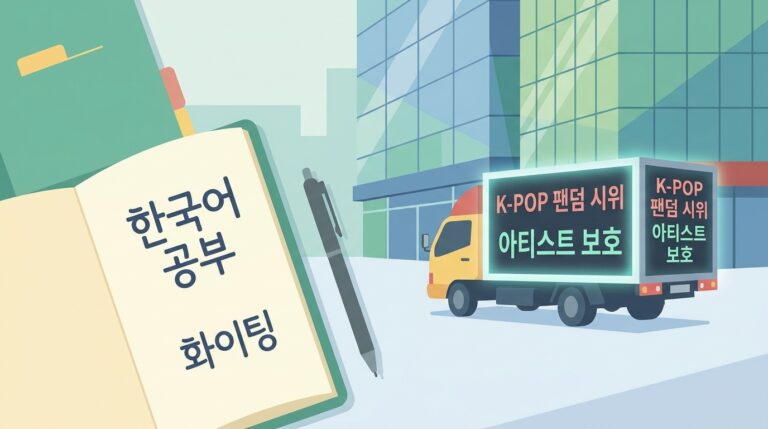
Picture this: It is midnight in Seoul. You refresh Weverse or X (formerly Twitter), only to discover that your ultimate bias has collapsed from exhaustion after back-to-back world tour dates. Instead of a thoughtful medical update, the agency drops a cold, two-line notice stating the idol will “sit out the next fan meeting due to poor condition.” Your international timeline is on fire with broken-heart emojis and furious English caps lock. Meanwhile, your Korean mutuals are mobilizing: they are drafting formal communiqués (성명문), trending laser-focused hashtags, and even organizing billboard trucks to park directly outside the entertainment headquarters in Gangnam or Mapo.
You desperately want to stand in solidarity, but your translator app keeps turning your passionate defense into either an accidental compliment or an overly aggressive insult that violates community guidelines. Sound familiar? Over the past five years mentoring global fans at Daily Hangul, the number one frustration B2 learners share is feeling linguistically powerless when it comes to defending their idols. Today, we are upgrading your vocabulary from helpless observer to articulate advocate. By the end of this guide, you will be able to express sharp, persuasive, and culturally sophisticated criticism of entertainment management—just like a seasoned Korean fandom organizer.
Phase 2: 3 Core Expressions in Depth
Here are three B2-level power phrases that Korean fans rely on to demand corporate accountability.
1. 아티스트 보호에 최선을 다해 주세요
- Pronunciation: [A-ti-seu-teu bo-ho-e choe-seon-eul da-hae ju-se-yo] (Think: Ah-tee-seu-teu bo-ho-eh chweh-sun-eul dah-heh joo-seh-yoh)
- Meaning: Literal: “Please do your best in artist protection.” | Nuance: “Your primary job is the safety and well-being of the artist—stop neglecting it.”
- K-Culture Moment: Seen as the signature closing sentence in fan statements on Weverse or fan cafe posts whenever rumors, sasaengs (stalkers), or health issues are mishandled.
- Editor’s Insight: Using “아티스트” (artist) rather than “가수” (singer) or “아이돌” (idol) elevates the performer’s status to a respected professional creative, putting psychological pressure on management.
- Situation Spectrum: Casual: ⚠️ | Semi-formal: ✅ | Formal: ✅
- 🤔 Think About It: In your home country, do fans hold management corporations directly responsible for a celebrity’s private safety and mental health, or is management viewed purely as business booking?
2. 늑장 대응 말고 제대로 된 피드백을 요구합니다
- Pronunciation: [Neuk-jang dae-eung mal-go je-dae-ro doen pi-deu-bae-geul yo-gu-ham-ni-da] (Think: Nook-jahng deh-oong mahl-go jeh-deh-ro dwen pee-deu-behk-eul yo-goo-hahm-nee-dah)
- Meaning: Literal: “We demand proper feedback, not a belated response.” | Nuance: “Stop stalling with PR fluff; give us transparent, timely answers right now.”
- K-Culture Moment: Displayed in bright red LED text on electronic protest trucks parked outside agency headquarters during controversy.
- Editor’s Insight: “늑장 대응” (delayed countermeasure / foot-dragging) is an impactful media-grade compound noun. Pairing it with “요구합니다” (we demand) shows that the fandom sees itself as an active stakeholder, not a passive consumer.
- Situation Spectrum: Casual: 🚫 | Semi-formal: ⚠️ | Formal: ✅
- 🤔 Think About It: Why does Korean fan culture place such an extreme value on speed of corporate feedback compared to Western celebrity controversies?
3. 소속사의 안일한 태도를 규탄합니다
- Pronunciation: [So-sok-sa-ui an-il-han tae-do-reul gyu-tan-ham-ni-da] (Think: Soh-sohk-sah-eui ahn-eel-hahn teh-doh-reul gyoo-tahn-hahm-nee-dah)
- Meaning: Literal: “We condemn the agency’s complacent attitude.” | Nuance: “Your laziness and negligence are unacceptable, and we are holding you publicly accountable.”
- K-Culture Moment: The bold headline of formal joint boycott announcements or press releases issued by unionized fan coalitions (총괄팬덤연합).
- Editor’s Insight: “규탄하다” is a heavyweight civic-protest verb meaning “to denounce” or “to condemn.” When international fans use this word, Korean fans immediately recognize high linguistic competence.
- Situation Spectrum: Casual: 🚫 | Semi-formal: ⚠️ | Formal: ✅
- 🤔 Think About It: Notice how Korean fandom adapts language from political and civic activism into entertainment discourse. What does this reveal about fan agency?
Phase 3: Textbook Korean vs. Real Korean
When textbook Korean sounds too robotic or misses the emotional gravity of the situation, native fans switch to these natural variations.
Situation 1: Calling out slow and useless agency statements
- 📖 교과서 한국어: 소속사의 발표가 너무 늦어서 화가 납니다. (So-sok-sa-ui bal-pyo-ga neo-mu neu-jeo-seo hwa-ga nam-ni-da / The agency’s announcement is too late, so I am angry.)
- 🗣️ 진짜 한국어: 피드백이 이렇게 느려서야 어디 믿고 응원하겠어요? (Pi-deu-bae-gi i-reoh-ge neu-ryeo-seo-ya eo-di mit-go eung-won-ha-gess-eo-yo? / If your feedback is this slow, how can we trust you and keep supporting the artist?)
- 💡 왜 다를까? Simply saying “I am angry” sounds childish. Real B2 Korean uses rhetorical questions ending in
-겠어요?to expose corporate failure while maintaining dignity.
Situation 2: Criticizing poor schedule planning and artist overwork
- 📖 교과서 한국어: 스케줄이 너무 많으니 일정을 줄여주세요. (Seu-ke-jyu-ri neo-mu man-eu-ni il-jeong-eul ju-ryeo-ju-se-yo / There are too many schedules, so please reduce the schedule.)
- 🗣️ 진짜 한국어: 무리한 살인 스케줄 당장 전면 재검토하세요. (Mu-ri-han sal-in seu-ke-jyu-ri dang-jang jeon-myeon jae-geom-to-ha-se-yo / Immediately conduct a full review of this unreasonable, killer schedule.)
- 💡 왜 다를까? Fandoms frame overworking not as a minor inconvenience, but as an existential threat. The colloquial term “살인 스케줄” (killer schedule) creates urgent moral pressure on management.
Phase 4: K-Culture Deep Dive & Non-Verbal Manners
4-1. Fandom Nunchi (눈치) & Strategic Manners
When challenging a multi-million-dollar entertainment conglomerate in Korea, how you say it matters just as much as what you say.
* Avoid Informal Slander: Writing emotional insults like “대표 바보” (CEO is stupid) does not hurt the agency—it hurts your idol’s brand value and opens you up to cyber-defamation reports.
* Adopt the Civic Voice: Korean fans intentionally write in strict formal honorifics (하십시오체 or -해 주시기 바랍니다). By speaking with legalistic precision, you strip the agency of excuses to dismiss fan concerns as “immature whining.”
* Hashtag Cleanliness: Never tag the idol’s personal social handles in protest posts. Keep corporate criticism directed toward the official label account (@회사_Official) so the idol does not absorb unnecessary online hostility.
4-2. Cultural Code Analysis: The “Fandom as Guardians” Phenomenon
In Western music industries, managers are seen as agents hired by the musician. In K-Pop, however, the idol is an employee bound to an exclusive contract, and the entertainment company holds virtually all administrative, legal, and creative power. Because of this asymmetry, Korean fans view themselves not merely as consumers buying music, but as the sole protective barrier (울타리) shielding the artist from corporate exploitation. This explains why protests feature sophisticated tools like dispatching LED protest trucks to agency lobbies, posting physical wreath stands (화환), and crowdfunding legal consultations.
Phase 5: Real-Life Roleplay Scenario
Setting: A quiet cafe across from the agency building in Yongsan, Seoul. You are sitting with Min-ji (민지), a veteran Korean fanbase coordinator, reviewing the draft of a collaborative joint statement regarding the group’s canceled health break.
- 민지 (Min-ji): [심각한 표정으로 서류를 건네며 / 🎭 Seriously handing over the statement draft]
해외 팬분들 서명도 다 모였어요. 이번 입장문 문구 한번 확인해 주실래요?
(Hae-oe paen-bun-deul seo-myeong-do da mo-yeoss-eo-yo. I-beon ip-jang-mun mun-gu han-beon hwag-in-hae ju-sil-lae-yo?)
“We have gathered all the signatures from international fans. Could you check the wording for this statement?” -
학습자 (You): [안경을 고쳐 쓰며 / 🎭 Adjusting your glasses]
네, 바로 볼게요. 소속사의 무성의한 태도에 대한 비판이 핵심이죠?
(Ne, ba-ro bol-ge-yo. So-sok-sa-ui mu-seong-ui-han tae-do-e dae-han bi-pan-i haek-sim-i-jyo?)
“Yes, I’ll read it right away. The main point is criticizing the agency’s insincere attitude, right?” -
민지 (Min-ji): [한숨을 쉬며 / 🎭 Sighing]
맞아요. 아티스트 건강이 무너지고 있는데 회사만 모른 척하고 있어요.
(Maj-a-yo. A-ti-seu-teu geon-gang-i mu-neo-ji-go iss-neun-de hoe-sa-man mo-reun cheok-ha-go iss-eo-yo.)
“Exactly. The artist’s health is deteriorating, but the company is pretending not to notice.” -
학습자 (You): [형광펜으로 특정 문장을 짚으며 / 🎭 Pointing at a specific line with a highlighter]
여기 ‘책임 있는 공식 입장을 표명하라’는 표현이 아주 명확하네요.
(Yeo-gi ‘chaek-im iss-neun gong-sik ip-jang-eul pyo-myeong-ha-ra’-neun pyo-hyeon-i a-ju myeong-hwag-ha-ne-yo.)
“Here, the phrasing ‘Express a responsible official stance’ is very clear.” -
민지 (Min-ji): [고개를 끄덕이며 / 🎭 Nodding]
내일 오전 9시에 트럭 시위도 동시에 시작할 예정이에요. 해시태그 총공도 맞춰야 해요.
(Nae-il o-jeon gu-si-e teu-reok si-wi-do dong-si-e si-jak-hal ye-jeong-i-e-yo. Hae-si-tae-geu chong-gong-do mat-chwo-ya hae-yo.)
“The protest truck will also start tomorrow at 9 AM sharp. We need to align the hashtag mass coordination.” -
학습자 (You): [단호한 눈빛으로 / 🎭 With a firm gaze]
글로벌 팬덤 연합에도 공지 올려서 같은 시간에 화력을 모으겠습니다.
(Geul-lo-beol paen-deom yeon-hab-e-do gong-ji ol-lyeo-seo gat-eun si-gan-e hwa-ryeog-eul mo-eu-gess-seum-ni-da.)
“I will post announcements across our global fan coalition to concentrate our posting firepower at the same time.” -
민지 (Min-ji): [감동한 미소를 지으며 / 🎭 Giving a touched smile]
고마워요! 국내외 팬들이 한목소리를 내야 소속사가 움직이니까요.
(Go-ma-wo-yo! Guk-nae-oe paen-deur-i han-mok-so-ri-reul nae-ya so-sok-sa-ga um-jig-i-ni-kka-yo.)
“Thank you! The agency will only budge when domestic and international fans speak with one unified voice.” -
학습자 (You): [주먹을 불끈 쥐며 / 🎭 Clenching a fist playfully yet resolutely]
더 이상 아티스트를 방치하지 못하게 끝까지 지켜봅시다.
(Deo i-sang a-ti-seu-teu-reul bang-chi-ha-ji mot-ha-ge kkeut-kka-ji ji-kyeo-bop-si-da.)
“Let us see this through to the end so they can no longer neglect the artist.”
🔀 Interactive Choice Point
Now Min-ji asks you: “What headline should we print on the agency protest truck’s digital display screen?”
- Choice A: 야 소속사 너네 미쳤냐? 당장 사과해! (Hey agency, are you crazy? Apologize right now!)
- Choice B: 아티스트 혹사 중단하고 책임 있는 대책을 제시하라. (Halt artist overwork and present responsible countermeasures.)
- Choice C: 이번 일은 좀 아쉽지만 그래도 소속사를 응원합니다. (This incident is a bit regrettable, but we still support the agency.)
Consequence Feedback:
* Choice A (Risk): Using aggressive banmal (너네 미쳤냐) gets dismissed instantly by the company’s legal department and makes news journalists paint the fandom as toxic.
* Choice B (Best): Perfectly strikes the B2 formal activist register. It is legally sound, focused on artist protection, and authoritative.
* Choice C (Bad): Passive and apologetic. Management will interpret this as “fans will buy merchandise anyway,” nullifying the entire protest.
Phase 6: 10-Second Emotion Shadowing Drill
Practice reading these lines out loud. The slashes / indicate brief pauses for cadence.
- [😤 단호하고 정중하게 / Firmly and politely]
소속사는 / 아티스트의 건강을 최우선으로 고려하여 / 스케줄을 조정해 주시기 바랍니다.
(So-sok-sa-neun / a-ti-seu-teu-ui geon-gang-eul choe-u-seon-eu-ro go-ryeo-ha-yeo / seu-ke-jyu-reul jo-jeong-hae ju-si-gi ba-ram-ni-da.) -
[🔥 답답하지만 논리적으로 / Frustrated yet logical]
납득할 수 없는 해명 대신 / 재발 방지를 위한 / 구체적인 계획을 발표하십시오.
(Nap-deuk-hal su eopt-neun hae-myeong dae-sin / jae-bal bang-ji-reul wi-han / gu-che-jeog-in gye-hoek-eul bal-pyo-ha-sip-si-o.) -
[🛡️ 흔들림 없이 당당하게 / Confident and protective]
우리는 소비자가 아닌 / 아티스트의 든든한 동반자로서 / 끝까지 책임을 묻겠습니다.
(U-ri-neun so-bi-ja-ga a-nin / a-ti-seu-teu-ui deun-deun-han dong-ban-ja-ro-seo / kkeut-kka-ji chaeg-im-eul mut-gess-seum-ni-da.)
Phase 7: K-Culture Mini Dictionary
Expand your fandom literacy with these four essential cultural terms:
- 입장문 (Ip-jang-mun) | Official Statement / Communiqué
- Everyday/Fandom Usage: A formal written declaration issued either by an entertainment company explaining a scandal or by a fan union listing their demands.
- 트럭 시위 (Teu-reok Si-wi) | LED Truck Protest
- Everyday/Fandom Usage: Renting small commercial trucks with high-definition digital screens to circle agency offices on loop, broadcasting protest slogans during work hours.
- 총공 (Chong-gong) | Coordinated Action (Mass Campaign)
- Everyday/Fandom Usage: Short for “총공격” (all-out offensive). Refers to fan communities synchronizing digital actions—such as streaming, reporting malicious accounts, or trending specific hashtags at a scheduled minute.
- 늑장 대응 (Neuk-jang Dae-eung) | Belated Countermeasure (Delayed Action)
- Everyday/Fandom Usage: Widely used in journalism and fan circles to describe a company waiting days or weeks to address an urgent crisis, allowing damaging rumors to fester.
Phase 8: Traveler’s Survival Kit
If you find yourself near agency buildings (like HYBE in Yongsan, SM in Seongsu, or JYP in Gangdong) during a fandom campaign, keep these tools handy.
Survival Expressions TOP 3
- 혹시 오늘 트럭 시위 위치가 어디인가요?
- Romanization: Hok-si o-neul teu-reok si-wi wi-chi-ga eo-di-in-ga-yo?
- Pro Tip: Useful if you are meeting fellow international fans to take photos of protest billboards for online visibility.
- 아티스트 보호 성명서 현장 배부처가 여기인가요?
- Romanization: A-ti-seu-teu bo-ho seong-myeong-seo hyeon-jang bae-bu-cheo-ga yeo-gi-in-ga-yo?
- Pro Tip: Use this to locate fan organizers passing out physical flyers or protest slogans near subway stations.
- 소속사 건물 앞 질서를 지켜주세요.
- Romanization: So-sok-sa geon-mul ap jil-seo-reul ji-kyeo-ju-se-yo.
- Pro Tip: Polite phrase used to remind fellow fans to keep pedestrian walkways clear so security or police do not shut down fan demonstrations.
Editor’s Travel Note
- Navigation: Never use Google Maps for walking routes in Korea. Find the exact locations of agency hubs and protest truck staging spots with the Naver Map app download for iOS and Android. It displays accurate building entrances and bus routes.
- Community Etiquette: Always verify information via the Weverse official community notice board or the group’s verified Daum Fan Cafe. Do not film company staff entering or exiting through security gates, as Korea has strict personal portrait and privacy laws (초상권).
Phase 9: One Step Deeper
Korean fandom power operates on what sociologists call “participatory consumer sovereignty.” In Korea, supporting an idol group is rarely a distant spectator sport; it is an active emotional and financial partnership. Fans invest staggering amounts of time, voting effort, and financial capital into album buying and streaming numbers to help their groups climb the charts. Consequently, when management compromises the artist’s health or reputation, the collective fandom asserts its moral authority not as entitled consumers, but as protective guardians. Understanding this high-context collective mindset helps you realize that speaking out isn’t “hating the company”—in Korean fandom culture, constructive critique is the ultimate form of loyalty.
💬 Your Turn: Have you ever disagreed with an agency’s handling of your favorite artist? How did the international fandom react versus the Korean fandom? Drop your thoughts below in Korean or English!
Phase 10: FAQ & Avoiding Misunderstandings
Q: Can I use informal speech (반말) when sending protest templates to an agency on social media?
A: Absolutely not. Agencies routinely ignore informal or emotionally abusive posts. High-impact statements are always drafted in formal honorifics (하십시오체 or -기 바랍니다), which force the agency’s PR and legal teams to treat the communication as legitimate stakeholder feedback.
Q: What is the difference between “소명하다” and “해명하다” in agency criticism?
A: “해명하다” (hae-myeong-ha-da) means to clarify facts or dispel misunderstandings. “소명하다” (so-myeong-ha-da) carries a stronger, almost legal obligation to prove innocence or justify an action with evidence. Asking an agency to “소명하라” signals much deeper scrutiny.
Q: Does participating in truck protests or hashtag campaigns make me look toxic in Korea?
A: Not if the cause is legitimate (such as artist health, sasaeng safety, or unfair discrimination). In modern Korean pop culture, coordinated fan demonstrations are viewed as standard consumer activism, provided they follow public assembly laws and remain respectful.
🚨 Common Mistakes Warning Board
- Calling the idol’s management company “사장님” (Boss):
- Wrong: 사장님 일 똑바로 하세요 (Boss, do your work properly).
- Correct Action: Address the corporate body as a whole: “소속사” (agency) or “소속사 경영진” (agency management/board).
- Translating “We are boycotting” literally with Google Translate:
- Wrong: 우리는 보이콧을 하고 있습니다.
- Correct Action: Use natural corporate-protest Korean: “소비자 불매 운동에 돌입하겠습니다” (We will enter a consumer boycott movement).
- Tagging the idol directly in protest threads:
- Wrong: Tagging
@IdolMemberto show them the truck photos. - Correct Action: Keep all hashtags and mentions strictly targeted at the official management handle (
@Company_Official), safeguarding the idol’s mental peace.
- Wrong: Tagging
Phase 11: Action Missions & Community
Ready to put your new vocabulary to the test? Complete these three missions:
- 🥉 Bronze Mission (Solo Practice): Read the Phase 6 shadowing drill out loud three times while recording your voice. Focus on pausing cleanly at the slash marks
/. - 🥈 Silver Mission (Social Media Application): Find an ongoing fan discussion on Weverse or X. Draft a polite, 2-sentence response demanding artist protection using “아티스트 보호에 최선을 다해 주세요”.
- 🥇 Gold Mission (Real-Time Translation Support): Find a Korean fan union’s official statement (성명문). Identify at least three terms from this guide (e.g., 늑장 대응, 입장문, 안일한 태도) and summarize the core demand for international fans in your own words.
🎮 K-Culture Mission: Search the Korean phrase 소속사 피드백 촉구 (Urging agency feedback) on YouTube or X. Observe how Korean news outlets cover fandom LED truck protests and notice the formal vocabulary used on the digital screens!
Phase 12: Interactive Quiz Challenge
Test your mastery before you take on the agency PR department!
- Situational Judgment: Your favorite idol group was injured during stage rehearsals due to faulty equipment. Which slogan is best suited for a formal fan coalition banner?
- A) 회사 진짜 노답이네, 대표님 나와라! (Company is totally hopeless, CEO come out!)
- B) 무책임한 안전 관리 규탄하며, 재발 방지 대책을 촉구합니다. (We condemn irresponsible safety management and urge countermeasures to prevent recurrence.)
- C) 다쳐서 너무 슬퍼요. 빨리 낫길 바랍니다. (I’m so sad they got hurt. I hope they recover quickly.)
- Fill in the Blank:
사건 발생 일주일이 지나도록 아무런 조치를 취하지 않는 소속사의 ( ) 대응을 비판합니다.- (Hint: Compound noun meaning “delayed response” / “foot-dragging”)
- True or False Cultural Quiz:
In Korean fandom culture, writing an official statement using polite formal honorifics (하십시오체) is considered weak and ineffective compared to using angry slang.- [True / False]
👉 Click to view answers and explanations!
- Answer: B
- Explanation: Choice B uses formal civic vocabulary (“규탄하며”, “재발 방지 대책을 촉구합니다”), demonstrating authoritative public critique. Choice A is too childishly informal, and Choice C merely expresses sympathy without demanding accountability.
- Answer: 늑장 (늑장 대응)
- Explanation: “늑장 대응” is the exact phrase used across Korean fan protests and news headlines to describe irresponsible foot-dragging by an agency.
- Answer: False
- Explanation: Quite the opposite! Formal honorifics give the fandom legal and rhetorical authority, ensuring management and the press take the demands seriously rather than dismissing them as juvenile outbursts.
- Explanation: Quite the opposite! Formal honorifics give the fandom legal and rhetorical authority, ensuring management and the press take the demands seriously rather than dismissing them as juvenile outbursts.







