

안녕하세요! 매일한글 에디터입니다.
Have you ever walked through the bustling streets of Seoul during the freezing depths of winter and noticed steam rising from a quiet alley behind a historic building? If you followed that aroma of warm radish soup, chances are you stumbled upon an unexpected sanctuary: a Buddhist temple or a Catholic parish running a community soup kitchen (무료 급식소 – muryo geupsikso). Many of our advanced learners tell me, “I know how to say ‘temple’ or ‘church’ in Korean, but when I want to discuss their deep involvement in democracy, disaster relief, or poverty alleviation, I suddenly feel like my vocabulary shrinks back to beginner level!”
It is completely natural to feel stuck. In standard textbooks, religious institutions are introduced merely through static architectural nouns like 절 (jeol, Buddhist temple) or 교회 (gyohoe, church). Yet in modern South Korea, religious spaces act as living, breathing shock absorbers of rapid modernization. Understanding how to articulate their civic contributions will elevate your Korean from merely transactional speech to deep, intellectually rewarding conversations with native speakers. This comprehensive guide draws directly from real feedback and field interviews to give you the exact linguistic toolkit you need.
1. 구호 활동을 펼치다 (Guho hwaldong-eul pyeolchida)
- Pronunciation: [Gu-ho hwal-dong-eul pyeol-chi-da] (Think of Gu-ho as an emergency life raft, and pyeol-chida sounds like opening an umbrella wide to shield someone).
- Meaning: Literally “to unfold relief activities” vs. actually “to actively mobilize and execute proactive humanitarian relief.”
- K-Culture Moment: In disaster dramas or medical human documentaries, when devastating floods or wildfires hit provincial towns, you will hear news anchors and community leaders state how temples and churches promptly organized supplies: “종교계가 앞장서서 구호 활동을 펼치고 있습니다.” (Jonggyogyega apjangseoseo guho hwaldong-eul pyeolchigo itseumnida. / Religious circles are taking the lead in executing relief operations.)
- Editor’s Insight: While 봉사하다 (bongsahada) means general volunteering, 구호 활동을 펼치다 conveys an organized, systemic deployment of emergency food, medical supplies, and shelter during critical crises.
- Situation Spectrum: Casual: ⚠️ | Semi-formal: ✅ | Formal: ✅
- 🤔 Think About It: In your home country, is disaster relief predominantly seen as a state responsibility, or do civic and spiritual communities naturally take the front line as they often do in Korean civil society?
2. 마지막 보루가 되어주다 (Majimak boru-ga doeeojuda)
- Pronunciation: [Ma-ji-mak bo-ru-ga doe-eo-ju-da] (Boru sounds like a sturdy rampart or stone barricade holding back a storm).
- Meaning: Literally “to become the last fortress/bastion” vs. actually “to serve as the final haven of protection for vulnerable or displaced citizens.”
- K-Culture Moment: Mentioned extensively in modern Korean history documentaries and political period dramas covering the 1970s and 1980s democratization movements, where Myeongdong Cathedral and major urban temples offered physical sanctuary to student activists and striking workers when state power closed in.
- Editor’s Insight: Use this expression when you want to highlight the profound moral and structural protection religious facilities provide against systemic failures or social isolation.
- Situation Spectrum: Casual: ⚠️ | Semi-formal: ✅ | Formal: ✅
- 🤔 Think About It: Why do you think a secularized, hyper-modern society still relies on sacred grounds to uphold moral safety nets when formal legal channels fall short?
3. 마음의 안식처를 제공하다 (Maeum-ui ansikcheo-reul jegonghada)
- Pronunciation: [Ma-eum-ui an-sik-cheo-reul je-gong-ha-da] (An-sik evokes an exhale of relief, settling deeply into quiet comfort).
- Meaning: Literally “to provide a resting place for the mind” vs. actually “to foster emotional healing, restorative sanctuary, and mental decompression for an exhausted public.”
- K-Culture Moment: Popularized across healing variety shows like I Live Alone or Omniscient Interfering View, where stressed celebrities attend weekend Templestay programs or silent meditation retreats at hillside hermitages.
- Editor’s Insight: C1 learners should pair 안식처 (ansikcheo) with words like 지친 현대인 (jichin hyeondaein – exhausted modern citizens) to articulate the therapeutic shift in contemporary Korean spirituality.
- Situation Spectrum: Casual: ✅ | Semi-formal: ✅ | Formal: ✅
- 🤔 Think About It: How has the purpose of spiritual institutions shifted in your culture from strict ritual practice to secularized emotional wellness?
Situation 1: Describing a religious soup kitchen for unhoused citizens
- 📖 교과서 한국어: 종교 시설이 가난한 사람들에게 밥을 나누어 줍니다. (Jonggyo siseori gananhan saramdeurege babeul nanueo jumnida.)
- 🗣️ 진짜 한국어: 종교 시설들이 복지 사각지대를 메우기 위해 발 벗고 나서고 있어요. (Jonggyo siseordeuri bokji sagakjidaereul me-ugi wihae bal beotgo naseogo isseoyo.)
- 💡 왜 다를까? Textbook phrasing sounds like an elementary school report. Real C1 speakers utilize idiomatic sociopolitical terms like 사각지대를 메우다 (bridging institutional blind spots) and 발 벗고 나서다 (proactively rolling up one’s sleeves).
Situation 2: Discussing how urban temples offer public mental health retreats
- 📖 교과서 한국어: 절에서 스트레스가 많은 사람들을 쉬게 해줍니다. (Jeoreseo seuteureseuga maneun saramdeureul swige haejumnida.)
- 🗣️ 진짜 한국어: 도심 속 사찰이 시민들에게 치유와 상생의 공간으로 재조명받고 있죠. (Dosim sok sachari simindeurege chiyu-wa sangsaeng-ui gongganeuro jaejomyeongbatgo itjyo.)
- 💡 왜 다를까? Educated adults elevate the discourse by framing religious facilities as spaces of mutual flourishing (상생) and cultural re-evaluation (재조명).
4-1. Nunchi & Gestures: Respectful Presence in Social Outreach Spaces
When visiting religious centers engaged in social work—such as community meal centers or public open-door temples—your physical demeanor speaks volumes before you utter a single sentence. Maintain a gentle posture; avoid pointed pointing or taking intrusive photos of vulnerable recipients, which violates the unspoken boundary of 체면 (chaemyeon, personal dignity). If you enter a Buddhist social hall, a subtle half-bow with palms lightly joined (합장 – hapjang) displays immediate cultural attunement. In Christian or Catholic welfare spaces, a polite two-handed bow upon greeting senior volunteers signals humility and solidarity.
4-2. Cultural Codes: The K-Travel Shift to Restorative Sanctuary
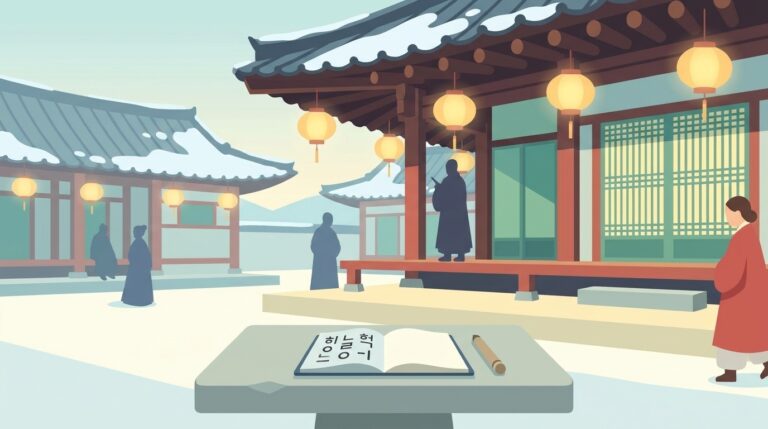
From the ancient mountain pavilions of Gyeongju to urban landmarks like Jogyesa in Insadong and Myeongdong Cathedral, Korean religious institutions have pivoted drastically. Today, they serve dual functions: preserving ancestral intangible cultural heritage and acting as public emotional retreats. Through the nationwide Templestay network and church-sponsored public classical concerts, these spaces transcend dogmatic boundaries. They open their doors to anyone suffering from burnout in Korea’s notoriously competitive “Pali-Pali” (hurry-hurry) culture, welcoming people regardless of creed.
Context & Characters
You are Alex, an international NGO coordinator collaborating with Ji-won, a seasoned community program director at an urban sanctuary in central Seoul. You are discussing plans for an upcoming winter outreach drive.
- 지지원 (Ji-won): 알렉스 씨, 요즘 날씨가 급격히 추워져서 쪽방촌 어르신들 걱정이 이만저만이 아니에요. (Alex-ssi, yojeum nalssiga geupgyeokhi chuwojyeoseo jjokbangchon eoreusindeul geokjeongi imanjeomani anieyo.)
🎭 한숨을 내쉬며 두 손을 모으고 진지한 눈빛을 보낸다.
“Alex, the weather has turned brutally cold lately, so I’m deeply concerned about the elderly residents in the micro-housing districts.” -
알렉스 (Alex): 맞아요. 공공 복지만으로는 한계가 있어서, 종교 시설의 사회적 안전망 역할이 더욱 절실해 보입니다. (Majayo. Gonggong bokjimaneoroneun hangyega isseoseo, jonggyo siseorui sahoejeok anjeonmang yeokhali deouk jeolsilhae boimnida.)
🎭 고개를 끄덕이며 진심 어린 표정으로 공감한다.
“I agree. Public welfare alone has clear limits, so the social safety net provided by religious institutions seems all the more crucial.” -
지지원 (Ji-won): 네, 그래서 이번 주말부터 우리 시설 강당을 개방해서 방한용품 지원과 구호 활동을 본격화하려고 합니다. (Ne, geuraeseo ibeon jumalbuteo uri siseol gangdangeul gaebanghaeseo banghanyongpum jiwon-gwa guho hwaldong-eul bongyeokhaharyeogo hamnida.)
🎭 일정표를 펼쳐 보이며 단호하고 다정한 어조로 설명한다.
“Yes, which is why starting this weekend we plan to open our main auditorium to launch winter supply drives and emergency relief operations in earnest.” -
알렉스 (Alex): 시설을 선뜻 내어주신 덕분에 취약계층 분들에게 실질적인 도움이 되겠네요. (Siseoreul seontteut naeeojusin deokbune chwiakgyecheung bundeurege siljiljeogin doumi doegenneyo.)
🎭 감사한 마음을 담아 정중히 눈을 맞춘다.
“Thanks to your willingness to open up the facility, it will provide tangible relief to the most vulnerable.” -
지지원 (Ji-won): 종교를 떠나서 소외된 이웃들에게 마지막 보루가 되어주는 것이 저희의 본분이니까요. (Jonggyoreul tteonaseo so-oedoen i-utdeurege majimak boruga doeeojuneun geosi jeohui-ui bonbun-ikkanikkayo.)
🎭 따뜻한 미소를 지으며 고요하게 찻잔을 내려놓는다.
“Regardless of faith, serving as the last bastion for our marginalized neighbors is, after all, our core duty.” -
알렉스 (Alex): 단순한 구제를 넘어서, 시민들에게 든든한 마음의 안식처를 제공하는 의미도 크다고 생각합니다. (Dansunhan gujereul neomeoseo, simindeurege deundeunhan maeum-ui ansikcheoreul jegonghaneun uimido keudago saenggakhamnida.)
🎭 차분하고 존경 섞인 목소리로 화답한다.
“Beyond simple material aid, I believe providing such a dependable sanctuary of peace for citizens holds profound significance.” -
지지원 (Ji-won): 그렇게 말씀해 주시니 큰 힘이 되네요. 자원봉사자 모집 공고도 곧 올릴 예정입니다. (Geureoke malsseumhae jusini keun himi doeneyo. Jawonbongsaja mojip gonggodo got ollil yejeong-imnida.)
🎭 환하게 웃으며 서류를 정리한다.
“Hearing you say that gives us tremendous strength. We plan to post the volunteer recruitment notice very shortly.” -
알렉스 (Alex): 저희 팀도 현장 배식과 물품 분류에 적극적으로 동참하겠습니다. 함께 힘을 보태시죠! (Jeohui timdo hyeonjang baesikgwa mulpum bunryu-e jeokgeukjeogeuro dongchamhagetseumnida. Hamkke himeul botaesijyo!)
🎭 주먹을 가볍게 쥐며 신뢰감 넘치는 미소를 짓는다.
“Our team will also actively join in meal distributions and supply sorting on-site. Let us combine our strength!”
🔀 Interactive Decision Point
How should Alex respond when Ji-won asks how to handle volunteers from diverse religious or secular backgrounds?
- Option A: “종교적 색채를 배제하고 인간 존중의 가치에 집중한다면 누구나 한마음으로 동참할 수 있을 것입니다.” (Jonggyojeok saekchaereul baejehado ingan jonjung-ui gachi-e jipjunghandamyeon nuguna hanma-umeuro dongchamhal su isseul geosimnida. / Best: Sophisticated, diplomatic C1 formulation emphasizing universal humanitarian value.)
- Option B: “종교 시설이니까 우리 종교를 믿는 사람만 봉사자로 뽑는 게 안전하지 않을까요?” (Jonggyo siseorinikka uri jonggyoreul minneun saramman bongsajarob ppomneun ge anjeonhaji aneulkkayo? / Bad: Divisive and contrary to modern community welfare ethics.)
- Option C: “종교가 없으면 이런 봉사의 참뜻을 이해하기 어려울 텐데 걱정입니다.” (Jonggyoga eopseumyeon ireon bongsaui chamtteuseul ihaehabi eoryeoul tende geokjeong-imnida. / Risk: Highly condescending, risking offense toward secular volunteers.)
Practice reading these sentences aloud, pausing precisely at the slashes (/) to build authentic native rhythm.
[🙏 경건하고 따뜻하게 - Reverent and warm]
종교 시설은 / 단순한 기도처를 넘어 / 우리 사회의 가장 어두운 곳을 밝히는 / 따뜻한 등대가 되어줍니다.
(Jonggyo siseoreun / dansunhan gidocho-reul neomeo / uri sahoe-ui gajang eoduun goseul balkhineun / ttatteut-han deungdaega doeeojumnida. / Religious institutions go beyond simple places of prayer, serving as a warm lighthouse illuminating our society’s darkest corners.)-
[🤝 결의에 차서 당차게 - Resolute and committed]
소외된 이웃들이 / 삶의 희망을 놓지 않도록 / 민관과 종교계가 함께 / 촘촘한 안전망을 구축해야 합니다.
(So-oedoen i-utdeuri / salm-ui huimang-eul nochi antorok / mingwan-gwa jonggyogyega hamkke / chomchomhan anjeonmangeul guchukhaeya hamnida. / To ensure marginalized neighbors do not lose hope in life, civil government and religious communities must build a dense safety net together.)
- 사각지대 (Sagakjidae) | Blind spot. In social policy, it refers to vulnerable groups who slip through government criteria and are caught by religious charity initiatives.
- 상생 (Sangsaeng) | Mutual coexistence and reciprocal flourishing. Often used in philosophical and community forums to describe diverse groups thriving harmoniously.
- 공헌 (Gongheon) | Contribution or selfless civic dedication. Frequently paired with 사회적 (social) to highlight philanthropic endeavors.
- 품다 (Pumda) | To embrace, cradle, or harbor. Figuratively conveys a temple or cathedral enveloping troubled souls in protective warmth.
Survival Phrases TOP 3
- 여기서 무료 급식 봉사를 신청할 수 있나요? (Yeogiseo muryo geupsik bongsareul sincheonghal su innayo?)
Pro Tip: Use this at the administrative office (종무소 or 사무국) of any temple or cathedral if you wish to sign up for weekend volunteer meal distribution. - 종교에 상관없이 누구나 참여할 수 있는 프로그램인가요? (Jonggyo-e sanggwan-eopsi nuguna chamyeohal su inneun peurogeuraem-in-gayo?)
Pro Tip: Perfect question when inquiring about neighborhood mindfulness sessions, classical recitals, or open soup kitchens. - 지역 사회를 위해 정말 뜻깊은 일을 하시네요. (Jiyeok sahoereul wihae jeongmal tteutgipeun ireul hasineyo.)
Pro Tip: The ultimate polite compliment to offer staff or volunteers working in community outreach.
Editor’s Travel Note
If you want to experience these spaces firsthand, hop on Seoul Subway Line 4 to Hyehwa Station or Line 2 to Euljiro 1-ga. Before heading out, make sure to check operating hours through the Naver Map App Download to locate designated community annexes. When entering, please silence your smartphone and remember that public transportation cards (T-money) work seamlessly on all feeder buses leading up to secluded mountain temple gates.
In many Western contexts, secularization often resulted in a sharp bifurcation between church and state welfare apparatuses. In South Korea, however, spiritual facilities have historically served as the physical and moral ground where human rights battles were fought, refugee aid was distributed, and community solidarity was forged. By referring to these spaces not merely as places of prayer, but as protectors of human dignity, you mirror the very ethos that carried modern Korea through its most turbulent epochs.
💬 Your Turn: Does your home culture rely more on faith-based outreach or state institutions during national emergencies? Drop your thoughts in the comments below using the word 마지막 보루 (last bastion)!
Q: 종교가 없는데 사찰이나 성당의 복지 시설 자원봉사에 참여해도 되나요?
A: 물론입니다! 대부분의 한국 종교 복지 시설은 개방적인 인도주의 원칙을 따르므로, 특정 종교에 대한 신앙 고백 없이도 순수한 봉사 의지만 있다면 언제든지 기쁘게 환영받을 수 있습니다.
Q: ‘절’과 ‘사찰’은 대화할 때 어떤 차이가 있나요?
A: ‘절’은 일상적이고 친숙한 순우리말이며, ‘사찰’은 공식적 담화, 언론, 학술 토론 등 품격 있는 맥락에서 주로 쓰이는 격식 높은 한자어 표현입니다.
Q: 종교적 구호 활동을 칭찬할 때 가장 세련된 C1 수준의 표현은 무엇인가요?
A: 단순히 “좋은 일 하시네요”라고 하기보다, “복지 사각지대에서 묵묵히 헌신해 주셔서 큰 울림을 줍니다”(Your silent dedication in welfare blind spots resonates deeply)와 같이 구체적 사회적 기여를 인정하는 문장을 추천합니다.
🚨 흔한 실수 (Common Mistakes)
- Mistake 1: Translating “religious activities” flatly as 종교 놀이 or 종교 일.
Correct Action: Always use 종교계의 사회적 역할 (social role of religious circles) or 구호/봉사 활동 (relief/volunteer activities). - Mistake 2: Assuming an outreach center is exclusive and asking “교인만 와요?” in an informal, abrupt tone.
Correct Action: Use the polite formal phrasing: “일반 시민들에게도 개방된 공간인가요?” (Is this space also open to the general public?). - Mistake 3: Describing an unhoused shelter as a “불쌍한 사람들의 집”.
Correct Action: Employ respectful civic terms like 취약계층을 위한 쉼터 (shelter for vulnerable social groups).
- Bronze Mission: Read the two Shadowing Drill sentences aloud three times while timing yourself under 10 seconds.
- Silver Mission: Leave a comment below utilizing today’s keyword 상생 (mutual coexistence) in a complete Korean sentence.
- Gold Mission: Visit a local Korean cultural center, historic temple, or community parish and respectfully inquire about their civic outreach using one of our Survival Phrases.
- 🎮 K-Culture Mission: Watch an episode of a social documentary or period drama (like Reply 1987 era clips) and see if you can spot community members gathering at a church or temple for civic protection.
1. Situational Judgment
Which sentence is the most natural, sophisticated way to explain to a colleague why you volunteer at a temple kitchen on weekends?
* A) 절에서 공짜 밥 주는 게 재미있어서 가요.
* B) 도심 사찰이 지역 사회의 안전망 역할을 하고 있어서 작은 힘을 보태고 있습니다.
* C) 스님들이 불쌍한 사람을 도우라고 해서 억지로 가고 있어요.
View Answer & Explanation
Correct Answer: B
Explanation: Option B uses advanced civic vocabulary such as “도심 사찰” (urban temple), “안전망 역할” (safety net role), and “작은 힘을 보태다” (contributing one’s modest strength), which perfectly fits a refined C1 register. Option A is overly simplistic, while Option C is impolite and culturally inaccurate.
2. Fill-in-the-Blank
Fill in the blank with the correct institutional term:
“정부의 손길이 미치지 못하는 복지 __________(을/를) 메우기 위해 종교 시설이 앞장섰다.”
View Answer & Explanation
Correct Answer: 사각지대 (Sagakjidae)
Explanation: The noun phrase “사각지대를 메우다” is an established idiomatic collocation in high-level Korean meaning to address blind spots in public systems or welfare coverage.
3. True or False Cultural Quiz
Statement: Korean Templestay and community cathedral concerts are strictly limited to verified believers who hold baptismal or refuge vows. (True / False)
View Answer & Explanation
Correct Answer: False
Explanation: Modern Korean religious institutions have widely secularized their healing, cultural, and welfare programs so that any citizen or foreign traveler can benefit from restorative rest regardless of personal faith.







