

Phase 1: 공감 (Story-Immersive Opening)
안녕하세요! 매일한글 에디터입니다.
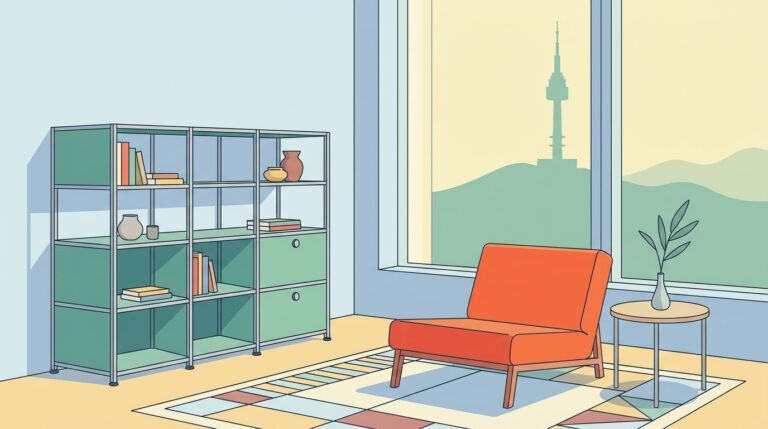
Imagine stepping into an apartment in Mapo or a hidden concept showroom in Seongsu. At first glance, it is the classic, uniform Korean apartment layout—polished wooden floors, white wallpaper, and floor-to-ceiling windows overlooking high-rises. But look closer: an electric-orange Herman Miller shell chair sits effortlessly beside an industrial modular sideboard made of perforated steel and glass, illuminated by a warm, paper-filtered Akari lamp.
If you have spent any time following Korean lifestyle influencers, browsing interior design platforms like Today’s House (오늘의집), or watching celebrity home tours on Home Alone (나 혼자 산다), you have witnessed this phenomenon firsthand: Korea has fallen head-over-heels for Mid-Century Modern (미드 센추리 모던, often affectionately abbreviated as ‘미센모’).
Yet, as an advanced speaker, you face a unique challenge. You know the textbook words like ‘가구’ (furniture), ‘심플하다’ (to be simple), and ‘오래되다’ (to be old). But when native Koreans start analyzing why this specific mid-20th-century Western design aesthetic exploded across post-modern Seoul apartments, standard vocabulary falls flat. You need the socio-cultural lexicon to critique spatial aesthetics, unpack urban living constraints, and navigate the fine line between personal taste and collective trend cycles. Curated from our veteran tutoring field notes and conversations with Seoul-based interior stylists, this guide gives you the C2-level communicative firepower to dissect Korea’s design culture with effortless fluency.
Phase 2: 핵심 표현 3선 심층 분석 (C2 Core Expressions)
1. 쇠테리어 감성 (Soeterieo gamseong)
- Pronunciation: [Soe-te-ri-eo gam-seong] (Think of ‘soe’ like the start of ‘soy’ combined with interior, rhyming with ‘cafeteria’)
- Meaning: Literal: Iron/Metal-terior sensibility. | Nuance: The hyper-trendy aesthetic centered on brushed stainless steel, chrome tubing, and cool-toned metallic surfaces popular in Korean Mid-Century spaces.
- K-Culture Moment: On MBC’s Home Alone (나 혼자 산다), when SHINee’s Key or actor Namkoong Min revealed their homes, viewers instantly praised the sleek combination of modular chrome shelves and glass tables as the epitome of ‘쇠테리어’.
- Editor’s Insight: This portmanteau merges ‘쇠’ (native Korean for metal/iron) and ‘인테리어’ (interior). It is distinct from gritty Western industrial design; ‘쇠테리어’ implies pristine, clean-edged, reflective modernism that offsets the visual warmth of traditional apartment flooring.
- Situation Spectrum: Casual ✅ | Semi-formal ✅ | Formal ⚠️
- 🤔 Think About It: How does combining a rustic native Korean root (‘쇠’) with a Western loanword (‘인테리어’) mirror Korea’s unique blending of historical identity with hyper-modern living?
2. 미니멀리즘의 변주 (Minimalijeum-ui byeonju)
- Pronunciation: [Mi-ni-meol-li-jeum-ui byeon-ju] (Pronounce ‘byeon-ju’ smoothly like ‘byun-joo’)
- Meaning: Literal: A variation on minimalism. | Nuance: Adapting classic minimalist interiors by injecting distinct geometric structures, primary accent colors, and tactile materials without cluttering the space.
- K-Culture Moment: Architectural critique essays in magazines such as Space or Living Sense discussing how Korean millennials moved beyond cold Scandinavian white tones toward Mid-Century palettes.
- Editor’s Insight: ‘변주’ (musical variation) is a premier C2-level rhetorical device used when critiquing cultural movements that evolve from a core doctrine rather than replacing it wholesale.
- Situation Spectrum: Casual ⚠️ | Semi-formal ✅ | Formal ✅
- 🤔 Think About It: In your culture, when a design trend evolves, is it characterized as an artistic ‘variation’ or a radical departure?
3. 공간의 물성을 살리다 (Gonggan-ui mulseong-eul sallida)
- Pronunciation: [Gong-gan-ui mul-seong-eul sal-li-da] (The ‘l’ in ‘mul’ transitions softly into ‘seong’)
- Meaning: Literal: To bring out the physical properties of a space. | Nuance: Skillfully highlighting the inherent textures and tactile qualities of materials—such as raw concrete, brushed aluminum, fiberglass, or bentwood—within an interior layout.
- K-Culture Moment: Top architectural curators on YouTube channels like E-Rae or Jip-ppol-lyeo analyzing why architectural-grade mid-century furniture looks so striking against Korea’s standardized concrete structures.
- Editor’s Insight: ‘물성’ (materiality / physical characteristics) combined with ‘살리다’ (to accentuate / revive) demonstrates native-level critical appreciation of sensory design.
- Situation Spectrum: Casual ⚠️ | Semi-formal ✅ | Formal ✅
- 🤔 Think About It: Does everyday speech in your native language discuss ‘materiality’ as an aesthetic virtue, or is it reserved strictly for architectural theory?
Phase 3: 교과서 한국어 vs 진짜 한국어 (Textbook vs. Native)
Situation 1: Praising the timeless appeal of a vintage designer piece
- 📖 교과서 한국어: “이 의자는 실용적이고 오래되었지만 디자인이 아름답습니다.” (This chair is practical and old, but the design is beautiful.)
- 🗣️ 진짜 한국어: “완전 미센모의 정석이라 질리지 않는 타임리스한 맛이 있네요.” (It’s the absolute textbook definition of Mid-Century Modern; it has that timeless appeal you never get tired of.)
- 💡 왜 다를까? Educated native speakers rarely use plain descriptors like ‘아름답다’ for curated interior spaces. They use professional short forms (‘미센모’) and conceptual terms like ‘타임리스한 맛’ (timeless flavor/vibe).
Situation 2: Analyzing the visual balance of chrome and acrylic furniture
- 📖 교과서 한국어: “쇠로 된 가구와 투명한 가구가 방을 넓어 보이게 합니다.” (Iron furniture and transparent furniture make the room look spacious.)
- 🗣️ 진짜 한국어: “스테인리스와 아크릴 소재 덕분에 시각적 개방감이 확실히 사네요.” (Thanks to the stainless steel and acrylic materials, the visual sense of openness truly comes alive.)
- 💡 왜 다를까? C2 native discussions center on spatial perception. ‘시각적 개방감’ (visual openness) conveys why these materials became a sensation in space-conscious urban Korean homes.
Phase 4: K-Culture 딥다이브 & 비언어적 매너
4-1. 눈치(Nunchi) & Gestures in Design Showrooms
When visiting high-end vintage furniture galleries in Hannam-dong or Seongsu-dong, appreciating vintage authenticity requires seasoned non-verbal etiquette. Genuine 1950s production pieces (오리지널 빈티지) are cultural artifacts, not replica showroom displays.
* The Tactile Pause: Never collapse your full weight onto an original Eames lounge or a vintage Pierre Jeanneret chair. Instead, lightly run the back of your hand across the wood patina or metal joints, stepping back half a pace to view the silhouette.
* The Understated Acknowledgment: When a curator mentions a piece is an ‘오리지널 빈티지’ (original vintage) rather than a ‘복각품’ (re-edition), offer a slow, affirmative nod with a gentle tilt of the head, conveying respect for provenance.
4-2. Cultural Code Analysis: The Apartment Complex Paradox
Why Mid-Century Modern? Over 60% of South Koreans live in high-rise apartments (아파트), built predominantly with uniform white walls, prefabricated entryways, and warm synthetic wood laminate. For younger Koreans, completely renovating structural floor plans is rarely feasible due to high leasehold (jeonse) turnover or strict building codes.
Mid-Century Modern emerged as the optimal aesthetic rebellion. Its clean, functional silhouettes and light-permeable glass or steel frames do not visually crowd a 59m² or 84m² apartment layout. Simultaneously, bold Bauhaus primary colors (cobalt blue, mustard, vermilion) shatter the monotonous beige-and-white uniformity. What began as a design movement in post-war America has been repurposed in Seoul as an individualistic tool to reclaim personal autonomy inside mass-produced urban architecture.
Phase 5: 실전 롤플레이 시나리오 (Practical Roleplay)
- Setting: An exclusive vintage design showroom & archive cafe in Seongsu-dong.
- Character: Min-woo (민우), a selective 30-something vintage curator and spatial designer.
민우: “어서 오세요. 천천히 둘러보세요. 이쪽 라인은 1950년대 바우하우스 영향을 받은 오리지널 피스들 위주로 큐레이션되어 있습니다.”
(Eoseo oseyo. Cheoncheonhi dulleoboseyo. Ijjok rain-eun cheon-gubaek-osip-nyeondae bauhauseu yeonghyang-eul badeun orijineol piseudeul wiju-ro kyureisyeon-doeeo itseumnida.)
“Welcome. Feel free to browse. This collection is curated mainly around original 1950s pieces influenced by the Bauhaus movement.”
🎭 Gesturing with an open palm toward an array of tubular steel lounge chairs and modular shelving.
Learner: “공간 배치가 참 인상적이네요. 특히 모듈 시스템 가구와 조명의 조화가 돋보여요.”
(Gonggan baechiga cham insangjeogineyo. Teukhi modyul siseutem gaguwa jomyeong-ui johwaga dotboyeoyo.)
“The spatial layout is truly impressive. The harmony between the modular system furniture and the lighting particularly stands out.”
🎭 Maintaining an analytical gaze, taking in the balance of the room.
민우: “안목이 남다르시네요. 요즘 유행하는 전형적인 쇠테리어랑은 결을 좀 달리하고 싶었거든요. 물성이 주는 차가움을 조명 톤으로 상쇄시켰달까요?”
(Anmogi namdareusineyo. Yojeum yuhaenghaneun jeonhyeongjeogin soeterieorang-eun gyeoreul jom dallihago sipeotgeodeunyo. Mulseong-i juneun chagaum-eul jomyeong toneuro sangswesikyeotdalkkayo?)
“You have an exceptional eye. I wanted to differentiate this from the typical ‘metal-terior’ trending lately. You could say I balanced the material coldness with ambient lighting tones.”
🎭 Offering a subtle, appreciative smile, leaning slightly against the wooden counter.
Learner: “맞아요. 자칫 차가워 보일 수 있는 스테인리스에 아크릴 컬러 포인트가 들어가서 공간에 생동감이 도는 것 같아요.”
(Majayo. Jachit chagawo boil su inneun seuteinriseue akeuril keolleo pointeuga deureogaseo gonggan-e saengdonggam-i doneun geot gatayo.)
“Exactly. Introducing acrylic color accents into stainless steel that might otherwise feel cold gives the room real vitality.”
🎭 Gently gesturing toward an amber acrylic partition on a chrome frame.
민우: “정확히 보셨습니다. 혹시 집 인테리어도 직접 스타일링하고 계신가요?”
(Jeonghwakhi bosyeotsseumnida. Hoksi jip interi-eodo jikjeop seutailinghago gyesin-gayo?)
“You caught that precisely. Are you styling your own home interior as well?”
🎭 Curiosity piqued, folding his arms comfortably.
Learner: “네, 구축 아파트 특유의 정형화된 구조에 미센모 가구로 시각적 변주를 주려고 고민 중이에요.”
(Ne, guchuk apateu teugyu-ui jeonghyeonghwadoen gujoe misenmo gaguro sigakjeok byeonjureul juryeogo gomin jung-ieyo.)
“Yes, I’m contemplating using Mid-Century Modern furniture to create a visual variation against the standardized layout typical of older apartments.”
🎭 Articulating thoughtfully with clear, measured cadence.
민우: “그게 가장 지혜로운 접근이죠. 획일성을 깨는 데는 모듈 가구만 한 게 없으니까요. 취향이 아주 깊으십니다.”
(Geuge gajang jihyeroun jeopgeun-ijyo. Hoeg-ilseong-eul kkaeneun deneun modyul gaguman han ge eopseunikkayo. Chwihyang-i aju gipeusimnida.)
“That’s the wisest approach. Nothing breaks monotony quite like modular furniture. You have profound taste.”
🎭 Nodding slowly in professional camaraderie.
Learner: “전문가께 그런 칭찬을 들으니 뿌듯하네요. 디테일을 더 배울 수 있어 즐겁습니다.”
(Jeonmun-gakke geureon chingchan-eul deureuni ppudeuthaneyo. Diteil-eul deo baeul su isseo jeulgeopseumnida.)
“Hearing that from an expert is truly flattering. It’s a pleasure learning more about these nuances.”
🎭 Exchanging a polite, respectful bow.
🔀 인터랙티브 분기점 (Interactive Choice)
Now Min-woo asks you about adding a statement piece to your living room:
“거실 메인 체어로 강렬한 컬러의 파이버글라스 체어를 두는 건 어떠세요?” (How about placing an intense colored fiberglass chair as the main living room chair?)
- Choice A: “너무 튀어서 아파트 기본 마감재랑 부딪히지 않을까요? 톤온톤으로 차분하게 누르는 게 나을 것 같아요.”
- Outcome: Best! Shows elevated aesthetic awareness of Korean apartment materials (wood/wallpaper balance).
- Choice B: “색깔이 예쁘면 무조건 좋은 거죠. 인스타 감성으로 사진 찍기 딱이겠네요.”
- Outcome: Bad. Sounds superficial; reduces a thoughtful design inquiry to generic social-media clout chasing.
- Choice C: “오리지널 빈티지면 비쌀 텐데 가품으로 저렴하게 맞추는 게 합리적이지 않나요?”
- Outcome: Risk. Asking a dedicated design curator about buying knock-offs (가품) breaches industry decorum.
Phase 6: 10초 감정 섀도잉 드릴 (Shadowing Drill)
Practice reading these lines using the slash (/) marks as breathing and rhythm pauses:
[😏 지적인 감탄을 담아 - With intellectual admiration]
“완전 미센모의 정석이라 / 질리지 않는 타임리스한 맛이 / 확실히 있네요.”
(Wanjeon misenmo-ui jeongseog-ira / jilliji anneun taimriseuhan masi / hwaksilhi inneyo.)-
[🧐 분석적이고 차분한 톤 - Analytical and composed]
“스테인리스와 아크릴 소재 덕분에 / 공간의 시각적 개방감이 / 훨씬 돋보여요.”
(Seuteinriseuwa akeuril sojae deokbune / gonggan-ui sigakjeok gaebang-gam-i / hwolssin dotboyeoyo.) -
[💡 감각적인 통찰을 드러내며 - Revealing aesthetic insight]
“구축 아파트의 획일적인 구조에 / 모듈 가구로 / 감각적인 변주를 주고 싶어요.”
(Guchuk apateu-ui hoeg-iljeogin gujoe / modyul gaguro / gamgakjeogin byeonjureul jugo sipeoyo.)
Phase 7: K-Culture 미니 사전 (Mini Dictionary)
- 쇠테리어 (Soeterieo) | Metallic Interior Aesthetic
The Korean spatial design trend relying heavily on reflective chrome, brushed stainless steel, and glass to foster a crisp, minimalist, urban aura. - 모듈 가구 (Modyul gagu) | Modular Furniture
Grid-based structural furniture systems (e.g., USM Haller) that can be disassembled, customized, and reconfigured to fit varying rental floor plans. - 랜선 집들이 (Laenseon jipdeuri) | Online / Virtual Housewarming
The cultural practice of sharing detailed photo essays and video walk-throughs of one’s styled home interior across social media and digital platforms. - 오브제 (Obeuje) | Artistic Accent Object (Objet)
From the French objet; refers to curated design items—vases, sculptural table lamps, or art monographs—placed with deliberate aesthetic intent.
Phase 8: 여행자를 위한 생존 키트 (Traveler’s Survival Kit)
Top 3 Spatial Design Survival Phrases
- Phrase 1: “이 제품 혹시 리에디션인가요, 아니면 오리지널 빈티지인가요?”
(I jepum hoksi ri-edisyeon-in-gayo, animyeon orijineol bintiji-in-gayo?)
Pro Tip: Essential when touring design studios in Hannam, Seongsu, or Euljiro to inquire respectfully about authenticity. - Phrase 2: “사진 촬영 조심스럽게 진행해도 괜찮을까요?”
(Sajin chwaryeong josimseureopge jinhaenghaedo gwaenchaneulkkayo?)
Pro Tip: Independent curators highly value intellectual courtesy. Always ask before snapping close-ups. - Phrase 3: “공간 테마에 대한 설명을 간략히 들어볼 수 있을까요?”
(Gonggan tema-e daehan seolmyeong-eul gallyakhi deureobol su isseulkkayo?)
Pro Tip: Unlocks engaging, high-level conversations with shop owners who are frequently working architects or spatial stylists.
Editor’s Travel Note
When hunting for vintage Mid-Century modern hubs in Seoul, steer clear of tourist traps. Head straight to the multi-concept showrooms nestled inside the gritty industrial alleys of Seongsu-dong or the quiet hills of Hannam-dong. To navigate these hidden basement galleries and rooftop ateliers seamlessly, use 네이버 지도 앱으로 성수동 디자인 쇼룸 길찾기. If you are sourcing inspiration from domestic trends, browse 오늘의집 앱 공식 다운로드 to observe how real residents adapt modular modernism into compact city living.
Phase 9: “한 발 더 깊이” (Humanities Reflection)
The explosion of the Mid-Century Modern movement in Korea is fundamentally an architectural dialogue between conformity and personal expression. In a society where economic real estate realities funnel millions into functionally indistinguishable apartment high-rises, the interior is the final frontier of self-determination. By bringing in modular steel and vibrant vintage pieces, Koreans are actively destabilizing institutional spatial monotony without tearing down structural load-bearing walls. To appreciate Korean ‘미센모’ is to appreciate the urban struggle for identity within uniform spaces.
💬 Your Turn: How does interior styling in your home country negotiate the balance between standardized housing architecture and personal aesthetic expression? Drop your thoughts below in Korean or English!
Phase 10: FAQ & 흔한 실수 방지 (FAQ & Mistakes)
Q: Why do Koreans say ‘미센모’ instead of just Mid-Century?
A: Korean conversational culture thrives on efficient four-syllable or three-syllable acronyms (줄임말). ‘미드 센추리 모던’ (six syllables) naturally condensed into ‘미센모’ across interior communities, lifestyle vlogs, and design marketplaces.
Q: Is ‘쇠테리어’ considered an official design term?
A: It is a neologism, but one that has fully crossed over into mainstream architectural journalism, marketing campaigns by major department stores, and television broadcasts. You can comfortably use it in any semi-formal lifestyle discussion.
Q: How do native speakers critique an interior that looks too trendy or derivative?
A: Instead of saying it is ‘bad’ (나쁘다), sophisticated speakers will say, “어디서 많이 본 듯한 레퍼런스네요” (It looks like a reference I’ve seen everywhere) or “유행을 그대로 복제한 느낌이 들어요” (It feels like an exact carbon copy of current trends).
🚨 흔한 실수 (Common Mistakes)
- Mistake 1: Calling every metal shelf ‘인더스트리얼’ (Industrial).
Correct Action: In Korea, ‘인더스트리얼’ evokes exposed brick, pipes, and raw rusted finishes. Sleek chrome, clean grids, and glass modular setups should be referenced as 미드 센추리 모던 or 쇠테리어. - Mistake 2: Using ‘골동품’ (Antique/Relic) for mid-20th-century furniture.
Correct Action: ‘골동품’ connotes Joseon Dynasty ceramics or century-old heirlooms. For 20th-century design masters, always use 빈티지 (Vintage) or 오리지널 피스 (Original piece). - Mistake 3: Saying “가구가 방에 편해요” when describing visual fit.
Correct Action: ‘편하다’ means physically comfortable to sit in. When furniture harmonizes visually with a room, say “공간에 자연스럽게 녹아들다” (melts naturally into the space).
Phase 11: 액션 미션 & 참여 유도 (Action Missions)
- 🥉 Bronze Mission: Practice saying the 3 Shadowing Sentences from Phase 6 aloud three times, emphasizing natural pauses at each
/mark. - 🥈 Silver Mission: Find an interior photo on Instagram with steel/modular furniture and write a Korean comment using the word “쇠테리어” or “물성”.
- 🥇 Gold Mission: Write a 3-sentence critique of your own living room or workspace in Korean using the expressions 미니멀리즘의 변주, 시각적 개방감, and 오브제.
- 🎮 K-Culture Mission: Watch a clip of an interior tour from Home Alone (나 혼자 산다) on YouTube and identify at least two Mid-Century Modern modular pieces or lighting fixtures.
Phase 12: 인터랙티브 퀴즈 챌린지 (Interactive Quiz)
Test your mastery of C2-level Korean interior culture with this three-part challenge!
1. Situational Judgment:
You are visiting an architect’s studio in Seoul. You notice an iconic, authentic 1960s modular storage unit with chrome tubes and orange panels. Which phrase demonstrates the highest linguistic and cultural tact?
(A) “이 플라스틱 수납장 진짜 싸고 예쁘네요!”
(B) “오리지널 모듈의 물성과 컬러감이 공간의 중심을 단단히 잡아주네요.”
(C) “인스타에서 봤는데 어디 짝퉁 사이트에서 사셨어요?”
2. Fill-in-the-Blank:
“철제와 유리 소재 가구를 배치했더니 좁은 거실의 ( )이/가 훨씬 살아났다.”
(Hint: The sensory expression for ‘visual sense of openness’ learned in Phase 3.)
3. True or False:
In Korean contemporary lifestyle terminology, calling an apartment interior ‘쇠테리어’ means the space is decorated with antique Joseon-era iron kettles and blacksmith tools. (T / F)
👉 정답 및 해설 확인하기 (Click to reveal answers)
1. Answer: (B)
Explanation: Option B employs C2 vocabulary (‘물성’, ‘컬러감’, ‘공간의 중심을 잡아주다’) to analyze design functionality and material presence. Option A trivializes designer materials as cheap plastic, while Option C breaches professional etiquette by assuming it is an imitation.
2. Answer: 시각적 개방감 (Visual sense of openness)
Explanation: This phrase accurately articulates the spatial breathing room created by light-permeable and reflective materials.
3. Answer: False
Explanation: ‘쇠테리어’ is a modern portmanteau of ‘쇠’ (metal) and ‘인테리어’ (interior), referring to the sleek mid-century chrome and stainless-steel aesthetic popular in contemporary urban apartments.







