

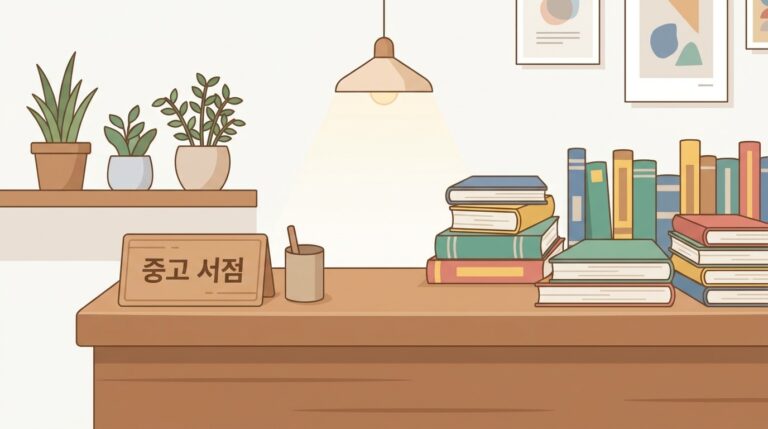
Phase 1: 공감 (Story Immersion Opening)
안녕하세요! 매일한글 에디터입니다.
Have you ever walked down the neon-lit streets of Sinchon or Gangnam, stepped into a massive Aladin Used Bookstore (알라딘 중고서점), and felt mesmerized by the sweet smell of vintage paper and freshly brewed cafe Americano? Maybe you bought a stack of Korean webtoon volumes or K-pop photo essays during your language study journey. But now, your bookshelf is groaning, or perhaps your semester in Korea is ending, and you need to lighten your suitcase. You muster your courage, lug a heavy tote bag to the counter, and the clerk asks a flurry of questions: “회원 가입 하셨어요?”, “매입 신청서 작성하셨나요?”
Panic sets in. You freeze, nervously pointing at your books. Many of our intermediate learners share this exact pain point: they know basic shopping phrases like “이거 얼마예요?” (How much is this?), but navigating the reverse process—selling your own items, negotiating condition grades, and handling payouts—feels like a high-stakes exam. Don’t worry! This comprehensive guide is built on real student feedback and insider cultural know-how. By the end of this post, you’ll walk straight up to the “책 파는 곳” counter with absolute confidence, turning your old books into extra won for dinner!
Phase 2: 핵심 표현 3선 심층 분석 (Top 3 Key Expressions)
1. 이 책 매입 가능한가요? (I chaek mae-ip ganeunghangayo?)
- Pronunciation: [I chaek mae-ip ga-neung-han-ga-yo?] (Think: “Mae” sounds like the month of ‘May’, and “ip” sounds like taking a sip without the ‘s’.)
- Meaning: Literal: “Is the purchase/acquisition of this book possible?” | Nuance: “Can I sell this book here? / Do you take this title?”
- K-Culture Moment: In slice-of-life K-dramas where a college student tidies up their cramped one-room studio (원룸), you will often hear them ask this exact phrase at modern used book counters.
- Editor’s Insight: While beginners might say “이 책 팔 수 있어요?”, using the word 매입 (mae-ip – business buyback/acquisition) elevates your Korean straight to fluent B1 level. Used bookstores have quotas for each title; if they already have 20 copies in stock, they won’t buy it. Asking this first saves everyone time.
- Situation Spectrum: Casual 🚫 | Semi-formal ✅ | Formal ✅
- 🤔 Think About It: In English, we focus on our action (“Can I sell this?”), whereas Korean business transactions often frame the inquiry around the store’s acceptance (“매입 가능한가요?”). How does this subtle shift reflect Korean service culture?
2. 상태 등급이 어떻게 나왔어요? (Sangtae deunggeubi eotteoke nawasseoyo?)
- Pronunciation: [Sang-tae deung-geu-bi eo-tteo-ke na-wa-sseo-yo?] (Think: ‘Sang’ as in sang a song, ‘tae’ like Tae-kwon-do.)
- Meaning: Literal: “How did the condition grade come out?” | Nuance: “What grade did my books receive?”
- K-Culture Moment: Similar to Korean variety shows where items undergo thorough appraisal, the bookstore clerk rigorously flips every single page, checking for highlighter marks or water damage under bright LED lights.
- Editor’s Insight: Secondhand chains in Korea categorize books strictly into 최상 (Best/Like New), 상 (Good), 중 (Acceptable), and 매입 불가 (Rejected). Asking “등급이 어떻게 나왔어요?” shows the clerk that you understand their grading algorithm.
- Situation Spectrum: Casual ⚠️ | Semi-formal ✅ | Formal ✅
- 🤔 Think About It: Notice the passive verb phrase “어떻게 나왔어요?” (How did it come out?) instead of “몇 등급 주셨어요?” (What grade did you give me?). It avoids placing personal blame on the clerk for a low grade.
3. 정산은 현금으로 받을게요. (Jeongsaneun hyeongeumeuro badeulgeyo.)
- Pronunciation: [Jeong-sa-neun hyeon-geu-meu-ro ba-deul-ge-yo.] (Think: ‘Jeong’ like the deep Korean sentiment of affection, ‘san’ like climbing a mountain.)
- Meaning: Literal: “As for the settlement, I will receive it in cash.” | Nuance: “I’d like my payout in cash, please.”
- K-Culture Moment: In retail spaces, cashier counters offer multiple payout routes: store points (예치금/적립금) or physical cash. You will hear this phrase whenever someone wants immediate liquid cash in hand.
- Editor’s Insight: 정산 (jeongsan) means financial settlement or balancing accounts. In chain bookstores, store credits often give an extra 10% bonus, but if you want cash, specifying “현금으로 받을게요” prevents the clerk from automatically depositing it into your app point balance.
- Situation Spectrum: Casual 🚫 | Semi-formal ✅ | Formal ✅
- 🤔 Think About It: Why does Korean rely heavily on the marker (으)로 for payments? It indicates the instrument or channel of transaction, highlighting clarity in business.
Phase 3: 교과서 한국어 vs 진짜 한국어 (Textbook vs. Real Korean)
Situation 1: Offering your books for sale at the counter
- 📖 교과서 한국어 (Textbook Korean):
“저는 이 중고 도서들을 가게에 팔고 싶습니다.” (Jeoneun i junggo doseodeureul gage-e palgo sipsumnida. / I wish to sell these secondhand books to the store.) - 🗣️ 진짜 한국어 (Real Korean):
“책 좀 팔려고 하는데요, 상태 확인 부탁드려요.” (Chaek jom pallyeogo haneundeyo, sangtae hwagin butakdeuryeoyo. / I’m looking to sell some books; could you please check their condition?) - 💡 왜 다를까? (Why is it different?): Textbook Korean overuses subject pronouns (“저는”) and heavy grammatical endings (“-고 싶습니다”). Native speakers soften opening requests using ~하려고 하는데요 (I intend to… so…), which sounds far more polite and cooperative.
Situation 2: Asking why a book was rejected
- 📖 교과서 한국어 (Textbook Korean):
“이 책은 왜 팔 수 없습니까?” (I chaekeun wae pal su eopseumnikka? / Why can this book not be sold?) - 🗣️ 진짜 한국어 (Real Korean):
“이건 어떤 점 때문에 매입이 안 되나요?” (Igeon eotteon jeom ttaemune mae-ibi an doenayo? / Which factor makes this ineligible for buyback?) - 💡 왜 다를까? (Why is it different?): Asking “왜 팔 수 없습니까?” sounds accusatory, as if questioning the staff’s authority. Real Koreans soften negative queries by asking “어떤 점 때문에…” (Due to what aspect…), preserving polite distance and face.
Phase 4: K-Culture 딥다이브 & 비언어적 매너 (Deep Dive & Non-Verbal Manners)
4-1. 눈치 (Nunchi) & Gestures
- Two-Hand Presentation: When placing your books on the inspection scale or counter, slide them forward gently using both hands. Never thud a heavy pile down loudly.
- The Patient Pause: The clerk will meticulously flip the pages to detect water stains (물 얼룩), penciled notes, or cracked spines. Do not interrupt this scanning process. Maintain comfortable eye contact, offer a slight nod, and wait until they review the screen.
- ID Readiness: In Korea, anti-theft regulations require sellers to present valid identification (Alien Registration Card / 외국인등록증 or Passport). Have it ready in your hand or in your phone wallet to showcase your situational 눈치 (nunchi).
4-2. Cultural Code Analysis: The Thriving Korean “Used Book Oasis”
In Korea, used bookstores like Aladin (알라딘) or traditional book alleys like Dongdaemun Heonchaekbang Golmok (동대문 헌책방 골목) are lifestyle hubs. Modern young Koreans view selling secondhand books not merely as frugality, but as part of a sleek, minimalist lifestyle (미니멀 라이프) and eco-friendly circulation. Furthermore, many fans sell pristine celebrity photo books (화보집) or graphic novels to cycle their collections. Understanding this turns your bookstore visit from a stressful chore into an authentic slice of everyday Korean city culture.
Phase 5: 실전 롤플레이 시나리오 (Real-Life Roleplay Scenario)
- Setting: The buzzing underground used book desk at Aladin Jongno branch. Soft jazz plays in the background, punctuated by the rhythmic beep of barcode scanners.
- Characters:
- Alex (알렉스): An international student holding three clean Korean novels.
- Clerk Min-su (민수 매니저): An efficient, quick-eyed bookstore manager wearing a black apron.
Turn 1
* Alex: 안녕하세요! 책 좀 팔려고 하는데요, 여기서 접수하면 되나요?
(Annyeonghaseyo! Chaek jom pallyeogo haneundeyo, yeogiseo jeopsuhamyeon doenayo?)
“Hello! I’d like to sell some books; should I register them right here?”
🎭 행동: Gently rests the tote bag on the side counter, smiling politely.
Turn 2
* Min-su: 네, 고객님! 책 이쪽으로 올려주시겠어요? 바코드 스캔 먼저 도와드리겠습니다.
(Ne, gogaeknim! Chaek ijjogeuro ollyeojusigesseoyo? Bakodeu seukaen meonjeo dowadeurigessumnida.)
“Yes, customer! Could you place the books up here? I’ll scan the barcodes first.”
🎭 행동: Gestures toward the padded rubber desk mat.
Turn 3
* Alex: 네, 여기 세 권 있습니다. 혹시 매입 안 되는 책도 있나요?
(Ne, yeogi se gwon itseumnida. Hoksi mae-ip an doeneun chaekdo innayo?)
“Sure, here are three volumes. By any chance, are any of these not eligible for buyback?”
🎭 행동: Hands over the three books with both hands.
Turn 4
* Min-su: 잠시만요… 아, 이 소설책은 재고가 많아서 매입 불가로 뜨네요. 나머지 두 권은 검수 진행하겠습니다.
(Jamsimanyo… A, i soseolchaegeun jaegoga manaseo mae-ip bulgaro tteuneyo. Nameoji du gwoneun geomsu jinhaenghagessumnida.)
“Just a moment… Ah, this novel shows ‘ineligible’ due to surplus stock. I will inspect the other two books.”
Turn 5
* Alex: 아, 그렇군요. 그럼 그 책은 다시 가져갈게요! 상태 등급은 어떻게 나왔어요?
(A, geureokgunyo. Geureom geu chaekeun dasi gajyeogalgeyo! Sangtae deunggeubeun eotteoke nawasseoyo?)
“Ah, I see. Then I’ll take that one back! What condition grades did the other ones get?”
🎭 행동: Slides the rejected book back into the tote bag without disappointment.
Turn 6
* Min-su: 한 권은 최상, 한 권은 밑줄이 있어서 ‘중’ 등급 나왔습니다. 총 8,500원 책정되었습니다.
(Han gwoneun choesang, han gwoneun mitjuri isseoseo ‘jung’ deunggeup nawasseumnida. Chong palcheonobaegwon chaekjeongdoeeosseumnida.)
“One is ‘Best’ grade, and one has pencil underlines so it’s graded ‘Acceptable’. The total is appraised at 8,500 won.”
Turn 7
* Alex: 좋아요. 정산은 현금으로 받을게요. 회원 적립도 가능한가요?
(Joayo. Jeongsaneun hyeongeumeuro badeulgeyo. Hoewon jeongnipdo ganeunghangayo?)
“Sounds good. I’ll take the settlement in cash. Can I get membership points as well?”
🎭 행동: Shows the Aladin membership barcode on smartphone screen.
Turn 8
* Min-su: 네, 회원 적립 완료되었고요, 신분증 확인 후 현금 8,500원 내어드리겠습니다!
(Ne, hoewon jeongnip wanryodoeeotgoyo, sinbunjeung hwagin hu hyeongeum palcheonobaegwon naeeodeurigessumnida!)
“Yes, membership points added! After checking your ID, I’ll hand over 8,500 won in cash!”
🔀 인터랙티브 분기점 (Interactive Branching Point)
Imagine the clerk says: “고객님, 이 책은 본문에 형광펜 필기가 있어서 매입이 어렵습니다.” (Customer, this book has highlighter marks, so we cannot buy it.) What is your response?
- Option A: “그냥 천 원이라도 깎아서 사주시면 안 돼요?” (Can’t you just knock 1,000 won off and buy it anyway?)
- Feedback [Bad ❌]: Major chain bookstores operate on strict algorithmic regulations. Bargaining at chain counters makes staff uncomfortable and violates store etiquette.
- Option B: “아, 규정이 그렇군요. 그럼 이 책은 제가 다시 챙길게요.” (Ah, that’s the policy. Then I will take this book back with me.)
- Feedback [Best ⭐]: Calm, respectful, and crystal clear. It respects store standards and speeds up your remaining transaction smoothly.
- Option C: “그럼 여기 쓰레기통에 그냥 버려주세요.” (Then please just throw it away in your trash can here.)
- Feedback [Risk ⚠️]: Some branches have recycling bins, but asking staff to discard your personal items puts a waste disposal burden on them. It’s safer to ask “폐기 처분 신청도 가능한가요?” (Is disposal processing available?).
Phase 6: 10초 감정 섀도잉 드릴 (10-Second Emotional Shadowing Drill)
Practice these natural rhythm pauses (/) while leaning into the indicated emotional vibe!
- [😊 Politeness & Warmth – Inquiring at the counter]
“저기요, / 이 책 좀 팔려고 하는데요, / 매입 가능한지 / 확인해 주시겠어요?”
(Jeogiyo, / i chaek jom pallyeogo haneundeyo, / mae-ip ganeunghanji / hwaginhae jusigesseoyo?)
“Excuse me, / I’m hoping to sell these books, / could you check / if they are eligible for purchase?” -
[🤔 Curiosity & Calm Understanding – Accepting grades]
“아, / 밑줄 때문에 / ‘중’ 등급으로 / 나온 건가요?”
(A, / mitjul ttaemune / ‘jung’ deunggeubeuro / naon geongayo?)
“Ah, / is it graded ‘Acceptable’ / because of / the underlines?” -
[✨ Cheerful Decision – Concluding settlement]
“네, / 확인했습니다! / 정산은 / 현금으로 부탁드려요.”
(Ne, / hwaginhaetseumnida! / Jeongsaneun / hyeongeumeuro butakdeuryeoyo.)
“Yes, / verified! / For the payout, / please do it in cash.”
Phase 7: K-Culture 미니 사전 (Mini Dictionary)
- 매입 (Mae-ip) | Store Buyback / Purchase
Usage: Unlike 일반 판매 (general selling), 매입 is the formal term stores use when buying used goods directly from consumers. Always look for the sign that reads “중고책 매입 데스크”. - 검수 (Geomsu) | Inspection / Quality Verification
Usage: The physical process of checking for missing pages, scribbles, spine cracks, or CD attachments. - 책정되다 (Chaekjeong-doeda) | To be Appraised / Fixed at a Price
Usage: Often used in passive form: “금액이 이렇게 책정되었습니다” (The price has been evaluated as this). - 헌책방 (Heon-chaek-bang) | Traditional Secondhand Bookstore
Usage: Refers to classic, nostalgic mom-and-pop bookstalls found in places like Cheonggyecheon or Busan Bosu-dong, where prices are negotiated human-to-human rather than via barcodes.
Phase 8: 여행자를 위한 생존 키트 (Traveler’s Survival Kit)
🎯 Survival Expressions Top 3
- “중고책 파는 곳이 어디에 있어요?”
(Junggochaek paneun gosi eodie isseoyo?)
Pro Tip: Used book desks are usually located at the far back or dedicated counters labeled “책 파는 곳”. - “회원 아이디로 적립해 주세요.”
(Hoewon aidiro jeongniphae juseyo.)
Pro Tip: If you don’t have the plastic card, reciting your registered phone number or app barcode earns bonus points. - “매입 불가한 책은 폐기해 주실 수 있나요?”
(Mae-ip bulgahan chaekeun pyegihae jusil su innayo?)
Pro Tip: If carrying rejected heavy books home sounds terrible, ask if the store offers free recycling disposal.
🧳 Editor’s Travel Note
- App Navigation: Before hauling 10 kilograms of books across town, download the store app! You can scan ISBN barcodes in advance on the official app to check store quotas and estimate prices. To easily find the nearest branch in Seoul, use the 네이버 지도 앱 다운로드 search engine rather than foreign mapping tools which often lack real-time subway exit data.
- Identification Rule: Foreign travelers must bring either their physical passport or ARC (외국인등록증). Without ID, cash payouts are legally prohibited in Korea to prevent fencing stolen items.
Phase 9: “한 발 더 깊이” (Cultural Thought Reflection)
In many Western cultures, a used book with scribbles or highlighted quotes can be viewed as charming evidence of a previous reader’s mind. In Korea, however, the commercial secondhand market prioritizes pristine cleanliness—demanding an experience that mimics opening a brand-new item. This reflects Korea’s deep cultural appreciation for neatness (깔끔함), mutual civic consideration (배려), and communal respect. When we preserve a book cleanly so that the next stranger enjoys it unblemished, we participate in an unspoken social pact of mutual care.
💬 Your Turn: How are used books valued in your home culture? Do you prefer a completely clean vintage find, or do you enjoy finding old notes left by strangers? Leave a comment below!
Phase 10: FAQ & 오해 방지 (FAQ & Common Mistakes)
Q: Can short-term tourists sell used books without a Korean bank account?
A: Yes! While app-based bank deposits require a domestic Korean bank account, tourists can receive immediate cash (현금 정산) by presenting their physical valid passport at the desk.
Q: Does Aladin buy English or foreign-language books in Korea?
A: Yes, but under strict criteria. High-demand English bestsellers, university textbooks, or classic literature with clear international ISBNs are often accepted, while obscure non-Korean titles may be flagged as 매입 불가.
Q: What is the fastest reason a book gets rejected during inspection?
A: Water damage (물에 젖은 흔적). Even if dried completely, rippled paper fibers automatically disqualify a book from resale because mold can spread to surrounding stock.
🚨 흔한 실수 (Common Mistakes) 경고판
- Mistake 1: Showing up with un-erasable pen/highlighter markings on more than 5 pages.
- Correct Action: Inspect your books beforehand. Pencil marks can be erased with a clean eraser; permanent markings will drop grades or trigger rejections.
- Mistake 2: Forgetting your physical ID.
- Correct Action: Korean secondhand commerce law requires identity logging. Always carry your passport or ARC.
- Mistake 3: Not checking branch inventory quotas before traveling.
- Correct Action: Use the Aladin app’s barcode scanner feature (중고 매입가 조회) at home. If a branch is overstocked, try another branch nearby!
Phase 11: 액션 미션 & 참여 유도 (Action Missions)
- 🥉 Bronze Level (Solo Practice): Pick one Korean book from your shelf. Look at the barcode and practice saying aloud: “이 책 매입 가능한가요?” 5 times with natural intonation.
- 🥈 Silver Level (Community Connection): Take a photo of your favorite Korean bookstore spot or study corner. Share it on Instagram with the sentence: “오늘 중고 서점에서 책 정리했어요!” and tag
#DailyHangul. - 🥇 Gold Level (Real-Life Mastery): Visit a local used bookstore in Seoul or online. Carry one book to the counter, successfully understand the condition appraisal, and receive your payout using “정산은 현금으로 받을게요”!
- 🎮 K-Culture Mission: Watch an episode of a cozy K-drama (like Romance is a Bonus Book / 로맨스는 별책부록). Spot how books are handled, bound, and appreciated in Korean everyday spaces!
Phase 12: 인터랙티브 퀴즈 챌린지 (Interactive Quiz Challenge)
1. 상황 판단 (Situational Judgment)
You brought two books to the desk. The clerk says: “고객님, 이 도서는 매입 불가입니다.” What does this mean?
* (A) The book is eligible for the highest payout.
* (B) The book cannot be bought by the store.
* (C) The book can only be paid via store points.
2. 빈칸 채우기 (Fill-in-the-Blank)
“책 상태 확인이 끝났습니다. 정산은 (______)으로 해 드릴까요, 포인트로 해 드릴까요?”
* Hint: You want physical paper bills and coins!
3. True / False 문화 퀴즈 (True or False)
- Q: In Korea, books with light water stains are considered high-grade because dried water doesn’t affect readability. (T / F)
👉 Click here to reveal Answers & Explanations (정답 및 해설 보기)
- 정답 (B): 매입 불가 (Mae-ip bulga) literally translates to “Purchase Impossible / Ineligible for buyback.” You can either take the book home or request disposal if permitted.
- 정답: 현금 (Hyeon-geum / Cash): The completed sentence is: “정산은 현금으로 해 드릴까요, 포인트로 해 드릴까요?” (Would you like settlement in cash, or in points?).
- 정답: False: Water damage (침수) is an instant dealbreaker at major Korean secondhand retailers due to the risk of wavy warping and paper mold!







