

How to Invite a Korean Friend Without Sounding Like an Old Textbook
Phase 1: Empathy (Real Talk from Your Seoul Bestie)
안녕하세요! 매일한글 에디터입니다. (Hello! I am your Daily Hangul editor.)
Picture this: You have been chatting with your wonderful Korean classmate or language exchange buddy, Minji, for a few weeks now. You finally muster the courage to invite her over to your place to make ramyeon and watch the latest hit K-Drama. You dig deep into the archives of your first-year Korean textbook and proudly text her:
“저의 집에 방문하시겠습니까?” (Jeoui jibe bangmunhasigesseumnikka?)
There is a long pause. Minji types, deletes, and finally replies with a flurry of “ㅋㅋㅋ” (laughter). Why? Because to a native Korean ear, you didn’t ask her to hang out—you sounded like a Joseon Dynasty diplomat inviting an ambassador to a royal banquet!
Here at Daily Hangul, this is hands down one of the most common hiccups our beginner (A2) learners share with us. You know grammar rules, but real life doesn’t happen in formal court language. When you want to bridge the gap from polite acquaintances to real, cozy friends, you need everyday conversational rhythm. In this guide, built directly from our community’s real-life experiences, you will master the exact three phrases native Koreans use to hang out, decode secret cultural etiquette, and never fear sending that invitation text again!
Phase 2: Core Expressions Deep Dive
Here are the top three golden phrases you will hear constantly among friends in Korea:
1. 우리 집에 놀러 올래? (Uri jibe nolleo ollae?)
- Pronunciation: oo-ree jee-beh nohl-ler ohl-lae (Think of it sounding like “no-ler” + “all-day”)
- Meaning: Literal: “Do you want to come play at our house?” | Real Nuance: “Wanna come hang out at my place?”
- K-Culture Moment: You see this in almost every coming-of-age K-Drama when two leads break the ice—one turns around on a walk home and casually tosses out this warm invitation.
- Editor’s Insight: Notice the word 우리 (uri), meaning “we/our”. In Korean culture, people rarely say “my house” (내 집). Saying 우리 집 signals welcoming, inclusive warmth, even if you live completely alone in a tiny studio!
- Situation Spectrum: Casual: ✅ | Semi-formal: ⚠️ (우리 집에 놀러 오실래요?) | Formal: 🚫
- 🤔 Think About It: Why do you think Korean uses “our” instead of “my” for personal living spaces? What does that tell us about communal bonding versus private ownership?
2. 이번 주말에 시간 돼? (Ibeon jumare sigan dwae?)
- Pronunciation: ee-beon joo-mah-reh shee-gahn dweh (Sounds like “she-gone” followed by “dweh”)
- Meaning: Literal: “Does time become this weekend?” | Real Nuance: “Are you free this weekend?”
- K-Culture Moment: The quintessential KakaoTalk opener before university students or coworkers plan a Friday night out in Hongdae or Seongsu-dong.
- Editor’s Insight: The verb 되다 (dweda) means “to become / to work out”. Asking if time “works out” is much gentler and less invasive than demanding, “Do you have an empty schedule?”
- Situation Spectrum: Casual: ✅ | Semi-formal: ⚠️ (이번 주말에 시간 돼요?) | Formal: 🚫 (시간 되십니까?)
- 🤔 Think About It: In English, we ask “Are you free?”, placing the focus on the person. In Korean, the inquiry is about whether time allows it. How does this subtle shift ease social pressure?
3. 같이 밥 먹자! (Gachi bap meokja!)
- Pronunciation: gah-chee bahp meok-jah (“Gachi” sounds like “got-chee”, and “bap” rhymes with “pop”)
- Meaning: Literal: “Let’s eat cooked rice together!” | Real Nuance: “Let’s grab a meal together! / Let’s hang out!”
- K-Culture Moment: The holy grail of Korean social connection. From Reply 1988 to Hospital Playlist, sitting across from someone with steaming bowls of food is how real relationships are cemented.
- Editor’s Insight: “밥” (bap) means rice, but in everyday Korean, it stands for food and companionship as a whole. Suggesting a meal is the warmest, most natural social anchor in Korea.
- Situation Spectrum: Casual: ✅ | Semi-formal: ⚠️ (같이 밥 먹어요!) | Formal: 🚫 (식사 같이 하시지요)
- 🤔 Think About It: Does your native language have an everyday food phrase that substitutes for “let’s spend quality time together”?
Phase 3: Textbook Korean vs. Real Korean
Let’s compare stiff book grammar with how modern 20-somethings actually talk.
Situation 1: Inviting a friend to your apartment
- 📖 교과서 한국어 (Textbook): 저의 집에 방문하시겠습니까? (Jeoui jibe bangmunhasigesseumnikka? – Would you like to pay a visit to my residence?)
- 🗣️ 진짜 한국어 (Real-Life): 우리 집에 놀러 올래? (Uri jibe nolleo ollae? – Wanna come hang out at my place?)
- 💡 왜 다를까? (Why the difference?): “방문하다” (bangmunhada) is Sino-Korean vocabulary reserved for official diplomatic visits or museum tours. With friends, always use the playful, cozy verb phrase 놀러 오다 (nolleo oda – to come over to play/relax).
Situation 2: Suggesting dinner together
- 📖 교과서 한국어 (Textbook): 오늘 저녁에 식사를 같이 합시다. (Oneul jeonyeoge siksareul gachi hapsida. – Let us have dinner together today.)
- 🗣️ 진짜 한국어 (Real-Life): 오늘 저녁에 밥 한 끼 하자! (Oneul jeonyeoge bap han kki haja! – Let’s grab dinner tonight!)
- 💡 왜 다를까? (Why the difference?): “식사” (siksa) feels formal and distant. Saying 밥 한 끼 (bap han kki – one meal) sounds relaxed, warm, and low-stress.
Phase 4: K-Culture Deep Dive & Non-Verbal Manners
4-1. 눈치 (Nunchi) & Body Language
- The Head Tilt: When asking “이번 주말에 시간 돼?” (Are you free this weekend?), tilt your head slightly to one side with a soft smile. It visually conveys: “No pressure at all if you are busy!”
- The Entryway Ritual (현관 매너): When welcoming your guest, immediately prepare indoor slippers (실내화). Stepping onto the main floor barefoot or in outdoor shoes is a huge taboo in Korean homes.
- The Guest Gesture: If a Korean friend comes over, they will almost never arrive empty-handed. Keep an eye out for a small bakery bag or beverage pack—they are exercising their home-visit manners!
4-2. Cultural Code: 집들이 (Jipdeuri) & 배달 (Baedal)
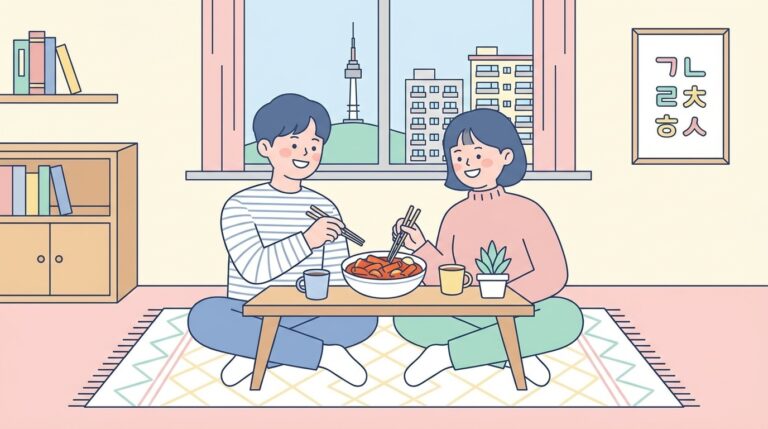
In Korea, an invitation home is a sign of true acceptance into someone’s inner circle. Don’t worry about cooking an elaborate 10-course meal! Modern Korean home-hangouts revolve around Korea’s incredible 배달 문화 (Baedal Munhwa – Food Delivery Culture). Ordering crispy fried chicken, tteokbokki, or Chinese jajangmyeon right to the living room floor table while chatting is the authentic Seoul lifestyle.
Phase 5: Real-Life Roleplay Scenario
Setting: Outside the campus library on a sunny Thursday afternoon. Alex (an exchange student) meets Minji (a Korean classmate).
- Alex: 민지야, 이번 주말에 시간 돼?
(Minji-ya, ibeon jumare sigan dwae?)
“Minji, are you free this weekend?”
🎭 Tilting head slightly with a hopeful smile. -
Minji: 토요일에는 약속 없는데, 왜?
(Toyoireneun yaksok eomneunde, wae?)
“I don’t have any plans on Saturday, why?”
🎭 Adjusting her backpack strap with curious eyes. -
Alex: 우리 집에 놀러 올래? 같이 맛있는 거 먹자!
(Uri jibe nolleo ollae? Gachi masinneun geo meokja!)
“Wanna come hang out at my place? Let’s eat something delicious together!”
🎭 Gesturing enthusiastically with open hands. -
Minji: 우와, 진짜? 좋아! 배달 음식 시켜 먹을까?
(Uwa, jinjja? Joa! Baedal eumsik sikyeo meogeulkka?)
“Wow, really? Sounds awesome! Shall we order delivery food?”
🎭 Clapping hands together happily. -
Alex: 응! 치킨이나 떡볶이 어때?
(Eung! Chikininha tteokbokki eottae?)
“Yeah! How about fried chicken or tteokbokki?”
🎭 Giving a bright thumbs up. -
Minji: 완전 좋아! 몇 시에 갈까?
(Wanjeon joa! Myeot sie galkka?)
“Totally love it! What time should I head over?”
🎭 Pulling out her phone calendar. -
Alex: 다섯 시쯤에 올래? 주소 카톡으로 보낼게.
(Daseot sijjeume ollae? Juso katogeuro bonaelge.)
“Can you come around 5 PM? I’ll send my address via KakaoTalk.”
🎭 Tapping on phone screen. -
Minji: 응, 알겠어! 토요일에 보자, 기대된다!
(Eung, algesseo! Toyoire boja, gidaedoenda!)
“Got it! See you Saturday, I’m looking forward to it!”
🎭 Waving goodbye with a wide grin.
🔀 Interactive Decision Point
How would you confirm the appointment on KakaoTalk that evening? Choose your reply:
- Option A: “토요일 5시에 절대 늦지 마.” (Toyoil daseot-sie jeoldae neutji ma. – Do not be late at 5 PM on Saturday.)
Feedback: [BAD] Too harsh and commanding! Sounds like a military officer drilling a recruit. - Option B: “귀하의 방문을 진심으로 환영합니다.” (Gwihaui bangmuneul jinsimeuro hwanyeonghamnida. – We sincerely welcome your esteemed arrival.)
Feedback: [RISK] Way too stiff! Minji might wonder if you are hosting a formal press conference. - Option C: “그래, 맛있는 거 시켜둘게! 조심히 와~” (Geurae, masinneun geo sikyeodulge! Josimhi wa~ – Great, I’ll prepare tasty food! Get here safely~)
Feedback: [BEST] Warm, friendly, hospitable, and perfectly natural Korean peer tone!
Phase 6: 10-Second Emotion Shadowing Drill
Practice out loud with these emotion milestones. Pay attention to the pauses marked with /:
[😊 신나고 다정하게 / Excited & Friendly]
“우리 집에 / 놀러 올래? / 같이 떡볶이 먹자!”
(Uri jibe / nolleo ollae? / Gachi tteokbokki meokja!)
Meaning: “Wanna come over to my place? Let’s eat tteokbokki together!”-
[🤔 조심스럽고 기대하며 / Tentative & Curious]
“이번 주말에 / 시간 돼? / 혹시 약속 있어?”
(Ibeon jumare / sigan dwae? / Hoksi yaksok isseo?)
Meaning: “Are you free this weekend? Do you happen to have plans?” -
[🥳 환영하며 반갑게 / Welcoming & Bright]
“어서 와! / 신발 편하게 벗어~”
(Eoseo wa! / Sinbal pyeonhage beoseo~)
Meaning: “Welcome! Take off your shoes and make yourself comfortable~”
Phase 7: K-Culture Mini Dictionary
- 집들이 (Jipdeuri) | Housewarming party
Usage: A gathering where friends visit a new apartment. Guests traditionally bring toilet paper (wishing fortune rolls out smoothly) or dish soap (wishing wealth bubbles up). - 홈파티 (Hom-pati) | Cozy home party
Usage: Hugely popular among youth in Seoul. It usually means ordering takeout, playing board games, and relaxing in sweatpants. - 불금 (Bulgeum) | “Burning Friday” (TGIF)
Usage: The most popular night to make plans. “오늘 불금인데 밥 먹자!” (It’s Burning Friday, let’s grab food!). - 배달의 민족 (Baedal-ui Minjok) | Delivery nation / Popular app
Usage: Refers to both Korea’s top food delivery app and the cultural pride in lightning-fast door-to-door food delivery.
Phase 8: Traveler’s Survival Kit
Top 3 Survival Phrases
- 몇 시에 만날까요? (Myeot sie mannalkkayo?)
Meaning: What time shall we meet?
Pro Tip: Use the polite ending -ㄹ까요? when deciding the time together collaboratively. - 주소 찍어 줄래요? (Juso jjigeo jullaeyo?)
Meaning: Can you pin/send me the address?
Pro Tip: “찍어 주다” literally means “to pin on a map”. Very handy when messaging on KakaoTalk. - 슬리퍼 신으세요! (Seullipeo sineuseyo!)
Meaning: Please put on these slippers!
Pro Tip: Say this as soon as your Korean guest steps into your entryway (현관).
Editor’s Travel Note
When coordinating a meeting point in Korea, standard Google Maps walking navigation often lags. Make sure to consult our Naver Map app download guide to find exact alleyway addresses and subway exits. Heading home late after a fun dinner? Hail an authorized ride via the Kakao T taxi booking service rather than waving down cabs on the street.
Phase 9: “One Step Deeper” (Reflective Thought)
In Western individualism, our home is often viewed as a private castle—a boundary where entry is strictly regulated. But in Korean, the linguistic preference for 우리 집 (our house) rather than 내 집 (my house) reveals the profound roots of Jeong (정)—the communal emotional bond that defines Korean society.
When a Korean invites you home to share a meal, they are not simply offering you a chair. They are saying: “You are no longer an outsider on the perimeter; you are part of my circle.” It is one of the highest compliments of hospitality you can receive.
💬 Your Turn: Have you ever been invited into a local home while traveling abroad? How did their hospitality feel compared to your hometown? Share your experience in the comments below!
Phase 10: FAQ & Avoiding Misunderstandings
Q: Can I use “우리 집에 놀러 올래?” with someone older than me?
A: No! This sentence uses casual talk (반말, banmal). If you are inviting a senior colleague, teacher, or older acquaintance, soften it with polite honorifics: “저희 집에 식사하러 오실래요?” (Jeohui jibe siksahareo osillaeyo?).
Q: Does “언제 밥 한번 먹자” always mean a real invitation?
A: Not necessarily! “언제 밥 한번 먹자” (Let’s eat together sometime) is often a friendly social pleasantry similar to “Take care!”. If they don’t follow up with specific dates like “이번 주말에 시간 돼?”, do not take it personally—it’s just a warm farewell greeting.
Q: What is an inexpensive, polite gift to bring if invited over?
A: You don’t need luxury items! A box of bakery pastries, a 6-pack of iced coffee bottles from a convenience store, or nice fruit from a local mart will make your Korean host beam with joy.
🚨 Common Mistakes TOP 3
- Mistake: Saying “내 집에 와” (Nae jibe wa – Come to my house).
Correct Action: Always say “우리 집에 놀러 와” (Uri jibe nolleo wa). It sounds 100 times more natural and culturally attuned. - Mistake: Stepping onto the raised wooden floor before taking off your shoes.
Correct Action: Step out of your shoes directly onto the entryway floor mat or into slippers provided by your host. - Mistake: Forgetting to ask about food allergies or preferences before ordering delivery.
Correct Action: Ask: “못 먹는 음식 있어?” (Mot meongneun eumsik isseo? – Is there any food you can’t eat?).
Phase 11: Action Missions
- 🥉 Bronze Mission (Solo): Stand in front of your mirror and practice saying: “우리 집에 놀러 올래? 같이 밥 먹자!” three times with your most welcoming smile.
- 🥈 Silver Mission (Community): Leave a comment below inviting an imaginary friend over in Korean, mentioning your favorite Korean dish (e.g., 치킨, 떡볶이, 라면)!
- 🥇 Gold Mission (Real World): Next time you chat with a Korean friend on KakaoTalk, ask: “이번 주말에 시간 돼?” and make real plans.
- 🎮 K-Culture Mission: Watch an episode of a slice-of-life drama like Hospital Playlist or Weightlifting Fairy Kim Bok-joo and spot how many times characters casually ask each other: “밥 먹었어?” (Did you eat?).
Phase 12: Interactive Quiz Challenge
Test your knowledge! Click on the spoiler toggles below to check your answers.
1. Situational Judgment
You want to invite your same-age close Korean friend to your studio apartment this Friday. Which line sounds most natural?
* A) 우리 집에 방문해 주시겠습니까?
* B) 우리 집에 놀러 올래?
* C) 내 집으로 거주하러 오세요.
👉 Click to reveal Answer & Explanation
Answer: B) 우리 집에 놀러 올래?
Explanation: Option A is overly formal like a state ceremony, and Option C means “Come reside in my house”! Option B is the ideal casual expression for friends.
2. Fill-in-the-Blank
Complete the sentence to ask your friend if they are free this weekend:
“이번 주말에 ________ 돼?” (Hint: The Korean word for ‘time’)
👉 Click to reveal Answer & Explanation
Answer: 시간 (sigan)
Full sentence: “이번 주말에 시간 돼?” (Ibeon jumare sigan dwae? – Are you free this weekend?)
3. True or False Culture Quiz
In Korea, bringing a pack of toilet paper (휴지) or dish soap (세제) as a housewarming gift is considered cheap and disrespectful.
👉 Click to reveal Answer & Explanation
Answer: False (X)
Explanation: Toilet paper and detergent are traditional, auspicious housewarming (집들이) gifts in Korea! They symbolize good fortune rolling out smoothly and wealth bubbling up.







