

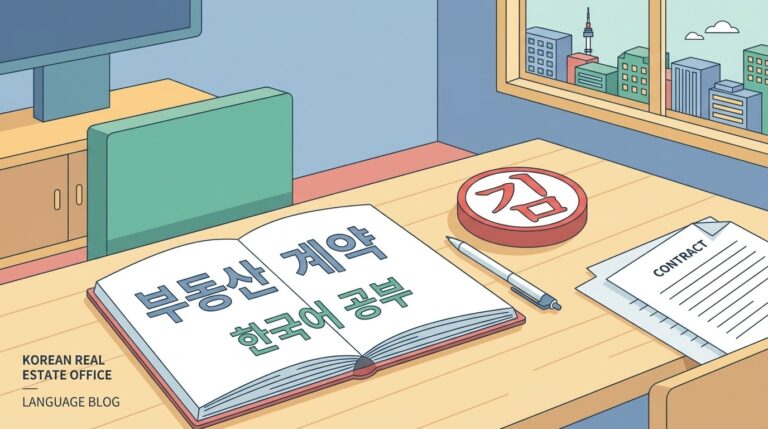
Phase 1: Empathy (Story-Driven Opening)
안녕하세요! 매일한글 에디터입니다.
Imagine this: You have just found that dreamy rooftop rooftop room (옥탑방 – oktapbang) straight out of a K-drama like Fight for My Way, or a sleek, sunny officetel in Hongdae. Your heart is racing with excitement! But five minutes later, you find yourself sitting across from a briskly talking real estate agent (공인중개사 – gonginjunggaesa) in a tiny office plastered with maps and neon flyers. A warm cup of sweet Maxim instant mix coffee is pushed toward you, followed by a thick contract loaded with legal jargon, deposit figures with way too many zeros, and a scary-looking red ink pad.
Your palms start to sweat. Where do I sign? Can I just use a pen instead of a stamp? What if I agree to something weird? Every single expat and exchange student I have mentored over the past ten years has faced this exact stomach-churning moment. Signing your first home contract in Korea feels intimidating, but here is the good news: you do not need fluent legal Korean to protect yourself and look confident. With just three foundational phrases, you will transform from a nervous newcomer into a savvy, respected tenant who commands respect. Let us walk through this life-changing milestone step by step!
Phase 2: Core 3 Expressions Deep Dive
1. 여기 서명하면 돼요? (Yeogi seomyeonghamyeon dwaeyo?)
- Pronunciation: [Yeo-gi seo-myeong-ha-myeon dwae-yo?] (Think of: “Yuh-key saw-myung-ha-myun dway-yo”)
- Meaning: Literal: “If I sign here, is it okay?” | Real Nuance: “Do I sign right here?”
- K-Culture Moment: In the classic romance drama Because This Is My First Life, the two leads sit at a diner table calmly confirming their contract marriage by asking this exact polite phrase while pointing a ballpoint pen at the signature line.
- Editor’s Insight: In Korea, people historically used personal name seals (도장 – dojang). While seals are still beloved by older generations, modern real estate offices routinely accept signatures from foreign residents. The ending
-(으)면 돼요?is the ultimate beginner cheat code for asking “Is it okay to do X?” - Situation Spectrum: Casual (⚠️ With friends) | Semi-formal (✅ Daily life) | Formal (✅ Legal / Budongsan)
- 🤔 Think About It: In English, you might casually say “Sign here?” but Korean etiquette naturally bakes consent and verification into
돼요?(“Is this proper?”). Notice how much humility and collaboration are built into standard questions!
2. 보증금은 언제 돌려받아요? (Bojeunggeumeun eonje dollyeobadayo?)
- Pronunciation: [Bo-jeung-geu-meun eon-je dol-lyeo-ba-da-yo?] (Think of: “Bow-jeung-geum-un un-jay doll-yuh-bah-dah-yo”)
- Meaning: Literal: “Security deposit, when to return-receive?” | Real Nuance: “When do I get my deposit back (after moving out)?”
- K-Culture Moment: Whenever a tenant in a webtoon or slice-of-life drama packs up their blue plastic moving crates, this is the very question they ask the landlord before handing over the digital door lock code.
- Editor’s Insight: Korea’s unique housing system involves hefty deposits (often 5 to 10 million KRW even for monthly rent). Asking clearly about your return timeline shows the agent that you understand your financial rights.
- Situation Spectrum: Casual (🚫 Too blunt) | Semi-formal (✅ Budongsan setting) | Formal (✅ Contract meetings)
- 🤔 Think About It: In many Western countries, deposits are held in independent escrow accounts. In Korea, the landlord transfers it directly back to you on move-out day. Why do you think asking this clearly upfront prevents misunderstandings later?
3. 계약서 확인했어요. (Gyeyakseo hwaginhaesseoyo.)
- Pronunciation: [Gye-yak-seo hwa-gin-haet-seo-yo.] (Think of: “Gyeh-yak-saw hwa-geen-het-saw-yo”)
- Meaning: Literal: “Contract confirmed/checked.” | Real Nuance: “I have reviewed and checked the contract.”
- K-Culture Moment: Picture any charismatic CEO or professional character in a business drama stamping a blue folder with a decisive, confident nod after reviewing the terms.
- Editor’s Insight: Never sign blindly under pressure! Saying this phrase signals that you have taken your time to match the address, name, and deposit amount with your passport and alien registration card before picking up the pen.
- Situation Spectrum: Casual (⚠️ Awkward) | Semi-formal (✅ Real estate) | Formal (✅ Official meetings)
- 🤔 Think About It: Notice the verb 확인하다 (hwaginhada – to verify). Korean business culture values clear verification steps to prevent ‘back-talk’ or future disputes.
Phase 3: Textbook Korean vs. Real Korean
Situation 1: Asking Where to Put Your Signature
- 📖 교과서 한국어 (Textbook): 여기에 당신의 성명을 기재하여 주십시오. (Yeogie dangsinui seongmyeongeul gijaehayeo jusipsio.) – “Please write down your full legal name in this location.”
- 🗣️ 진짜 한국어 (Real-World): 여기에 사인해 주세요. (Yeogie sainhae juseyo.) or 여기 서명하면 돼요? (Yeogi seomyeonghamyeon dwaeyo?)
- 💡 왜 다를까?: Nobody says “당신” (dangsin) or heavy legal verbs like “기재하다” (gijaehada) out loud in a neighborhood agency! Everyday agents use the loan word 사인 (sain – sign) or the soft polite ending
-해 주세요.
Situation 2: Asking About Monthly Rent Payment Dates
- 📖 교과서 한국어 (Textbook): 월세 납부 기한은 며칠입니까? (Weolse napbu gihaneun myeochirimnikka?) – “What date is the deadline for monthly rent remittance?”
- 🗣️ 진짜 한국어 (Real-World): 월세는 며칠에 보내요? (Weolseneun myeochire bonaeyo?)
- 💡 왜 다를까?: The verb 보내다 (bonaeda – to send/transfer) is what native speakers actually say because rent is almost exclusively transferred via mobile banking apps directly to the landlord’s account.
Phase 4: K-Culture Deep Dive & Non-Verbal Manners
4-1. 눈치 (Nunchi) & Vital Body Language
- The Two-Hand Rule (두 손): When the agent hands you the printed contract, identification, or a pen, always receive it with both hands (or touch your left hand softly to your right forearm). Handing something over with one limp hand can look dismissive.
- Attentive Nodding (고개 끄덕이기): As the agent scans through each clause with a bright yellow highlighter, maintain light eye contact and nod gently saying “네~” (Ne~ / Yes). It shows you are actively following along, building great nunchi rapport.
- Check the Red Stamp Ink (인감도장): If you brought a personal seal, hold it straight and press down evenly onto the red ink pad (인주 – inju). Test it on scrap paper first so it does not smudge!
4-2. Culture Code: The “Budongsan Maxim Mix” Ritual
Step into any neighborhood real estate office (부동산 – budongsan) across Seoul or Busan, and within 30 seconds, you will hear the whistle of an electric kettle. You will be handed a yellow paper cup containing Maxim Mocha Gold instant coffee. In Korean culture, accepting this sweet drink is an informal social contract of goodwill. It signals: Let’s pause, relax, and make a clean, honest deal together. Take a polite sip with both hands before diving into the papers!
Phase 5: Real-World Roleplay Scenario
Setting: A sunlit budongsan in Mapo-gu. Mr. Park (박 소장님), a warm realtor with gold-rimmed glasses, slides three copies of the lease agreement across a neat wooden desk.
- 소장님: 자, 여기 계약서 다 준비했습니다. (Ja, yeogi gyeyakseo da junbihaesseumnida.)
🎭 Slides the paper closer, tapping the highlighted bottom corner.
“Well, I have prepared all the contract copies here.” -
You: 네, 감사합니다. 계약서 확인했어요. (Ne, gamsahamnida. Gyeyakseo hwaginhaesseoyo.)
🎭 Receive the papers with both hands, taking a moment to look over the numbers.
“Yes, thank you. I checked the contract.” -
소장님: 보증금 천만 원에 월세 60만 원 맞지요? (Bojeunggeum cheonman wone weolse yuksipman won matjiyo?)
🎭 Smiles warmly and points at the deposit line.
“Ten million won deposit and 600,000 won monthly rent, correct?” -
You: 네, 맞아요. 월세는 며칠에 보내요? (Ne, majayo. Weolseneun myeochire bonaeyo?)
🎭 Speaks with a clear, polite tone.
“Yes, that’s right. What date do I send the monthly rent?” -
소장님: 매달 25일에 집주인 통장으로 보내시면 됩니다. (Maedal isiboire jipjuin tongjangeuro bonaesimyeon doemnida.)
🎭 Hands you a black pen.
“You can send it to the landlord’s bank account on the 25th of every month.” -
You: 알겠습니다. 보증금은 언제 돌려받아요? (Algetseumnida. Bojeunggeumeun eonje dollyeobadayo?)
🎭 Asks attentively before taking the pen.
“Understood. When do I get the deposit back?” -
소장님: 이사 나가는 날 방 확인하고 바로 계좌로 들어옵니다! (Isa naganeun nal bang hwaginhago baro gyejwaro deureoomnida!)
🎭 Gives an assuring nod.
“On moving day, right after we inspect the room, it gets transferred straight to your account!” -
You: 다행이네요. 여기 서명하면 돼요? (Dahaengineyo. Yeogi seomyeonghamyeon dwaeyo?)
🎭 Points politely to the signature box with the pen tip.
“What a relief. Do I sign right here?”
🔀 Interactive Choice Point
The agent says: “Here is the signature space, you can use your stamp or sign.” What do you do?
- Option A: Scribble your initial quickly with one hand while browsing Instagram with the other.
- Feedback (Bad 🚫): Major faux pas! In Korea, official contracts demand respectful focus. Doing this makes the realtor worry you aren’t taking the legal obligations seriously.
- Option B: Hold the pen with your right hand, support your right wrist lightly with your left hand, and clearly ask: “여기 서명하면 돼요?” (Yeogi seomyeonghamyeon dwaeyo?)
- Feedback (Best ⭐): Absolutely flawless! You demonstrate cultural respect, clear communication, and calm confidence.
- Option C: Panic because you do not have a traditional red wooden seal stamp, and run out of the office to find an engraver.
- Feedback (Risk ⚠️): Unnecessary stress! Foreign tenants can legally sign (서명 – seomyeong) with a pen on standard rental contracts. Just clarify with Option B first!
Phase 6: 10-Second Emotion Shadowing Drill
Practice these with natural rhythm! Slash marks / indicate natural micro-pauses.
[🧐 Cautious & Professional]
네, / 계약서 / 확인했어요.
(Ne, / gyeyakseo / hwaginhaesseoyo.)
Slightly lower pitch, steady and calm.-
[🤔 Curious & Mindful]
보증금은 / 언제 / 돌려받아요?
(Bojeunggeumeun / eonje / dollyeobadayo?)
Gentle rise on ‘언제’, softening slightly at ‘돌려받아요?’. -
[😊 Relieved & Polite]
여기 / 서명하면 돼요?
(Yeogi / seomyeonghamyeon dwaeyo?)
Soft smile while asking, rising tone on ‘돼요?’.
Phase 7: K-Culture Mini Dictionary
- 보증금 (Bojeunggeum – Security Deposit)
The lump sum of money you deposit with the landlord upon move-in. It protects against unpaid rent or damages and is fully returned when your contract ends. - 월세 (Wolse – Monthly Rent)
The monthly housing fee paid on a fixed date. Korea also has Jeonse (전세 – huge lump sum with zero monthly rent), but most international students and travelers use Wolse. - 관리비 (Gwallibi – Maintenance Fee)
The building maintenance fee covering cleaning, elevator upkeep, hallway lighting, and sometimes water/internet. Always check if this is included in your monthly bill! - 도장 (Dojang – Stamp / Seal)
Personal red carved stamp traditionally required on official documents. Modern rental contracts allow signatures, but having a custom Korean engraved stamp makes an unforgettable souvenir!
Phase 8: Survival Kit for Travelers & Expats
TOP 3 Survival Phrases
- 영수증 주세요. (Yeongsujeung juseyo.)
Pro Tip: Always ask this after paying your contract deposit fee (계약금 – gyeyakgeum) to keep paper proof. - 관리비 포함이에요? (Gwallibi pohamieyo?)
Pro Tip: Critical phrase! Clarifies whether the advertised monthly price includes internet, water, and building maintenance. - 천천히 말씀해 주세요. (Cheoncheonhi malsseumhae juseyo.)
Pro Tip: Real estate agents talk at lightning speed. Use this magic phrase to ask them politely to slow down.
Editor’s Travel & Living Note
Before stepping into a budongsan, download the [Zigbang App for Korean Studio Search] or check listings on the [Naver Real Estate Portal]. Make sure to carry your Alien Registration Card (ARC) or Passport, plus an active Korean bank account or digital banking app for real-time account verification.
Phase 9: “One Step Deeper” (Reflective Thought)
In Western rental markets, contracts are often signed remotely via digital signatures, devoid of human touch. In South Korea, sitting face-to-face over instant coffee at the local budongsan remains an enduring cultural anchor. It reflects the Korean value of Jeong (정) and collective accountability: the broker is not just a middleman, but a community guarantor standing between neighbor and newcomer. When you take the time to sit, review, and exchange signatures in person, you aren’t just renting four walls—you are formally joining a Korean neighborhood.
💬 Your Turn: What surprised you the most about the Korean rental process? Would you prefer using a carved personal stamp (도장) or your regular pen signature? Share your thoughts below!
Phase 10: FAQ & Avoiding Misunderstandings
Q: Do foreigners legally need a Korean stamp (도장) to sign a lease?
A: No! Under Korean contract law, a handwritten signature (서명 – seomyeong) is legally binding for foreigners as long as it matches your passport or Alien Registration Card.
Q: What is the most critical step right after signing the contract?
A: You must visit the local community center (주민센터 – jumin center) to register your move-in and receive a “Confirmed Date” stamp (확정일자 – hwakjeong-ilja). This legally safeguards your deposit against building foreclosures.
Q: Can I negotiate the monthly rent or deposit?
A: Yes! It is common to ask for a slight adjustment (e.g., trading a higher deposit for lower monthly rent, known as 보증금 조절). Always ask politely through the real estate agent rather than confronting the landlord directly.
🚨 흔한 실수 (Common Mistakes) Warning Board
- Mistake 1: Signing without confirming the owner’s identity.
Correct Action: Always ask the realtor to show you the real estate register (등기부등본 – deunggibudeungbon) to verify that the person receiving your money is the actual deed owner. - Mistake 2: Forgetting to clarify utility bills.
Correct Action: Ask “가스비랑 전기세는 따로예요?” (Are gas and electricity separate?) to avoid huge surprises in winter when ondol heating runs high. - Mistake 3: Throwing away the physical paper contract.
Correct Action: Keep your physical paper contract safe in a clear plastic folder. You will need it at immigration and the community service center!
Phase 11: Action Missions
- 🥉 Bronze Mission (Solo Shadowing): Stand in front of your mirror with a pen in hand. Practice saying “여기 서명하면 돼요?” (Yeogi seomyeonghamyeon dwaeyo?) three times with natural intonation.
- 🥈 Silver Mission (Voice Note): Record yourself asking “보증금은 언제 돌려받아요?” (Bojeunggeumeun eonje dollyeobadayo?) and check if your pauses match the emotion shadowing guide.
- 🥇 Gold Mission (Real-Life Application): Next time you visit a Korean convenience store, cafe, or store requiring card verification, gently ask the cashier “여기 서명하면 돼요?” when the card pad lights up!
- 🎮 K-Culture Mission: Watch an episode of Because This Is My First Life or Strangers From Hell and spot the iconic yellow signs of a Korean budongsan!
Phase 12: Interactive Quiz Challenge
Question 1: Situation Judgment
You are sitting in a budongsan office and the agent gives you the final lease copy. You want to let them know that you have finished reading and reviewing every item on the paper. Which phrase is best?
* A) 계약서 확인했어요. (Gyeyakseo hwaginhaesseoyo.)
* B) 돈 없어요. (Don eopseoyo.)
* C) 그냥 사인하세요. (Geunyang sainhaseyo.)
Question 2: Fill in the Blank
Complete the sentence to ask where to sign:
“여기 ___________ 돼요?”
* Hint: It means “to sign / signature”.
Question 3: Cultural True or False
True or False: In Korea, foreign renters are legally forbidden from using pen signatures on house contracts and must carve a wooden name stamp (도장).
👉 Click here for Answers & Explanations!
- Question 1 Answer: A) 계약서 확인했어요.
Explanation: This politely and professionally states “I checked the contract.” Option B means “I have no money,” and Option C rudely tells the agent to sign it themselves! - Question 2 Answer: 서명하면 (seomyeonghamyeon)
Explanation: Full phrase is “여기 서명하면 돼요?” (Do I sign here?). - Question 3 Answer: False!
Explanation: While stamps (도장) are traditional and widely popular, standard rental agreements legally recognize handwritten signatures from foreigners matching their official identification.







