

Inviting Friends to Your Home in Korean: Speak Like a True Local
Phase 1: 공감 (Story-Immersive Opening)
안녕하세요! 매일한글 에디터입니다.
Have you ever stood chatting with a Korean friend or classmate, desperately wanting to say, “Hey, do you want to come hang out at my place?”—only to freeze completely? You replay textbook sentences in your head, but they all sound stiff, like a formal invitation to a diplomatic banquet: “저의 집에 당신을 초대합니다” (I officially invite thee to my dwelling). Or maybe you worried about coming on too strong, remembering those comedic K-Drama scenes where a simple invite for ramyun causes total panic!
Inviting someone into your personal living space in Korea is a major milestone in friendship. It signals warmth, trust, and real closeness. At Daily Hangul, we often hear A2 learners say: “I can order food or ask for directions, but inviting a friend over feels like an emotional minefield!” We completely get it. Drawing from real coaching sessions with expat learners living in Seoul, this guide gives you the sweetest, most natural, and culturally effortless phrases to host your friends without any awkwardness. Let’s make your home the coziest hangout spot!
Phase 2: 핵심 표현 3선 심층 분석 (Top 3 Core Expressions)
1. 우리 집에 놀러 올래요? (Uri jibe nolleo ollaeyo?)
- Pronunciation: Uri ji-be nol-leo ol-lae-yo? (Sounds like: “Oo-ree jee-beh nohl-luh ohl-leh-yo”)
- Meaning: Literal: “Will you come to our house to play?” | Real Nuance: “Do you want to come hang out at my place?”
- K-Culture Moment: Two college friends leaving a lecture hall on a Friday afternoon, casually deciding where to study and binge-watch variety shows.
- Editor’s Insight: Notice how Koreans say 우리 집 (uri jip = “our house”) rather than 내 집 (nae jip = “my house”), even if they live alone in a tiny studio! Using “우리” wraps the invitation in community warmth.
- Situation Spectrum: Casual: ✅ | Semi-formal: ✅ | Formal: 🚫
- 🤔 Think About It: In your native language, do you say “my house” or “our house”? Why does Korean prioritize “we” over “me” even in private spaces?
2. 맛있는 거 해 줄게요 (Masinneun geo hae julgeyo)
- Pronunciation: Ma-sin-neun geo hae jul-ge-yo (Sounds like: “Mah-sheen-neun guh heh jool-geh-yo”)
- Meaning: Literal: “I will make a delicious thing for you.” | Real Nuance: “I’ll whip up something delicious for you!”
- K-Culture Moment: A host offering to cook homemade tteokbokki, kimchi fried rice, or an authentic dish from their own home country to break the ice.
- Editor’s Insight: Food is the primary language of care in Korea. You do not need to prepare an elaborate banquet; the sentiment of making or sharing food is what melts social barriers.
- Situation Spectrum: Casual: ✅ | Semi-formal: ✅ | Formal: ⚠️
- 🤔 Think About It: Does hosting in your culture always involve cooking food, or is simply hanging out without food common?
3. 편하게 입고 와요 (Pyeonhage ipgo wayo)
- Pronunciation: Pyeon-ha-ge ip-go wa-yo (Sounds like: “Pyun-hah-geh eep-goh wah-yoh”)
- Meaning: Literal: “Come wearing comfortably.” | Real Nuance: “Just dress comfortably! No need to dress up.”
- K-Culture Moment: Texting a friend right before they head over, making sure they know sweatpants and oversized tees are 100% acceptable.
- Editor’s Insight: Koreans pay great attention to etiquette and appearance. Stating this upfront relieves your guest of the pressure of wearing stiff, polite clothing to your home.
- Situation Spectrum: Casual: ✅ | Semi-formal: ✅ | Formal: ⚠️
- 🤔 Think About It: How do dress codes differ between visiting a family home versus a close friend’s studio apartment in your culture?
Phase 3: 교과서 한국어 vs 진짜 한국어 (Textbook vs. Real Korean)
Situation 1: Extending the Invitation
- 📖 교과서 한국어: 저의 집에 당신을 초대합니다. (Jeoui jibe dangsineul chodaehamnida. – “I invite you to my home.”)
- 🗣️ 진짜 한국어: 이번 주말에 우리 집 올래요? (Ibeon jumare uri jip ollaeyo? – “Wanna come over to my place this weekend?”)
- 💡 왜 다를까?: The textbook version uses 당신 (which sounds overly dramatic or confrontational in spoken Korean) and 초대합니다 (sounds like a black-tie gala invitation). Real Koreans use the gentle question ending -(으)ㄹ래요?.
Situation 2: Deciding What to Eat
- 📖 교과서 한국어: 무엇을 드시고 싶으십니까? (Mueoseul deusigo sipeusimnikka? – “What would you desire to consume?”)
- 🗣️ 진짜 한국어: 뭐 먹을래요? 배달 시켜 먹을까요? (Mwo meogeullaeyo? Baedal sikyeo meogeulkkayo? – “What do you want to eat? Shall we order delivery?”)
- 💡 왜 다를까?: Modern Korean hangouts revolve around Korea’s incredible delivery app culture. Suggesting delivery (배달) is warm, casual, and stress-free for both host and guest.
Phase 4: K-Culture 딥다이브 & 비언어적 매너 (Deep Dive & Manners)
4-1. 눈치 (Nunchi) & Gestures
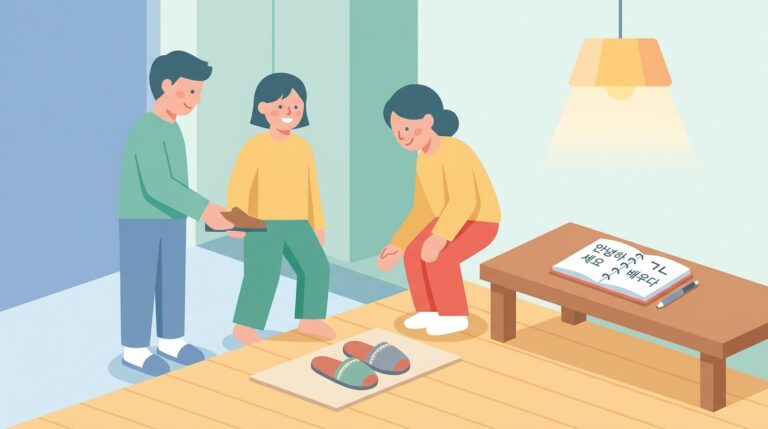
- The Threshold Line (현관 – Hyeon-gwan): Never step onto the raised wooden flooring while your outdoor shoes are still on. Step out of your shoes directly into the house slippers provided by your host.
- Pointing Slippers: When receiving guests, turn the house slippers so the toes point toward the interior of the house. It’s a subtle, high-level non-verbal welcome gesture!
- Two Hands for Refreshments: When handing a cup of barley tea, water, or coffee to your guest, use both hands or support your right forearm with your left hand.
4-2. Cultural Code: The Cozy “Baedal” Feast
In many Western cultures, having someone over demands a spotless house and an elaborate home-cooked meal. In contemporary urban Korea—especially among university students and young professionals—inviting someone to your one-room (studio apartment) often means lounging on a heated floor (ondol), setting up a folding floor table (bapsang), and ordering crispy Korean fried chicken (chimaek) or tteokbokki via a delivery app. It is personal, low-pressure, and deeply comforting.
Phase 5: 실전 롤플레이 시나리오 (Role-Play Scenario)
- Setting: Friday afternoon. You and your Korean language exchange partner, Minji (민지), are packing up your bags after class.
-
Turn 1 (You): 민지 씨, 오늘 저녁에 특별한 계획 있어요?
(Minji ssi, oneul jeonyeoge teukbyeolhan gyehoek isseoyo? / “Minji, do you have any special plans tonight?”)
🎭 Smiling warmly while slinging your backpack over your shoulder. -
Turn 2 (Minji): 아니요, 오늘은 그냥 쉬려고요. 왜요?
(Aniyo, oneureun geunyang swiryeogoyo. Waeyo? / “No, I’m just planning to rest. Why?”)
🎭 Tilting her head with a friendly, inquisitive smile. -
Turn 3 (You): 괜찮으면 오늘 우리 집에 놀러 올래요?
(Gwaenchaneumyeon oneul uri jibe nolleo ollaeyo? / “If it’s okay, do you want to come hang out at my place?”)
🎭 Casually pointing in the direction of your apartment. -
Turn 4 (Minji): 와, 정말요? 가도 돼요?
(Wa, jeongmallyo? Gado dwaeyo? / “Wow, really? May I really come over?”)
🎭 Eyes widening with pleasant surprise. -
Turn 5 (You): 당연하죠! 제가 맛있는 저녁 해 줄게요.
(Dang-yeonhajyo! Jega masinneun jeonyeok hae julgeyo. / “Of course! I’ll make you a delicious dinner.”)
🎭 Nodding reassuringly with an enthusiastic grin. -
Turn 6 (Minji): 좋아요! 그럼 제가 가는 길에 마실 거 사 갈게요.
(Jowayo! Geureom jega ganeun gire masil geo sa galgeyo. / “Sounds great! Then I’ll buy some drinks on the way.”)
🎭 Quickly pulling out her phone to locate a nearby café or convenience store. -
Turn 7 (You): 고마워요. 부담 갖지 말고 편하게 입고 와요!
(Gomawoyo. Budam gatji malgo pyeonhage ipgo wayo! / “Thank you. Don’t feel pressured and just dress comfortably!”)
🎭 Laughing softly and making a relaxing hand gesture. -
Turn 8 (Minji): 네! 얼른 준비하고 갈게요. 기대돼요!
(Ne! Eolleun junbihago galgeyo. Gidaedwaeyo! / “Okay! I’ll get ready quickly and head over. I’m excited!”)
🎭 Clapping hands lightly with genuine anticipation.
🔀 Interactive Branching Point
Minji texts you 10 minutes later: “혹시 뭐 필요한 거 없어요? 사 갈게요!” (Is there anything you need? I’ll buy it on my way!)
- Choice A: “진짜 아무것도 안 사 와도 돼요! 그냥 몸만 와요!”
(Real Nuance: “Seriously, you don’t need to bring anything! Just bring yourself!”)
👉 [Best]: Super natural! Koreans love the friendly expression “몸만 와요” (just bring your body). It shows warm hospitality. - Choice B: “소고기랑 비싼 와인 좀 사다 주세요.”
(Real Nuance: “Please buy some beef and an expensive bottle of wine.”)
👉 [Bad]: Unless you are best friends sharing a grocery bill, asking for expensive items feels greedy and burdens the guest. - Choice C: “아무거나 사 오세요.”
(Real Nuance: “Buy whatever.”)
👉 [Risk]: While not rude, 아무거나 leaves the guest stranded and overthinking what to bring. If you really want something, suggest something cheap like ice cream (아이스크림) or wet wipes.
Phase 6: 10초 감정 섀도잉 드릴 (10-Sec Shadowing Drill)
Practice these lines out loud with the correct rhythm and emotional tone. The slashes / mark brief pauses!
[😊 Warm & Inviting]
이번 주말에 / 우리 집에 / 놀러 올래요?
(Ibeon jumare / uri jibe / nolleo ollaeyo?)-
[🍕 Proud & Generous]
제가 / 진짜 맛있는 거 / 해 줄게요!
(Jega / jinjja masinneun geo / hae julgeyo!) -
[🛋️ Relaxed & Cozy]
부담 갖지 말고 / 편하게 / 입고 와요.
(Budam gatji malgo / pyeonhage / ipgo wayo.)
Phase 7: K-Culture 미니 사전 (Mini Dictionary)
- 집들이 (Jipdeuri) | Housewarming Party | The celebratory gathering when someone moves into a new home. Guests traditionally bring toilet paper (wishing fortunes unravel smoothly) or laundry detergent (wishing wealth bubbles up).
- 현관 (Hyeongwan) | Entryway / Foyer | The sunken tiled entryway where shoes must be removed before entering the living area.
- 배달 (Baedal) | Delivery Culture | Hyper-convenient Korean food delivery. Essential when hosting friends for an impromptu movie night.
- 집밥 (Jipbap) | Home-cooked Food | Wholesome, comforting home cooking. Inviting a friend for 집밥 is one of the highest compliments of intimacy in Korea.
Phase 8: 여행자를 위한 생존 키트 (Traveler’s Survival Kit)
Top 3 Survival Expressions for Hosting
- 1. 실내화 신으세요. (Silnae-hwa sineuseyo. – “Please put on these indoor slippers.”)
Pro Tip: Offer slippers immediately as your guest steps onto the 현관. - 2. 편하게 계세요. (Pyeonhage gyeseyo. – “Please make yourself at home.”)
Pro Tip: Say this right after showing them where to put their jacket or bag. - 3. 배달 시켜 먹을까요? (Baedal sikyeo meogeulkkayo? – “Shall we order food delivery?”)
Pro Tip: The ultimate magic phrase for hosting with zero kitchen stress.
Editor’s Travel & Living Note
When inviting friends to an Airbnb or officetel in Seoul, don’t forget to send them your exact address via the Naver Map navigation app download. KakaoMap and Naver Map provide building entrance pinpoints that Google Maps often misses! Also, send them your building’s ground-floor intercom code (공동현관 비밀번호) in advance so they won’t get stuck standing outside in the cold.
Phase 9: “한 발 더 깊이” (One Step Deeper: Thought Essay)
In the Korean language, the word 우리 (Uri)—meaning “we” or “our”—replaces “my” in almost every personal domain. Koreans say 우리 엄마 (our mom), 우리 학교 (our school), and 우리 집 (our home), even if they are an only child living in a single-room studio. This linguistic instinct stems from Korea’s deep-rooted collectivism and the concept of 정 (Jeong): an invisible bond of affection and mutual belonging. When you invite someone to 우리 집, you are not just inviting them to a physical piece of real estate; you are opening a warm communal space where the distinction between “mine” and “yours” softens.
💬 Your Turn: Does your native culture use “I/My” or “We/Our” when talking about your family home? Share your cultural perspective in the comments below!
Phase 10: FAQ & 오해 방지 (FAQ & Common Mistakes)
Q: Is it considered rude to order delivery food instead of cooking when inviting a Korean friend over?
A: Not at all! In modern Korean culture, ordering delivery (배달) is considered practical, fun, and completely normal. In fact, many guests prefer it because they know the host isn’t slaving away in the kitchen and can actually sit and chat.
Q: Do I really need to provide indoor slippers for my guests?
A: In modern apartments with wooden floors, indoor slippers (실내화) are highly appreciated. They keep feet warm and demonstrate attentive hospitality. While close friends might walk in socks, having a pair of clean slippers ready is always polite.
Q: If I am invited to a Korean friend’s home, what is an appropriate gift to bring?
A: You should rarely arrive empty-handed! Safe, thoughtful choices include a box of bakery pastries, seasonal fruit (like strawberries or shine muscat grapes), or small home treats like roll cakes from Paris Baguette.
🚨 흔한 실수 (Common Mistakes) 경고판
- Mistake: Stepping onto the raised wooden living room floor with outdoor shoes still on.
Correct Action: Slip your shoes off at the sunken entrance tile (현관) before your feet touch the living room floor. - Mistake: Saying “내 집에 오세요” (Nae jibe oseyo).
Correct Action: Always say “우리 집에 놀러 오세요”. Using 내 집 sounds possessive and strangely distant. - Mistake: Apologizing excessively for your small apartment (원룸).
Correct Action: Compact living is standard in Korean metropolitan areas. Simply say “누추하지만 편하게 계세요” (It’s humble, but please make yourself at home) or just smile and offer drinks!
Phase 11: 액션 미션 & 참여 유도 (Action Missions)
- 🥉 Bronze Mission (Solo Practice): Stand in front of your mirror and practice saying: “이번 주말에 우리 집에 놀러 올래요?” three times with a bright, welcoming smile.
- 🥈 Silver Mission (Text a Friend): Message a Korean friend or language buddy on KakaoTalk: “날씨 좋은데 이번 주에 우리 집 올래요? 배달 시켜 먹어요!” (The weather is nice, wanna come to my place this week? Let’s order delivery!).
- 🥇 Gold Mission (Live Host): Successfully host a friend at your home, greet them at the 현관 with slippers, and say “편하게 계세요!”.
- 🎮 K-Culture Mission: Next time you watch an episode of I Live Alone (나 혼자 산다), notice how Korean celebrities greet their home visitors at the front door. Look for the slipper transition!
Phase 12: 인터랙티브 퀴즈 챌린지 (Interactive Quiz)
Q1. Situation Challenge: You want to invite your Korean study buddy to your apartment this Saturday in a natural, friendly tone. Which sentence is best?
* A) 저의 아파트에 당신을 초대합니다.
* B) 이번 주 토요일에 우리 집에 놀러 올래요?
* C) 내 집으로 빨리 오십시오.
Q2. Fill in the Blank: Complete the phrase that relieves your guest from dressing up formally:
“부담 갖지 말고 _________ 입고 와요!”
* A) 비싸게 (Bissage)
* B) 편하게 (Pyeonhage)
* C) 조용하게 (Joyonghage)
Q3. True or False: When living alone in a studio apartment in Korea, you must say “내 집” instead of “우리 집” so you don’t confuse people into thinking you have roommates.
* [True / False]
👉 Click here to reveal the answers and explanations!
- Q1 Answer: B) 우리 집에 놀러 올래요? is the quintessential natural A2 invitation phrase! (A sounds like a formal invitation card; C sounds like a military command).
- Q2 Answer: B) 편하게 (Pyeonhage = comfortably). The phrase 편하게 입고 와요 translates to “Just dress comfortably!”
- Q3 Answer: False! Koreans almost universally say 우리 집 even when living completely on their own in a studio. It expresses warmth and communal hospitality.







