

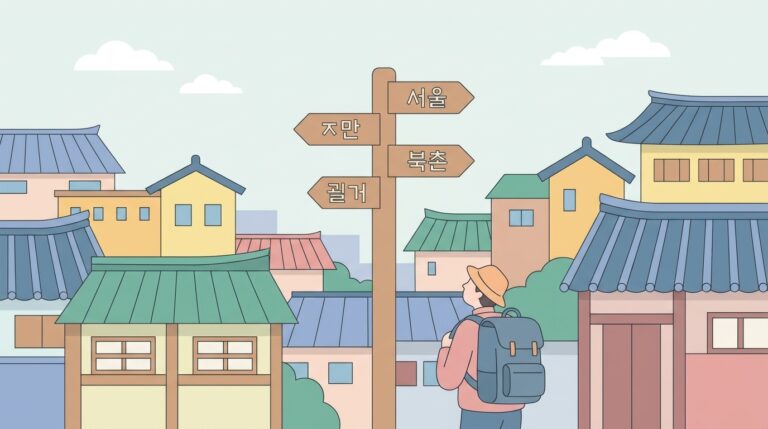
Master Korean Location Words: Yeogi, Geogi, and Jeogi Without Fear!
Phase 1: Empathy & Storytelling Opening
안녕하세요! 매일한글 에디터입니다.
Imagine this: You finally land in Seoul, drop your bags, and wander into the vibrant, neon-lit alleyways of Hongdae. Your stomach is rumbling, and the irresistible scent of spicy tteokbokki pulls you toward a cozy street food cart. You want to ask the friendly vendor where the napkins are, or tell your friend to sit at that cute empty table across the lane. You open your mouth, and suddenly your brain freezes: Was it yeogi? Geogi? Or jeogi?
If you have ever watched a K-drama and wondered why characters shout “Jeogiyo!” to call restaurant servers, or why pointing in Korean feels so different from English, you are not alone! Over the past ten years coaching hundreds of A1 beginner learners at Daily Hangul, I have seen almost everyone stumble over this exact spatial triangle.
Getting these three little words straight is one of the highest-return milestones in your Korean journey. The moment you master them, ordering food, hopping into taxis, asking for directions, and navigating subway stations becomes effortless. Let’s unlock these essentials together with warmth, zero stress, and plenty of real Seoul flavor!
Phase 2: Core 3 Expressions Deep Dive
1. 여기 (Yeogi)
- Pronunciation: [yeo-gi] (Sounds like “yaw-ghee” or “yuh-gee”)
- Meaning: Literal: “Here” | Nuance: The immediate space right where the speaker is standing or touching.
- K-Culture Moment: In romance K-dramas, when the protagonist taps the empty chair beside them on a rainy bus: 여기 앉아. (Yeogi anja. / Sit here.)
- Editor’s Insight: Think of 여기 (yeogi) as your personal bubble. If you can physically touch it without walking, or if you are standing on it right now, it is always yeogi.
- Situation Spectrum: Casual: ✅ | Semi-formal: ✅ | Formal: ✅
- 🤔 Think About It: In English, we might loosely say “here in this neighborhood,” but in Korean, spatial awareness is deeply tied to immediate physical presence. How close does something feel to you before you claim it as “here”?
2. 거기 (Geogi)
- Pronunciation: [geo-gi] (Sounds like “guh-gee”)
- Meaning: Literal: “There” | Nuance: The space close to the listener, or a place already established in conversation.
- K-Culture Moment: On a late-night phone call in a drama: 거기 날씨는 어때? (Geogi nalssineun eottae? / How is the weather over there where you are?)
- Editor’s Insight: This is the biggest trap for English speakers! English has only “here” and “there.” Korean splits “there” into two: 거기 (geogi) belongs to the person you are speaking with. Even if it is across town, if the other person is there, it is geogi.
- Situation Spectrum: Casual: ✅ | Semi-formal: ✅ | Formal: ✅
- 🤔 Think About It: Notice how Korean grammar directly honors the listener’s physical coordinate. Language truly mirrors how much Korean culture values interpersonal connection!
3. 저기 (Jeogi)
- Pronunciation: [jeo-gi] (Sounds like “juh-gee”)
- Meaning: Literal: “Over there” | Nuance: Far from both you and the listener, but visible to both.
- K-Culture Moment: Walking through Seoul and spotting an iconic K-pop billboard in the distance: 저기 봐! (Jeogi bwa! / Look over there!)
- Editor’s Insight: When you add the polite ending -요 (-yo) to create 저기요 (jeogiyo), it literally means “Over there, please!” but functions as the universal Korean way to say “Excuse me!” to servers and store clerks.
- Situation Spectrum: Casual: ✅ | Semi-formal: ✅ | Formal: ✅
- 🤔 Think About It: Why do Koreans say “over there” to call someone instead of saying “hey employee”? Calling out toward a general spatial direction is considered far more polite and less confrontational in Korean etiquette.
Phase 3: Textbook Korean vs. Real Korean
Situation 1: Offering someone a seat at a cafe
- 📖 교과서 한국어 (Textbook): 이곳에 앉으십시오. (Igose anjeusipsio. / Please sit in this location.)
- 🗣️ 진짜 한국어 (Real-life): 여기 앉으세요! (Yeogi anjeuseyo! / Please sit right here!)
- 💡 왜 다를까? (Why the difference?): Igot is formal written Korean found in signs and user manuals. Real humans in Seoul always use warm, conversational words like yeogi.
Situation 2: Calling a waiter at a Korean BBQ restaurant
- 📖 교과서 한국어 (Textbook): 종업원님, 이쪽으로 오십시오. (Jongeobwon-nim, ijjog-euro osipsio. / Server, please come toward this side.)
- 🗣️ 진짜 한국어 (Real-life): 저기요~! (Jeogiyo~! / Excuse me~!)
- 💡 왜 다를까? (Why the difference?): Calling someone by their job title like jongeobwon creates awkward robotic distance. A pleasant, rising-pitch jeogiyo is friendly, natural, and instantly effective.
Phase 4: K-Culture Deep Dive & Non-Verbal Manners
4-1. 눈치 (Nunchi) & Hand Gestures
When using location words in Korea, your hands speak just as loudly as your mouth:
* Never point with an index finger: Pointing directly with one finger at a location where people are sitting, or pointing at someone when saying jeogi, can feel blunt or rude.
* The Open Palm Manner: Keep your fingers together and gesture gracefully with your entire palm facing upward. Whether indicating 여기 (yeogi) for an available seat or 저기 (jeogi) for the restroom, an open palm displays natural etiquette and warmth.
* The Gentle Call: When shouting 저기요 (jeogiyo) in a bustling restaurant, raise your hand slightly to shoulder height with a gentle nod and warm eye contact. No aggressive waving needed!
4-2. The Pojangmacha & Street Food Code
In street food culture (like Pojangmacha tent stalls), space is intimate. You might sit right in front of the bubbling tteokbokki pot (여기 / yeogi), ask for the pickled radish plate sitting in front of your dining partner (거기 / geogi), and ask the owner where the skewers are stored (저기 / jeogi). Using these three words smoothly shows the owner you respect the kitchen space and know your local dining manners!
Phase 5: Real-Life Roleplay Scenario
Setting: A vibrant, fragrant street cart in Myeongdong on a crisp evening. Steam rises from huge metal trays of tteokbokki and fish cake broth.
Characters: You (an eager beginner traveler) and Imo (이모, the sweet, energetic street cart auntie).
- Turn 1 (Imo): 어서 오세요! 뭐 드릴까요? (Eoseo oseyo! Mwo deurilkkayo? / Welcome! What can I get for you?)
🎭 Smiling broadly behind the steaming pans - Turn 2 (You): 저기… 떡볶이 일 인분 있어요? (Jeogi… tteokbokki il inbun isseoyo? / Excuse me… do you have one portion of tteokbokki?)
🎭 Pointing with an open palm toward the red simmering dish - Turn 3 (Imo): 그럼요! 여기 떡볶이 바로 나와요! (Geureomyo! Yeogi tteokbokki baro nawayo! / Of course! The tteokbokki right here is coming right up!)
🎭 Ladling a generous portion onto a classic green-spotted plate - Turn 4 (You): 감사합니다! 혹시 물은 어디에 있어요? (Gamsahamnida! Hoksi mureun eodie isseoyo? / Thank you! By any chance, where is the water?)
🎭 Looking around gently - Turn 5 (Imo): 물은 거기 컵 옆에 있어요. (Mureun geogi keop yeope isseoyo. / Water is right there by your side, next to the cups.)
🎭 Pointing with her chin toward the water dispenser near your elbow - Turn 6 (You): 아, 거기요! 찾았어요. (A, geogiyo! Chaj-asseoyo. / Ah, right there! Found it.)
🎭 Nodding politely as you pour a paper cup of cold water - Turn 7 (Imo): 저기 파란 의자에 앉아서 편하게 먹어요! (Jeogi paran uijae anj-aseo pyeonhage meogeoyo! / Sit over there on that blue chair and eat comfortably!)
🎭 Gesturing with an open hand toward the covered seating corner - Turn 8 (You): 네, 저기 앉을게요. 잘 먹겠습니다! (Ne, jeogi anjeulgeyo. Jal meokgetseumnida! / Yes, I will sit over there. I will enjoy the food!)
🎭 Bowing slightly with a happy smile
🔀 Interactive Branching Moment
Imo smiles and asks: 어묵 국물도 줄까요? (Eomuk gungmuldo julkkayo? / Shall I give you some fish cake broth too?)
How do you answer where she should put the cup?
- Option A: “네, 여기 주세요!” (Ne, yeogi juseyo! / Yes, please give it right here to me!)
- Outcome: [BEST! 🌟] Perfect! Since you are standing right by the counter and want her to hand it to you in your personal space, yeogi is completely natural.
- Option B: “네, 거기 주세요!” (Ne, geogi juseyo! / Yes, please give it there by you!)
- Outcome: [BAD ❌] Confusing! Geogi means next to Imo. She might wonder if you are asking her to drink it herself!
- Option C: “저기요!” (Jeogiyo! / Excuse me!)
- Outcome: [RISK ⚠️] Awkward! You already have her attention. Shouting jeogiyo again sounds like you are resetting the conversation or distracted.
Phase 6: 10-Second Emotional Shadowing Drill
Practice these aloud! Follow the slashes (/) for natural micro-pauses and breathe the matching emotion into each phrase.
[😊 Bright & Polite calling attention]
저기요! / 메뉴판 좀 / 보여주세요.
(Jeogiyo! / menyupan jom / boyeojuseyo. / Excuse me! / The menu, please / could you show me?)-
[🤝 Warm & Welcoming to a friend]
여기 / 자리 / 있어요!
(Yeogi / jari / isseoyo! / Over here / a seat / there is!) -
[👀 Curious & Pointing toward the horizon]
저기 / 예쁜 카페 / 가볼까요?
(Jeogi / yeppeun kape / gabolkkayo? / Over there / that pretty cafe / shall we go check it out?)
Phase 7: K-Culture Mini Dictionary
- 여기 (Yeogi) | Pronunciation: yeo-gi | The space of the speaker (“Here”). Used universally in retail, dining, and daily conversation to indicate personal proximity.
- 거기 (Geogi) | Pronunciation: geo-gi | The space of the listener (“There by you”). Essential in phone conversations or when referring to a place your friend is currently at or mentioning.
- 저기 (Jeogi) | Pronunciation: jeo-gi | The space far from both (“Over there”). Points out landmarks, distant buildings, or people across the room.
- 저기요 (Jeogiyo) | Pronunciation: jeo-gi-yo | The polite conversational call (“Excuse me!”). The golden key to getting service in any restaurant, train station, or shop in South Korea.
Phase 8: Survival Kit for Travelers
Top 3 Survival Expressions
- 1. 여기요! (Yeogiyo! / Right here, please!)
- Pro Tip: Use this when the server brings food to your table or when you raise your hand to say “I’m ready to pay here!”
- 2. 저기 화장실 어디예요? (Jeogi hwajangsil eodieyo? / Where is the restroom over there?)
- Pro Tip: Combining jeogi as an introductory filler with the location makes your inquiry feel soft and polite.
- 3. 거기 어떻게 가요? (Geogi eotteoke gayo? / How do I get there?)
- Pro Tip: When pointing to a destination on a friend’s phone screen, refer to the screen location as geogi!
Editor’s Travel Note
- Essential Navigation App: Google Maps often has limited walking routing in South Korea due to local mapping regulations. Before your trip, make sure you download the Naver Map application on your smartphone to find precise walking directions.
- Transit Pointer: When asking bus drivers if a bus goes to your destination, point to your phone address and ask: 거기 가요? (Geogi gayo? / Does it go there?). It is short, polite, and universally understood!
Phase 9: “One Step Deeper” (Reflective Cultural Insight)
In Western languages, space is often perceived through geometric distance: “here” (near) versus “there” (far). Korean, however, uses a tripartite spatial system (이/그/저 – i/geu/jeo) that is deeply relational rather than merely physical. By distinguishing between the speaker’s space (여기), the listener’s space (거기), and the shared distant horizon (저기), the Korean language embeds community awareness directly into spatial words. You are never an isolated individual viewing the world through GPS coordinates; you are constantly orienting yourself in harmony with the person standing beside you.
💬 Your Turn: Have you ever noticed how your own native language marks physical space? Does it have two zones like English, or three zones like Korean and Spanish? Share your thoughts in the comments below!
Phase 10: FAQ & Common Mistakes
Q: Can I use “여기요” to call someone on the street?
A: While 저기요 (jeogiyo) is the standard polite way to get a stranger’s attention on the street, 여기요 (yeogiyo) means “Look right here!” Calling a stranger with yeogiyo can sound slightly demanding or impatient. Stick to jeogiyo when starting an interaction with someone you don’t know!
Q: What is the difference between “여기” and “이곳”?
A: Both mean “here,” but 이곳 (igot) is formal and written (found in news, poetry, literature, and subway announcements). In spoken daily conversation, using igot sounds like you are reading from a dramatic history script. Always stick to 여기 (yeogi) when chatting!
Q: If my friend and I are looking at a photo together on my phone, do I say “여기” or “거기”?
A: If you are holding the phone in your hand, say 여기 (yeogi / here). If your friend is holding their phone and showing the photo to you, refer to the screen as 거기 (geogi / there by you). Easy and intuitive!
🚨 Common Mistakes Alert Board
- Mistake: Shouting “여기요!” angrily across a restaurant room.
- Correct Action: Say “저기요~” with a smooth, slightly rising melody and a gentle hand raise.
- Mistake: Pointing your index finger straight at people or sacred temple statues.
- Correct Action: Use an open, upward-facing palm when saying “저기예요” (Jeogiyeyo / It is over there).
- Mistake: Calling a place far away from both you and your friend 거기 (geogi).
- Correct Action: If you both have to look far into the distance, always switch to 저기 (jeogi).
Phase 11: Action Missions & Community Engagement
- 🥉 Bronze Mission (Solo Practice): Stand in your room. Touch your desk and say 여기 (yeogi). Point to the door across the room and say 저기 (jeogi). Do this 5 times until the sounds roll off your tongue effortlessly.
- 🥈 Silver Mission (Social Share): Open your favorite social app or notebook. Write one sentence using 저기요 to order your dream Korean comfort food (e.g., 저기요, 김밥 주세요! / Excuse me, kimbap please!).
- 🥇 Gold Mission (Real-world Execution): The next time you visit a local Korean restaurant, mart, or speak with a Korean language exchange partner, use 저기요 to get their attention and point to a menu item with an open palm saying 이거 주세요! (Igeo juseyo! / Please give me this one!).
- 🎮 K-Culture Mission: Pick an episode of your favorite K-drama. Set a timer for 15 minutes and count how many times you hear the characters say yeogi, geogi, or jeogiyo. You will be amazed at how frequently they appear!
Phase 12: Interactive Quiz Challenge
Test your new superpowers! Read each question, choose your answer, and open the spoiler toggle to verify.
Question 1 (Scenario Judgment)
You are sitting at a cafe table. Your friend walks in from the entrance. You want them to come over and sit next to you. What do you shout with a happy wave?
* A) 거기 앉으세요! (Geogi anjeuseyo!)
* B) 여기 앉으세요! (Yeogi anjeuseyo!)
* C) 저기 앉으세요! (Jeogi anjeuseyo!)
Question 2 (Fill in the Blank)
You are browsing a subway map with a station attendant. You point to a station far at the top edge of the map that neither of you can easily reach with your finger:
“실례지만, [ ______ ] 어떻게 가요?” (Sillyejiman, [ ______ ] eotteoke gayo? / Excuse me, how do I get [ ______ ]?)
* A) 여기 (yeogi)
* B) 저기 (jeogi)
* C) 거기 (geogi)
Question 3 (Cultural True or False)
True or False: In a bustling Korean restaurant, calling out 저기요! (Jeogiyo!) is considered rude and offensive to the restaurant staff.
👉 Click here to reveal the answers and explanations!
Question 1 Answer: B) 여기 앉으세요! (Yeogi anjeuseyo!)
Explanation: Because the seat is right next to you (in the speaker’s immediate personal space), you must use 여기 (yeogi).
Question 2 Answer: B) 저기 (jeogi)
Explanation: The station is far away from both of you on the large wall map, making 저기 (jeogi / over there) the most natural choice.
Question 3 Answer: False!
Explanation: Shouting 저기요! with a polite, melodic tone is the standard, culturally accepted way to call restaurant staff in Korea. Staying silent and waiting for servers to stop by your table might leave you waiting forever!







